
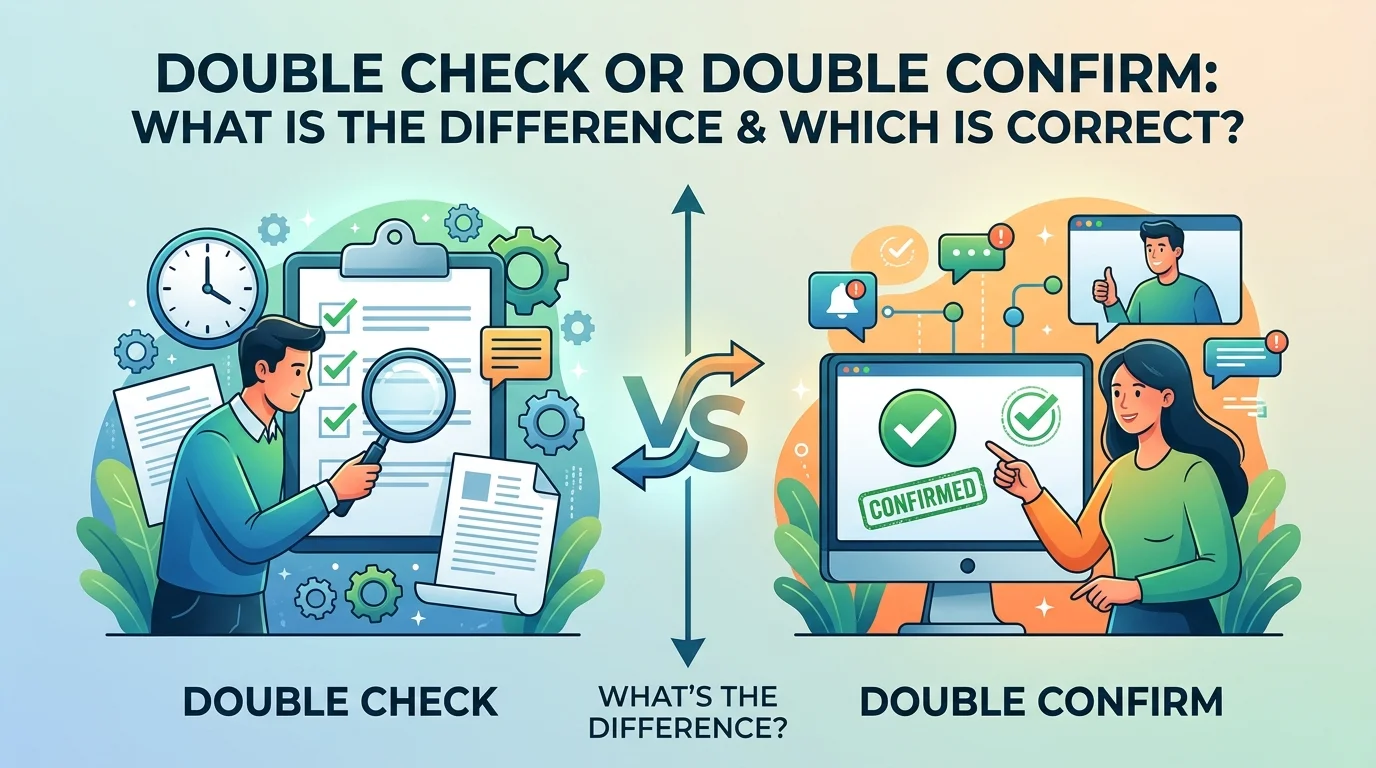

Many English learners and even native speakers confuse “double check” and “double confirm” because both relate to verifying information. While they may seem similar, they are used differently in grammar, tone, and context. Understanding the difference helps you communicate more naturally, especially in business, writing, education, and everyday conversations.
Comparison Overview
“Double check” and “double confirm” are both phrases used when verifying something for accuracy or certainty. However, “double check” is a standard and widely accepted English expression, while “double confirm” is less common and often sounds unnatural in native English usage.
“Double check” usually means reviewing something again to make sure it is correct. “Double confirm” attempts to express confirming something again, but it is not commonly preferred in standard English.
| Term | Meaning | Commonness | Natural Usage |
| Double Check | Verify again for accuracy | Very common | Natural and correct |
| Double Confirm | Confirm again | Less common | Often awkward or unnecessary |
Definition of Double Check
“Double check” means to examine, review, or verify something one more time to ensure it is accurate or correct. It is a very common phrase in spoken and written English.
People use “double check” when they want to avoid mistakes or confirm details carefully.
Examples:
- Please double check the report before sending it.
- I need to double check my answers.
- She double checked the address.
The phrase works naturally in academic, business, technical, and casual contexts.
Definition of Double Confirm
“Double confirm” means to confirm something again or provide additional confirmation. Although understandable, it is not commonly used by native English speakers.
In many cases, people simply say:
- confirm
- reconfirm
- verify
- double check
“Double confirm” can sound repetitive because “confirm” already means to establish certainty.
Examples:
- Please confirm the booking.
- Let me reconfirm the schedule.
- I will double check the information.
Main Differences Between Double Check and Double Confirm
The biggest difference is naturalness and standard usage.
| Feature | Double Check | Double Confirm |
| Common in English | Yes | Rare |
| Sounds natural | Yes | Sometimes awkward |
| Main meaning | Review again carefully | Confirm again |
| Preferred in professional writing | Yes | Usually no |
| Used in casual conversation | Frequently | Rarely |
| Alternative forms | Verify, review | Reconfirm |
“Double check” focuses on reviewing for accuracy.
“Double confirm” focuses on confirming certainty again, but English speakers usually replace it with “reconfirm” or simply “confirm.”
Why “Double Check” Is More Common
Native English speakers prefer shorter and smoother expressions. Since “check” means examine, adding “double” clearly expresses checking twice.
However, “confirm” already suggests certainty. Adding “double” often feels unnecessary.
Natural examples:
- I’ll double check the figures.
- Please confirm your attendance.
- Let me reconfirm the reservation.
Less natural:
- I’ll double confirm the figures.
Common Alternatives
| Instead of | Better Alternative |
| Double confirm | Reconfirm |
| Double confirm | Confirm again |
| Double confirm | Verify again |
| Double confirm | Double check |
Grammar Guide
How Each Term Is Used in Sentences
Double Check
Pattern:
- double check + noun
- double check + clause
Examples:
- Please double check the calculations.
- I double checked whether the door was locked.
Double Confirm
Pattern:
- double confirm + noun
- double confirm + clause
Examples:
- I need to double confirm the reservation.
- She double confirmed the details.
Although grammatically possible, these examples sound less natural than using “reconfirm.”
Better version:
- I need to reconfirm the reservation.
Common Mistakes Learners Make
Using “Double Confirm” Too Often
Many learners directly translate expressions from their native language and overuse “double confirm.”
Incorrect:
- Please double confirm this information.
Better:
- Please confirm this information.
- Please double check this information.
Confusing Check and Confirm
“Check” means examine carefully.
“Confirm” means establish certainty officially or clearly.
Example:
- Check the spelling.
- Confirm the appointment.
Using Both Together Unnecessarily
Incorrect:
- Please check and confirm and double confirm.
Better:
- Please double check the details.
- Please confirm the details.
Simple Rules to Remember
- Use “double check” when reviewing accuracy.
- Use “confirm” when establishing certainty.
- Use “reconfirm” instead of “double confirm” in formal English.
- “Double check” is the safer and more natural phrase in most situations.
Quick Tips for Writing and Speaking
- In professional emails, prefer “double check.”
- In customer service, use “confirm” or “reconfirm.”
- Avoid overusing “double confirm.”
- If unsure, “double check” is usually correct.
When to Use Each One
Use “Double Check” When:
- Reviewing work for mistakes
- Verifying numbers or spelling
- Checking details again
- Making sure something is accurate
Examples:
- Double check the invoice.
- Please double check the email address.
Use “Double Confirm” When:
- Informally emphasizing repeated confirmation
- Speaking casually in nonnative environments
However, “reconfirm” is usually better.
Examples:
- I want to reconfirm our meeting time.
- Please reconfirm your booking.
When NOT to Use Each One
Do Not Use “Double Check” When:
- You need official confirmation
- You are approving something formally
Incorrect:
- The manager double checked my attendance officially.
Better:
- The manager confirmed my attendance.
Do Not Use “Double Confirm” When:
- Writing formal business English
- Speaking with native-level fluency goals
- A simpler word works better
Incorrect:
- Please double confirm the payment.
Better:
- Please confirm the payment.
- Please reconfirm the payment.
Which One to Use (Decision Guide)
| Situation | Best Choice |
| Reviewing work | Double check |
| Verifying spelling | Double check |
| Confirming attendance | Confirm |
| Confirming again | Reconfirm |
| Business communication | Double check or confirm |
| Casual re-verification | Double check |
Decision Rule:
- Use “double check” for accuracy.
- Use “confirm” for certainty.
- Use “reconfirm” instead of “double confirm” in formal English.
Real-World Practical Examples
Double Check Examples
- The teacher asked students to double check their math answers.
- I always double check my passwords before logging in.
- The engineer double checked the safety system.
- Please double check the meeting time.
- She double checked the spelling in her essay.
Double Confirm Examples
- I called to double confirm the hotel booking.
- He wanted to double confirm the interview schedule.
- They double confirmed the delivery address.
- She double confirmed the reservation details.
- We double confirmed the travel dates.
Better Alternatives to Double Confirm
- I reconfirmed the appointment yesterday.
- Please confirm your attendance.
- The airline reconfirmed my ticket.
- Let me verify the information again.
- The company confirmed the payment.
Self-Assessment (Fill in the Blanks)
- Please ______ the address before shipping the package.
- I want to ______ my exam answers carefully.
- The hotel asked me to ______ the reservation.
- She called again to ______ the meeting time.
- You should ______ the spelling before publishing.
- The manager asked us to ______ the final numbers.
- I need to ______ whether the payment arrived.
- He decided to ______ the flight booking.
- Always ______ important documents for mistakes.
- The company emailed customers to ______ attendance.
- I will ______ the calculations one more time.
- Please ______ your registration details.
- She wanted to ______ the event schedule.
- We should ______ the instructions carefully.
- The scientist ______ the experiment results.
- They called to ______ the reservation again.
- I always ______ my homework before submission.
- Please ______ your email address.
- The team leader asked everyone to ______ the report.
- We need to ______ the appointment tomorrow.
Answers
- double check
- double check
- confirm
- reconfirm
- double check
- double check
- confirm
- reconfirm
- double check
- confirm
- double check
- confirm
- reconfirm
- double check
- double checked
- reconfirm
- double check
- confirm
- double check
- reconfirm
Final Verdict
“Double check” is the correct and most natural phrase in standard English when talking about reviewing something again for accuracy. It is widely used in education, business, technology, and everyday communication. “Double confirm” is understandable but much less common and often sounds unnatural to native speakers.
In most situations, use:
- “double check” for reviewing carefully
- “confirm” for establishing certainty
- “reconfirm” for confirming again
If you want your English to sound fluent and professional, “double check” is usually the best choice.
Conclusion About Double Check Or Double Confirm
Understanding the difference between “double check” and “double confirm” can make your English sound more natural, polished, and professional. While both phrases relate to verifying information, “double check” is the more common and widely accepted expression in everyday communication, academic writing, and business settings. “Double confirm” is understandable, but native speakers usually prefer alternatives like “confirm again” or “reconfirm” for smoother and clearer communication.
Choosing the right phrase depends on the situation and your intended meaning. If you are reviewing something carefully for mistakes or accuracy, “double check” is the best option. If you are verifying certainty or approval, “confirm” or “reconfirm” works better. By learning these small but important differences, you can avoid common grammar mistakes and communicate with greater confidence in speaking and writing.
FAQs
Is “double check” grammatically correct?
Yes, “double check” is completely grammatically correct and widely used in both spoken and written English. It means reviewing or verifying something again to ensure accuracy. Native speakers commonly use it in professional, academic, and casual situations because it sounds natural and clear.
Is “double confirm” wrong?
“Double confirm” is not technically wrong, but it sounds less natural in standard English. Most native speakers prefer words like “confirm,” “reconfirm,” or “double check” instead. The phrase can feel repetitive because “confirm” already implies certainty or verification.
What is the difference between “double check” and “confirm”?
“Double check” means reviewing something carefully again for mistakes or accuracy. “Confirm” means establishing certainty or verifying information officially. For example, you double check spelling errors, but you confirm appointments, reservations, or attendance.
Can I use “double check” in formal writing?
Yes, “double check” is acceptable in formal and professional writing when used naturally. It is commonly used in business emails, instructions, technical writing, and academic settings. However, in very formal documents, words like “verify” or “review” may sometimes sound more professional.
What can I say instead of “double confirm”?
Better alternatives include “reconfirm,” “confirm again,” “verify again,” or “double check,” depending on the context. These expressions sound smoother and are more commonly used by native English speakers in professional and casual communication.
Why do English learners confuse these phrases?
Many English learners translate directly from their native language, where repeating confirmation phrases may be normal. Since “check” and “confirm” both involve verification, learners often assume they are interchangeable even though English uses them differently in natural conversation.
Is “reconfirm” better than “double confirm”?
Yes, “reconfirm” is generally considered more natural and professional than “double confirm.” It clearly means confirming something again without sounding repetitive. Native speakers frequently use “reconfirm” in travel, business, scheduling, and customer service contexts.
When should I use “double check”?
Use “double check” when reviewing something for accuracy, mistakes, or completeness. It works well for checking homework, reports, emails, calculations, schedules, passwords, and instructions. The phrase is flexible and suitable for both casual and professional communication.
Can “double check” and “verify” mean the same thing?
In many situations, yes. Both involve checking accuracy or truth. However, “verify” sounds more formal and technical, while “double check” sounds more conversational and everyday. For example, a scientist may verify data, while a student double checks homework.
Which phrase sounds more natural to native speakers?
“Double check” sounds far more natural and common in everyday English. Native speakers use it frequently across many situations. “Double confirm” is understandable, but it is much less common and may sound awkward compared to “confirm” or “reconfirm.”
