
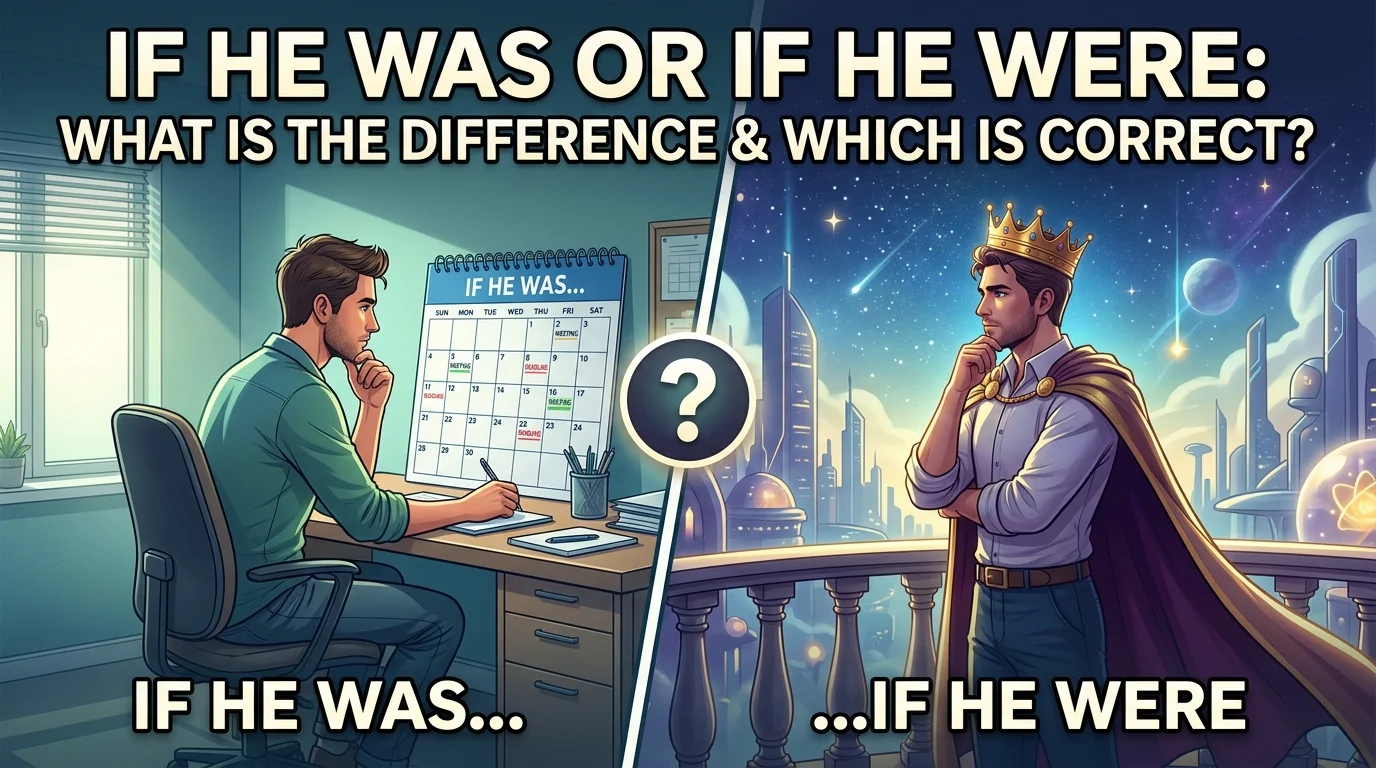

Understanding the difference between “if he was” and “if he were” can be confusing because both phrases are grammatically correct in certain situations. The key difference lies in the meaning and context of the sentence. One is generally used for real or possible situations, while the other is often used for hypothetical or imaginary situations. Learning when to use each form will make your writing and speaking more accurate and natural.
Comparison Overview
The phrases “if he was” and “if he were” both appear in conditional sentences, but they serve different purposes.
- If he was is commonly used when discussing something that may have actually happened in the past.
- If he were is used for hypothetical, unreal, imagined, or contrary-to-fact situations.
Although many native speakers use both forms interchangeably in casual conversation, formal grammar still distinguishes between them.
| Feature | If He Was | If He Were |
| Grammar Form | Indicative Mood | Subjunctive Mood |
| Purpose | Real or possible situations | Hypothetical or unreal situations |
| Time Reference | Usually past events | Present or future imaginary situations |
| Formality | Common in everyday speech | Preferred in formal writing |
| Example | If he was late, he missed the bus. | If he were taller, he could play basketball. |
Definition of If He Was
“If he was” uses the past tense verb was in the indicative mood. It refers to situations that may have actually occurred or are being questioned as possible facts.
This phrase is commonly used when discussing uncertainty about a real event or condition.
Examples:
- If he was at the meeting, he probably heard the announcement.
- I don’t know if he was serious.
- If he was tired, he should have rested.
The focus is on something that could have been true.
Definition of If He Were
“If he were” uses the subjunctive mood. It is used when discussing situations that are imagined, unlikely, impossible, or contrary to reality.
This form does not suggest the situation is true. Instead, it presents a hypothetical idea.
Examples:
- If he were richer, he could buy that house.
- If he were here, he would help us.
- If he were a doctor, he would understand the report.
The focus is on an unreal or imagined condition.
Main Differences Between If He Was and If He Were
The primary distinction is whether the situation is considered real or hypothetical.
| Aspect | If He Was | If He Were |
| Reality | May be true | Not true or imagined |
| Mood | Indicative | Subjunctive |
| Function | Describes possible facts | Describes hypothetical conditions |
| Common Context | Past events | Wishes, dreams, unreal situations |
| Example | If he was sick, he stayed home. | If he were sick, he would stay home. |
Meaning Difference
- If he was sick suggests he may actually have been sick.
- If he were sick suggests an imagined situation where he is sick.
Context Difference
- Use was when questioning or discussing facts.
- Use were when imagining alternatives.
Indicative vs Subjunctive Mood
Understanding grammatical mood helps clarify the distinction.
Indicative Mood
The indicative mood states facts, asks questions, or discusses real possibilities.
Example:
- If he was at school, he attended the lecture.
Subjunctive Mood
The subjunctive mood expresses wishes, hypotheticals, demands, or unreal conditions.
Example:
- If he were at school, he would be attending the lecture.
Common Sentence Structures
Using “If He Was”
Pattern:
If + subject + was + condition
Examples:
- If he was angry, he hid it well.
- If he was present, I didn’t see him.
Using “If He Were”
Pattern:
If + subject + were + condition + would/could/might
Examples:
- If he were younger, he would travel more.
- If he were available, he could join us.
Grammar Guide
How Each Term Is Used in Sentences
If He Was
Used when referring to actual or potentially true situations.
Examples:
- If he was at work, he received the email.
- If he was upset, nobody noticed.
If He Were
Used when discussing unreal or imagined situations.
Examples:
- If he were a pilot, he could fly the plane.
- If he were more patient, he would succeed.
Common Mistakes Learners Make
Mistake 1: Using “was” for imaginary situations
Incorrect:
- If he was a king, he would rule the country.
Correct:
- If he were a king, he would rule the country.
Mistake 2: Using “were” for factual possibilities
Less Appropriate:
- If he were at the conference yesterday, he heard the speech.
Better:
- If he was at the conference yesterday, he heard the speech.
Simple Rules to Remember
- Use was for possible facts.
- Use were for imaginary situations.
- If the sentence includes would, could, or might, were is often the better choice.
- Formal English strongly prefers were in hypothetical statements.
Quick Tips for Writing and Speaking
- Ask whether the situation is real or imagined.
- Use were in formal essays and academic writing.
- Use was when discussing uncertain past events.
- Watch for words like would, could, and might.
When to Use Each One
Use “If He Was” When:
- Discussing a possible past event.
- Referring to uncertainty about facts.
- Investigating what may have happened.
- Talking about real-world situations.
Examples:
- If he was involved, we need evidence.
- If he was there, he saw everything.
Use “If He Were” When:
- Imagining different circumstances.
- Expressing wishes.
- Creating hypothetical scenarios.
- Discussing impossible situations.
Examples:
- If he were invisible, nobody would see him.
- If he were the manager, things would change.
When NOT to Use Each One
Do Not Use “If He Was”
Avoid it when discussing unreal situations.
Incorrect:
- If he was a millionaire, he would buy a yacht.
Correct:
- If he were a millionaire, he would buy a yacht.
Do Not Use “If He Were”
Avoid it when referring to likely or actual past events.
Incorrect:
- If he were at the office yesterday, he signed the report.
Correct:
- If he was at the office yesterday, he signed the report.
Which One to Use (Decision Guide)
Ask yourself this simple question:
Is the situation real or potentially true?
- Yes → Use if he was
- No, it is imagined or hypothetical → Use if he were
Quick Decision Chart:
| Situation | Correct Choice |
| Real possibility | If he was |
| Past uncertainty | If he was |
| Imaginary condition | If he were |
| Wishful thinking | If he were |
| Contrary-to-fact statement | If he were |
| Formal hypothetical writing | If he were |
Real-World Practical Examples
If He Was Examples
- If he was absent from class, he missed the quiz.
- If he was at the conference, he learned a lot.
- If he was using the software, he saw the update.
- If he was involved in the project, his name should appear in the report.
- If he was driving yesterday, he may have encountered traffic.
If He Were Examples
- If he were a scientist, he would understand the experiment.
- If he were taller, he could reach the shelf.
- If he were the CEO, he would approve the proposal.
- If he were living abroad, communication would be harder.
- If he were more confident, he would speak publicly.
Self-Assessment (Fill in the Blanks)
- I will use ______ when referring to a possible past event. The correct word is ______ because it may have actually happened.
- I will use ______ when imagining he is a billionaire. The correct word is ______ because the situation is hypothetical.
- I will use ______ when discussing an uncertain fact. The correct word is ______ because it could be true.
- I will use ______ when describing an unreal condition. The correct word is ______ because the situation is imagined.
- I will use ______ when asking whether he attended the meeting. The correct word is ______ because it concerns a real possibility.
- I will use ______ when imagining him as president. The correct word is ______ because it is not a real situation.
- I will use ______ when discussing what happened yesterday. The correct word is ______ because it refers to an actual past event.
- I will use ______ when creating a fantasy scenario. The correct word is ______ because it is hypothetical.
- I will use ______ when checking whether he was present. The correct word is ______ because presence is a factual possibility.
- I will use ______ when discussing an impossible condition. The correct word is ______ because it is contrary to fact.
- I will use ______ when talking about a real investigation. The correct word is ______ because facts are being examined.
- I will use ______ when imagining he could fly. The correct word is ______ because the idea is unreal.
- I will use ______ when discussing possible attendance records. The correct word is ______ because the event may have occurred.
- I will use ______ when expressing a wish about his abilities. The correct word is ______ because the situation is not real.
- I will use ______ when referring to a likely historical event. The correct word is ______ because it concerns reality.
- I will use ______ when describing an alternate universe scenario. The correct word is ______ because it is imaginary.
- I will use ______ when discussing evidence from yesterday. The correct word is ______ because it involves actual events.
- I will use ______ when talking about what he would do as king. The correct word is ______ because it is hypothetical.
- I will use ______ when examining whether he participated. The correct word is ______ because participation is a factual possibility.
- I will use ______ when imagining a completely different life. The correct word is ______ because it is unreal.
Answers
- if he was, if he was
- if he were, if he were
- if he was, if he was
- if he were, if he were
- if he was, if he was
- if he were, if he were
- if he was, if he was
- if he were, if he were
- if he was, if he was
- if he were, if he were
- if he was, if he was
- if he were, if he were
- if he was, if he was
- if he were, if he were
- if he was, if he was
- if he were, if he were
- if he was, if he was
- if he were, if he were
- if he was, if he was
- if he were, if he were
Final Verdict
Both “if he was” and “if he were” are correct, but they are used in different situations. Choose “if he was” when talking about something that may actually have happened or when discussing a real possibility. Choose “if he were” when expressing a hypothetical, imaginary, or contrary-to-fact situation. In modern conversation, native speakers sometimes use “was” where traditional grammar recommends “were,” but formal writing still strongly favors the subjunctive form “were” for unreal conditions. By remembering the simple rule of real possibility = was and imaginary situation = were, you can confidently select the correct phrase in both writing and speech.
Conclusion About If He Was Or If He Were
Understanding the difference between if he was and if he were can greatly improve both your writing and speaking skills. While these phrases may look similar, they serve different grammatical purposes. If he was is generally used when referring to a real possibility, an uncertain fact, or something that may have happened in the past. In contrast, if he were is traditionally used for hypothetical, imaginary, or contrary-to-fact situations.
Choosing the correct phrase depends on whether you are discussing reality or an imagined scenario. Although modern spoken English sometimes blurs the distinction, formal writing still favors if he were for hypothetical conditions. By learning this simple rule, you can communicate more clearly and confidently. Whether you’re writing essays, business documents, academic papers, or everyday messages, understanding if he was or if he were will help you use English grammar more accurately and naturally.
FAQs
Is “if he was” grammatically correct?
Yes, if he was is grammatically correct when referring to a real or possible situation. It is commonly used when discussing uncertain facts or events that may have happened. The phrase follows the indicative mood and is widely accepted in both spoken and written English.
Is “if he were” grammatically correct?
Yes, if he were is grammatically correct and is traditionally used in the subjunctive mood. It is most appropriate when discussing hypothetical situations, wishes, or circumstances that are not true or are unlikely to be true in reality.
Why do people say “if he was” instead of “if he were”?
Many native English speakers use if he was in everyday conversation because it sounds more natural in informal speech. However, formal grammar rules generally recommend if he were when describing hypothetical or unreal situations.
When should I use “if he were”?
Use if he were when talking about imaginary conditions, wishes, dreams, or situations that are contrary to fact. It often appears in sentences that include words such as would, could, or might.
When should I use “if he was”?
Use if he was when referring to a situation that may actually have occurred or when discussing a real possibility. It is especially common when talking about uncertain events from the past.
Is “if he were” more formal than “if he was”?
Yes, if he were is generally considered more formal when used in hypothetical statements. Academic writing, professional documents, and formal communication often prefer the subjunctive form for grammatical accuracy.
Can both phrases be correct in some situations?
In certain contexts, both forms may appear acceptable, especially in informal English. However, the intended meaning usually determines which one is more appropriate. Real possibilities favor was, while hypothetical situations favor were.
What is the subjunctive mood?
The subjunctive mood is a grammatical form used to express wishes, hypothetical ideas, recommendations, or situations that are not necessarily real. The phrase if he were is one of the most common examples of the subjunctive mood in English.
Do native speakers always follow this grammar rule?
No, many native speakers use if he was and if he were interchangeably in casual conversation. Nevertheless, formal grammar guides continue to distinguish between the two forms based on whether the situation is real or hypothetical.
How can I easily remember the difference?
A simple rule is to think about reality. If the situation could be true or actually happened, use if he was. If the situation is imaginary, unlikely, or contrary to reality, use if he were.
