
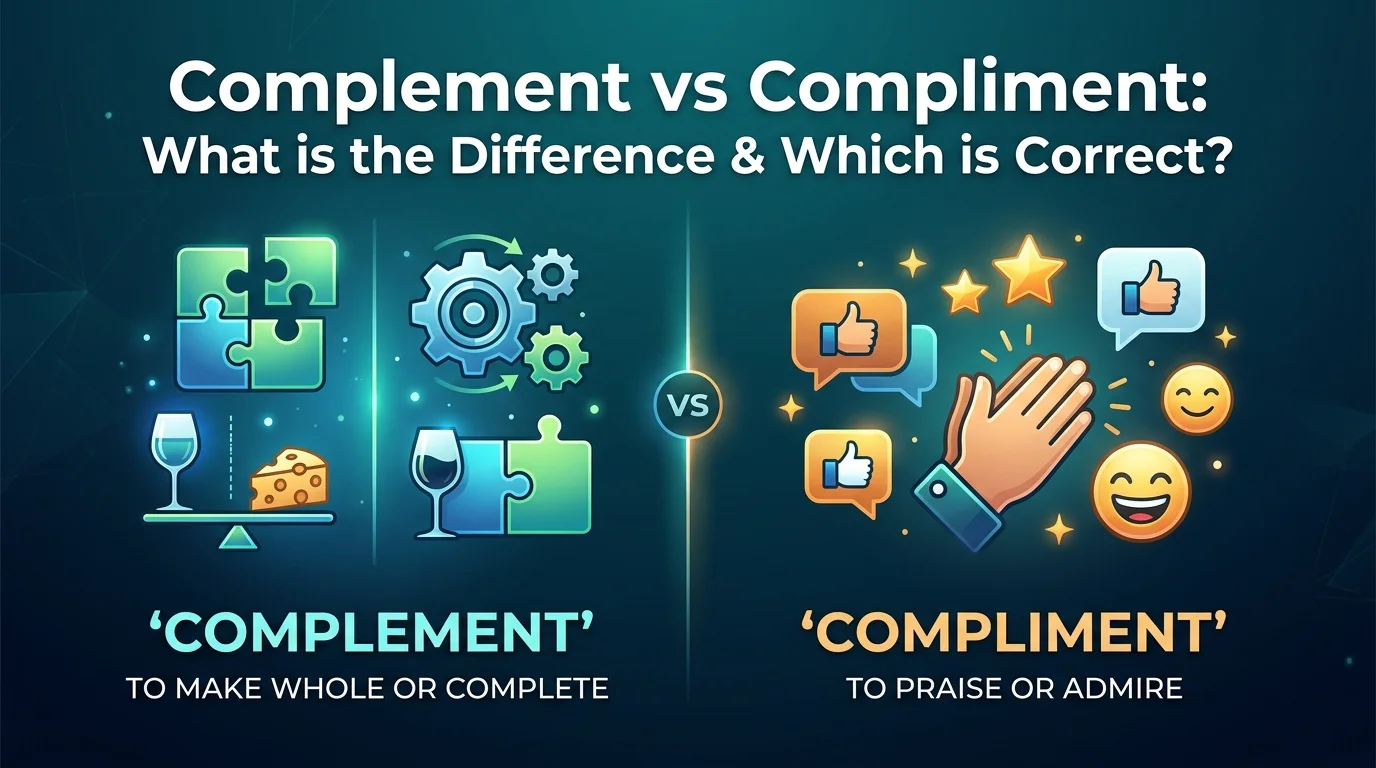

Understanding the difference between complement and compliment is important because these two words sound the same but have completely different meanings. Many English learners confuse them in writing and speech, which can completely change the meaning of a sentence. This guide explains both words clearly with meanings, usage, and real examples so you can use them correctly.
Comparison Overview
Complement and compliment are homophones, meaning they sound identical but have different meanings and spellings. Complement refers to something that completes or enhances another thing. Compliment refers to praise or a polite expression of admiration. Both are commonly used in English but in very different situations.
Definition of Complement
Complement means something that completes, improves, or works well with something else. It is used when two things fit together in a balanced or enhancing way. It can also refer to a word or phrase that completes the meaning of a sentence in grammar.
Definition of Compliment
Compliment means an expression of praise, admiration, or approval. It is used when someone says something nice about another person, object, or action. Compliments are common in everyday conversations, reviews, and social interactions.
Main Differences Between Complement and Compliment
Complement is about completion, balance, or enhancement. Compliment is about praise, appreciation, or positive comments.
Complement is used in contexts like design, food pairing, fashion, and grammar. Compliment is used in social situations, feedback, and conversations.
In simple terms, complement improves or completes something, while compliment expresses admiration.
Grammar Guide
How each term is used in sentences
Complement is used when one thing goes well with another. Example structure: A complements B.
Compliment is used when someone expresses praise. Example structure: I compliment you on something.
Common mistakes learners make
Many learners confuse spelling and meaning, especially when writing quickly. Another common mistake is using compliment when describing matching or completing relationships.
Simple rules to remember
Think of complement as “complete.”
Think of compliment as “commend.”
If it completes something, use complement.
If it praises something, use compliment.
Quick tips for writing and speaking
Link complement with “together makes better.”
Link compliment with “kind words.”
Focus on context before choosing the word.
When to Use Each One
Use complement when describing things that enhance or complete each other, such as colors, ideas, designs, or skills.
Use compliment when expressing appreciation, admiration, or positive feedback about someone or something.
When NOT to Use Each One
Do not use compliment when talking about things that complete or match each other.
Do not use complement when giving praise or positive comments.
Mixing them can change the meaning of your sentence completely.
Which One to Use (Decision Guide)
If the idea is about improvement, balance, or matching, use complement.
If the idea is about praise or positive words, use compliment.
Ask yourself whether the sentence is about “completing” or “praising” to choose correctly.
Real-World Practical Examples
Complement Examples
- The blue curtains complement the room’s interior.
- His skills complement the team’s strategy.
- This sauce complements the dish perfectly.
- Her experience complements his technical knowledge.
- The music complements the mood of the scene.
Compliment Examples
- She gave me a compliment on my outfit.
- I want to compliment you on your work.
- He received many compliments after his speech.
- The teacher complimented the student’s effort.
- They complimented the chef for the delicious food.
Self-Assessment (Fill in the Blanks)
- I will use ______ when something completes another thing.
- The correct word is ______ when expressing praise.
- This color can ______ the design of the room.
- She gave him a ______ for his presentation.
- These ingredients ______ each other well.
- He received a ______ from his boss.
- The shoes ______ the outfit perfectly.
- I want to ______ your performance.
- Good lighting can ______ photography results.
- She accepted the ______ with a smile.
- The jacket ______ his shirt.
- The manager gave a ______ to the employee.
- These ideas ______ each other in the project.
- He returned the ______ politely.
- The spices ______ the flavor of the dish.
- She received a nice ______ today.
- Their strengths ______ each other.
- I heard a positive ______ about you.
- The wine ______ the meal.
- The audience gave a ______ after the show.
Answers
- complement
- compliment
- complement
- compliment
- complement
- compliment
- complement
- compliment
- complement
- compliment
- complement
- compliment
- complement
- compliment
- complement
- compliment
- complement
- compliment
- complement
- compliment
Final Verdict
Complement and compliment sound the same but have completely different meanings. Complement is used when something completes or enhances something else. Compliment is used when expressing praise or admiration. Understanding the context of your sentence makes it easy to choose the correct word every time.
Conclusion About Complement vs Compliment
Understanding the difference between complement and compliment helps you avoid one of the most common English mistakes. Although these words sound identical, their meanings are completely different and serve separate purposes in communication. Complement is used when something improves, matches, or completes another thing, while compliment is used when expressing praise or admiration. Once you clearly understand the context, choosing the right word becomes simple and natural. Whether you are writing professionally, speaking in daily life, or improving your grammar skills, remembering this distinction will make your English more accurate, confident, and effective. With regular practice and awareness, you can easily avoid confusion and use both words correctly in the right situations.
FAQs
What is the main difference between complement and compliment?
The main difference is meaning. Complement refers to something that completes or enhances another thing, while compliment refers to a polite expression of praise or admiration. Although they sound the same, their usage depends entirely on context. One is about matching or improvement, and the other is about appreciation or kind words in communication.
How can I remember complement and compliment easily?
A simple trick is to link complement with “complete” because both share similar meanings. For compliment, think of “praise” or “commend.” If something improves or completes another thing, use complement. If someone is saying something nice or expressing admiration, use compliment. This memory technique helps avoid confusion in writing and speaking.
Is complement used in grammar?
Yes, complement is used in grammar to refer to words or phrases that complete the meaning of a sentence. For example, in “She is happy,” the word “happy” is a complement. It gives full meaning to the sentence by describing the subject. Without a complement, some sentences would feel incomplete or unclear.
Can compliment be used in formal writing?
Yes, compliment is commonly used in formal writing when expressing appreciation or positive feedback. It is often found in emails, reviews, reports, and professional communication. For example, you may compliment a colleague’s performance or a company’s service. It is a polite and appropriate way to show respect and recognition.
Why do people confuse complement and compliment?
People often confuse these words because they are homophones, meaning they sound exactly the same when spoken. However, their spellings and meanings are different. Without careful attention to context and spelling, it is easy to mix them up in writing. Learning their definitions and usage helps eliminate this confusion.
Can complement and compliment be used in the same sentence?
Yes, both words can appear in the same sentence if used correctly. For example, “I complimented her on how her dress complemented her shoes.” Here, compliment refers to praise, while complement refers to matching or enhancing. This shows how both words can work together in different meanings.
What are some examples of complement?
Examples of complement include phrases like “The sauce complements the dish,” or “Her skills complement his leadership.” In these cases, one thing improves or completes another. Complement is often used in design, fashion, food, and teamwork contexts where harmony or balance is involved.
What are some examples of compliment?
Examples of compliment include “She gave him a compliment on his speech,” or “They complimented the chef on the meal.” These sentences show appreciation or praise. Compliment is commonly used in everyday conversation, reviews, and polite interactions to express positive feedback.
Is complement only used in academic English?
No, complement is used in both academic and everyday English. While it is common in grammar, design, and technical subjects, it is also used in daily life. People often use it when talking about matching colors, food pairings, or teamwork where things enhance each other.
How can I avoid mistakes with complement and compliment?
To avoid mistakes, always check the meaning before writing. Ask yourself if you are talking about completion or praise. If it is about matching or improving, use complement. If it is about appreciation or kind words, use compliment. Practicing with examples regularly will help build confidence and accuracy.
