
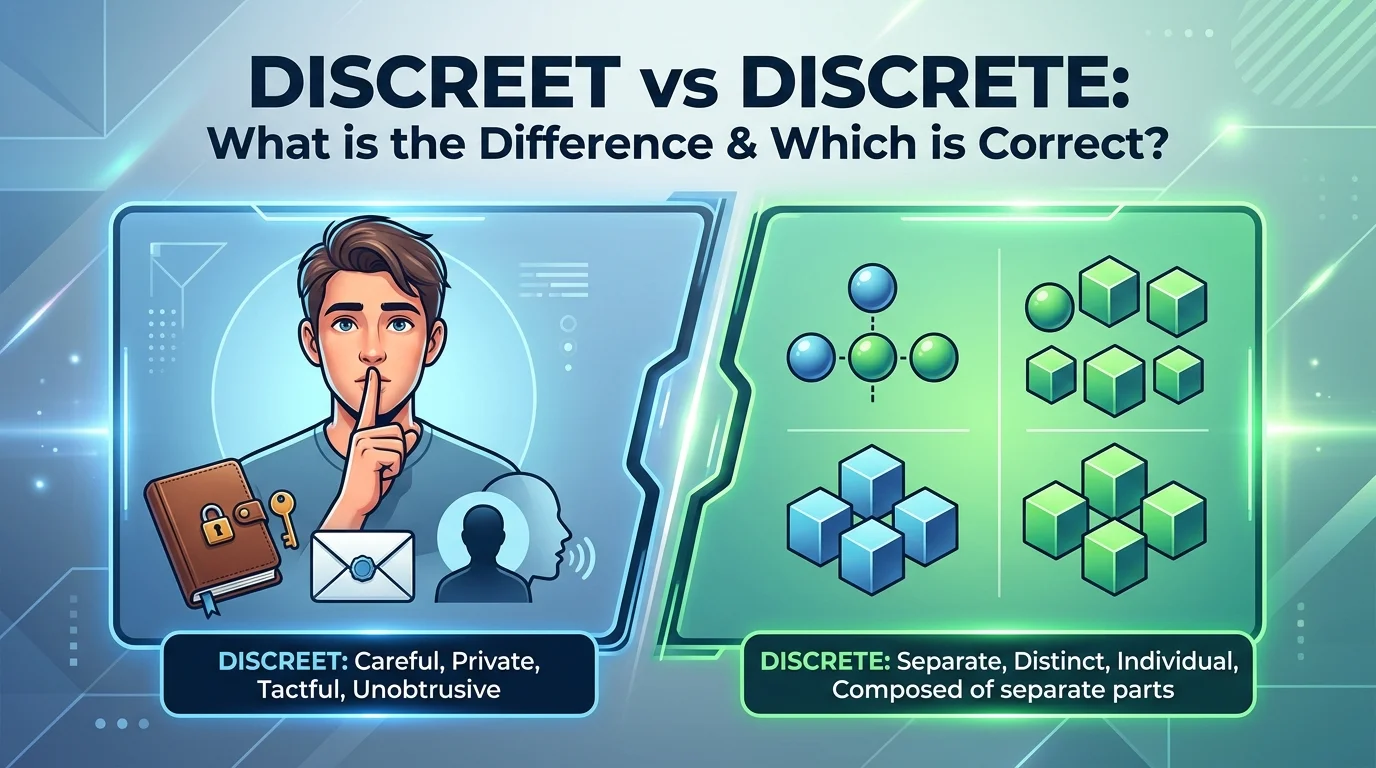

Understanding the difference between “discreet” and “discrete” is important because they sound the same but mean completely different things. This confusion often leads to mistakes in writing and speaking. One word is about careful behavior and privacy, while the other is about separation and distinct units in science, math, and logic.
Comparison Overview
“Discreet” and “discrete” are homophones, meaning they have identical pronunciation but different meanings and spellings. “Discreet” refers to careful, tactful, and private behavior, especially in sensitive situations. “Discrete” refers to things that are separate, distinct, and individually identifiable, often used in academic and technical contexts.
Definition of Discreet
“Discreet” is an adjective used to describe someone who acts carefully to avoid embarrassment, attention, or revealing private information. It is commonly used in social, professional, and personal situations where sensitivity and confidentiality are important.
Definition of Discrete
“Discrete” is an adjective used to describe things that are separate or distinct from one another. It is widely used in mathematics, science, statistics, and computing to refer to individual units rather than continuous forms.
Main Differences Between Discreet and Discrete
The main difference lies in meaning and context.
“Discreet” focuses on behavior, privacy, and tact. It is used when describing how someone acts or communicates in sensitive situations.
“Discrete” focuses on separation and individuality. It is used when describing separate units, categories, or values in technical or scientific contexts.
Comparison Table
Discreet: careful, private, tactful behavior, social and professional situations, example: discreet conversation
Discrete: separate, distinct, individual units, scientific and mathematical usage, example: discrete data points
Grammar Guide
Both words are adjectives, but they operate in different meaning areas. “Discreet” modifies behavior related to privacy or caution. “Discrete” modifies objects, data, or concepts that exist as separate units.
How each term is used in sentences
Discreet: She was discreet about the confidential matter.
Discrete: The analysis uses discrete values.
Sentence patterns:
Discreet: subject + verb + discreet + about + topic
Discrete: noun + verb + discrete + from + other elements
Common mistakes learners make
A common mistake is using “discrete” when talking about private behavior. Another is using “discreet” in mathematical or scientific writing. These errors can completely change the meaning of a sentence.
Simple rules to remember
Use “discreet” for privacy, careful behavior, and tact.
Use “discrete” for separate units, categories, or distinct elements.
A helpful memory trick is that “discrete” has a “t” like “two separate things.”
Quick tips for writing and speaking
Check the context before choosing the word. If it involves people, communication, or secrecy, use “discreet.” If it involves data, numbers, or categories, use “discrete.”
When to Use Each One
Use “discreet” in everyday communication, professional behavior, and situations involving privacy or sensitivity.
Use “discrete” in academic, scientific, mathematical, and technical contexts involving separate units or values.
When NOT to Use Each One
Do not use “discreet” for scientific data or mathematical concepts.
Do not use “discrete” for describing polite, careful, or private behavior.
Mixing them leads to incorrect meaning and confusion.
Which One to Use (Decision Guide)
If the sentence is about behavior, privacy, or careful action, choose “discreet.”
If the sentence is about separation, distinct units, or categories, choose “discrete.”
Think whether you are describing a person’s actions or separate elements.
Real-World Practical Examples
Discreet Examples
- She gave a discreet response during the meeting.
- The detective remained discreet while gathering information.
- He made a discreet exit from the event.
- The doctor was discreet about patient details.
- They had a discreet conversation in the hallway.
Discrete Examples
- The system processes discrete inputs.
- The graph shows discrete data points.
- Mathematics deals with discrete variables.
- The task is divided into discrete steps.
- Each signal is recorded as a discrete event.
Self-Assessment (Fill in the Blanks)
I will use ______ when referring to careful behavior.
The correct word is ______ for separate values.
She acted very ______ during the conversation.
The system uses ______ data.
He remained ______ about the secret.
The study analyzes ______ variables.
The manager was ______ in handling the issue.
The chart shows ______ points.
They had a ______ discussion.
Science uses ______ measurements.
She was very ______ with information.
The process involves ______ steps.
He gave a ______ reply.
The dataset includes ______ categories.
The lawyer stayed ______ about details.
The research focuses on ______ elements.
The speaker was ______ in tone.
The software handles ______ inputs.
They followed a ______ approach.
The model works with ______ units.
Answers
- discreet
- discrete
- discreet
- discrete
- discreet
- discrete
- discreet
- discrete
- discreet
- discrete
- discreet
- discrete
- discreet
- discrete
- discreet
- discrete
- discreet
- discrete
- discreet
- discrete
Final Verdict
“Discreet” and “discrete” are often confused because they sound identical, but they serve very different purposes. “Discreet” is about careful, private behavior, while “discrete” is about separate and distinct units in technical or academic contexts. The correct choice always depends on the context of the sentence.
Conclusion About Discreet vs Discrete
Understanding the difference between discreet and discrete helps you avoid one of the most common English mistakes. Although they sound identical, their meanings are completely unrelated. Discreet is all about being careful, private, and tactful in behavior, especially in sensitive situations. On the other hand, discrete refers to things that are separate, distinct, or individually divided, commonly used in science, math, and technical writing. Once you clearly understand the context each word belongs to, choosing the correct one becomes simple and natural. Whether you are writing academically, professionally, or in everyday communication, using the right term improves clarity and precision. With a little practice and attention to meaning, you can confidently avoid confusion and use both words correctly in the right situations.
FAQs
What does discreet mean in simple words?
Discreet means being careful, quiet, and tactful in behavior, especially when handling private or sensitive matters. It is used when someone avoids drawing attention or keeps information confidential. For example, a discreet person does not share secrets and behaves in a way that does not cause embarrassment or unwanted notice.
What does discrete mean in easy language?
Discrete means separate or distinct. It is used when talking about things that are individually divided or not continuous. In mathematics or science, discrete values are clearly separated units. For example, numbers like one, two, and three are discrete because they are distinct and not part of a continuous flow.
Why do discreet and discrete sound the same?
They sound the same because they are homophones in English. This means they share identical pronunciation but have different spellings and meanings. Such words often confuse learners because listening alone does not reveal the correct spelling or meaning without understanding the context.
How can I remember the difference between discreet and discrete?
A simple trick is to link discreet with privacy and behavior, and discrete with separation. You can also remember that discrete has a “t” which can remind you of “two separate things.” This mental association helps reduce confusion in writing and speaking.
Is discreet used in professional communication?
Yes, discreet is often used in professional settings where confidentiality and tact are important. For example, managers, doctors, and lawyers must be discreet when handling sensitive information. It reflects careful communication and respectful behavior in workplace situations.
Where is discrete commonly used?
Discrete is commonly used in mathematics, science, computing, and statistics. It describes separate units, values, or categories. For example, data points in a graph or steps in a process are considered discrete because they are individually distinct and not continuous.
Can discreet and discrete be used interchangeably?
No, they cannot be used interchangeably because they have completely different meanings. Using one instead of the other changes the meaning of the sentence. Discreet refers to behavior, while discrete refers to separation or distinct elements in structured contexts.
What is a simple example of discreet in a sentence?
A simple example is: She gave a discreet smile during the meeting. This shows careful and subtle behavior meant not to attract attention. The word is commonly used when describing polite, private, or sensitive actions in social situations.
What is a simple example of discrete in a sentence?
A simple example is: The data is divided into discrete categories. This means the information is separated into distinct groups. It is often used in academic and technical writing to describe clear divisions between values or elements.
Why is it important to know the difference between them?
Knowing the difference improves your writing accuracy and communication clarity. Misusing these words can confuse readers or change the meaning of your sentence. Understanding their correct usage helps you sound more professional and confident in both academic and everyday English.
