
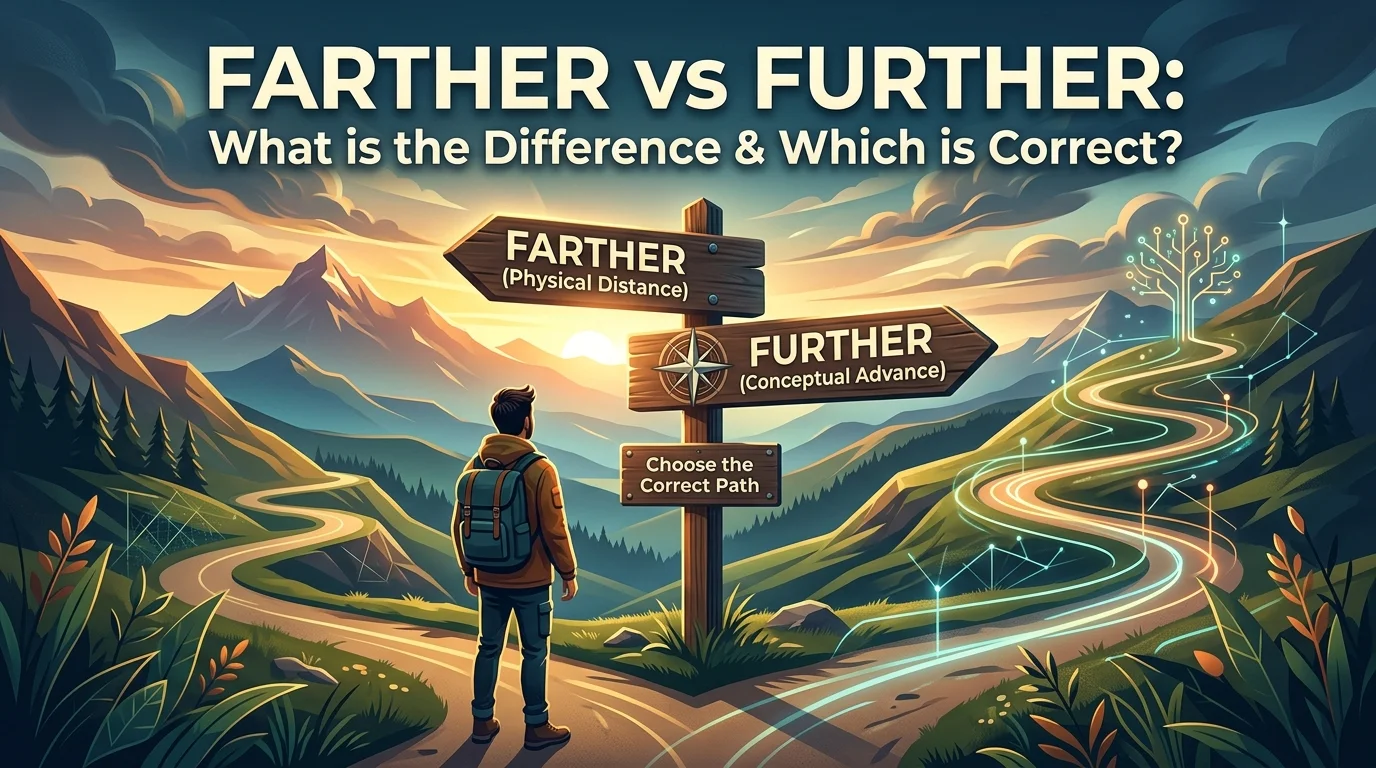

The words “farther” and “further” often confuse English learners because they look similar and are sometimes used in similar situations. However, they have subtle differences in meaning and usage. Understanding when to use each one helps improve clarity in writing and speaking, especially in academic, professional, and everyday communication.
Comparison Overview
“Farther” and “further” both relate to distance or extent, but they are not always interchangeable. “Farther” is mainly used for physical distance, while “further” is used for abstract ideas such as progress, degree, or additional information. Over time, usage has overlapped, but their traditional distinctions remain important for clear grammar.
Definition of Farther
“Farther” refers to measurable physical distance. It is used when talking about how far something is in a literal sense, such as miles, kilometers, or steps. It answers questions about actual movement or spatial separation between two points.
In simple terms, “farther” is about real, physical distance you can measure or see.
Definition of Further
“Further” refers to abstract or figurative extension. It is used when talking about additional information, progress, development, or intensity rather than physical distance. It can also be used as a verb meaning “to advance” or “to promote.”
In simple terms, “further” is about extra amount, progress, or deeper meaning rather than physical space.
Main Differences Between Farther and Further
The main difference lies in the type of meaning each word expresses.
“Farther” is used for physical distance, such as how far you travel from one place to another. It is concrete and measurable.
“Further” is used for non-physical ideas like extra discussion, deeper understanding, or continued progress. It is abstract and broader in use.
While modern English sometimes allows overlap, especially in informal contexts, maintaining this distinction improves clarity and precision in writing.
| Aspect | Farther | Further |
| Meaning | Physical distance | Abstract or additional extent |
| Usage | Measurable space | Ideas, progress, information |
| Form | Comparative of far | Comparative and verb usage |
| Example focus | Travel, geography | Learning, discussion, development |
Grammar Guide
How each term is used in sentences
Farther is commonly used in comparisons involving distance.
Example pattern: A is farther than B.
Further is used when discussing continuation or additional ideas.
Example pattern: We need further discussion on this topic.
Common mistakes learners make
A frequent mistake is using “further” when talking about physical distance.
Another mistake is thinking both words are completely interchangeable in all contexts, which can reduce clarity in formal writing.
Simple rules to remember
Use “farther” when you can measure distance physically.
Use “further” when you mean “additional” or “more advanced.”
Quick tips for writing and speaking
If you can replace the word with “more distance,” use farther.
If you can replace it with “more information” or “more progress,” use further.
When to Use Each One
Use “farther” when talking about travel, geography, walking distance, or measurable space between two points.
Use “further” when talking about learning, business growth, research, conversation, or any idea that involves expansion beyond physical space.
When NOT to Use Each One
Do not use “farther” for abstract ideas like “further information” or “further discussion.”
Do not strictly limit “further” to only formal writing, as it is widely used in both formal and informal contexts.
Avoid using either word without context, as it can confuse readers if the meaning is unclear.
Which One to Use (Decision Guide)
If the sentence is about physical distance, choose “farther.”
If the sentence is about ideas, progress, or additional information, choose “further.”
When unsure, check whether you can physically measure the distance. If yes, use “farther.” If not, use “further.”
Real-World Practical Examples
Farther Examples
- The school is farther from my house than the market.
- She ran farther than her friend during practice.
- This road goes farther into the mountains.
- My office is farther away than I expected.
- The next town is farther down the highway.
Further Examples
- We need further discussion before making a decision.
- The teacher provided further explanation of the topic.
- He decided to further his studies abroad.
- There is no further information available right now.
- The company plans to further expand its services.
Self-Assessment (Fill in the Blanks)
- The airport is ______ away than the train station.
- We need ______ details before we proceed.
- She walked ______ than anyone else in the group.
- The manager asked for ______ clarification.
- This village is ______ from the city center.
- The scientist requested ______ research on the topic.
- He ran ______ than his teammates during the race.
- The lawyer demanded ______ evidence.
- The next checkpoint is ______ down the road.
- They agreed to ______ discuss the issue tomorrow.
- My house is ______ from the school than yours.
- The report needs ______ analysis.
- The hikers went ______ into the forest.
- We require ______ support to complete the project.
- The destination is ______ than we thought.
- The professor offered ______ guidance to students.
- She can throw the ball ______ than I can.
- The investigation needs ______ review.
- The road extends ______ than the map shows.
- The company decided to ______ invest in technology.
Answers
- farther
- further
- farther
- further
- farther
- further
- farther
- further
- farther
- further
- farther
- further
- farther
- further
- farther
- further
- farther
- further
- farther
- further
Final Verdict
“Farther” and “further” are closely related but serve different purposes in English. “Farther” is best for physical distance, while “further” is used for abstract ideas, progress, and additional information. Understanding this difference helps you communicate more clearly and write with greater accuracy in both formal and informal contexts.
Conclusion About Farther vs Further
Understanding the difference between “farther” and “further” makes English clearer, more precise, and easier to use in both writing and conversation. While both words come from the idea of “far,” they serve different purposes in modern usage. “Farther” is best suited for physical distance that can be measured, while “further” expands into abstract ideas like progress, information, or development. Although they sometimes overlap in casual speech, using them correctly helps you sound more accurate and confident. Whether you are writing essays, giving directions, or explaining ideas, choosing the right word improves clarity and professionalism. With a little practice, this distinction becomes natural and effortless in everyday communication.
FAQs
What is the main difference between farther and further?
Farther is used for physical distance that can be measured, such as miles or kilometers. Further is used for abstract ideas like progress, information, or development. While they may seem similar, their meanings differ based on whether the context is literal or figurative in communication.
Can farther and further be used interchangeably?
In modern English, they are sometimes used interchangeably, especially in informal speech. However, in formal writing, it is better to use farther for physical distance and further for abstract meanings. This helps maintain clarity and grammatical accuracy in professional and academic contexts.
Is farther only used for distance?
Yes, traditionally farther is used only for physical distance that can be measured or seen. For example, walking distance or travel distance. It does not apply to abstract ideas like progress or discussion, where further is the more appropriate choice.
Can further be used as a verb?
Yes, further can function as a verb meaning to promote, advance, or develop something. For example, “She wants to further her career.” This usage is common in both formal and informal English and adds flexibility to the word.
Which is more formal, farther or further?
Both words are considered correct, but further is more commonly used in formal writing due to its broader meaning. Farther is more specific to physical distance. Choosing the correct one depends on context rather than formality alone.
How do I remember when to use farther?
A simple way to remember is to link farther with “physical far.” If you can measure the distance in miles, steps, or kilometers, then farther is correct. This trick helps avoid confusion in everyday usage.
When should I avoid using farther?
Avoid using farther when referring to abstract concepts like ideas, progress, or additional information. In such cases, further is always the better choice. Using farther incorrectly in these contexts may sound unnatural or unclear.
Is further always related to ideas?
Mostly yes, further is used for abstract meanings such as extra information, development, or continuation. However, it can also function as a verb, making it more versatile than just being limited to ideas or non-physical concepts.
Do native speakers mix farther and further?
Yes, many native speakers use them interchangeably in casual conversation without strict rules. However, in academic or professional writing, the distinction is usually maintained to ensure clarity and precision in meaning.
Which word is more commonly used in English?
Further is more commonly used overall because it covers both abstract meanings and verb usage. Farther is less frequent since it is limited to physical distance. This makes further the more versatile and widely used option in modern English.
