
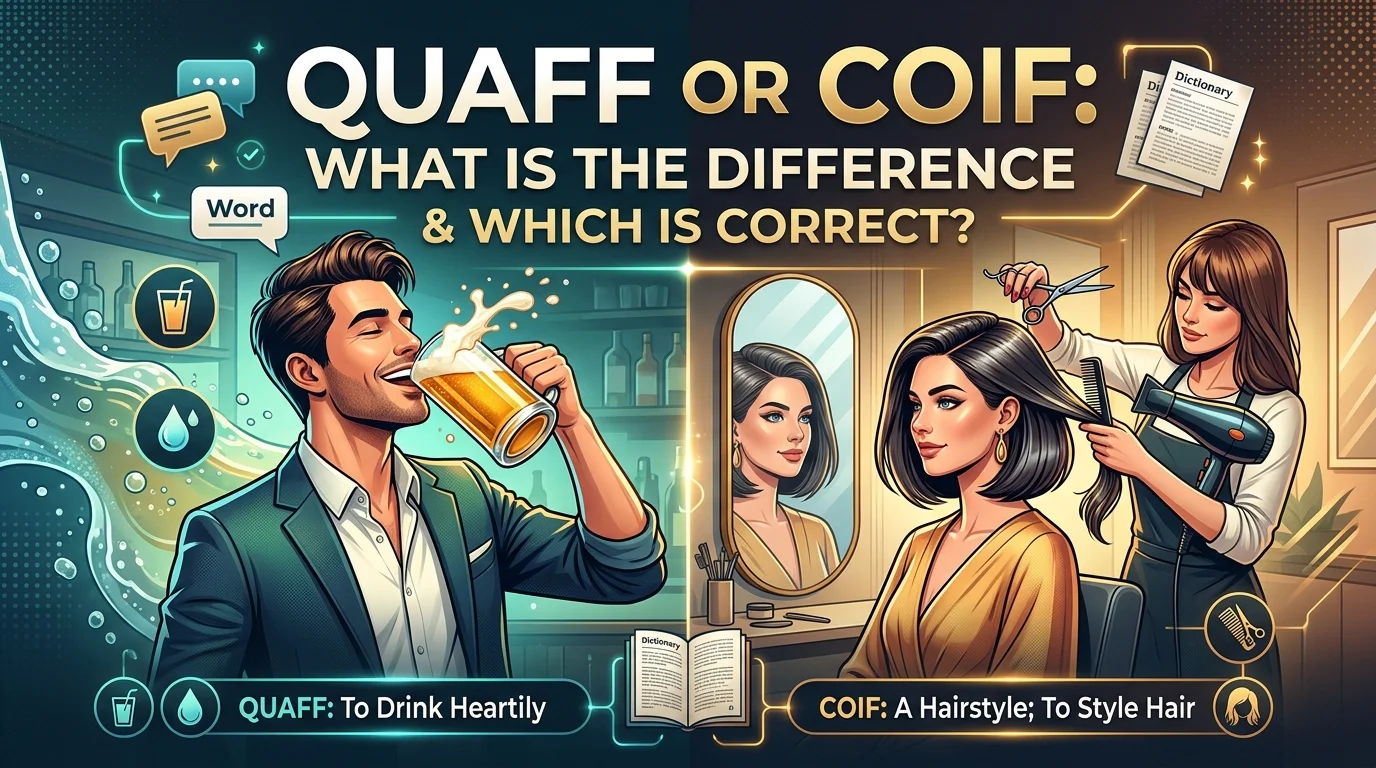

Many English learners confuse “quaff” and “coif” because the words sound somewhat similar and are uncommon in daily conversation. However, they have completely different meanings and uses. Understanding the difference between these two words helps improve vocabulary, writing accuracy, and communication skills. This guide explains each term clearly, compares them in detail, and shows when to use each one correctly.
Comparison Overview
“Quaff” and “coif” belong to entirely different categories of English vocabulary. “Quaff” is mainly used as a verb related to drinking, while “coif” is usually connected to hairstyles or head coverings. Even though they may look or sound alike to some learners, their meanings, grammar, and usage contexts are very different.
| Feature | Quaff | Coif |
| Main Meaning | To drink heartily | A hairstyle or head covering |
| Part of Speech | Verb | Noun or verb |
| Common Context | Drinking beverages | Hair and fashion |
| Tone | Literary or expressive | Fashion or formal |
| Example | He quaffed the juice quickly. | She wore an elegant coif. |
Definition of Quaff
“Quaff” means to drink a liquid deeply, quickly, or enthusiastically. It is often used when someone drinks a beverage with enjoyment or in large amounts.
The word is commonly found in literature, storytelling, and expressive writing rather than casual everyday conversation.
Examples:
- The travelers quaffed cold water after the hike.
- He quaffed a mug of tea before leaving.
- They quaffed lemonade during the picnic.
“Quaff” usually creates a vivid image of drinking eagerly.
Definition of Coif
“Coif” refers to a hairstyle, hair arrangement, or a close-fitting cap worn on the head. It can also be used as a verb meaning to style or arrange hair.
The word is mostly used in fashion, beauty, or historical contexts.
Examples:
- Her elegant coif attracted attention at the event.
- The stylist carefully coiffed the actor’s hair.
- The queen wore a decorative coif.
“Coif” is much more related to appearance and grooming than action.
Main Differences Between Quaff and Coif
The biggest difference between “quaff” and “coif” is their meaning and purpose.
Meaning
- “Quaff” relates to drinking liquids.
- “Coif” relates to hairstyles or head coverings.
Grammar Role
- “Quaff” is mainly used as a verb.
- “Coif” is mostly used as a noun, though it can also function as a verb.
Usage Context
- “Quaff” appears in storytelling, food writing, or descriptive language.
- “Coif” appears in beauty, fashion, or historical writing.
Emotional Tone
- “Quaff” sounds lively and expressive.
- “Coif” sounds stylish or formal.
Example Comparison
| Sentence | Correct Word |
| He ______ a bottle of juice after the game. | Quaffed |
| The model’s elegant ______ impressed everyone. | Coif |
| The barber carefully ______ her hair. | Coiffed |
Historical Background of the Words
Understanding the origins of these words can make them easier to remember.
Origin of Quaff
“Quaff” comes from old Germanic roots connected with drinking heavily or deeply. The word has existed in English for centuries and often appears in poetry and classic literature.
Origin of Coif
“Coif” comes from Old French and originally referred to a close-fitting cap. Over time, it became associated with hairstyles and hair arrangement.
Common Contexts Where These Words Appear
Where You Usually See “Quaff”
- Fantasy novels
- Historical stories
- Beverage advertisements
- Food and drink reviews
- Poetry
Where You Usually See “Coif”
- Fashion magazines
- Beauty salons
- Historical costume discussions
- Hairstyling tutorials
- Celebrity style articles
Grammar Guide
How Each Term Is Used in Sentences
Using “Quaff”
Pattern:
Subject + quaff/quaffed + beverage
Examples:
- She quaffed the smoothie quickly.
- They quaffed fresh juice after exercise.
- The knight quaffed ale in the tavern.
Using “Coif”
Pattern as noun:
Subject + has/wears + coif
Pattern as verb:
Subject + coiffed + hair
Examples:
- Her coif looked beautiful.
- The stylist coiffed the bride’s hair.
- He admired the actor’s fashionable coif.
Common Mistakes Learners Make
Many learners confuse these words because both are uncommon.
Common mistakes include:
- Using “coif” when talking about drinking
- Using “quaff” when discussing hairstyles
- Forgetting that “quaff” is mostly a verb
- Assuming both words are interchangeable
Incorrect:
- She quaffed her hair before the party.
Correct:
- She coiffed her hair before the party.
Incorrect:
- He coifed the lemonade.
Correct:
- He quaffed the lemonade.
Simple Rules to Remember
- “Quaff” = drink quickly or eagerly.
- “Coif” = hairstyle or hair arrangement.
- If the sentence involves beverages, use “quaff.”
- If the sentence involves hair or appearance, use “coif.”
Memory Trick:
- “Quaff” contains “qua,” which can remind you of liquid or quantity.
- “Coif” sounds fashionable and stylish, like hair fashion.
Quick Tips for Writing and Speaking
- Use “quaff” in creative or descriptive writing.
- Use “coif” in beauty or fashion discussions.
- Avoid overusing either word in casual conversation.
- Make sure the sentence context matches the meaning.
When to Use Each One
Use “Quaff” When:
- Talking about drinking enthusiastically
- Describing beverages in stories
- Writing expressive food or drink content
- Creating dramatic or literary scenes
Use “Coif” When:
- Discussing hairstyles
- Referring to elegant hair arrangements
- Talking about grooming or fashion
- Describing historical headwear
When NOT to Use Each One
Do Not Use “Quaff”:
- For hairstyles
- For clothing descriptions
- For hair styling activities
Do Not Use “Coif”:
- For drinking actions
- For beverages
- For eating or consuming liquids
Which One to Use (Decision Guide)
Use this quick guide to choose correctly:
| Situation | Correct Word |
| Drinking water quickly | Quaff |
| Styling hair | Coif |
| Describing a hairstyle | Coif |
| Drinking enthusiastically | Quaff |
| Beauty and fashion topics | Coif |
| Beverage storytelling | Quaff |
If your sentence involves liquids or drinking, choose “quaff.” If it involves hair, beauty, or appearance, choose “coif.”
Real-World Practical Examples
Quaff Examples
- The athletes quaffed sports drinks after training.
- He quaffed coffee before the morning meeting.
- The travelers quaffed cold juice during the hot afternoon.
- Students quaffed water after the football match.
- The king quaffed wine during the celebration.
Coif Examples
- The actress displayed a glamorous coif on the red carpet.
- The hairstylist coiffed the bride beautifully.
- Her vintage coif matched the historical costume perfectly.
- The magazine featured modern coif trends.
- The model’s elegant coif impressed fashion critics.
Self-Assessment (Fill in the Blanks)
- He decided to ______ a glass of lemonade after the game.
- The stylist carefully fixed the bride’s ______.
- Travelers often ______ water after long hikes.
- Her elegant ______ attracted attention at the ceremony.
- The knight loved to ______ ale at feasts.
- The actor’s fashionable ______ became popular online.
- After exercising, the team ______ cold juice.
- The salon can ______ hair for weddings.
- She admired the queen’s decorative ______.
- The hikers stopped to ______ fresh spring water.
- The correct word is ______ because the sentence discusses drinking.
- The correct word is ______ because the sentence discusses hair styling.
- We usually ______ beverages, not hairstyles.
- A stylish hair arrangement is called a ______.
- The barber ______ the customer’s hair carefully.
- Writers often use “______” in descriptive drinking scenes.
- Beauty magazines frequently discuss modern ______ styles.
- He quickly ______ the hot chocolate before leaving.
- The designer created a royal ______ for the play.
- The correct word is ______ because the context involves beverages.
Answers
- quaff
- coif
- quaff
- coif
- quaff
- coif
- quaffed
- coif
- coif
- quaff
- quaff
- coif
- quaff
- coif
- coiffed
- quaff
- coif
- quaffed
- coif
- quaff
Final Verdict
“Quaff” and “coif” may sound somewhat similar, but they have completely different meanings and uses. “Quaff” relates to drinking enthusiastically or deeply, while “coif” refers to hairstyles or hair arrangement. Remembering the context is the easiest way to choose correctly. If the topic involves beverages or drinking, use “quaff.” If it involves hair, fashion, or grooming, use “coif.” Learning these distinctions improves vocabulary, grammar accuracy, and confidence in both writing and speaking English.
Conclusion About Quaff Or Coif
Understanding the difference between “quaff” and “coif” can make your English vocabulary more accurate and expressive. While “quaff” is connected with drinking enthusiastically, “coif” relates to hairstyles, grooming, or decorative head coverings. Because the words sound somewhat similar, many learners accidentally confuse them in writing and conversation. However, once you connect “quaff” with beverages and “coif” with hair or fashion, choosing the correct term becomes much easier. These words are not interchangeable, and each belongs to a completely different context. Whether you are improving your grammar, expanding your vocabulary, or writing more professionally, knowing when to use “quaff” or “coif” helps you communicate clearly and confidently. With regular practice and real sentence examples, you can avoid common mistakes and use both words naturally in speaking and writing.
FAQs
What does quaff mean?
“Quaff” means to drink something eagerly, deeply, or in large amounts. It is usually used for beverages such as water, juice, tea, or wine. The word often appears in descriptive or literary writing to create a vivid image of someone drinking enthusiastically rather than casually sipping a drink.
What does coif mean?
“Coif” refers to a hairstyle, hair arrangement, or sometimes a close-fitting head covering. It can also be used as a verb meaning to style someone’s hair. The word is most commonly used in fashion, beauty, historical, or grooming contexts rather than in everyday casual conversation.
Are quaff and coif interchangeable?
No, “quaff” and “coif” are completely different words with unrelated meanings. “Quaff” is about drinking liquids, while “coif” is related to hairstyles or hair styling. Using one in place of the other creates grammatical and meaning errors in both speaking and writing.
Is quaff a formal word?
Yes, “quaff” is generally considered more literary or expressive than everyday vocabulary. People usually say “drink” in normal conversation, while “quaff” appears more often in novels, storytelling, advertisements, poetry, or descriptive writing about beverages and celebrations.
Is coif commonly used today?
“Coif” is less common in everyday speech, but it still appears in fashion magazines, beauty discussions, hairstyle descriptions, and historical writing. Modern speakers may use “hairstyle” more often, but “coif” adds a stylish or elegant tone to the sentence.
Can coif be used as a verb?
Yes, “coif” can be used as a verb. When used this way, it means to arrange or style someone’s hair. For example, “The stylist coiffed the model’s hair before the photo shoot” is a correct sentence using the verb form.
What type of word is quaff?
“Quaff” is mainly a verb because it describes an action involving drinking. It explains how someone consumes a beverage, often in an eager or enthusiastic way. The word is action-focused and usually appears with drinks such as water, juice, tea, or wine.
Why do learners confuse quaff and coif?
Learners often confuse these words because they sound somewhat similar and are both uncommon in daily English. However, their meanings are entirely unrelated. Remembering that “quaff” involves drinks and “coif” involves hair can help prevent mistakes and improve vocabulary accuracy.
Can quaff describe any kind of drinking?
Usually, “quaff” describes enthusiastic or hearty drinking rather than slow or careful sipping. It is often used when someone drinks quickly, happily, or in large amounts. The word creates a stronger and more vivid image compared to the simpler word “drink.”
How can I remember the difference between quaff and coif?
A simple memory trick is to connect “quaff” with beverages and “coif” with hairstyles. If the sentence talks about liquids or drinking, use “quaff.” If it talks about hair, grooming, or fashion, use “coif.” Associating each word with its context makes remembering easier.
