
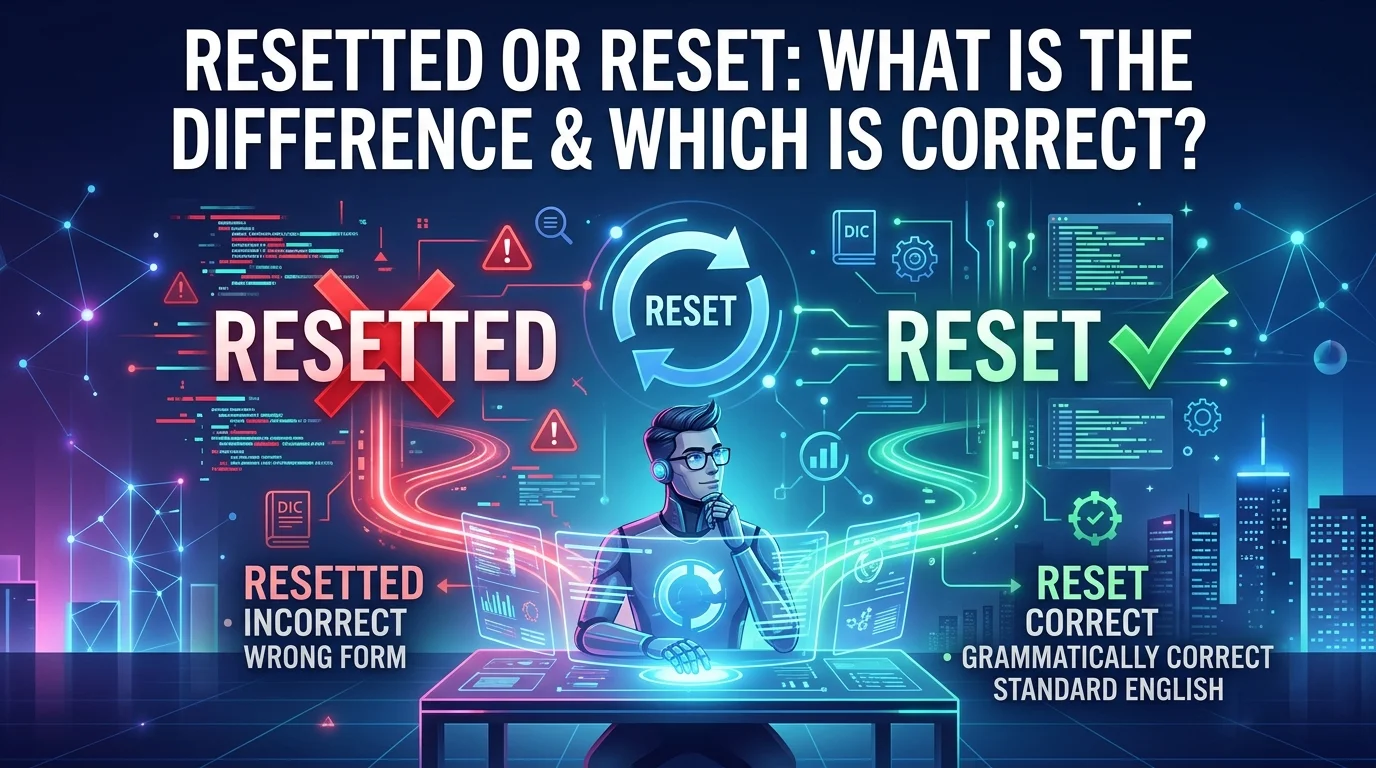

Many English learners and native speakers alike wonder whether “resetted” or “reset” is the correct past tense form. The confusion often arises because many English verbs form their past tense by adding -ed, while others remain unchanged. Understanding the difference between these two forms helps you write and speak more accurately in academic, professional, and everyday situations.
Comparison Overview
Both resetted and reset are related to the verb reset, which means to set something back to its original state, starting point, or default condition.
The key difference is that reset is the standard and widely accepted past tense and past participle form, while resetted is generally considered nonstandard and is rarely used in modern English.
| Term | Part of Speech | Standard Usage | Common Acceptance |
| Reset | Verb | Correct present, past tense, and past participle | Widely accepted |
| Resetted | Verb (nonstandard form) | Usually considered incorrect | Rarely accepted |
Definition of Resetted
Resetted is an alternative past tense form created by adding -ed to the verb reset.
Some speakers and writers use it because it follows the pattern of regular verbs such as “started” or “completed.” However, major dictionaries and style guides generally do not recognize it as the preferred form.
Meaning:
To have returned something to its original settings or condition.
Example:
- Incorrect or nonstandard: The technician resetted the system yesterday.
Definition of Reset
Reset is both the present tense and the standard past tense and past participle form of the verb.
Like verbs such as cut, put, and set, the word reset typically remains unchanged in the past tense.
Meaning:
To return something to a starting point, original condition, or default setting.
Examples:
- I reset the password.
- Yesterday, I reset the password.
- The password has been reset.
Main Differences Between Resetted and Reset
| Feature | Resetted | Reset |
| Grammar Status | Nonstandard | Standard |
| Past Tense Usage | Generally avoided | Correct |
| Past Participle Usage | Generally avoided | Correct |
| Dictionary Recognition | Limited | Widely recognized |
| Professional Writing | Not recommended | Recommended |
| Academic Writing | Not recommended | Recommended |
Key Difference in Meaning
There is no significant difference in meaning between the two forms. The distinction is almost entirely grammatical.
Key Difference in Usage
- Reset is the accepted form in modern English.
- Resetted is considered unnecessary and usually incorrect.
Why Does This Confusion Happen?
English contains both regular and irregular verbs.
Many verbs follow this pattern:
- Start → Started
- Jump → Jumped
- Walk → Walked
Because of this pattern, some people naturally assume:
- Reset → Resetted
However, reset behaves like:
- Set → Set
- Put → Put
- Cut → Cut
Therefore:
- Reset → Reset
Comparison Table: Correct Usage
| Sentence | Correct? |
| I reset the device yesterday. | Yes |
| The system has been reset. | Yes |
| She reset her account password. | Yes |
| The device was resetted yesterday. | No |
| We have resetted the settings. | No |
| The administrator resetted the server. | No |
Grammar Guide
How Each Term Is Used in Sentences
Reset
Present Tense:
- I reset the router every month.
Past Tense:
- I reset the router yesterday.
Past Participle:
- The router has been reset.
Resetted
Although occasionally seen online:
- I resetted the router yesterday.
This form is generally avoided in formal and standard English.
Common Mistakes Learners Make
Adding “-ed” Automatically
Incorrect:
- I resetted my phone.
Correct:
- I reset my phone.
Using Resetted in Professional Documents
Incorrect:
- The server was resetted by IT staff.
Correct:
- The server was reset by IT staff.
Confusing Present and Past Forms
Because the spelling stays the same, some learners think the tense is unclear.
Example:
- Today I reset the system.
- Yesterday I reset the system.
The time expression provides the context.
Simple Rules to Remember
- Think of set → set.
- Since reset contains set, it follows the same pattern.
- Use reset for present, past tense, and past participle.
- Avoid resetted in standard writing.
Quick Tips for Writing and Speaking
- Use reset in all formal situations.
- Use reset in academic work.
- Use reset in business communication.
- Use reset in technology documentation.
- Treat resetted as a nonstandard variation.
When to Use Each One
Use Reset When
- Writing professional emails.
- Creating technical documents.
- Writing academic papers.
- Speaking in formal situations.
- Communicating in business environments.
- Describing completed actions.
Examples:
- The engineer reset the machine.
- The password has been reset.
- We reset the software settings.
Use Resetted When
Generally, you should not use resetted in standard English.
You may occasionally encounter it in:
- Informal online discussions.
- User-generated content.
- Non-native English writing.
When NOT to Use Each One
Do Not Use Reset Incorrectly
Avoid assuming it is only present tense.
Incorrect assumption:
- Reset cannot describe a past action.
Correct:
- Yesterday, I reset the system.
Do Not Use Resetted
Avoid it in:
- Essays
- Reports
- Business writing
- Technical manuals
- Academic assignments
- Professional communication
Which One to Use (Decision Guide)
Ask yourself the following questions:
Are You Referring to the Verb “Reset”?
Use reset.
Is the Action in the Past?
Still use reset.
Are You Using a Past Participle?
Use reset.
Are You Writing Professionally?
Definitely use reset.
Are You Thinking About Using Resetted?
Replace it with reset.
Decision Summary:
| Situation | Correct Choice |
| Present tense | Reset |
| Past tense | Reset |
| Past participle | Reset |
| Academic writing | Reset |
| Business writing | Reset |
| Technical writing | Reset |
| Informal speech | Reset |
Real-World Practical Examples
Resetted Examples
These examples show common but generally nonstandard usage:
- The technician resetted the machine after the failure.
- She resetted her phone before selling it.
- The user resetted the application settings.
- We resetted the testing environment.
- The administrator resetted the network configuration.
Reset Examples
- The teacher reset the classroom timer.
- The company reset its annual goals.
- The scientist reset the experiment parameters.
- I reset my account password yesterday.
- The software automatically reset the configuration.
Additional examples from different contexts:
- The laptop was reset before deployment.
- The athlete reset his training schedule.
- The bank reset online access credentials.
- The game reset after the update.
- The customer reset the device using the instruction manual.
Self-Assessment (Fill in the Blanks)
- I will use ______ when referring to the correct past tense of the verb reset. The correct word is ______ because it is the standard form.
- I will use ______ when describing restoring factory settings. The correct word is ______ because it is grammatically accepted.
- I will use ______ in a business report. The correct word is ______ because professional writing requires standard English.
- I will use ______ when talking about yesterday’s system update. The correct word is ______ because it is the proper past tense.
- I will use ______ when describing a completed password change. The correct word is ______ because it functions as a past participle.
- I will use ______ in a technical manual. The correct word is ______ because it follows standard usage.
- I will use ______ after restoring software defaults. The correct word is ______ because it is accepted by dictionaries.
- I will use ______ when writing an academic essay. The correct word is ______ because formal writing prefers standard forms.
- I will use ______ when discussing a reset completed last week. The correct word is ______ because it is the correct past tense.
- I will use ______ when describing restarting a device configuration. The correct word is ______ because it is grammatically correct.
- I will use ______ in professional communication. The correct word is ______ because it is the accepted form.
- I will use ______ when writing a project report. The correct word is ______ because it is standard English.
- I will use ______ when referring to a system restored to defaults. The correct word is ______ because it serves as a past participle.
- I will use ______ when describing a completed technology task. The correct word is ______ because it is widely accepted.
- I will use ______ when discussing server maintenance. The correct word is ______ because it is the preferred form.
- I will use ______ when speaking formally. The correct word is ______ because it avoids nonstandard grammar.
- I will use ______ when editing a professional document. The correct word is ______ because it follows modern usage.
- I will use ______ when describing a completed software action. The correct word is ______ because it is grammatically correct.
- I will use ______ when referring to resetting settings yesterday. The correct word is ______ because it is the standard past tense.
- I will use ______ when choosing between resetted and reset. The correct word is ______ because it is the accepted English form.
Answers
- Reset, Reset
- Reset, Reset
- Reset, Reset
- Reset, Reset
- Reset, Reset
- Reset, Reset
- Reset, Reset
- Reset, Reset
- Reset, Reset
- Reset, Reset
- Reset, Reset
- Reset, Reset
- Reset, Reset
- Reset, Reset
- Reset, Reset
- Reset, Reset
- Reset, Reset
- Reset, Reset
- Reset, Reset
- Reset, Reset
Final Verdict
When comparing resetted and reset, the clear winner is reset. Modern English treats reset as both the present tense and the standard past tense and past participle form of the verb. While resetted occasionally appears in informal writing, it is generally considered nonstandard and should be avoided in academic, professional, business, and technical contexts. If you are unsure which form to choose, use reset every time. It is the grammatically correct, widely accepted, and safest option for all forms of communication.
Conclusion About Resetted Or Reset
Understanding the difference between resetted and reset can help you avoid one of the most common grammar mistakes involving this verb. While both forms may appear to express the same idea of returning something to its original state, standard English overwhelmingly prefers reset as the correct present tense, past tense, and past participle form. The word follows the same pattern as verbs like set and put, which do not change in the past tense.
Whether you are writing a business report, academic paper, technical document, email, or everyday message, reset is the form you should choose. Although resetted occasionally appears in informal writing, it is generally considered nonstandard and may make your writing seem less polished. By remembering this simple rule, you can communicate more confidently and accurately. When in doubt, stick with reset because it is the accepted and widely recognized form in modern English.
FAQs
Is reset the correct past tense of reset?
Yes, reset is the correct past tense of the verb reset. Standard English uses the same spelling for the present tense, past tense, and past participle. For example, “I reset the computer yesterday” is correct and commonly used in both formal and informal communication.
Is resetted a real word?
Resetted does appear occasionally in some forms of writing and speech, but it is generally considered nonstandard. Most dictionaries, style guides, and grammar experts recommend using reset instead. In professional and academic contexts, it is best to avoid resetted.
Why do people say resetted?
Many people assume that reset follows the regular verb pattern and therefore add -ed to create the past tense. Since English contains many regular verbs, this mistake is understandable. However, reset follows an irregular pattern and remains unchanged in the past tense.
Can I use resetted in formal writing?
No, using resetted in formal writing is not recommended. Business documents, academic papers, technical manuals, and professional communications should use reset. Choosing the standard form helps maintain credibility and grammatical accuracy.
Is reset both a past tense and past participle?
Yes, reset functions as both the past tense and past participle. For example, “I reset the device yesterday” uses the past tense, while “The device has been reset” uses the past participle form.
What is the difference between reset and resetted?
The main difference is grammatical acceptance. Reset is the standard and correct form used in modern English, while resetted is generally viewed as nonstandard. Both express the same meaning, but only reset is widely accepted.
Do dictionaries recognize resetted?
Some dictionaries may list resetted as a variant form, but they typically identify reset as the preferred and standard version. Most grammar resources advise writers to use reset in nearly all situations.
Is reset an irregular verb?
Yes, reset is commonly treated as an irregular verb because its past tense does not change form. Similar verbs include set, cut, and put, which also retain the same spelling in the present and past tenses.
How should I write about a device restored to factory settings?
You should use reset. For example, “The phone was reset to factory settings” is correct. This construction is widely used in technology, customer support, and technical documentation.
What is the easiest way to remember the correct form?
A simple trick is to remember the verb set. Since set stays the same in the past tense, reset follows the same pattern. If you would say “set” rather than “setted,” then you should say “reset” rather than “resetted.”
