
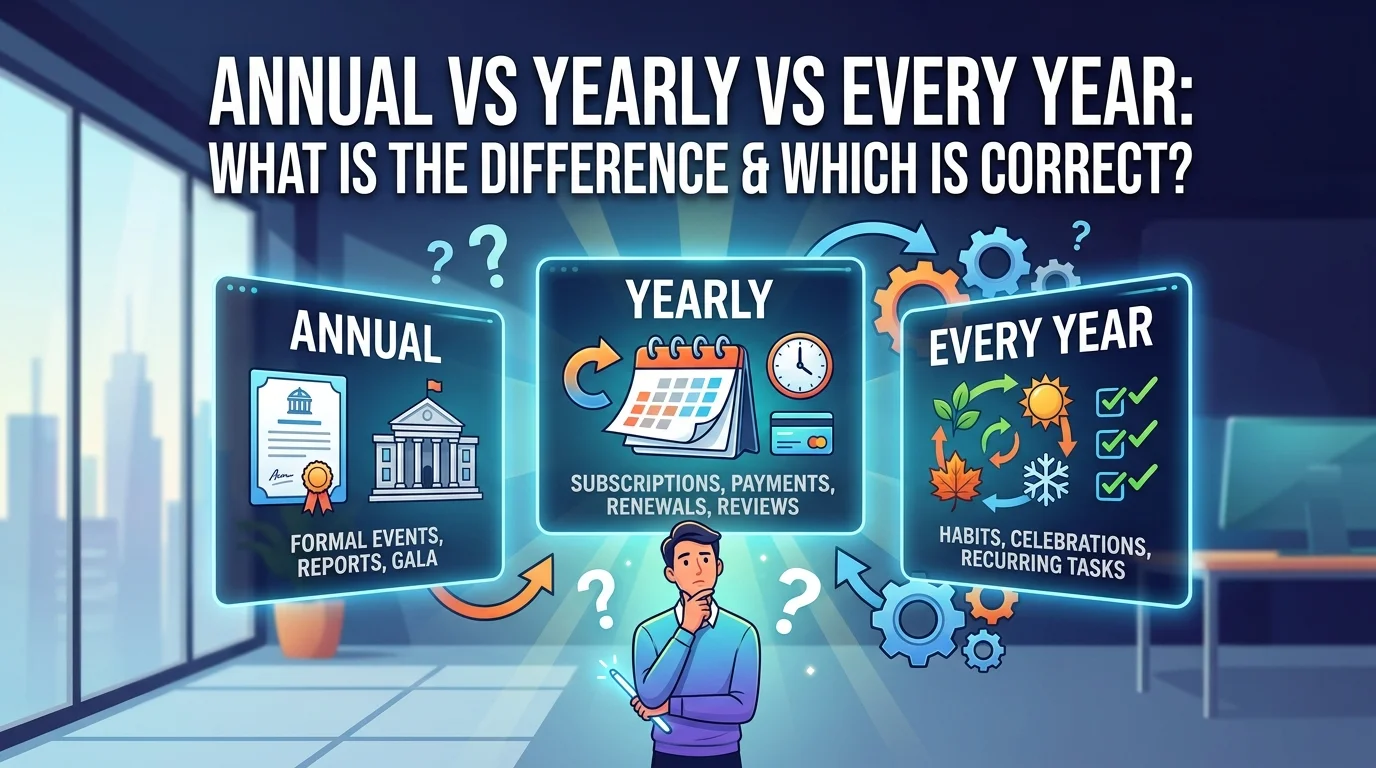

Many English learners confuse “annual,” “yearly,” and “every year” because all three relate to something happening once a year. However, they are not always used in the same way. Understanding the difference helps improve grammar, writing clarity, and natural speaking. This guide explains the meaning, usage, grammar rules, and practical examples of each term in a simple and beginner-friendly way.
Comparison Overview
“Annual,” “yearly,” and “every year” all describe events, actions, or situations that happen once within a twelve-month period. Even though they share a similar idea, they differ in tone, grammar, and sentence structure.
“Annual” is more formal and is commonly used in business, education, reports, and official writing. “Yearly” is less formal and sounds more conversational. “Every year” is a phrase often used in everyday speech and general writing to describe repeated yearly actions.
Here is a quick overview:
| Term | Type | Tone | Common Usage |
| Annual | Adjective | Formal | Reports, meetings, subscriptions |
| Yearly | Adjective/Adverb | Neutral | General descriptions |
| Every Year | Phrase | Informal/Natural | Daily conversation |
Definition of Annual
“Annual” is an adjective that means something happens once each year or lasts for one year. It is commonly used in formal or professional contexts.
Examples include annual meetings, annual reports, annual celebrations, and annual subscriptions.
The word often appears before a noun.
Examples:
- The company published its annual report.
- We attend the annual conference in July.
- The school holds an annual sports day.
“Annual” sounds polished and professional, making it common in business and academic writing.
Definition of Yearly
“Yearly” means happening once every year. It can function as both an adjective and an adverb.
As an adjective:
- We pay a yearly fee.
As an adverb:
- The event occurs yearly.
“Yearly” is less formal than “annual” but still grammatically correct in most situations. It is often used in regular conversation and casual writing.
Definition of Every Year
“Every year” is a time expression phrase used to show that something repeats once each year.
Unlike “annual” and “yearly,” this phrase does not usually come directly before a noun.
Examples:
- We travel to the mountains every year.
- She buys new books every year.
This phrase sounds natural in conversation and is very common in spoken English.
Main Differences Between Annual, Yearly, and Every Year
The main differences involve grammar structure, formality, and sentence placement.
| Feature | Annual | Yearly | Every Year |
| Word Type | Adjective | Adjective/Adverb | Phrase |
| Formality | Formal | Neutral | Informal/Natural |
| Position in Sentence | Before nouns | Flexible | Usually at end |
| Common Contexts | Business, official writing | General writing | Everyday conversation |
“Annual” usually modifies nouns directly:
- annual budget
- annual meeting
“Yearly” can describe nouns or actions:
- yearly payment
- occurs yearly
“Every year” explains frequency:
- We celebrate every year.
Another important difference is tone. “Annual” sounds professional, while “every year” sounds more conversational.
Formal vs Informal Usage
Understanding tone helps you choose the correct expression.
Formal Situations
Use “annual” in:
- Business reports
- Academic writing
- Official announcements
- Corporate communication
Examples:
- annual revenue
- annual performance review
Neutral Situations
Use “yearly” when:
- Writing casually
- Describing repeated activities
- Giving general information
Examples:
- yearly checkup
- yearly membership
Everyday Conversation
Use “every year” in:
- Speaking
- Storytelling
- Friendly writing
- Casual discussions
Examples:
- We visit our grandparents every year.
- The festival happens every year.
Comparison Table
| Situation | Best Choice |
| Business report | Annual |
| Friendly conversation | Every year |
| General description | Yearly |
| Official event | Annual |
| Talking naturally | Every year |
| Repeated fee/payment | Yearly |
Grammar Guide
How Each Term Is Used in Sentences
Annual
“Annual” is mainly used as an adjective before nouns.
Pattern:
- annual + noun
Examples:
- annual conference
- annual income
- annual celebration
Yearly
“Yearly” works as both an adjective and adverb.
Patterns:
- yearly + noun
- verb + yearly
Examples:
- yearly budget
- The competition is held yearly.
Every Year
“Every year” functions as a time phrase.
Pattern:
- action + every year
Examples:
- We meet every year.
- He travels abroad every year.
Common Mistakes Learners Make
Many learners incorrectly replace one term with another without considering grammar or tone.
Incorrect:
- We had every year meeting.
Correct:
- We had an annual meeting.
Incorrect:
- The company releases every year reports.
Correct:
- The company releases annual reports.
Another common mistake is overusing “annual” in casual speech where “every year” sounds more natural.
Too formal:
- I visit my cousins annually.
More natural:
- I visit my cousins every year.
Simple Rules to Remember
- Use “annual” before nouns in formal contexts.
- Use “yearly” for flexible casual or neutral usage.
- Use “every year” when describing repeated actions naturally.
- “Annual” sounds professional.
- “Every year” sounds conversational.
Quick Tips for Writing and Speaking
- Choose “annual” for reports, business, and academic writing.
- Choose “yearly” when you want flexibility.
- Choose “every year” for natural conversation.
- Avoid placing “every year” directly before nouns.
- Use “annual” when writing titles or official documents.
When to Use Each One
Use “Annual” When:
- Writing formally
- Naming official events
- Discussing business topics
- Referring to scheduled yearly programs
Examples:
- annual budget
- annual conference
Use “Yearly” When:
- Writing casually
- Describing recurring activities
- Talking about payments or subscriptions
Examples:
- yearly review
- yearly salary increase
Use “Every Year” When:
- Speaking casually
- Explaining repeated actions
- Telling stories or experiences
Examples:
- We celebrate together every year.
- Flowers bloom every year.
When NOT to Use Each One
Avoid “Annual” When:
- Speaking casually with friends
- Writing informal dialogue
- You want a relaxed tone
Avoid “Yearly” When:
- Formal business wording is needed
- Official titles are required
Avoid “Every Year” When:
- A noun needs direct modification
- Formal document language is expected
Incorrect:
- every year report
Correct:
- annual report
Which One to Use (Decision Guide)
Ask yourself these questions:
Is the context formal?
Use “annual.”
Are you describing a repeated action casually?
Use “every year.”
Do you want a neutral middle option?
Use “yearly.”
Are you modifying a noun directly?
Use “annual” or “yearly.”
Are you describing when something happens?
Use “every year.”
Quick decision chart:
| Need | Correct Choice |
| Formal writing | Annual |
| Casual speech | Every year |
| Flexible everyday writing | Yearly |
| Official event title | Annual |
| Natural storytelling | Every year |
Real-World Practical Examples
Annual Examples
- The company released its annual financial report.
- Our school hosts an annual science fair.
- The museum organizes an annual art exhibition.
- She completed her annual medical checkup.
- The annual conference attracted thousands of visitors.
Yearly Examples
- We pay a yearly membership fee.
- The town experiences yearly flooding.
- Employees receive yearly evaluations.
- The software requires yearly renewal.
- The family takes a yearly vacation.
Every Year Examples
- We decorate the house every year for the festival.
- Birds migrate south every year.
- My grandparents visit us every year.
- Farmers plant crops every year.
- Students participate in competitions every year.
Self-Assessment (Fill in the Blanks)
- The company publishes an ______ report.
- We travel to the beach ______.
- She pays a ______ subscription fee.
- The school hosts an ______ function.
- My family gathers together ______.
- The hospital performs ______ health reviews.
- He renews his license ______.
- The organization conducts an ______ audit.
- We celebrate this tradition ______.
- They hold a ______ business meeting.
- The software requires a ______ payment.
- Birds return here ______.
- The club arranges an ______ dinner.
- We clean the park ______.
- Employees receive ______ bonuses.
- The company plans an ______ seminar.
- My cousins visit us ______.
- We complete a ______ performance review.
- The event happens ______.
- The university publishes an ______ magazine.
Answers
- annual
- every year
- yearly
- annual
- every year
- annual
- yearly
- annual
- every year
- annual
- yearly
- every year
- annual
- every year
- yearly
- annual
- every year
- annual
- yearly
- annual
Final Verdict
“Annual,” “yearly,” and “every year” all describe something happening once within a year, but they are used differently depending on grammar and context. “Annual” is best for formal and professional writing, especially before nouns like reports, meetings, or events. “Yearly” is more flexible and works well in both writing and speech. “Every year” sounds the most natural in conversation and is ideal for describing repeated actions.
Choosing the correct term depends on sentence structure and tone. If you need a formal adjective, use “annual.” If you want a neutral alternative, use “yearly.” If you are speaking casually or describing frequency naturally, use “every year.” Understanding these differences will make your English clearer, more accurate, and more natural in both writing and speaking.
Conclusion About Annual Vs Yearly Vs Every Year
Understanding the difference between “Annual,” “yearly,” and “every year” can make your English sound more natural, accurate, and confident. While all three expressions refer to something happening once within a year, each one fits different situations and writing styles. “Annual” works best in formal and professional communication, “yearly” offers a flexible and neutral choice, and “every year” feels the most conversational and easygoing. Knowing when to use each term helps improve grammar, sentence flow, and clarity in both speaking and writing. Whether you are writing reports, having conversations, creating content, or learning English as a beginner, choosing the correct expression can make a big difference. By practicing these terms in real sentences and understanding their unique roles, you will be able to communicate more clearly and avoid common mistakes with confidence.
FAQs
Is annual the same as yearly?
Yes, both “annual” and “yearly” generally mean something happens once every year. However, “annual” sounds more formal and is often used in business or official writing, while “yearly” is more neutral and conversational.
Which is more formal, annual or yearly?
“Annual” is considered more formal than “yearly.” It is commonly used in professional documents, company reports, official events, and academic writing where a polished tone is preferred.
Can I use every year instead of annual?
You can use “every year” in many situations, especially in casual speech. However, it does not work well before nouns. For example, “annual meeting” is correct, while “every year meeting” is incorrect.
Is yearly grammatically correct?
Yes, “yearly” is completely grammatically correct. It can function as both an adjective and an adverb depending on the sentence structure and context.
Why do companies use the word annual?
Companies prefer “annual” because it sounds formal, professional, and concise. It is commonly used for reports, budgets, reviews, and meetings that happen once a year.
Can annual and yearly be used interchangeably?
In many cases, yes. Both words share a very similar meaning. However, tone and context matter because “annual” sounds more official, while “yearly” feels more casual and flexible.
Is every year more natural in conversation?
Yes, “every year” sounds very natural in everyday speech. Native speakers often use it when discussing routines, traditions, vacations, or repeated yearly activities.
What part of speech is annual?
“Annual” is mainly used as an adjective. It describes nouns that occur once each year, such as annual event, annual report, or annual festival.
Should I use annual in academic writing?
Yes, “annual” is a strong choice for academic and formal writing because it sounds professional and fits structured communication styles better than casual alternatives.
What is the easiest way to remember the difference?
A simple rule is this: use “annual” for formal nouns, “yearly” for flexible everyday writing, and “every year” for natural conversations about repeated actions.
