
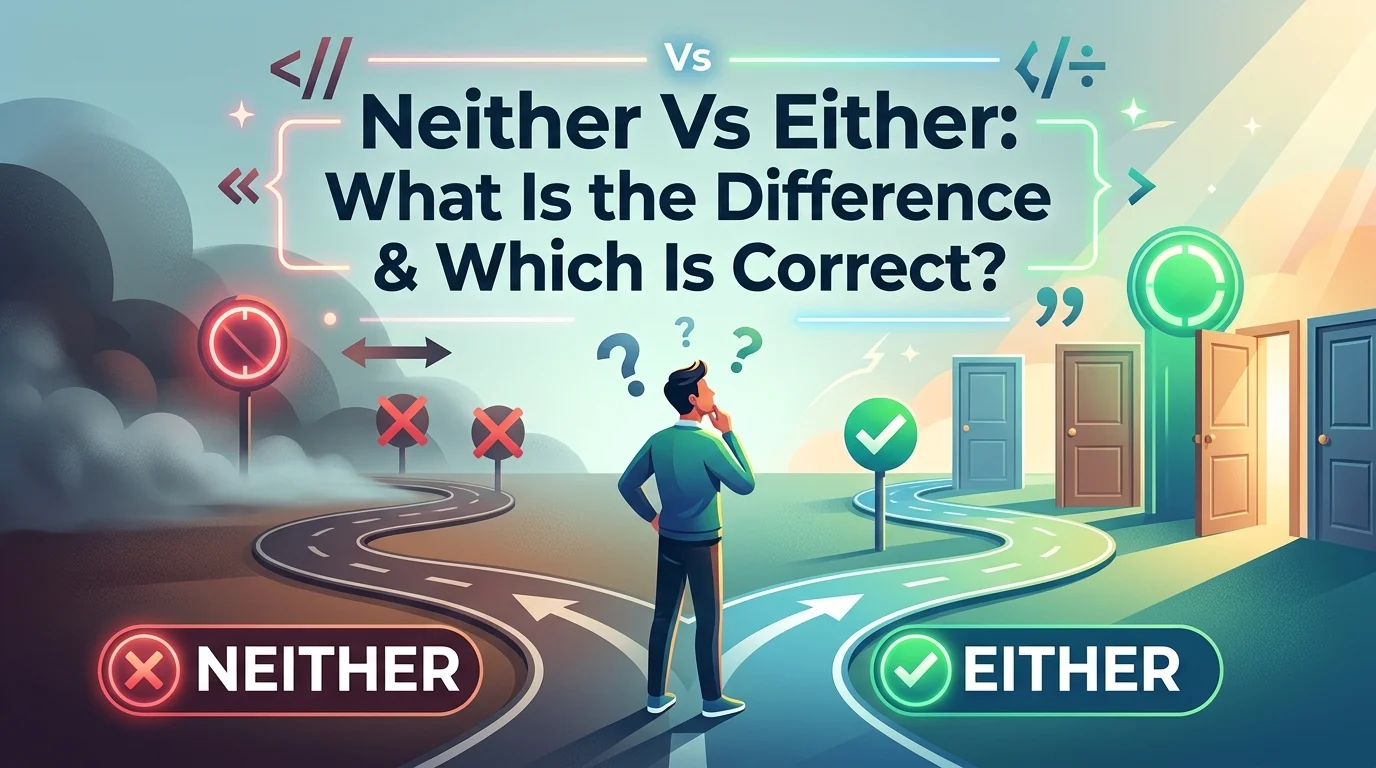

“Neither” and “either” are common English words that often confuse learners because they are closely related in meaning and grammar. Both are used when talking about two choices, options, or possibilities, but they are not interchangeable. Understanding the difference between neither and either helps improve grammar, writing clarity, and everyday communication.
Comparison Overview
“Neither” and “either” are both determiners, pronouns, conjunctions, and adverbs in English grammar. They are mainly used when discussing two people, things, or options.
“Either” usually refers to one of two choices, while “neither” means not one and not the other. These words appear frequently in conversations, academic writing, business communication, and formal English.
| Feature | Either | Neither |
| Main Meaning | One or the other | Not one and not the other |
| Number | Refers to two options | Refers to two options |
| Tone | Positive/neutral | Negative |
| Common Pair | Either…or | Neither…nor |
| Verb Agreement | Usually singular | Usually singular |
Definition of Neither
“Neither” means not one and not the other of two people, objects, ideas, or choices. It creates a negative meaning in a sentence.
It is commonly used when rejecting both options.
Examples:
- Neither answer is correct.
- Neither student attended the class.
- I like neither movie.
“Neither” often appears with “nor” in paired conjunctions.
Example:
- Neither Sarah nor Ali was available.
Definition of Either
“Either” means one or the other of two choices. It is used when both options are possible, acceptable, or available.
Examples:
- You can choose either dress.
- Either road will take you there.
- I don’t like either option.
“Either” commonly appears with “or” in paired conjunctions.
Example:
- Either Ahmed or Bilal will lead the project.
Main Differences Between Neither and Either
The biggest difference between “neither” and “either” is their meaning.
“Either” is generally positive or neutral because it refers to one possible choice out of two. “Neither” is negative because it rejects both choices.
| Aspect | Either | Neither |
| Meaning | One of two | None of the two |
| Sentence Tone | Positive or neutral | Negative |
| Paired With | Or | Nor |
| Example | Either book is useful. | Neither book is useful. |
| Usage Type | Choice | Rejection |
Another important difference is sentence structure.
Examples:
- Either tea or coffee is fine.
- Neither tea nor coffee is available.
In negative sentences, “either” can also mean “also not.”
Example:
- I don’t like it either.
Positive vs Negative Meaning
Understanding positivity and negativity is essential when using these words correctly.
Either in Positive Contexts
“Either” is used when at least one option works.
Examples:
- Either plan will solve the issue.
- You may sit in either seat.
Neither in Negative Contexts
“Neither” means both options are rejected.
Examples:
- Neither explanation was convincing.
- Neither player scored a goal.
Common Sentence Structures
Here are the most common grammar patterns.
| Structure | Example |
| Either + singular noun | Either answer is acceptable. |
| Neither + singular noun | Neither answer is correct. |
| Either…or | Either Tom or Jack is coming. |
| Neither…nor | Neither Tom nor Jack is coming. |
Grammar Guide
Understanding grammar rules for “neither” and “either” makes writing more accurate and natural.
How Each Term Is Used in Sentences
Using “Either”
Pattern examples:
- Either + singular noun
- Either…or
- Negative sentence + either
Examples:
- Either option works.
- Either Sana or Hina will help.
- I don’t want pizza either.
Using “Neither”
Pattern examples:
- Neither + singular noun
- Neither…nor
Examples:
- Neither idea is practical.
- Neither Ali nor Omar agreed.
Common Mistakes Learners Make
Many learners mix up these terms because they both refer to two options.
Common mistakes:
- Incorrect: Neither of the answers are correct.
- Correct: Neither of the answers is correct.
- Incorrect: Either Ahmed nor Usman came.
- Correct: Neither Ahmed nor Usman came.
- Incorrect: I don’t like neither option.
- Correct: I like neither option.
Double negatives are especially common mistakes with “neither.”
Simple Rules to Remember
- Use “either” when choosing one of two options.
- Use “neither” when rejecting both options.
- Use “either…or” together.
- Use “neither…nor” together.
- Avoid double negatives with “neither.”
Quick Tips for Writing and Speaking
- Think of “either” as a choice word.
- Think of “neither” as a negative word.
- Use singular verbs in most cases.
- Keep sentence structures parallel.
- Avoid mixing “either” with “nor.”
Examples:
- Correct: Either Anna or Sara is coming.
- Correct: Neither Anna nor Sara is coming.
When to Use Each One
Use “either” when:
- One of two options is possible
- Both choices are acceptable
- Giving alternatives
- Discussing flexible decisions
Examples:
- Either route is safe.
- You can choose either laptop.
Use “neither” when:
- Both choices are rejected
- Nothing from two options is acceptable
- Creating negative meaning
Examples:
- Neither explanation helped.
- Neither player performed well.
When NOT to Use Each One
Do not use “either”:
- When rejecting both choices
- With “nor”
- In double-negative structures
Incorrect:
- Either Ali nor Ahmed arrived.
Do not use “neither”:
- With another negative word
- When only one option is rejected
- With “or”
Incorrect:
- Neither Ali or Ahmed arrived.
Correct:
- Neither Ali nor Ahmed arrived.
Which One to Use (Decision Guide)
Use this simple guide:
| Situation | Correct Word |
| One of two choices | Either |
| Both choices rejected | Neither |
| Offering alternatives | Either |
| Showing negative meaning | Neither |
| Pairing with “or” | Either |
| Pairing with “nor” | Neither |
Ask yourself:
- Am I selecting one option? → Use “either.”
- Am I rejecting both options? → Use “neither.”
Real-World Practical Examples
Neither Examples
- Neither employee completed the report on time.
- Neither restaurant serves vegetarian food.
- Neither computer could connect to the network.
- Neither scientist supported the theory.
- Neither of the students understood the assignment.
Either Examples
- Either candidate can manage the project successfully.
- You may use either password to log in.
- Either solution will improve performance.
- Either bus goes to the airport.
- Either manager can approve the request.
Everyday Conversation Examples
Neither in Conversations
- Neither of us wants to leave early.
- Neither movie looked interesting.
- Neither answer sounds correct.
Either in Conversations
- Either choice is fine with me.
- You can call me either tonight or tomorrow.
- Either restaurant sounds good.
Academic and Professional Usage
Using Neither in Formal Writing
- Neither experiment produced reliable results.
- Neither proposal met company standards.
Using Either in Formal Writing
- Either method can be applied effectively.
- Either department may handle customer complaints.
Self-Assessment (Fill in the Blanks)
- You can choose ______ shirt for the interview.
- ______ answer was completely correct.
- I do not want coffee, and my friend does not want it ______.
- ______ Sara or Maria will present the report.
- ______ Sara nor Maria attended the meeting.
- The manager accepted ______ proposal.
- The teacher liked ______ essay.
- We can travel on ______ Friday or Saturday.
- ______ road leads to the city center.
- ______ solution solved the problem.
- I don’t like spicy food, and my brother doesn’t ______.
- ______ player scored during the match.
- You may invite ______ Ahmed or Bilal.
- ______ explanation was convincing.
- The company can use ______ strategy successfully.
- ______ laptop worked properly.
- You can sit in ______ seat.
- ______ team qualified for the final.
- ______ teacher nor student noticed the error.
- I did not watch the film, and my sister did not watch it ______.
Answers
- Either
- Neither
- Either
- Either
- Neither
- Either
- Neither
- Either
- Either
- Neither
- Either
- Neither
- Either
- Neither
- Either
- Neither
- Either
- Neither
- Neither
- Either
Final Verdict
“Neither” and “either” are essential English grammar words used when talking about two choices. “Either” refers to one of two options and is commonly used for alternatives or possibilities. “Neither” rejects both options and creates a negative meaning. Learning their differences helps improve sentence accuracy, grammar confidence, and communication skills.
A simple way to remember them is this: use “either” when one option works, and use “neither” when both options do not work. Also remember the common pairings: “either…or” and “neither…nor.” Once you practice these patterns regularly, choosing the correct word becomes much easier in speaking and writing.
Conclusion About Neither Vs Either
Understanding the difference between “neither” and “either” is an important step toward mastering everyday English grammar. While these two words are closely connected, they serve very different purposes in communication. “Either” helps you talk about one possible choice out of two, while “neither” clearly rejects both options. Learning when and how to use them correctly can improve your writing, speaking, and overall confidence in English.
These terms appear in conversations, emails, academic work, business communication, and even casual texting, which makes them essential for learners of all levels. By remembering simple patterns like “either…or” and “neither…nor,” you can avoid common grammar mistakes and sound more natural in both formal and informal situations. With regular practice and exposure to real examples, using neither and either correctly will quickly become second nature.
FAQs
What is the main difference between neither and either?
“Either” refers to one of two choices, while “neither” means not one and not the other. In simple terms, “either” is used when at least one option works, and “neither” is used when both options are rejected. They are commonly used in grammar, conversation, and writing when discussing two possibilities.
Can neither and either be used in the same sentence?
Yes, they can appear in the same sentence if the meaning requires both choice and rejection. For example, “Either student could answer the question, but neither did.” The sentence first presents two possible options and then explains that both failed to act. Proper sentence structure is important for clarity.
Is neither always negative in meaning?
Yes, “neither” creates a negative meaning because it rejects both choices or options. It already carries a negative idea, so it should not usually be combined with another negative word in the same sentence. This helps avoid double negatives, which are common grammar mistakes among English learners.
Do either and neither use singular or plural verbs?
They usually take singular verbs because they refer to one option at a time within a pair. For example, “Neither answer is correct” and “Either solution works” are both grammatically correct. However, in informal spoken English, plural verbs are sometimes heard, especially in longer sentence structures.
What does either mean in negative sentences?
In negative sentences, “either” often means “also” or “too” in a negative sense. For example, “I don’t like the movie either” means the speaker also dislikes it. This usage is very common in casual conversation and helps avoid repeating negative sentence structures unnecessarily.
What is the correct pair: either or nor?
The correct grammatical pair is “either…or.” These words work together to present two alternatives or choices. For example, “Either tea or coffee is available.” Using “either” with “nor” is incorrect because the two words belong to different grammatical pairings in English.
What is the correct pair: neither or nor?
The correct grammatical pair is “neither…nor.” This structure is used to reject two options together. For example, “Neither Ahmed nor Ali attended the meeting.” Using “neither” with “or” is generally considered incorrect in standard English grammar and formal writing.
Can either and neither be used as pronouns?
Yes, both words can function as pronouns. For example, “Either is acceptable” and “Neither was available” are correct sentences. In these cases, the words replace nouns instead of describing them. This makes them useful in both short responses and more formal sentence constructions.
Why do learners confuse neither and either?
Learners often confuse these terms because both relate to two choices and appear in similar sentence structures. The biggest challenge is understanding that “either” presents possibilities, while “neither” removes both possibilities. Confusion also happens when learners mix up the pairings “either…or” and “neither…nor.”
How can I remember the difference between neither and either?
A simple way to remember them is to connect “either” with choice and “neither” with rejection. If one option is possible, use “either.” If both options are not possible, use “neither.” Practicing common sentence patterns and reading real examples regularly can make the distinction easier to remember naturally.
