
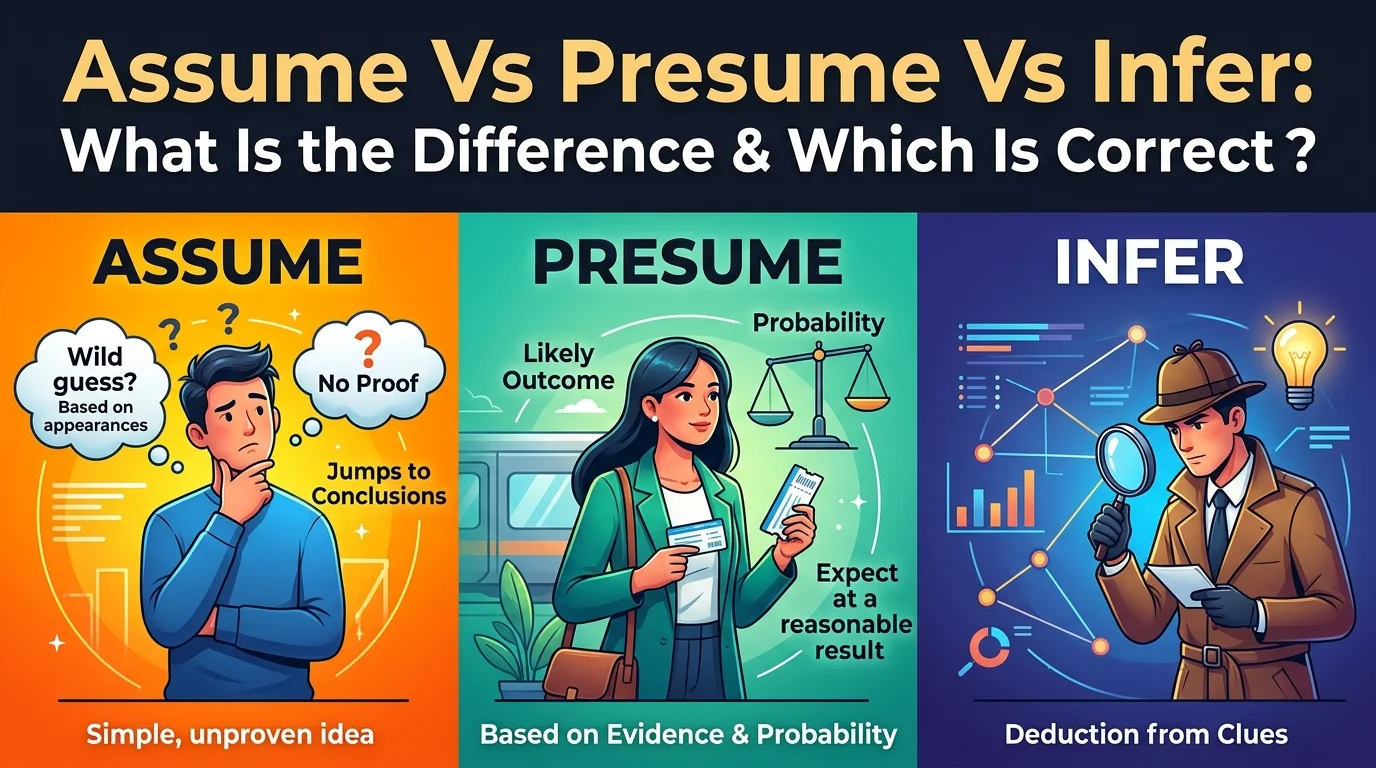

Many English learners confuse “assume,” “presume,” and “infer” because all three relate to forming ideas without complete proof. However, these words are not interchangeable in every situation. Understanding the difference helps improve grammar, writing clarity, academic communication, and everyday conversations. This guide explains the meanings, grammar rules, usage patterns, and practical examples of each term in a simple and beginner-friendly way.
Comparison Overview
“Assume,” “presume,” and “infer” are verbs connected to thinking, reasoning, or reaching conclusions.
“Assume” means to accept something as true without proof.
“Presume” means to believe something is likely true based on probability, evidence, or social expectation.
“Infer” means to reach a conclusion using evidence, clues, or reasoning.
Although these words are related, they are used in different contexts and carry different levels of certainty.
| Word | Basic Meaning | Based On | Level of Confidence |
| Assume | Accept something as true | Little or no evidence | Low |
| Presume | Believe something is probably true | Some evidence or expectation | Medium |
| Infer | Reach a conclusion | Clear evidence or clues | Higher |
Definition of Assume
“Assume” means to think something is true without having real proof or complete information.
People often use “assume” when making guesses, predictions, or expectations.
Core Meaning
To accept an idea as true without checking facts.
Purpose
“Assume” is commonly used in casual conversations, mathematics, science, and logical discussions.
Example Sentences
- I assumed the meeting was canceled.
- Don’t assume everyone agrees with you.
- Scientists sometimes assume ideal conditions in experiments.
Definition of Presume
“Presume” means to believe something is probably true because there is some reason, evidence, or expectation supporting it.
It sounds slightly more formal than “assume.”
Core Meaning
To suppose something is true with some logical basis.
Purpose
“Presume” is often used in formal writing, law, polite communication, and professional settings.
Example Sentences
- I presume you received my email.
- The court presumes a person innocent until proven guilty.
- We presumed the train would arrive on time.
Definition of Infer
“Infer” means to reach a conclusion after examining evidence, clues, facts, or hints.
Unlike “assume” and “presume,” “infer” involves reasoning.
Core Meaning
To conclude something from available evidence.
Purpose
“Infer” is commonly used in reading comprehension, science, analysis, research, and discussions.
Example Sentences
- From his tone, I inferred he was upset.
- Scientists inferred the climate changed over time.
- Readers can infer the character’s emotions from the story.
Main Differences Between Assume, Presume, and Infer
The biggest difference is how much evidence exists before reaching a conclusion.
“Assume” requires little or no evidence.
“Presume” uses some reasonable expectation or probability.
“Infer” depends on clues, facts, or logical reasoning.
| Feature | Assume | Presume | Infer |
| Evidence Needed | None or very little | Some evidence | Strong clues or evidence |
| Style | Neutral/common | More formal | Analytical |
| Purpose | Guessing | Reasonable expectation | Logical conclusion |
| Common Contexts | Daily speech | Formal speech, law | Reading, analysis |
| Confidence Level | Low | Medium | Higher |
Simple Difference in One Situation
- Assume: “I assume he is busy.”
- Presume: “I presume he is busy because he hasn’t replied.”
- Infer: “I infer he is busy from his missed calls and emails.”
Understanding the Level of Certainty
These three words also differ in certainty.
Assume
A quick belief without checking facts.
Presume
A belief supported by probability or normal expectation.
Infer
A conclusion reached through observation or evidence.
Comparison Table for Quick Understanding
| Situation | Correct Word | Why |
| Guessing without facts | Assume | No evidence |
| Expecting based on normal behavior | Presume | Some logical basis |
| Drawing a conclusion from clues | Infer | Evidence exists |
| Reading between the lines | Infer | Interpretation |
| Casual prediction | Assume | Informal guess |
| Formal expectation | Presume | More formal tone |
Grammar Guide
Understanding grammar usage helps avoid confusion between these terms.
How Each Term Is Used in Sentences
Assume
Pattern:
Subject + assume + clause/noun
Examples:
- I assume she knows the answer.
- They assumed the road was safe.
Presume
Pattern:
Subject + presume + clause/noun
Examples:
- We presume the report is accurate.
- I presumed you were busy.
Infer
Pattern:
Subject + infer + clause/noun
Examples:
- She inferred that he was unhappy.
- We inferred the results from the data.
Common Mistakes Learners Make
Using “infer” instead of “imply”
Incorrect:
- He inferred that he was angry.
Correct:
- He implied that he was angry.
- I inferred that he was angry.
Using “assume” when evidence exists
Incorrect:
- Scientists assumed the conclusion from data.
Correct:
- Scientists inferred the conclusion from data.
Confusing “presume” and “assume”
Many learners use them interchangeably, but “presume” usually suggests some supporting reason.
Simple Rules to Remember
- Assume = guess without proof
- Presume = expect with some reason
- Infer = conclude from evidence
Quick Tips for Writing and Speaking
- Use “assume” in casual conversation.
- Use “presume” in formal or polite situations.
- Use “infer” when discussing evidence or analysis.
- Avoid using “infer” when you mean “suggest” or “imply.”
- In academic writing, “infer” is usually more accurate than “assume.”
When to Use Each One
When to Use “Assume”
Use “assume” when:
- You are making a quick guess.
- No evidence is available.
- The statement is informal.
Examples:
- I assumed you were asleep.
- Don’t assume the answer.
When to Use “Presume”
Use “presume” when:
- There is some reasonable expectation.
- The tone is formal.
- Social rules or probability support the idea.
Examples:
- I presume you understand the instructions.
- The law presumes innocence.
When to Use “Infer”
Use “infer” when:
- You analyze clues or evidence.
- You reach a logical conclusion.
- You interpret information.
Examples:
- We inferred the meaning from the context.
- Detectives inferred the suspect’s location.
When NOT to Use Each One
Do Not Use “Assume”
- When strong evidence exists.
- In analytical conclusions.
Incorrect:
- Scientists assumed the findings from data.
Do Not Use “Presume”
- For completely unsupported guesses.
- In very casual speech where “assume” sounds more natural.
Incorrect:
- I presume aliens stole my keys.
Do Not Use “Infer”
- When expressing random guesses.
- When you actually mean “imply.”
Incorrect:
- She inferred that she wanted help.
Which One to Use (Decision Guide)
Use this simple guide to choose the correct word.
| If You Want To… | Use |
| Make a simple guess | Assume |
| Express a likely belief | Presume |
| Reach a conclusion from evidence | Infer |
Easy Memory Trick
- Assume = without proof
- Presume = probably true
- Infer = evidence-based conclusion
Real-World Practical Examples
Assume Examples
- I assumed the store was closed because the lights were off.
- Teachers should not assume every student learns the same way.
- The software assumed the user entered correct data.
- We assumed traffic would be light on Sunday morning.
- She assumed her friend already knew the news.
Presume Examples
- I presume you have completed the assignment.
- Doctors presumed the patient would recover quickly.
- We presumed the event would continue despite the rain.
- The company presumed demand would increase next year.
- The judge presumed the witness was telling the truth.
Infer Examples
- Scientists inferred the age of the fossils from rock layers.
- Readers can infer the story’s message from the ending.
- Detectives inferred the suspect entered through the window.
- From his silence, I inferred disappointment.
- Analysts inferred market trends from customer behavior.
Self-Assessment (Fill in the Blanks)
- I will use ______ when making a guess without evidence.
- The correct word is ______ because the conclusion comes from clues.
- We ______ the train would arrive on time.
- Readers can ______ the character’s emotions from the dialogue.
- I ______ you already knew about the meeting.
- Scientists ______ the result from collected data.
- Never ______ someone’s intentions without asking.
- The law may ______ innocence until guilt is proven.
- She ______ he was tired because he kept yawning.
- I ______ the package was delivered yesterday.
- Detectives ______ the suspect’s location from evidence.
- Teachers should not ______ every student understands immediately.
- We ______ you received our message.
- From the dark clouds, they ______ it would rain soon.
- The manager ______ sales would improve next quarter.
- Students often ______ meaning from context clues.
- Do not ______ facts without verification.
- The audience ______ the actor was nervous from his voice.
- The scientist did not ______ randomly but studied evidence carefully.
- I ______ you would join us because you confirmed earlier.
Answers
- assume
- infer
- presumed
- infer
- assumed
- inferred
- assume
- presume
- inferred
- assumed
- inferred
- assume
- presume
- inferred
- presumed
- infer
- assume
- inferred
- assume
- presumed
Final Verdict
“Assume,” “presume,” and “infer” are closely related words, but they are used differently based on evidence and certainty. “Assume” is best for unsupported guesses, “presume” works for reasonable expectations, and “infer” is used when conclusions come from evidence or clues. Choosing the correct word improves grammar, communication, academic writing, and professional English. If you remember that assumptions lack proof, presumptions have some basis, and inferences rely on evidence, you can confidently use all three words correctly in speaking and writing.
Conclusion About Assume Vs Presume Vs Infer
Understanding the difference between “assume,” “presume,” and “infer” can make your English clearer, more accurate, and more professional. While these words may seem similar, each one carries a different level of certainty and reasoning. “Assume” is commonly used for guesses without proof, “presume” suggests a belief based on probability or expectation, and “infer” involves drawing conclusions from evidence or clues. Knowing when to use each term helps improve academic writing, business communication, reading comprehension, and everyday conversations. Many learners confuse these words because they all relate to thinking and understanding, but mastering their differences builds stronger grammar skills and more confident communication. By remembering the simple rules and examples shared in this guide, you can avoid common mistakes and choose the correct word naturally in both speaking and writing.
FAQs
What is the main difference between assume and presume?
“Assume” usually means accepting something as true without evidence, while “presume” suggests there is at least some reason or probability behind the belief. “Presume” often sounds more formal and confident than “assume.” Both involve belief, but the level of supporting information is different.
Is infer the same as assume?
No, “infer” and “assume” are different. “Infer” means reaching a conclusion based on evidence, clues, or reasoning, while “assume” means guessing without proof. If facts or observations help form the conclusion, “infer” is usually the correct word to use.
Can assume and presume be used interchangeably?
Sometimes they can be used interchangeably in casual conversation, but they are not always identical. “Presume” often implies some logical basis or expectation, while “assume” may be a simple guess. Formal writing usually distinguishes between the two more carefully.
Why is infer commonly used in reading comprehension?
“Infer” is important in reading comprehension because readers often need to understand hidden meanings, emotions, or ideas using context clues. Instead of directly stating information, writers may suggest it indirectly, and readers infer the meaning through analysis and reasoning.
Which word is more formal: assume or presume?
“Presume” is generally considered more formal than “assume.” It is commonly used in legal, professional, and academic settings. “Assume” is more common in everyday speech and informal writing because it sounds simpler and more conversational.
Can you infer without evidence?
No, inference normally requires some type of evidence, clue, observation, or logical reasoning. Without evidence, the statement becomes an assumption rather than an inference. The strength of an inference depends on how reliable the supporting information is.
Is presume used in law?
Yes, “presume” is frequently used in legal language. One common example is the phrase “presumed innocent until proven guilty.” In law, “presume” often refers to accepting something as true unless evidence proves otherwise.
What are common mistakes with assume, presume, and infer?
A common mistake is using “infer” instead of “imply.” Another error is using “assume” when evidence actually exists, where “infer” would be more accurate. Learners also confuse “assume” and “presume” because both involve believing something to be true.
How can I remember the difference easily?
A simple memory trick is this: assume means guessing, presume means probably true, and infer means concluding from evidence. Remembering the level of proof involved makes it much easier to choose the correct word in writing and speaking.
Which word should I use in academic writing?
In academic writing, “infer” is often preferred when discussing conclusions based on evidence or analysis. “Presume” may appear in formal arguments or legal discussions, while “assume” is commonly used when explaining starting conditions, theories, or hypothetical situations.
