
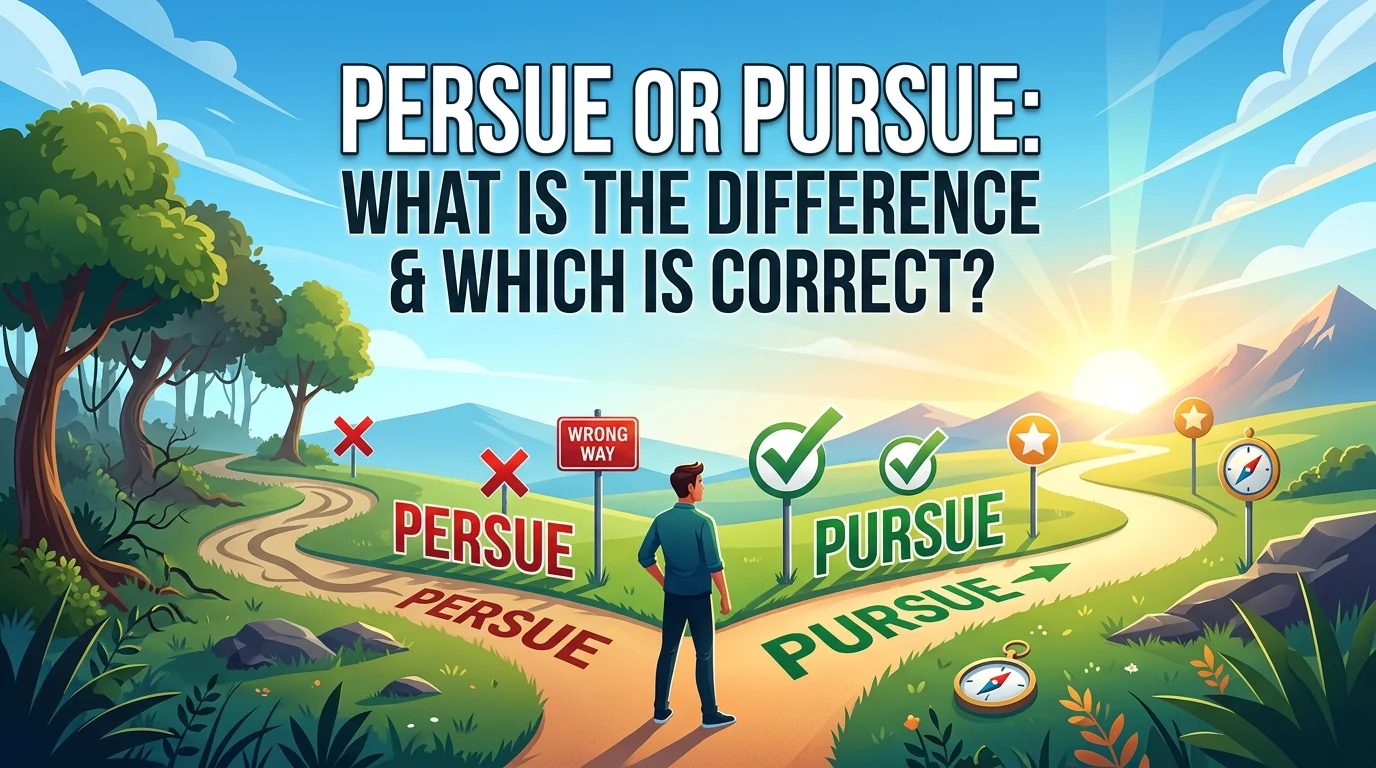

Many English learners confuse “persue” and “pursue” because the two words look very similar. However, only one of them is correct in standard English. Understanding the difference is important for writing, speaking, academic work, and professional communication. This guide explains the meaning, grammar, usage, and common mistakes related to these terms in a simple and beginner-friendly way.
Comparison Overview
“Persue” and “pursue” are often compared because they appear almost identical in spelling. The confusion usually happens because English spelling can be tricky. In reality, “pursue” is the correct English word, while “persue” is considered a misspelling.
The word “pursue” is commonly used when talking about following goals, chasing dreams, continuing activities, or trying to achieve something. “Persue” has no accepted meaning in modern English dictionaries.
| Term | Correct or Incorrect | Meaning |
| Persue | Incorrect | Misspelling of “pursue” |
| Pursue | Correct | To follow, continue, or try to achieve something |
Definition of Persue
“Persue” is not a correct English word. It is a spelling mistake that people sometimes make when they intend to write “pursue.”
This error commonly appears because writers confuse the placement of vowels in the word. Although it may occasionally appear online or in informal writing, it is not accepted in formal English grammar or dictionaries.
Key Point About “Persue”
- Incorrect spelling
- Not recognized as standard English
- Should be replaced with “pursue”
Definition of Pursue
“Pursue” is a correct English verb. It means to follow something, continue an activity, work toward a goal, or chase after someone or something.
People use “pursue” in education, careers, business, relationships, sports, and many other contexts.
Common Meanings of “Pursue”
- To chase or follow
- To continue doing something
- To work toward achieving a goal
- To seek or obtain something
Example Sentences
- She wants to pursue a medical career.
- The police pursued the suspect.
- He decided to pursue higher education.
- They pursued their dreams despite difficulties.
Main Differences Between Persue and Pursue
The biggest difference is that “pursue” is the correct spelling, while “persue” is incorrect.
| Feature | Persue | Pursue |
| Spelling Status | Incorrect | Correct |
| Dictionary Recognition | No | Yes |
| Used in Formal Writing | No | Yes |
| Grammar Acceptance | Incorrect | Correct |
| Meaning | None | To follow or achieve something |
Usage Difference
“Pursue” should always be used when discussing goals, ambitions, actions, investigations, careers, or physical chasing.
Incorrect:
- I want to persue my dreams.
Correct:
- I want to pursue my dreams.
Why People Confuse Persue and Pursue
Many learners accidentally write “persue” because English pronunciation does not always match spelling patterns.
Common Reasons for Confusion
- Similar sound patterns
- Fast typing errors
- Weak spelling memory
- Confusion with similar English words
Easy Memory Trick
Remember this phrase:
“PURsue your PURpose.”
Both words begin with “PUR,” making it easier to remember the correct spelling.
Comparison Table
| Aspect | Persue | Pursue |
| Part of Speech | None | Verb |
| Correct English Word | No | Yes |
| Used in Academic Writing | No | Yes |
| Used in Business Communication | No | Yes |
| Appears in Dictionaries | No | Yes |
| Meaning | No meaning | To follow or seek |
Grammar Guide
How each term is used in sentences
Persue in Sentences
“Persue” should not be used because it is incorrect.
Incorrect Examples:
- She will persue her studies.
- We plan to persue success.
Pursue in Sentences
“Pursue” works as a verb.
Sentence Patterns:
- pursue + goal
- pursue + career
- pursue + education
- pursue + opportunity
Correct Examples:
- He wants to pursue engineering.
- They pursued legal action.
- I will pursue my passion for music.
Common mistakes learners make
Spelling Errors
Many learners replace “u” with “e” and write “persue.”
Incorrect:
- persue
Correct:
- pursue
Using the Wrong Word in Formal Writing
Incorrect spelling in resumes, essays, or emails can create a negative impression.
Confusing Pronunciation and Spelling
People sometimes spell the word exactly how they think it sounds.
Simple rules to remember
- “Pursue” is always correct.
- “Persue” is always incorrect.
- Think of “purpose” to remember the “pur” spelling.
- Double-check spelling in formal writing.
Quick tips for writing and speaking
- Use spell check tools when writing.
- Practice writing “pursue” in sentences.
- Read English articles to become familiar with correct spelling.
- Memorize common phrases like “pursue a career” or “pursue success.”
When to Use Each One
Use “Pursue” When:
- Talking about goals
- Discussing education
- Mentioning careers
- Referring to investigations
- Chasing opportunities
- Continuing activities
Examples:
- pursue happiness
- pursue knowledge
- pursue justice
- pursue excellence
Use “Persue” When:
You should never intentionally use “persue” in proper English writing because it is incorrect.
When NOT to Use Each One
When NOT to Use “Pursue”
Do not use “pursue” if another verb fits better.
Examples:
- “Watch” instead of “pursue” for casual viewing
- “Follow” instead of “pursue” in some social contexts
When NOT to Use “Persue”
Never use “persue” in:
- Essays
- Emails
- Academic papers
- Business documents
- Exams
- Professional communication
Which One to Use (Decision Guide)
Use this quick guide to decide:
| Situation | Correct Choice |
| Academic writing | Pursue |
| Career goals | Pursue |
| Business communication | Pursue |
| Everyday conversation | Pursue |
| Formal grammar | Pursue |
| English exams | Pursue |
Final Decision Rule
If you are choosing between “persue” and “pursue,” always choose “pursue.”
Real-World Practical Examples
Persue Examples
These examples show incorrect usage:
- I want to persue my dreams.
- She plans to persue law school.
- They will persue new opportunities.
- He decided to persue science.
- We should persue better results.
Pursue Examples
- The student decided to pursue engineering.
- She wants to pursue a career in medicine.
- The company pursued international growth.
- Scientists pursue new discoveries every year.
- He pursued his passion for photography.
Additional Pursue Examples in Different Contexts
Education
- Students should pursue knowledge actively.
Technology
- The startup pursued innovative software solutions.
Business
- The manager pursued new partnerships.
Daily Life
- She pursued a healthier lifestyle.
Conversation
- Always pursue what makes you happy.
Self-Assessment (Fill in the Blanks)
- She wants to ______ a career in science.
- The correct spelling is ______ because it is recognized in dictionaries.
- Never write ______ in formal English.
- Students often ______ higher education after graduation.
- The police continued to ______ the suspect.
- The incorrect spelling is ______.
- You should ______ your dreams confidently.
- Businesses often ______ long-term growth.
- The correct word is ______ because it means “to follow a goal.”
- Writers should avoid using ______ in essays.
- He decided to ______ a music career.
- Scientists ______ answers through research.
- The correct term in grammar is ______.
- We should not use ______ in professional emails.
- Athletes ______ excellence through training.
- The company plans to ______ expansion.
- The misspelled version is ______.
- Teachers encourage students to ______ success.
- The correct word is ______ because “persue” is not accepted English.
- Lawyers may ______ legal action in court.
Answers
- pursue
- pursue
- persue
- pursue
- pursue
- persue
- pursue
- pursue
- pursue
- persue
- pursue
- pursue
- pursue
- persue
- pursue
- pursue
- persue
- pursue
- pursue
- pursue
Final Verdict
Between “persue” and “pursue,” only “pursue” is correct in English grammar. “Persue” is simply a spelling mistake and should be avoided in all forms of writing and communication. The word “pursue” is widely used when discussing goals, ambitions, careers, education, investigations, and opportunities. Remembering the correct spelling is important for clear and professional communication. A simple trick is to connect “pursue” with “purpose,” since both begin with “pur.” Once you practice the correct form regularly, choosing the right word becomes much easier.
Conclusion About Persue Or Pursue
Understanding the difference between “persue” and “pursue” is essential for clear and correct English communication. While the two words may look similar, only “pursue” is the proper spelling recognized in grammar, dictionaries, academic writing, and professional communication. “Persue” is simply a common spelling mistake that should always be avoided. Whether you are writing an essay, sending a business email, preparing for exams, or improving your everyday English, using “pursue” correctly will make your writing more polished and professional. The word itself is powerful because it represents ambition, determination, goals, and progress. By practicing the correct spelling and understanding how to use it naturally in sentences, you can communicate with greater confidence. Remember the simple trick of connecting “pursue” with “purpose,” and you will be much less likely to make the mistake again in the future.
FAQs
Is “persue” a real English word?
No, “persue” is not a correct English word. It is a common spelling mistake of the word “pursue.” Standard dictionaries, grammar guides, and academic writing rules only recognize “pursue” as the correct spelling.
What does “pursue” mean?
“Pursue” means to follow, continue, or work toward something. People commonly use it when talking about goals, careers, education, dreams, opportunities, or even chasing someone physically.
Why do people confuse “persue” and “pursue”?
People often confuse them because the pronunciation sounds similar and English spelling rules can be difficult. Many learners accidentally switch the vowels while typing or writing quickly.
Is “pursue” used in formal writing?
Yes, “pursue” is widely used in formal writing such as academic papers, resumes, business communication, and professional emails because it is the correct spelling and proper English verb.
Can I use “persue” in casual writing?
It is still best to avoid “persue” even in casual writing because readers may view it as a spelling error. Using “pursue” correctly improves clarity and professionalism in all situations.
How can I remember the correct spelling of “pursue”?
A simple trick is to connect “pursue” with the word “purpose.” Both words begin with “pur,” which can help you remember the correct spelling more easily.
Is “pursue” a verb or a noun?
“Pursue” is a verb. It describes an action such as following a goal, continuing an activity, or chasing something physically or emotionally.
What are common phrases with “pursue”?
Some common phrases include “pursue a career,” “pursue success,” “pursue education,” “pursue happiness,” and “pursue legal action.” These phrases are widely used in both spoken and written English.
Can spell check detect “persue”?
Most modern spell check tools can identify “persue” as incorrect and suggest “pursue” as the correct spelling. However, proofreading is still important for accurate writing.
Is “pursue” commonly used in daily conversation?
Yes, “pursue” is very common in everyday English. People use it when discussing goals, ambitions, relationships, education, jobs, and personal interests in both casual and professional conversations.
