
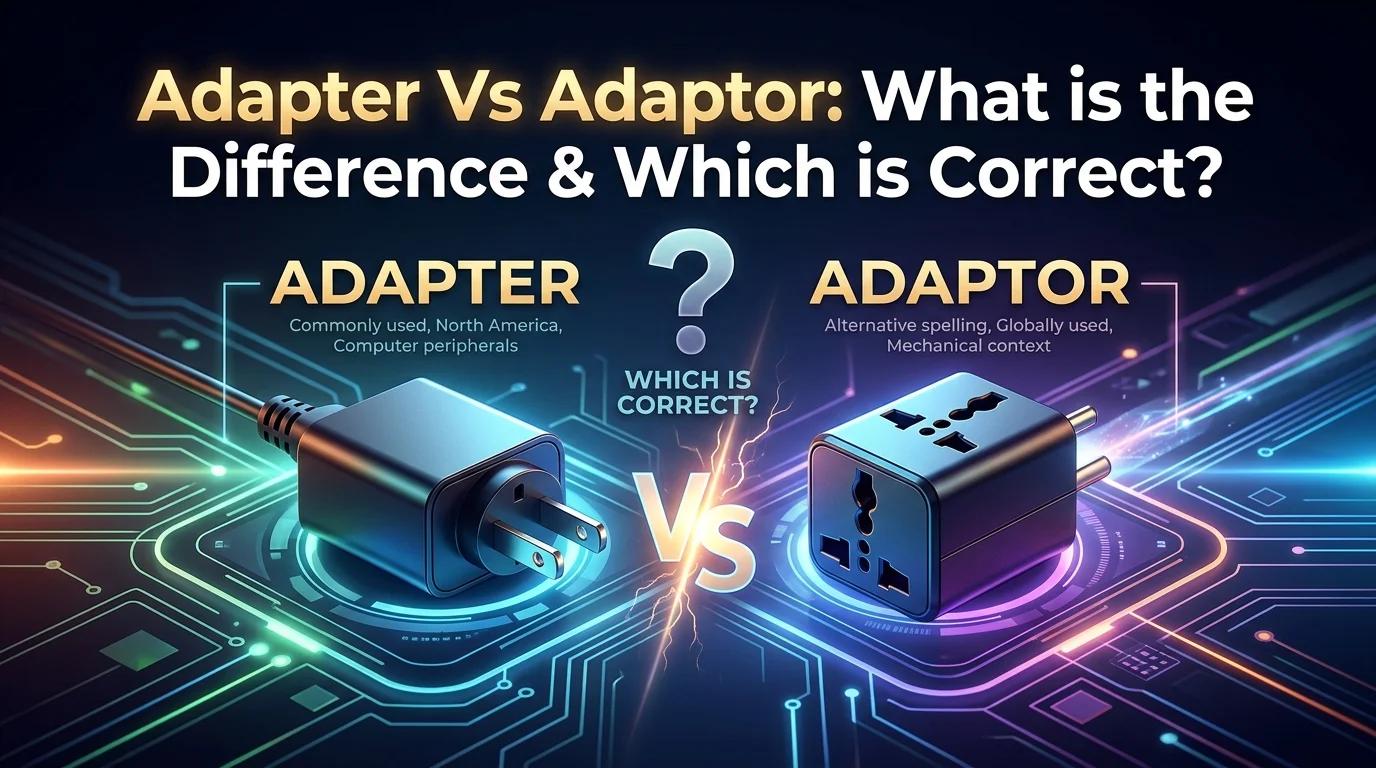

Many English learners and even native speakers get confused between “adapter” and “adaptor” because both words look similar and often refer to the same thing. The confusion mainly comes from spelling differences, industry preferences, and regional usage. Understanding when to use each term correctly can improve your writing, communication, and technical accuracy.
Comparison Overview
“Adapter” and “adaptor” are two spelling variations of the same word. Both refer to a device, object, or person that helps connect or modify something so it works with another thing. In modern English, “adapter” is far more common, especially in technology and everyday writing, while “adaptor” still appears in specific technical, scientific, and regional contexts.
| Feature | Adapter | Adaptor |
| Meaning | A connector or modifying device | Same meaning |
| Common Usage | Modern English and technology | Older or specialized usage |
| Popularity | Much more common | Less common |
| Preferred In | Consumer electronics, general writing | Biology, engineering, some British usage |
| Correctness | Correct | Also correct |
Definition of Adapter
An “adapter” is a device or object that allows two incompatible things to work together. It is commonly used in electronics, technology, travel equipment, and communication tools.
For example, a phone charger adapter allows a charger to fit into a different power outlet. In writing and speech, “adapter” is now considered the standard spelling in most situations.
Key Characteristics of Adapter
- Common in modern English
- Frequently used in technology
- Preferred spelling in American English
- Easy to recognize in everyday communication
Example Sentence
I bought a USB adapter for my laptop.
Definition of Adaptor
An “adaptor” has the same meaning as “adapter.” It also refers to something that connects, adjusts, or modifies one thing so it works with another.
However, “adaptor” is less common today. It is still used in some scientific fields, engineering documents, and certain British English contexts.
Key Characteristics of Adaptor
- Alternative spelling of “adapter”
- More common in older texts
- Sometimes preferred in scientific terminology
- Seen in specialized industries
Example Sentence
The laboratory adaptor connected the two glass tubes.
Main Differences Between Adapter and Adaptor
Although both words share the same meaning, there are important differences in usage, popularity, and context.
| Aspect | Adapter | Adaptor |
| Spelling Style | Modern standard spelling | Alternative spelling |
| Frequency | Very common | Less common |
| Technology Usage | Preferred | Rare |
| Scientific Usage | Sometimes used | Often used in older technical writing |
| American English | Strongly preferred | Rare |
| British English | Common | Still occasionally used |
Usage Difference
“Adapter” is widely accepted in modern communication, especially in technology and business. “Adaptor” is usually limited to niche technical or scientific fields.
Style Difference
Writers often choose “adapter” for simplicity and clarity because readers recognize it more easily.
Industry Difference
Electronics companies almost always use “adapter,” while some laboratory or engineering equipment manuals may still use “adaptor.”
Adapter vs Adaptor in Technology
In the technology world, “adapter” is the dominant spelling.
Examples include:
- Power adapter
- Wireless adapter
- Network adapter
- HDMI adapter
- USB adapter
Most manufacturers, websites, and software manuals use “adapter” because it aligns with modern English standards.
Adapter vs Adaptor in Science
In scientific and laboratory contexts, “adaptor” may still appear.
Examples include:
- Glass tube adaptor
- Laboratory adaptor
- Chemical adaptor
This usage is more traditional and less common outside scientific writing.
Grammar Guide
How each term is used in sentences
Both “adapter” and “adaptor” function as nouns.
Sentence Patterns
- Subject + uses + adapter
- Subject + connects + adaptor
Examples
- The adapter charges the device quickly.
- The adaptor linked the laboratory equipment.
- We need an adapter for the projector.
- The engineer replaced the adaptor yesterday.
Common mistakes learners make
Using “adaptor” in modern tech writing
Many learners use “adaptor” for electronics because they assume both spellings are equally common. In reality, “adapter” is preferred in technology.
Incorrect:
I need a phone adaptor.
Preferred:
I need a phone adapter.
Thinking one spelling is completely wrong
Both spellings are correct. The difference is mostly stylistic and contextual.
Mixing spellings in one document
Writers sometimes switch between “adapter” and “adaptor” in the same article. Consistency is important.
Simple rules to remember
- Use “adapter” for modern everyday English.
- Use “adapter” for electronics and technology.
- Use “adaptor” only in specialized or traditional contexts.
- Stay consistent with one spelling style.
Quick tips for writing and speaking
- Choose “adapter” if you are unsure.
- Use “adapter” in business and academic writing unless instructed otherwise.
- Check technical manuals because some industries still prefer “adaptor.”
- Match the spelling style used by your organization or publication.
When to Use Each One
Use “Adapter” When:
- Writing about technology
- Discussing electronics
- Communicating in business
- Writing modern English
- Creating educational content
Use “Adaptor” When:
- Referring to specialized scientific equipment
- Following older technical terminology
- Matching a specific industry style guide
- Using terminology from laboratory settings
When NOT to Use Each One
Do Not Use “Adapter” When:
- Your technical field specifically requires “adaptor”
- You are quoting older scientific material using “adaptor”
Do Not Use “Adaptor” When:
- Writing about consumer electronics
- Creating general content for modern audiences
- Writing simple educational material
- Referring to phone or computer accessories
Which One to Use (Decision Guide)
Use this simple guide to choose correctly.
| Situation | Best Choice |
| Phone charger | Adapter |
| USB connector | Adapter |
| Laptop accessory | Adapter |
| Business writing | Adapter |
| School writing | Adapter |
| Scientific apparatus | Adaptor |
| Traditional engineering documents | Adaptor |
Easy Decision Rule
If your topic involves modern technology or everyday English, use “adapter.” If you are writing in a specialized scientific or traditional technical field, “adaptor” may be acceptable.
Real-World Practical Examples
Adapter Examples
- I bought a travel adapter for my trip to Europe.
- The wireless adapter improved the internet connection.
- She connected the monitor using an HDMI adapter.
- The teacher used a projector adapter during the presentation.
- My laptop adapter stopped working yesterday.
- The business ordered new power adapters for employees.
- A USB adapter helped transfer the files quickly.
Adaptor Examples
- The scientist cleaned the glass adaptor carefully.
- The laboratory adaptor connected the chemical containers.
- The engineer replaced the damaged adaptor in the testing machine.
- The technical manual described the adaptor installation process.
- The old machine required a special adaptor for operation.
- The chemistry experiment used a tube adaptor.
- The research facility stored several adaptors in the equipment room.
Self-Assessment (Fill in the Blanks)
- I need a USB ______ for my computer.
- The laboratory ______ connected two glass tubes.
- Most electronics companies prefer the spelling ______.
- The scientist installed the chemical ______ carefully.
- She packed a travel ______ before flying overseas.
- The wireless ______ improved signal strength.
- Traditional engineering texts sometimes use the word ______.
- I bought a charging ______ for my phone.
- The technician repaired the broken ______ in the laboratory.
- Modern business writing usually prefers ______.
- The network ______ allowed internet access.
- The chemistry teacher demonstrated the use of an ______.
- We used an HDMI ______ for the projector.
- The older manual referred to the device as an ______.
- A power ______ helps connect devices safely.
- The research lab ordered a replacement ______.
- Most consumers recognize the spelling ______ more easily.
- The scientific instrument required a tube ______.
- My laptop ______ overheated yesterday.
- The less common spelling is ______.
Answers
- adapter
- adaptor
- adapter
- adaptor
- adapter
- adapter
- adaptor
- adapter
- adaptor
- adapter
- adapter
- adaptor
- adapter
- adaptor
- adapter
- adaptor
- adapter
- adaptor
- adapter
- adaptor
Final Verdict
“Adapter” and “adaptor” have the same meaning, but they differ in popularity and context. “Adapter” is the standard modern spelling and is widely used in technology, education, business, and daily communication. “Adaptor” is still correct but mainly appears in specialized scientific or technical contexts. For most situations, especially in modern English writing, “adapter” is the best and safest choice.
Conclusion About Adapter Vs Adaptor
Understanding the difference between “adapter” and “adaptor” can make your writing clearer and more professional. While both words share the same meaning and refer to something that connects or modifies another object, “adapter” has become the preferred spelling in modern English, especially in technology, business, and everyday communication. On the other hand, “adaptor” still appears in certain scientific and technical fields where traditional terminology remains common. Choosing the correct spelling depends mostly on context, audience, and industry standards. If you are writing about electronics, chargers, computers, or daily accessories, “adapter” is usually the safest option. If you are working with laboratory equipment or older technical documentation, “adaptor” may still be appropriate. By learning these small but important differences, you can communicate more accurately and avoid common grammar and spelling confusion in both writing and speaking.
FAQs
Is adapter or adaptor more correct?
Both “adapter” and “adaptor” are correct spellings. However, “adapter” is far more common in modern English, especially in technology and business writing. “Adaptor” is mostly used in specialized scientific or technical contexts.
Why do people confuse adapter and adaptor?
People confuse these words because they have the same meaning and very similar spellings. Different industries and regions also prefer different versions, which makes the distinction less obvious for learners and everyday writers.
Which spelling is used in technology?
“Adapter” is the preferred spelling in technology. You will commonly see terms like power adapter, USB adapter, and network adapter in electronics, software, and consumer products.
Is adaptor old-fashioned?
“Adaptor” is not wrong or outdated, but it is less common in modern English. It is mainly found in scientific writing, laboratory terminology, and older engineering documents.
Do British and American English use different spellings?
American English strongly prefers “adapter.” British English also commonly uses “adapter,” although “adaptor” may appear occasionally in technical or scientific contexts.
Can adapter and adaptor be used interchangeably?
Yes, both words can usually be used interchangeably because they have the same meaning. However, “adapter” is generally more accepted and recognized in everyday communication.
What does an adapter do?
An adapter helps connect two devices, systems, or objects that would not normally work together. It modifies compatibility so the connection functions properly.
Is power adaptor wrong?
“Power adaptor” is not technically wrong, but “power adapter” is the standard and more natural spelling in modern electronics and consumer technology.
Why is adapter more popular today?
“Adapter” became more popular because modern industries, technology companies, and style guides adopted it as the standard spelling. It is simpler and more familiar to most readers.
Should students use adapter or adaptor in essays?
Students should usually use “adapter” because it is the standard modern spelling. It is clearer, more widely accepted, and appropriate for academic and general writing.
