
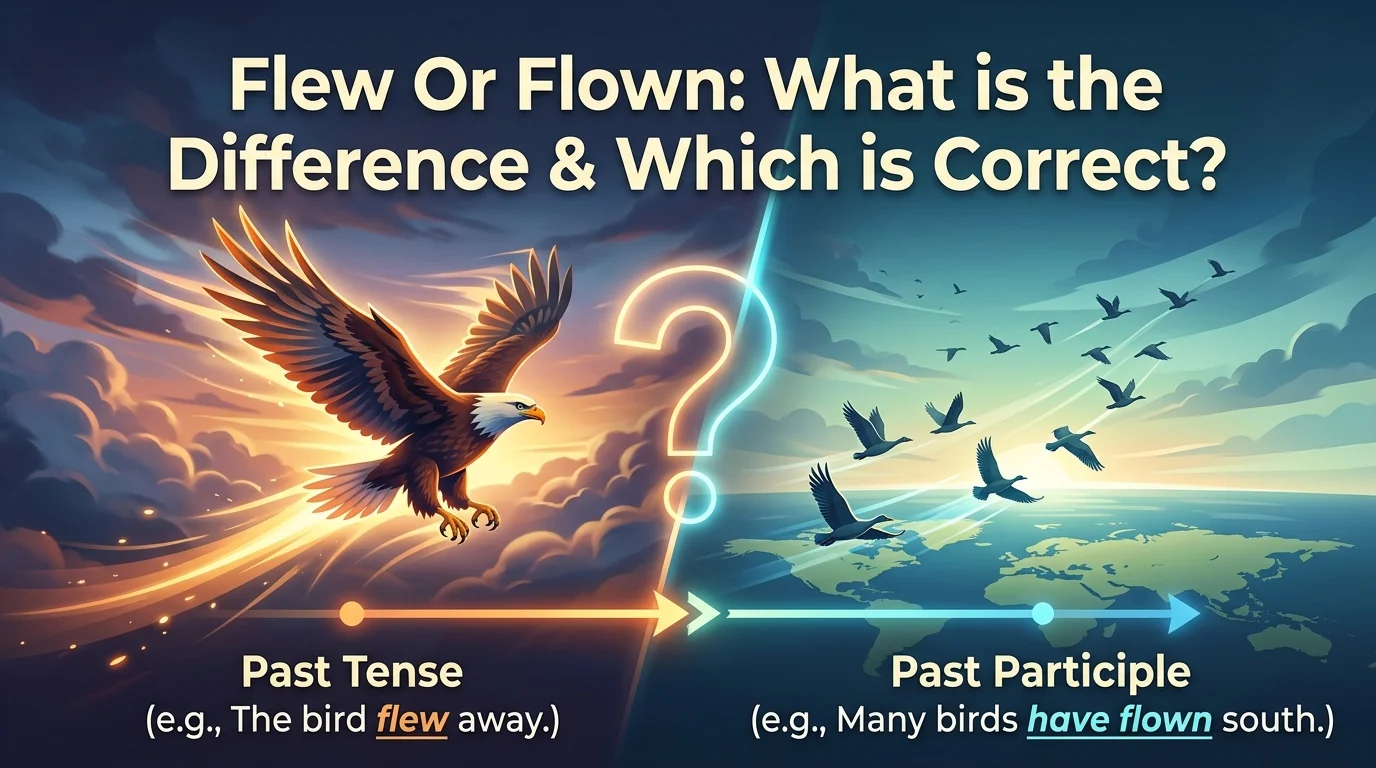

Many English learners get confused between “flew” and “flown” because both words come from the verb “fly.” Even native speakers sometimes mix them up in writing and conversation. Understanding the difference is important because each word has a different grammatical role. Once you learn the simple rules, choosing the correct word becomes much easier in everyday speaking and writing.
Comparison Overview
“Flew” and “flown” are both forms of the irregular verb “fly.” They are used to describe movement through the air, usually by birds, airplanes, or even people traveling by plane. The main difference is grammatical tense.
“Flew” is the simple past tense of “fly,” while “flown” is the past participle form. Although they are related, they cannot always be used interchangeably. Correct usage depends on sentence structure and helping verbs.
| Word | Verb Form | Usage |
| Flew | Simple past tense | Used for completed past actions |
| Flown | Past participle | Used with helping verbs like has, have, or had |
Definition of Flew
“Flew” is the simple past tense of the verb “fly.” It describes an action that already happened in the past.
It is used when talking about a completed event without needing a helping verb.
Examples:
- The bird flew across the sky.
- We flew to Dubai last summer.
- The paper airplane flew far.
“Flew” focuses on the action happening and finishing in the past.
Definition of Flown
“Flown” is the past participle form of the verb “fly.” It cannot usually stand alone as the main verb. It is commonly used with helping verbs such as “has,” “have,” “had,” “was,” or “were.”
Examples:
- She has flown to London many times.
- The plane had flown before the storm arrived.
- The kite has flown away.
“Flown” is often used in perfect tenses and passive structures.
Main Differences Between Flew and Flown
The biggest difference between “flew” and “flown” is grammar and sentence structure.
| Feature | Flew | Flown |
| Verb Type | Simple past tense | Past participle |
| Helping Verb Needed | No | Yes |
| Common Usage | Completed past actions | Perfect tenses |
| Example | He flew home yesterday. | He has flown home before. |
Key differences:
- “Flew” works alone in a sentence.
- “Flown” usually requires a helping verb.
- “Flew” describes a specific past action.
- “Flown” connects past actions to another time or condition.
Verb Forms of Fly
Understanding all forms of “fly” makes the difference easier.
| Base Form | Past Tense | Past Participle |
| Fly | Flew | Flown |
Examples:
- I fly every month.
- I flew yesterday.
- I have flown many times.
Why People Confuse Flew and Flown
Many learners confuse these words because both refer to past actions. Since English irregular verbs do not follow standard “-ed” patterns, remembering correct forms can be difficult.
Common reasons for confusion:
- Both words describe flying actions.
- Both relate to the past.
- Learners forget helping verbs.
- Spoken English sometimes sounds similar.
Incorrect:
- I have flew to Paris.
Correct:
- I have flown to Paris.
Grammar Guide
How Each Term Is Used in Sentences
Using Flew
Pattern:
Subject + flew + object/place
Examples:
- They flew to Canada.
- The eagle flew over the mountains.
- She flew home yesterday.
Using Flown
Pattern:
Subject + helping verb + flown
Examples:
- They have flown to Canada.
- The drone has flown successfully.
- She had flown before the rain started.
Common Mistakes Learners Make
Here are some frequent errors:
| Incorrect | Correct |
| I have flew there. | I have flown there. |
| She flown yesterday. | She flew yesterday. |
| They has flown away. | They have flown away. |
| We flew many times before. | We have flown many times before. |
Mistakes usually happen when learners forget whether a helping verb is required.
Simple Rules to Remember
- Use “flew” for simple past actions.
- Use “flown” after helping verbs.
- If the sentence includes “has,” “have,” or “had,” use “flown.”
- If the action simply happened in the past, use “flew.”
Easy memory trick:
- Flew = past action
- Flown = has/have/had + action
Quick Tips for Writing and Speaking
- Check for helping verbs before choosing the word.
- Use “flew” in storytelling about past events.
- Use “flown” in formal writing with perfect tenses.
- Practice with common travel-related sentences.
- Read sentences aloud to hear what sounds natural.
When to Use Each One
Use “Flew” When:
- Talking about a completed past event
- Describing travel in the past
- Writing simple past tense sentences
Examples:
- We flew to Karachi yesterday.
- The bird flew away quickly.
Use “Flown” When:
- Using perfect tenses
- Writing with helping verbs
- Describing experiences up to the present
Examples:
- I have flown internationally before.
- She had flown many hours already.
When NOT to Use Each One
Do Not Use “Flew”:
- After helping verbs like has, have, or had
Incorrect:
- He has flew home.
Correct:
- He has flown home.
Do Not Use “Flown”:
- Alone as a simple past verb
Incorrect:
- She flown yesterday.
Correct:
- She flew yesterday.
Which One to Use (Decision Guide)
Ask yourself these questions:
Is there a helping verb?
- Yes → Use “flown”
- No → Use “flew”
Is the sentence in simple past tense?
- Yes → Use “flew”
Is the sentence in present perfect or past perfect tense?
- Yes → Use “flown”
Quick guide:
| Sentence Type | Correct Word |
| Simple past | Flew |
| Present perfect | Flown |
| Past perfect | Flown |
| Standalone verb | Flew |
Real-World Practical Examples
Flew Examples
- The scientist flew a drone during the experiment.
- We flew to Islamabad for a business meeting.
- The child flew a kite in the park.
- The soccer ball flew into the crowd.
- The pilot flew through bad weather safely.
Flown Examples
- She has flown on more than twenty international flights.
- The package had flown across the country overnight.
- Many astronauts have flown into space.
- The airline has flown millions of passengers safely.
- The research drone has flown successfully for hours.
Self-Assessment (Fill in the Blanks)
- We ______ to Lahore last year.
- She has ______ on a private jet before.
- The bird ______ over the lake yesterday.
- They had ______ for many hours already.
- My uncle ______ to Turkey in 2024.
- The airplane has ______ safely through the storm.
- He ______ his drone near the beach.
- I have never ______ internationally.
- The kite ______ high into the sky.
- The team had ______ overnight for the meeting.
- She ______ home after the conference.
- The helicopter has ______ above the city all morning.
- The paper airplane ______ across the classroom.
- We have ______ with that airline twice.
- The eagle ______ over the mountains.
- The pilot had ______ many difficult routes before.
- The ball ______ into the window yesterday.
- They have ______ together many times.
- The insect ______ toward the light.
- She had ______ across three countries in one week.
Answers
- flew
- flown
- flew
- flown
- flew
- flown
- flew
- flown
- flew
- flown
- flew
- flown
- flew
- flown
- flew
- flown
- flew
- flown
- flew
- flown
Final Verdict
“Flew” and “flown” both come from the verb “fly,” but they serve different grammatical purposes. “Flew” is the simple past tense used for actions completed in the past, while “flown” is the past participle used with helping verbs such as “has,” “have,” and “had.” The easiest way to choose correctly is to check the sentence structure. If there is no helping verb, “flew” is usually correct. If a helping verb appears, “flown” is normally the right choice. By understanding these simple grammar patterns and practicing real examples, you can confidently use both words correctly in speaking and writing.
Conclusion About Flew Or Flown
Understanding the difference between “flew” and “flown” becomes much easier once you recognize their grammatical roles. Both words come from the verb “fly,” but they are used in different sentence structures. “Flew” works as the simple past tense for actions that already happened, while “flown” is the past participle used with helping verbs like “has,” “have,” and “had.” Learning this distinction can improve your grammar, writing clarity, and speaking confidence. Whether you are writing emails, telling stories, discussing travel, or preparing academic work, using the correct form helps your English sound more natural and professional. The best way to master these words is through regular practice and exposure to real examples. Once you remember the simple rule about helping verbs, choosing between “flew” and “flown” will feel automatic in everyday communication.
FAQs
Is “flew” a real English word?
Yes, “flew” is the correct simple past tense form of the verb “fly.” It is used to describe an action that happened and finished in the past. For example, “We flew to Dubai last year” is grammatically correct.
Is “flown” grammatically correct?
Yes, “flown” is grammatically correct when used as the past participle form of “fly.” It is usually paired with helping verbs such as “has,” “have,” or “had.” For example, “She has flown internationally before” is correct.
What is the main difference between flew and flown?
The main difference is grammatical usage. “Flew” is the simple past tense, while “flown” is the past participle. “Flew” can stand alone in a sentence, but “flown” generally needs a helping verb before it.
Can I say “I have flew”?
No, “I have flew” is incorrect grammar. After helping verbs like “have,” you must use the past participle form “flown.” The correct sentence is “I have flown.”
When should I use “flew”?
Use “flew” when talking about a completed action in the past without a helping verb. It commonly appears in storytelling, travel discussions, and descriptions of past events. Example: “The bird flew away quickly.”
When should I use “flown”?
Use “flown” when the sentence includes helping verbs such as “has,” “have,” or “had.” It is commonly used in perfect tenses. Example: “They have flown to many countries.”
Why do English learners confuse flew and flown?
Many learners confuse them because both words refer to past actions and come from the same base verb “fly.” Irregular verbs in English do not follow standard patterns, so remembering the correct form can take practice.
Is “flown” ever used without a helping verb?
Usually, no. “Flown” normally appears with helping verbs. Saying “She flown yesterday” is incorrect. The correct version is “She flew yesterday.”
Are flew and flown only used for airplanes?
No, both words can describe many kinds of flying actions. They may refer to birds, insects, drones, kites, airplanes, or even objects moving quickly through the air.
What is the easiest way to remember flew and flown?
A simple trick is to check for helping verbs. If the sentence has “has,” “have,” or “had,” use “flown.” If there is no helping verb and the action happened in the past, use “flew.”
