
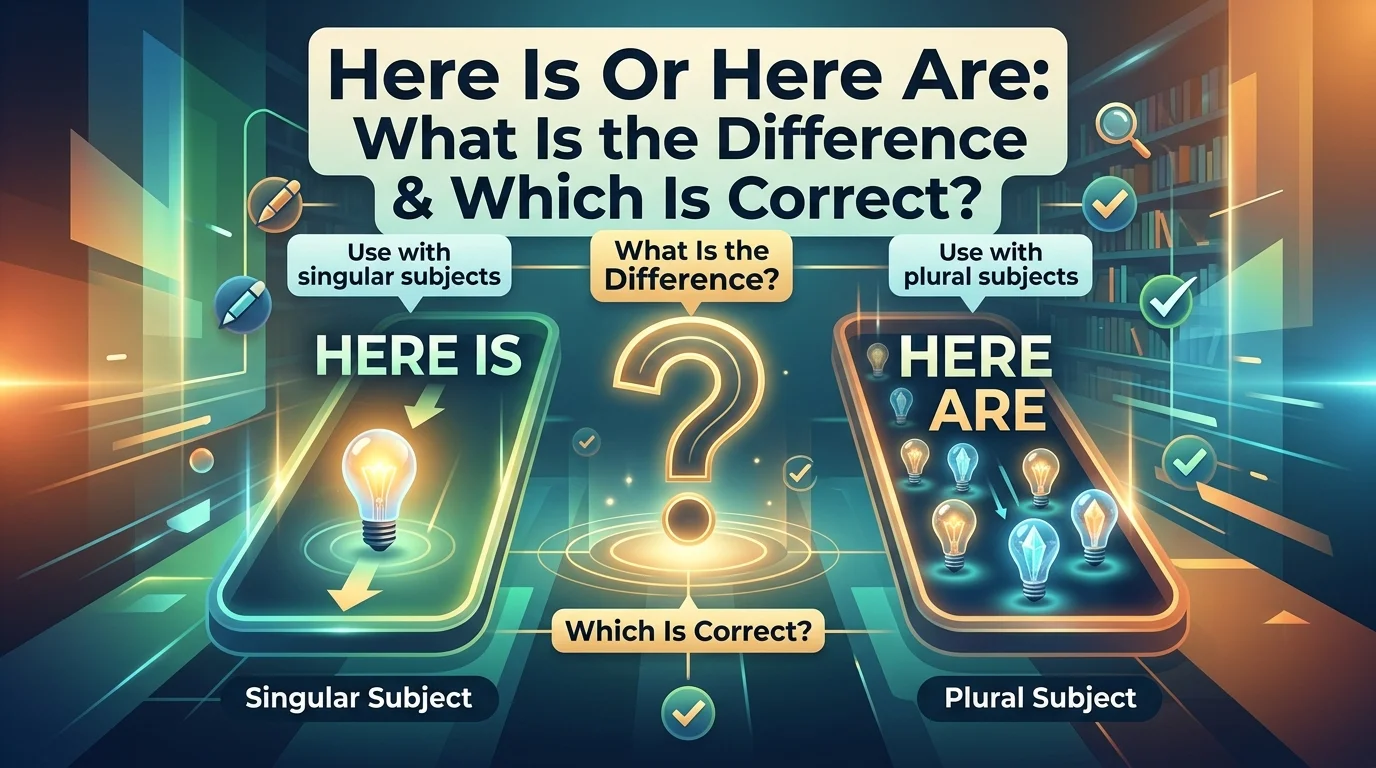

Many English learners get confused between “here is” and “here are” because both phrases introduce something nearby or being presented. The difference mainly depends on whether the noun is singular or plural. Understanding when to use each phrase helps improve grammar, speaking, and writing clarity in everyday English communication.
Comparison Overview
“Here is” and “here are” are both commonly used introductory phrases in English. They help point out, present, or introduce people, objects, ideas, or information. Although they seem similar, the correct choice depends on the number of nouns being discussed.
“Here is” is generally used with singular nouns, while “here are” is used with plural nouns. Choosing the right phrase makes sentences grammatically correct and easier to understand.
| Phrase | Used With | Example |
| Here is | Singular noun | Here is your book. |
| Here are | Plural noun | Here are your books. |
Definition of Here Is
“Here is” is a phrase used to introduce or point to one person, object, idea, or thing. It combines the word “here” with the singular verb “is.”
This phrase is commonly used in conversations, presentations, instructions, and writing when talking about a single item.
Examples:
- Here is my phone.
- Here is the answer.
- Here is your coffee.
The phrase focuses on something singular or uncountable.
Definition of Here Are
“Here are” is a phrase used to introduce or point to multiple people, objects, or things. It combines “here” with the plural verb “are.”
This phrase is used when the noun after it is plural.
Examples:
- Here are your shoes.
- Here are the documents.
- Here are my friends.
The phrase always refers to more than one item.
Main Differences Between Here Is and Here Are
The main difference between “here is” and “here are” is grammatical number.
| Feature | Here Is | Here Are |
| Verb Type | Singular | Plural |
| Used For | One thing/person | Multiple things/people |
| Common Structure | Here is + singular noun | Here are + plural noun |
| Example | Here is the key. | Here are the keys. |
Another important difference is how natural the sentence sounds in spoken English. Native speakers automatically match the verb with the noun quantity.
Incorrect:
- Here is the books.
Correct:
- Here are the books.
Singular vs Plural Usage
Understanding singular and plural nouns is the easiest way to choose between these phrases.
Singular Examples
Use “here is” with:
- One object
- One person
- One idea
- Uncountable nouns
Examples:
- Here is the report.
- Here is your water.
- Here is my brother.
Plural Examples
Use “here are” with:
- Multiple objects
- Multiple people
- Multiple ideas
Examples:
- Here are the reports.
- Here are your classmates.
- Here are the instructions.
Common Sentence Patterns
| Pattern | Example |
| Here is + singular noun | Here is the ticket. |
| Here are + plural noun | Here are the tickets. |
| Here is + uncountable noun | Here is some milk. |
| Here are + plural countable noun | Here are some apples. |
Grammar Guide
Correct grammar depends on matching the verb with the noun.
How Each Term Is Used in Sentences
Here Is Sentence Pattern
Structure:
- Here is + singular noun
Examples:
- Here is the solution.
- Here is your bag.
- Here is the teacher.
Here Are Sentence Pattern
Structure:
- Here are + plural noun
Examples:
- Here are the solutions.
- Here are your bags.
- Here are the teachers.
Common Mistakes Learners Make
Many learners accidentally mix singular and plural forms.
Common mistakes:
- Here is the apples.
- Here are the book.
Correct forms:
- Here are the apples.
- Here is the book.
Another mistake happens with long noun phrases.
Incorrect:
- Here is the students from our class.
Correct:
- Here are the students from our class.
Simple Rules to Remember
- Use “is” for one thing.
- Use “are” for multiple things.
- Check the noun after the phrase.
- Ignore extra descriptive words and focus on the main noun.
Easy memory trick:
- “Is” = one
- “Are” = many
Quick Tips for Writing and Speaking
- Read your sentence aloud.
- Identify whether the noun is singular or plural.
- Use “here is” for uncountable nouns like water, information, or advice.
- Use “here are” only with plural countable nouns.
- In casual speech, contractions are common:
- Here’s the file.
- Here are the files.
When to Use Each One
Use “Here Is” When:
- Introducing one item
- Referring to one person
- Talking about uncountable nouns
- Presenting a single idea
Examples:
- Here is your certificate.
- Here is some advice.
- Here is the winner.
Use “Here Are” When:
- Introducing multiple items
- Referring to several people
- Listing plural objects
- Presenting multiple ideas
Examples:
- Here are your certificates.
- Here are the winners.
- Here are the results.
When NOT to Use Each One
Do Not Use “Here Is” With Plural Nouns
Incorrect:
- Here is the cars.
Correct:
- Here are the cars.
Do Not Use “Here Are” With Singular Nouns
Incorrect:
- Here are the laptop.
Correct:
- Here is the laptop.
Avoid Confusion With Uncountable Nouns
Uncountable nouns still use “here is.”
Correct:
- Here is the information.
- Here is some rice.
Incorrect:
- Here are the information.
Which One to Use (Decision Guide)
Use this simple guide:
| If the noun is… | Use… |
| Singular | Here is |
| Plural | Here are |
| Uncountable | Here is |
| One person | Here is |
| Multiple people | Here are |
Quick decision examples:
- One book → Here is the book.
- Three books → Here are the books.
- Water → Here is the water.
- Two students → Here are the students.
Real-World Practical Examples
Here Is Examples
- Education: Here is your homework assignment.
- Daily Life: Here is your breakfast.
- Business: Here is the financial report.
- Technology: Here is the updated software.
- Conversation: Here is my phone number.
Here Are Examples
- Education: Here are your exam results.
- Daily Life: Here are the groceries.
- Business: Here are the meeting notes.
- Technology: Here are the updated files.
- Conversation: Here are my cousins.
Self-Assessment (Fill in the Blanks)
- ______ the answer to your question.
- ______ the books you requested.
- I will use ______ when talking about one object.
- The correct word is ______ because the noun is plural.
- ______ my new laptop.
- ______ the students from class.
- The correct phrase is ______ because “information” is uncountable.
- ______ your keys on the table.
- I will use ______ when introducing several people.
- ______ the teacher for today’s lesson.
- ______ the new updates from the company.
- The correct phrase is ______ because only one item is mentioned.
- ______ your package.
- ______ the apples from the market.
- I will use ______ for multiple documents.
- The correct phrase is ______ because “water” is singular and uncountable.
- ______ the final decision.
- ______ the players ready for the game.
- I will use ______ when introducing one person.
- The correct word is ______ because the noun “reports” is plural.
Answers
- Here is
- Here are
- Here is
- Here are
- Here is
- Here are
- Here is
- Here are
- Here are
- Here is
- Here are
- Here is
- Here is
- Here are
- Here are
- Here is
- Here is
- Here are
- Here is
- Here are
Final Verdict
“Here is” and “here are” are simple but important English phrases used to introduce or point out things. The key difference is that “here is” works with singular or uncountable nouns, while “here are” is used with plural nouns. By checking whether the noun is one thing or many things, you can quickly choose the correct phrase. Learning this small grammar rule helps improve sentence accuracy, speaking confidence, and writing clarity in both formal and casual English situations.
Conclusion About Here Is Or Here Are
Understanding the difference between “here is” and “here are” can make your English sound more natural, accurate, and confident. While both phrases are used to introduce or point out something, the choice depends on whether the noun is singular, plural, or uncountable. “Here is” works with one thing or uncountable nouns, while “here are” is used for multiple items or people. This simple grammar rule is extremely useful in daily conversations, writing, business communication, education, and presentations. Once you learn to identify whether the noun is singular or plural, choosing the correct phrase becomes easy. With regular practice and real-life examples, you can avoid common mistakes and improve both your spoken and written English. Mastering these small grammar details helps create clearer communication and stronger language skills in every situation.
FAQs
What is the difference between here is and here are?
“Here is” is used with singular or uncountable nouns, while “here are” is used with plural nouns. The difference depends on the number of items being introduced. For example, “Here is the book” refers to one book, while “Here are the books” refers to more than one book.
Is “here is” grammatically correct?
Yes, “here is” is completely grammatically correct when used with singular or uncountable nouns. It is commonly used in both spoken and written English. Examples include “Here is your coffee” and “Here is the information you requested.”
When should I use “here are”?
You should use “here are” when referring to more than one person, object, or item. The noun after the phrase must be plural. For example, “Here are your documents” and “Here are the students from our class” are both correct.
Can I use “here is” with uncountable nouns?
Yes, uncountable nouns use “here is” because they are treated as singular in grammar. Examples include “Here is some water,” “Here is the advice,” and “Here is the information.” Even though these nouns may describe large amounts, they remain grammatically singular.
Why do learners confuse here is and here are?
Many learners focus on nearby words instead of the main noun in the sentence. Long phrases can also create confusion. For example, in “Here are the books on the shelf,” the main noun is “books,” which is plural, so “are” must be used.
Is “here’s” the same as “here is”?
Yes, “here’s” is simply the contraction of “here is.” It is very common in casual conversation and informal writing. For example, “Here’s your phone” means the same thing as “Here is your phone.” However, “here’s” is not normally used with plural nouns.
Can I say “here’s the books”?
In informal speech, some native speakers may say it casually, but it is not grammatically correct in standard English. The proper form is “Here are the books” because “books” is plural. Formal writing and correct grammar require agreement between the verb and noun.
Are here is and here are used in formal writing?
Yes, both phrases are used in formal and informal writing. They are common in reports, presentations, emails, instructions, and academic writing. Correct usage improves clarity and professionalism, especially when introducing information or presenting items.
How can I quickly choose the correct phrase?
Look at the noun immediately following the phrase. If it is singular or uncountable, use “here is.” If it is plural, use “here are.” This quick grammar check helps avoid mistakes and improves sentence accuracy in speaking and writing.
What are common examples of here is and here are?
Examples of “here is” include:
- Here is your ticket.
- Here is my idea.
Examples of “here are” include:
- Here are your tickets.
- Here are my ideas.
These examples show how the noun determines the correct phrase.
