
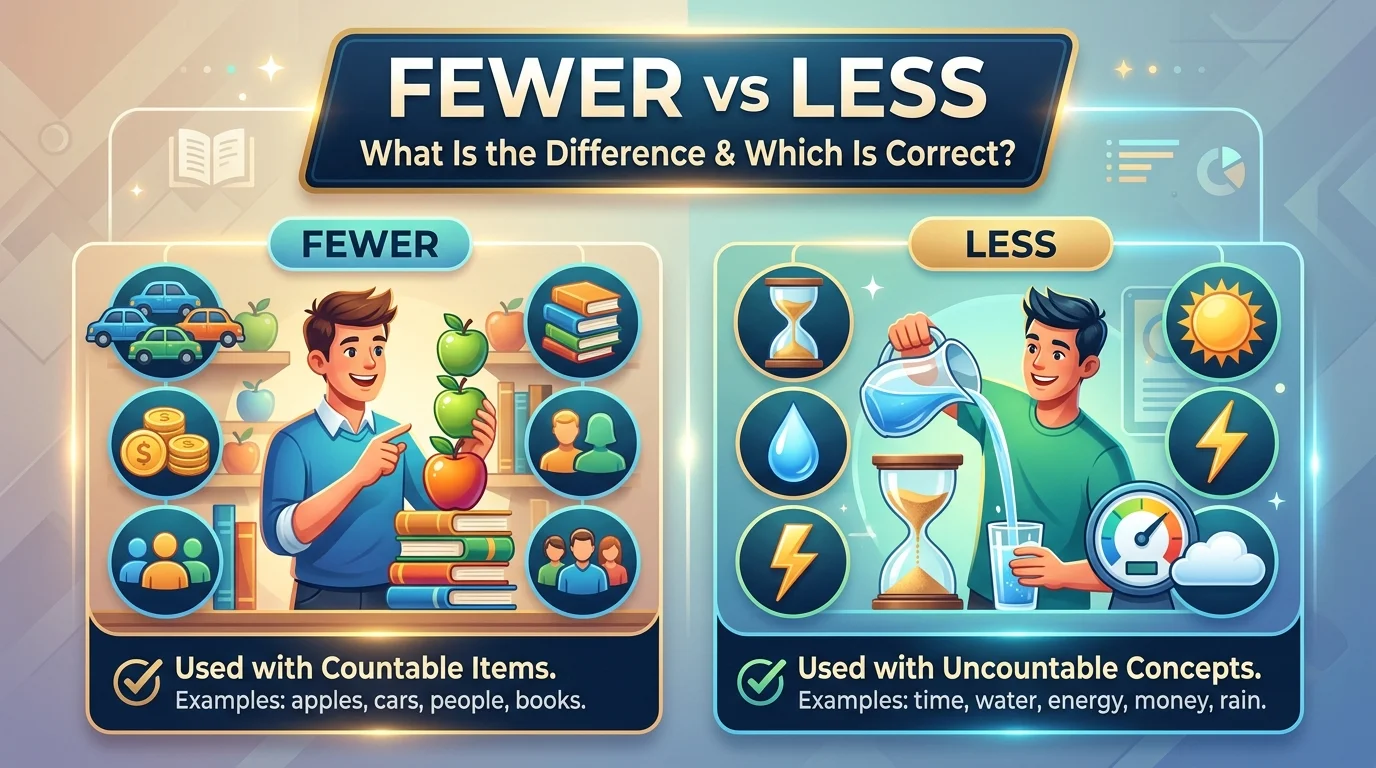

Many English learners struggle with fewer and less because both words refer to smaller amounts. While they seem similar, they are used in different grammatical situations. Understanding the difference between fewer and less helps you write and speak more accurately, whether you’re communicating in everyday conversations, academic writing, or professional settings.
Comparison Overview
Fewer and less are both comparative words used to indicate a reduction in quantity. However, they apply to different types of nouns.
- Fewer is generally used with countable nouns.
- Less is generally used with uncountable nouns.
Although native speakers sometimes mix them in casual speech, standard grammar follows a clear distinction between the two.
| Feature | Fewer | Less |
| Used with | Countable nouns | Uncountable nouns |
| Refers to | Number of items | Amount or quantity |
| Example | Fewer books | Less water |
| Grammar role | Comparative determiner | Comparative determiner |
| Formal correctness | Countable things | Non-countable things |
Definition of Fewer
Fewer is a comparative word used when talking about things that can be counted individually.
If you can count the items one by one, fewer is usually the correct choice.
Examples:
- Fewer students attended the class.
- There are fewer apples in the basket.
- We need fewer chairs for the meeting.
The word emphasizes a smaller number of separate items.
Definition of Less
Less is a comparative word used with things that cannot usually be counted individually.
It refers to a smaller amount, quantity, degree, or volume.
Examples:
- I need less sugar in my coffee.
- There is less traffic today.
- She spends less time on social media.
The word emphasizes a reduced amount rather than a reduced number.
Main Differences Between Fewer and Less
The primary difference is based on whether the noun is countable or uncountable.
| Aspect | Fewer | Less |
| Noun type | Countable | Uncountable |
| Focus | Number | Amount |
| Example | Fewer cars | Less fuel |
| Example | Fewer books | Less information |
| Example | Fewer employees | Less money |
Consider these examples:
- Correct: Fewer people attended the concert.
- Incorrect: Less people attended the concert.
- Correct: Less water is available.
- Incorrect: Fewer water is available.
The distinction becomes important in formal writing and grammar tests.
Countable vs Uncountable Nouns
Understanding countable and uncountable nouns makes choosing between fewer and less much easier.
Countable Nouns
Countable nouns can be counted individually.
Examples:
- Books
- Cars
- Students
- Pens
- Houses
Use fewer with these nouns.
Uncountable Nouns
Uncountable nouns cannot normally be counted individually.
Examples:
- Water
- Milk
- Information
- Advice
- Furniture
Use less with these nouns.
Common Exceptions and Special Cases
Although the standard rule is straightforward, English contains some accepted exceptions.
Use less with:
- Time
- Money
- Distance
- Weight
- Percentages (in many contexts)
Examples:
- Less than five minutes.
- Less than ten miles.
- Less than fifty dollars.
Even though these can technically be counted, standard English commonly accepts less in these measurements.
Grammar Guide
How Each Term Is Used in Sentences
Fewer Sentence Pattern
Fewer + Countable Noun
Examples:
- Fewer employees arrived today.
- Fewer emails were received.
- Fewer mistakes were made.
Less Sentence Pattern
Less + Uncountable Noun
Examples:
- Less energy is required.
- Less effort is needed.
- Less information was available.
Common Mistakes Learners Make
Many learners mistakenly use less with countable nouns.
Incorrect:
- Less books
- Less students
- Less cars
Correct:
- Fewer books
- Fewer students
- Fewer cars
Another mistake is using fewer with uncountable nouns.
Incorrect:
- Fewer water
- Fewer money
- Fewer traffic
Correct:
- Less water
- Less money
- Less traffic
Simple Rules to Remember
- If you can count it, use fewer.
- If you cannot count it individually, use less.
- Think “number” for fewer.
- Think “amount” for less.
- Measurements often use less.
Quick Tips for Writing and Speaking
- Countable = fewer.
- Uncountable = less.
- Check whether the noun has a plural form.
- In formal writing, follow the traditional rule carefully.
- Proofread signs, reports, and essays for this common error.
When to Use Each One
Use Fewer When:
- Counting people.
- Counting objects.
- Counting events.
- Counting documents.
- Counting animals.
Examples:
- Fewer guests arrived.
- Fewer files were submitted.
- Fewer birds visited the garden.
Use Less When:
- Talking about substances.
- Discussing time.
- Referring to effort.
- Discussing money.
- Talking about abstract quantities.
Examples:
- Less coffee was consumed.
- Less time was available.
- Less money was spent.
When NOT to Use Each One
Do Not Use Fewer
Avoid fewer with:
- Water
- Air
- Money
- Traffic
- Information
Incorrect:
- Fewer information
Correct:
- Less information
Do Not Use Less
Avoid less with:
- Students
- Books
- Cars
- Houses
- Computers
Incorrect:
- Less computers
Correct:
- Fewer computers
Which One to Use (Decision Guide)
Ask yourself one simple question:
Can I count the item individually?
If YES:
➡ Use Fewer
Examples:
- Fewer books
- Fewer students
- Fewer chairs
If NO:
➡ Use Less
Examples:
- Less water
- Less noise
- Less information
Quick formula:
Countable = Fewer
Uncountable = Less
Real-World Practical Examples
Fewer Examples
- Education: Fewer students enrolled this semester.
- Daily Life: We bought fewer groceries this week.
- Business: The company hired fewer workers.
- Technology: Fewer bugs appeared after the update.
- Science: Researchers observed fewer errors in the experiment.
Less Examples
- Education: Students spent less time on homework.
- Daily Life: I drink less soda now.
- Business: The project required less funding.
- Technology: The software uses less memory.
- Science: The reaction produced less heat.
Self-Assessment (Fill in the Blanks)
- I will use ______ when referring to a smaller number of books.
- The correct word is ______ because water is uncountable.
- I will use ______ when discussing students in a classroom.
- The correct word is ______ because money is treated as an amount.
- I will use ______ when talking about apples.
- The correct word is ______ because information is uncountable.
- I will use ______ when discussing employees.
- The correct word is ______ because traffic cannot usually be counted individually.
- I will use ______ when referring to chairs.
- The correct word is ______ because sugar is an uncountable noun.
- I will use ______ when talking about cars.
- The correct word is ______ because effort is uncountable.
- I will use ______ when discussing people at an event.
- The correct word is ______ because milk is uncountable.
- I will use ______ when counting assignments.
- The correct word is ______ because time is treated as an amount.
- I will use ______ when discussing houses.
- The correct word is ______ because energy is uncountable.
- I will use ______ when talking about computers.
- The correct word is ______ because advice is uncountable.
Answers
- Fewer
- Less
- Fewer
- Less
- Fewer
- Less
- Fewer
- Less
- Fewer
- Less
- Fewer
- Less
- Fewer
- Less
- Fewer
- Less
- Fewer
- Less
- Fewer
- Less
Final Verdict
The difference between fewer and less comes down to one essential grammar rule: use fewer with countable nouns and less with uncountable nouns. If you can count individual items such as books, students, cars, or employees, choose fewer. If you are talking about amounts such as water, money, time, information, or effort, choose less. While everyday speech sometimes blurs the distinction, following this rule will make your writing clearer, more professional, and grammatically correct. By remembering the simple principle of number versus amount, you can confidently decide whether fewer or less is the right choice in any situation.
Conclusion About Fewer vs Less
Understanding the difference between fewer vs less is one of the most important grammar skills for clear and accurate English communication. Although both words describe a smaller quantity, they are not interchangeable in every situation. In most cases, fewer is used with countable nouns such as books, students, and cars, while less is used with uncountable nouns like water, time, and information. Knowing this simple distinction can help you avoid common writing mistakes and improve your confidence in both formal and everyday communication. Whether you are writing an essay, sending a business email, or having a casual conversation, choosing the correct word makes your message more precise and professional. By remembering that fewer relates to numbers and less relates to amounts, you can easily decide which term fits the context. With regular practice, using fewer and less correctly will soon become second nature.
FAQs
What is the main difference between fewer and less?
The main difference is that fewer is used with countable nouns, while less is used with uncountable nouns. If you can count individual items, use fewer. If you are referring to an amount, quantity, or substance that cannot be counted individually, use less.
Is it fewer people or less people?
In standard grammar, fewer people is correct because people are countable. Since you can count individuals one by one, fewer should be used instead of less in formal writing and professional communication.
Why do stores sometimes use “ten items or less”?
Many stores use the phrase because it sounds natural in everyday speech. However, traditional grammar rules suggest that ten items or fewer is technically more correct because items are countable objects.
Can less ever be used with countable nouns?
Yes, there are exceptions involving measurements such as time, distance, money, and weight. For example, phrases like “less than an hour” or “less than twenty dollars” are widely accepted in standard English.
Is fewer always grammatically correct with plural nouns?
Not always, but usually. Fewer is generally used with plural countable nouns. However, some plural nouns that represent amounts or measurements may still take less depending on the context and meaning.
How can I quickly remember the difference?
A simple trick is to remember that fewer means number and less means amount. If you can count the thing individually, choose fewer. If you cannot count it individually, choose less.
Is it less water or fewer water?
Less water is correct because water is an uncountable noun. You cannot normally count water as separate units unless you specify containers, such as bottles or glasses.
Is it fewer mistakes or less mistakes?
Fewer mistakes is correct because mistakes can be counted individually. Whenever the noun has a countable plural form, fewer is usually the proper choice.
Do native English speakers confuse fewer and less?
Yes, many native speakers use the terms interchangeably in casual conversation. However, formal writing, academic work, and grammar guides generally maintain the traditional distinction between fewer and less.
Why is learning fewer vs less important?
Understanding fewer vs less improves grammar accuracy, writing quality, and communication clarity. Using the correct term helps your writing appear more polished and professional while reducing common language errors.
