
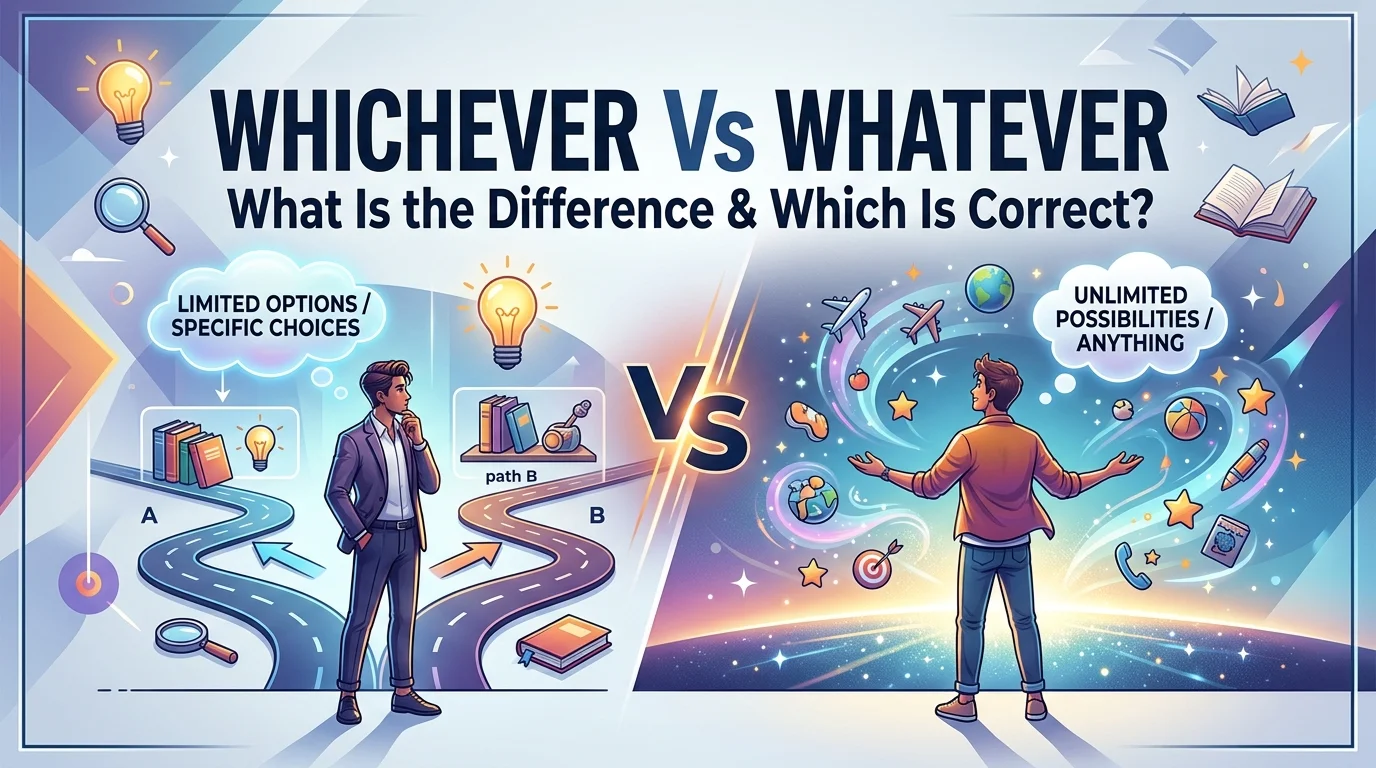

Choosing between whichever and whatever can be confusing because both words express flexibility or a lack of restriction. However, they are not interchangeable in every situation. Understanding the difference helps you write and speak more accurately. This guide explains the meaning, grammar, usage, and practical differences between whichever and whatever in a simple and easy-to-understand way.
Comparison Overview
Both whichever and whatever belong to a group of words known as indefinite pronouns and determiners. They are used when the exact choice, thing, or option is not specified.
The main difference is that whichever refers to a choice from a limited set of options, while whatever refers to anything without emphasizing a specific set of choices.
| Feature | Whichever | Whatever |
| Meaning | Any one from a known set of choices | Anything or any thing at all |
| Focus | Selection among options | No restriction or limitation |
| Used for | Choices and alternatives | Objects, actions, ideas, or situations |
| Specificity | More specific | More general |
| Example | Choose whichever book you like. | Do whatever makes you happy. |
Definition of Whichever
Whichever means any one that or no matter which one from a group of known or possible choices.
It is commonly used when there are multiple options available and the exact choice does not matter.
Examples:
- Take whichever seat is available.
- Choose whichever color you prefer.
- You can use whichever method works best.
The focus is on selecting from available alternatives.
Definition of Whatever
Whatever means anything that, no matter what, or anything at all.
It is used when there are no specific limitations placed on the thing being discussed.
Examples:
- Eat whatever you want.
- Do whatever makes you happy.
- Take whatever you need.
The focus is on complete freedom rather than selecting from specific choices.
Main Differences Between Whichever and Whatever
Although these words appear similar, they serve different purposes.
| Aspect | Whichever | Whatever |
| Refers to | A choice among options | Anything without restriction |
| Implies alternatives | Yes | Not necessarily |
| Common question form | Which one? | What thing? |
| Scope | Limited options | Unlimited possibilities |
| Example | Pick whichever route is faster. | Say whatever you think. |
Consider these examples:
- Choose whichever shirt you like.
- Several shirts exist and you may select one.
- Wear whatever you like.
- There are no restrictions on what you wear.
In the first sentence, the speaker refers to a group of shirts. In the second sentence, the speaker places no limits on clothing choices.
Common Situations Where They Differ
Choosing From Available Options
Use whichever when selecting from choices.
Examples:
- Pick whichever restaurant you prefer.
- Use whichever computer is free.
- Take whichever path looks safest.
Expressing Complete Freedom
Use whatever when there are no restrictions.
Examples:
- Say whatever you want.
- Buy whatever you need.
- Watch whatever interests you.
Formal and Informal Usage
Both words work in formal and informal English, but whichever often sounds more precise because it refers to identifiable choices.
Grammar Guide
How Each Term Is Used in Sentences
Whichever
Pattern:
- Whichever + noun + clause
- Whichever + clause
Examples:
- Choose whichever option fits your budget.
- Whichever team wins will advance.
- Use whichever tool is available.
Whatever
Pattern:
- Whatever + noun + clause
- Whatever + clause
Examples:
- Do whatever you think is right.
- Whatever happens, stay calm.
- Eat whatever food you like.
Common Mistakes Learners Make
Mistake 1: Using Whatever for Limited Choices
Incorrect:
- Choose whatever book on the shelf.
Better:
- Choose whichever book on the shelf.
Mistake 2: Using Whichever for Unlimited Possibilities
Incorrect:
- Do whichever makes you happy.
Better:
- Do whatever makes you happy.
Mistake 3: Confusing “Which” and “What”
Remember:
- Whichever comes from which.
- Whatever comes from what.
Simple Rules to Remember
- If there are identifiable options, use whichever.
- If anything is possible, use whatever.
- Think of whichever as connected to choice.
- Think of whatever as connected to freedom.
- Ask yourself whether a limited set exists.
Quick Tips for Writing and Speaking
- Use whichever when choosing among alternatives.
- Use whatever when no limits exist.
- In professional writing, use whichever for precise selections.
- In everyday conversation, whatever often expresses flexibility.
- Check whether you are referring to options or unrestricted possibilities.
When to Use Each One
Use Whichever When:
- Choosing from several options.
- Referring to available alternatives.
- Discussing selections.
- Giving someone a choice.
- Comparing specific possibilities.
Examples:
- Choose whichever candidate is best qualified.
- Take whichever bus arrives first.
Use Whatever When:
- Referring to anything at all.
- Giving complete freedom.
- Discussing unrestricted actions.
- Expressing acceptance of outcomes.
- Referring to unknown things.
Examples:
- Buy whatever you need.
- Whatever happens, keep trying.
When NOT to Use Each One
Do Not Use Whichever When:
- No specific options exist.
- Referring to anything generally.
- Giving unlimited freedom.
Incorrect:
- Eat whichever you want.
Better:
- Eat whatever you want.
Do Not Use Whatever When:
- Selecting from a known set of alternatives.
- Referring to a specific group of choices.
Incorrect:
- Choose whatever candidate from the list.
Better:
- Choose whichever candidate from the list.
Which One to Use (Decision Guide)
Ask yourself these questions:
Are there specific options available?
- Yes → Whichever
- No → Continue
Are you referring to anything without limits?
- Yes → Whatever
Is the focus on selection?
- Yes → Whichever
Is the focus on freedom?
- Yes → Whatever
Quick decision chart:
| Situation | Correct Word |
| Choosing among options | Whichever |
| Unlimited possibilities | Whatever |
| Selecting one from a group | Whichever |
| Referring to anything | Whatever |
| Making a choice | Whichever |
| No restrictions | Whatever |
Real-World Practical Examples
Whichever Examples
- Education: Choose whichever course matches your goals.
- Daily Life: Sit in whichever chair is empty.
- Business: Use whichever supplier offers the best price.
- Technology: Install whichever software meets your needs.
- Writing: Select whichever title sounds most appealing.
Whatever Examples
- Education: Study whatever interests you most.
- Daily Life: Eat whatever you want for dinner.
- Business: Do whatever is necessary to meet the deadline.
- Science: Record whatever observations you notice.
- Conversation: Say whatever is on your mind.
Self-Assessment (Fill in the Blanks)
- I will use ______ when choosing one option from a list.
- The correct word is ______ because there are no restrictions.
- I will use ______ when selecting a restaurant from several choices.
- The correct word is ______ because anything is acceptable.
- I will use ______ when picking a book from a shelf.
- The correct word is ______ because unlimited possibilities exist.
- I will use ______ when selecting a route from available roads.
- The correct word is ______ because no specific options are mentioned.
- I will use ______ when choosing a candidate from a group.
- The correct word is ______ because any action is acceptable.
- I will use ______ when choosing a color from several samples.
- The correct word is ______ because all possibilities are open.
- I will use ______ when selecting a computer from available devices.
- The correct word is ______ because the choice is unrestricted.
- I will use ______ when deciding among listed alternatives.
- The correct word is ______ because there is complete freedom.
- I will use ______ when choosing one of several plans.
- The correct word is ______ because anything may happen.
- I will use ______ when selecting from identified options.
- The correct word is ______ because no limits are placed on the choice.
Answers
- Whichever
- Whatever
- Whichever
- Whatever
- Whichever
- Whatever
- Whichever
- Whatever
- Whichever
- Whatever
- Whichever
- Whatever
- Whichever
- Whatever
- Whichever
- Whatever
- Whichever
- Whatever
- Whichever
- Whatever
Final Verdict
Whichever and whatever are both useful words, but they serve different purposes. Use whichever when choosing from a known set of options or alternatives. Use whatever when referring to anything without restrictions or limits. If your sentence involves selecting one option from several possibilities, choose whichever. If it allows complete freedom or refers to anything at all, choose whatever. Understanding this simple distinction will help you use both words confidently in speaking and writing.
Conclusion About Whichever Vs Whatever
Understanding the difference between whichever and whatever can make your writing and speaking much clearer. While both words express flexibility, they are used in different situations. Whichever is the right choice when you are selecting from a specific group of options, whereas whatever is used when there are no limits or restrictions on the choice being made. Recognizing this distinction helps you avoid common grammar mistakes and communicate your ideas more accurately.
In everyday conversations, academic writing, business communication, and professional documents, choosing the correct word can improve clarity and confidence. A simple way to remember the difference is that whichever relates to choosing among options, while whatever refers to anything at all. By practicing the examples and rules discussed in this guide, you can confidently decide when to use each term and avoid confusion in both spoken and written English.
FAQs
What is the main difference between whichever and whatever?
The main difference is that whichever refers to choosing from a specific set of options, while whatever refers to anything without restrictions. If choices are available, use whichever. If no limits are placed on the choice, use whatever.
Can whichever and whatever be used interchangeably?
Not always. Although they are similar, they have different meanings. Whichever is used for selecting from known options, while whatever is used when referring to anything generally. Using the wrong one can make a sentence less precise.
Is whichever grammatically correct?
Yes, whichever is completely grammatically correct. It is commonly used in both formal and informal English when a person is choosing one option from several available choices.
Is whatever grammatically correct?
Yes, whatever is also grammatically correct. It is widely used when referring to anything, regardless of limitations, and is appropriate in both casual and formal communication.
When should I use whichever in a sentence?
Use whichever when you are selecting from identifiable options. For example, “Choose whichever seat you prefer” implies there are multiple seats available and one must be selected.
When should I use whatever in a sentence?
Use whatever when no specific options are being considered. For example, “Do whatever makes you happy” gives complete freedom without limiting the possible choices.
Which word is more specific, whichever or whatever?
Whichever is more specific because it involves a known group of options. Whatever is broader and more general because it does not focus on a particular set of choices.
Can whichever be used in formal writing?
Yes, whichever is frequently used in formal writing, academic papers, business documents, and professional communication when discussing alternatives or selections among available options.
Why do learners confuse whichever and whatever?
Learners often confuse them because both words suggest flexibility and freedom. However, the key difference is that whichever involves choices among options, while whatever does not require a specific set of alternatives.
How can I remember the difference easily?
A simple trick is to connect whichever with the word which, which implies choosing among options. Connect whatever with the word what, which refers more broadly to things without specific limitations.
