
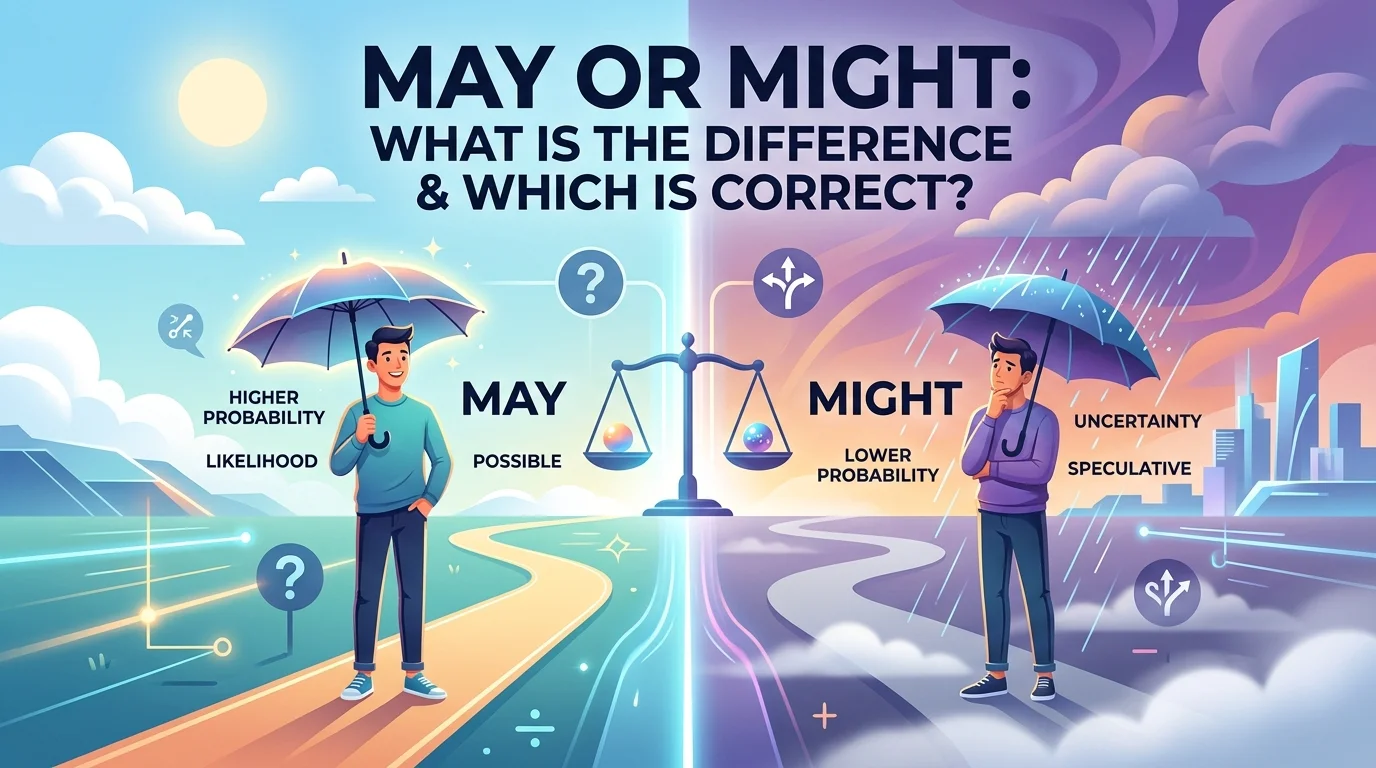

Many English learners struggle with may and might because both words express possibility. While they are closely related and often interchangeable, they can carry slightly different meanings and levels of certainty. Understanding the difference between may and might helps you communicate more accurately in speaking and writing.
Comparison Overview
Both may and might are modal verbs used to talk about possibility, uncertainty, permission, and hypothetical situations. They help speakers express whether something could happen or is likely to happen.
Although they share many similarities, may often suggests a stronger possibility, while might usually indicates a weaker or more uncertain possibility.
| Feature | May | Might |
| Expresses possibility | Yes | Yes |
| Degree of certainty | Slightly stronger | Slightly weaker |
| Used for permission | Yes | Rarely |
| Formal writing | Common | Common |
| Hypothetical situations | Sometimes | Frequently |
| Past reported speech | Often changes to might | Common |
Definition of May
May is a modal verb used to express possibility or permission.
It often suggests that something is possible and has a reasonable chance of happening.
Examples:
- It may rain this afternoon.
- You may leave the classroom now.
- The results may arrive tomorrow.
The word is commonly used in formal and professional communication.
Definition of Might
Might is a modal verb used to express possibility, uncertainty, or hypothetical situations.
It usually indicates a lower degree of certainty than may.
Examples:
- It might rain this afternoon.
- She might join us later.
- We might visit the museum if we have time.
Might is frequently used when discussing imagined or less likely situations.
Main Differences Between May and Might
The biggest difference lies in the level of possibility being expressed.
| Aspect | May | Might |
| Possibility | More likely | Less likely |
| Permission | Commonly used | Rarely used |
| Formal requests | Appropriate | Usually not used |
| Hypothetical meaning | Less common | More common |
| Reported speech | May become might | Standard choice |
Degree of Certainty
- May suggests a stronger chance.
- Might suggests a weaker chance.
Example:
- The train may be late. (Fairly possible)
- The train might be late. (Less certain)
Permission Usage
- You may enter the room. ✔
- You might enter the room. ✘
Hypothetical Situations
- If I had more money, I might buy a new car.
- If she called, I might answer.
May vs Might in Everyday English
In modern English, native speakers often use may and might interchangeably when discussing possibility.
Examples:
- I may go to the party.
- I might go to the party.
Both sentences are grammatically correct, though the second sounds slightly more uncertain.
Comparison Table
| Situation | May | Might |
| Asking permission | ✔ | ✘ |
| Giving permission | ✔ | ✘ |
| Strong possibility | ✔ | Sometimes |
| Weak possibility | Sometimes | ✔ |
| Hypothetical condition | Sometimes | ✔ |
| Formal writing | ✔ | ✔ |
Grammar Guide
How Each Term Is Used in Sentences
May Pattern
Subject + may + base verb
Examples:
- She may arrive soon.
- They may win the game.
- We may need assistance.
Might Pattern
Subject + might + base verb
Examples:
- She might arrive soon.
- They might win the game.
- We might need assistance.
Common Mistakes Learners Make
Using “might” for permission
Incorrect:
- You might leave now.
Correct:
- You may leave now.
Adding “to” after may or might
Incorrect:
- She may to come later.
Correct:
- She may come later.
Using double modals
Incorrect:
- He may might attend.
Correct:
- He may attend.
- He might attend.
Simple Rules to Remember
- Use may for permission.
- Use may when the possibility feels stronger.
- Use might when the possibility feels weaker.
- Use might in many hypothetical situations.
- Never add to after may or might.
Quick Tips for Writing and Speaking
- Use may in formal communication.
- Use might when expressing uncertainty.
- For permission, choose may.
- For imagined situations, choose might.
- When unsure, either word is often acceptable for possibility.
When to Use Each One
Use May When
- Giving permission
- Asking permission formally
- Expressing a reasonably likely possibility
- Writing professional documents
- Making polite statements
Examples:
- May I ask a question?
- The shipment may arrive tomorrow.
- Employees may work remotely.
Use Might When
- Discussing uncertain possibilities
- Talking about hypothetical situations
- Describing less likely outcomes
- Reporting possibilities cautiously
- Speculating about future events
Examples:
- I might stay home tonight.
- She might accept the offer.
- We might see improvements next year.
When NOT to Use Each One
Do Not Use May
- When certainty already exists.
- When discussing definite facts.
Incorrect:
- The sun may rise in the east.
Correct:
- The sun rises in the east.
Do Not Use Might
- When giving official permission.
- When certainty is intended.
Incorrect:
- Students might submit assignments today. (As permission)
Correct:
- Students may submit assignments today.
Which One to Use (Decision Guide)
Ask yourself these questions:
- Are you giving or requesting permission?
- Use may.
- Are you expressing a possibility?
- Either may work.
- Is the possibility fairly strong?
- Use may.
- Is the possibility weaker or more uncertain?
- Use might.
- Are you discussing a hypothetical situation?
- Use might.
Quick Decision Chart
| Situation | Best Choice |
| Permission | May |
| Formal request | May |
| Strong possibility | May |
| Weak possibility | Might |
| Hypothetical event | Might |
| Speculation | Might |
Real-World Practical Examples
May Examples
- Education: Students may access the online library after registration.
- Daily Life: I may visit my grandparents this weekend.
- Science: Increased temperatures may affect plant growth.
- Business: Sales may improve during the holiday season.
- Technology: The update may fix several software issues.
Might Examples
- Education: The professor might postpone the exam.
- Daily Life: We might order pizza tonight.
- Science: The experiment might produce unexpected results.
- Business: Investors might support the new proposal.
- Technology: The application might crash on older devices.
Self-Assessment (Fill in the Blanks)
- I will use ______ when asking for permission.
- The correct word is ______ because the chance is very uncertain.
- It ______ rain later today.
- She ______ attend the meeting if she finishes work early.
- ______ I borrow your notebook?
- We ______ travel next month.
- The package ______ arrive tomorrow.
- He ______ be at home, but I am not sure.
- Employees ______ work remotely with approval.
- The project ______ succeed if funding increases.
- You ______ enter the laboratory now.
- They ______ cancel the event due to weather.
- I ______ apply for the scholarship next year.
- She ______ have forgotten the appointment.
- Visitors ______ park in designated areas.
- We ______ see improvements after the update.
- The company ______ launch a new product soon.
- If I had more time, I ______ learn another language.
- Students ______ use calculators during the test.
- The results ______ vary depending on conditions.
Answers
- May
- Might
- May
- Might
- May
- Might
- May
- Might
- May
- Might
- May
- Might
- May
- Might
- May
- Might
- May
- Might
- May
- May
Final Verdict
Both may and might are correct English modal verbs that express possibility, but they are not always identical. May generally indicates a stronger possibility and is the standard choice for giving or requesting permission. Might usually expresses greater uncertainty and is commonly used in hypothetical situations. In everyday conversation, the two words are often interchangeable, but understanding their subtle differences can make your English sound more natural and precise. If you are talking about permission or a reasonably likely event, choose may. If you are describing a less certain or imagined situation, choose might. Mastering this distinction will improve both your writing and speaking skills.
Conclusion About May or Might
Understanding the difference between may and might can make your English more accurate, confident, and natural. Although both modal verbs express possibility, they are used in slightly different ways. May is often preferred when talking about a stronger possibility or when giving and asking for permission, while might is commonly used for weaker possibilities, uncertainty, and hypothetical situations. In many everyday conversations, the two words can be interchangeable, but choosing the most appropriate one helps convey the exact meaning you intend. Whether you are writing an academic paper, sending a business email, having a casual conversation, or improving your grammar skills, knowing when to use may or might is valuable. By remembering the basic rules, recognizing common mistakes, and practicing with real examples, you can use both words correctly and communicate more effectively in any situation.
FAQs
What is the main difference between may and might?
The main difference is the level of certainty. May usually suggests a stronger possibility, while might often indicates a weaker or more uncertain possibility. However, in many modern contexts, the difference is very small and both words may be acceptable.
Can may and might be used interchangeably?
Yes, they can often be used interchangeably when expressing possibility. For example, “It may rain” and “It might rain” are both correct. However, may can sound slightly more confident, while might can sound less certain.
Is may more formal than might?
Yes, may is generally considered more formal, especially when used for permission or in professional writing. Might is also acceptable in formal English but is more commonly associated with possibility and hypothetical situations.
Which word should I use for permission?
You should use may for permission. Sentences such as “May I leave early?” and “You may enter the room” are standard and grammatically correct. Might is rarely used to give or request permission in modern English.
Is might the past tense of may?
Historically, might developed as a past form of may, but today it functions as its own modal verb. In modern English, it is often used to express uncertainty, possibility, or hypothetical situations rather than simply acting as a past tense.
Can I use might in hypothetical situations?
Yes, might is frequently used in hypothetical situations. For example, “If I had more money, I might buy a larger house.” This use helps describe situations that are imagined rather than real.
Why do native speakers often use might?
Native speakers often use might because it sounds cautious and less definite. It allows speakers to discuss possibilities without sounding too certain, making conversations more natural in uncertain situations.
Is it wrong to say may instead of might?
Not usually. In many sentences, both words are grammatically correct. The choice often depends on how certain you want the possibility to sound. Context and tone determine which option works best.
Which word is better for academic writing?
Both can be used in academic writing. May is commonly used to discuss likely outcomes or interpretations, while might is useful when describing more speculative or uncertain conclusions.
How can I remember when to use may or might?
A simple rule is to use may for permission and stronger possibilities, and use might for weaker possibilities or hypothetical situations. Regular practice with examples will help make the distinction easier to remember.
