
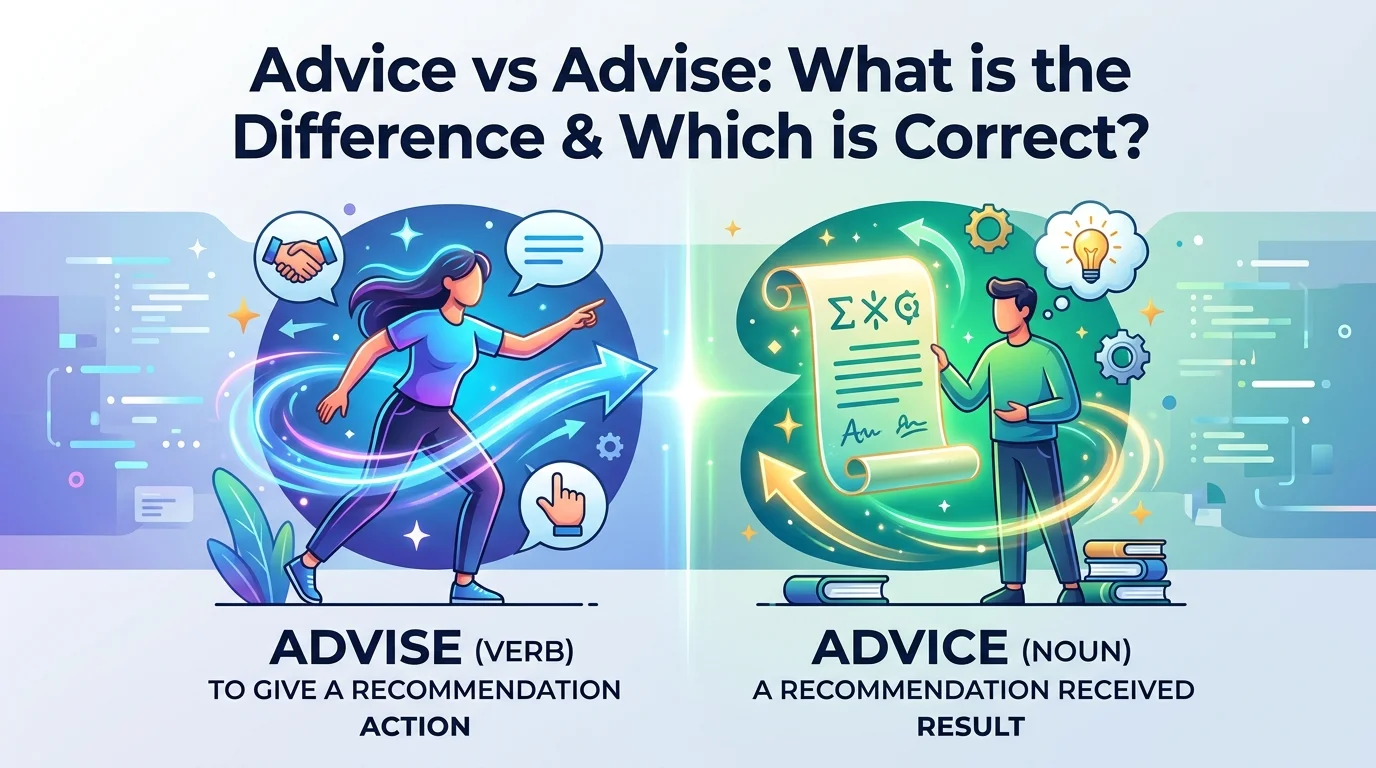

Understanding the difference between advice and advise is important for clear and correct English usage. These two words are often confused because they look similar, but they function differently in grammar and meaning. This guide will help you clearly understand how each word works so you can use them correctly in writing and speaking.
Comparison Overview
Advice and advise are closely related words, but they belong to different parts of speech. Advice is a noun that refers to suggestions or recommendations, while advise is a verb that means the act of giving suggestions. Many learners mix them up because they share the same root and similar spelling, but their usage in sentences is different.
Definition of Advice
Advice is a noun that refers to guidance, recommendations, or opinions offered to help someone make a decision. It is something you receive from others rather than something you do.
It is commonly used in everyday communication when talking about suggestions, guidance, or counsel.
Definition of Advise
Advise is a verb that means to give advice or recommendations to someone. It describes the action of offering guidance or suggestions.
It is used when someone is actively helping another person by telling them what they think is best.
Main Differences Between Advice and Advise
The key difference between advice and advise lies in their grammar and function. Advice is a noun, while advise is a verb. Advice refers to the suggestion itself, whereas advise refers to the act of giving that suggestion.
Advice is something you can receive, accept, or follow. Advise is something you do when you guide or recommend something to someone else.
| Aspect | Advice | Advise |
| Part of speech | Noun | Verb |
| Meaning | Suggestion or guidance | To give suggestions |
| Usage | Received or given as information | Action of giving guidance |
| Example | Good advice helps decisions | Teachers advise students |
Grammar Guide
Understanding the grammar of advice and advise helps avoid common confusion and mistakes in writing and speaking.
How each term is used in sentences
Advice is used as a noun in sentences such as:
You can give someone advice or receive advice from someone.
Advise is used as a verb in sentences such as:
You advise someone to do something.
Common mistakes learners make
Many learners mistakenly use advice as a verb or advise as a noun. Another common mistake is spelling advice when the verb form is needed or using advise when referring to a piece of guidance.
Simple rules to remember
Advice ends with ice and is a thing you can receive. Advise ends with ise and is an action you perform. If you can replace the word with suggestion, use advice. If you can replace it with recommend, use advise.
Quick tips for writing and speaking
Think of advice as a thing and advise as an action. When in doubt, check if the sentence needs a noun or a verb before choosing the correct word.
When to Use Each One
Use advice when talking about suggestions or recommendations received from someone else. It is suitable for conversations about decisions, problems, or guidance.
Use advise when describing the act of giving suggestions, especially in formal or instructional contexts such as teaching, counseling, or professional communication.
When NOT to Use Each One
Do not use advice when you need a verb in the sentence. Avoid using advise as a noun when referring to a piece of guidance. Mixing them can make sentences grammatically incorrect and confusing.
Which One to Use (Decision Guide)
If you are talking about a thing or idea you receive, use advice. If you are describing an action of telling someone what to do or suggesting something, use advise. Checking whether the sentence needs a noun or verb will help you choose correctly every time.
Real-World Practical Examples
Advice Examples
- I need your advice about choosing a career.
- Her advice helped me solve the problem quickly.
- He always follows his father’s advice before making decisions.
- The doctor gave me advice on improving my health.
- Good financial advice can save you money in the long run.
Advise Examples
- I advise you to study harder for the exam.
- The teacher advises students to read daily.
- Doctors advise patients to exercise regularly.
- I advise against making a quick decision.
- Experts advise businesses to plan carefully before investing.
Self-Assessment (Fill in the Blanks)
- I need your ______ about this situation.
- The teacher will ______ students before the exam.
- Good ______ can help you make better choices.
- I always ______ my friends to stay focused.
- His ______ was very helpful.
- The doctor will ______ you on healthy eating.
- She gave me useful ______ about studying abroad.
- I ______ you to take care of your health.
- Financial ______ is important for saving money.
- They ______ us to avoid risky decisions.
- I followed my parents’ ______ carefully.
- The manager will ______ employees about safety rules.
- He ignored my ______ and made a mistake.
- I ______ you to start early.
- Her ______ changed my perspective.
- The expert will ______ clients on investments.
- I need professional ______ before deciding.
- They always ______ new employees during training.
- That was the best ______ I received.
- I strongly ______ you to think again.
Answers
- advice
- advise
- advice
- advise
- advice
- advise
- advice
- advise
- advice
- advise
- advice
- advise
- advice
- advise
- advice
- advise
- advice
- advise
- advice
- advise
Final Verdict
Advice and advise are often confused but have very clear roles in English grammar. Advice is a noun used for suggestions or guidance, while advise is a verb used for the act of giving suggestions. Once you understand this difference, using them correctly becomes simple and natural in both writing and speech.
Conclusion About Advice vs Advise
Understanding the difference between advice and advise makes English grammar much easier and more accurate in everyday use. Although these two words look similar, they serve completely different roles in sentences. Advice is used when referring to suggestions or guidance, while advise is used when describing the action of giving those suggestions. Once you remember that advice is a noun and advise is a verb, confusion becomes much less likely. Using them correctly not only improves your grammar but also makes your communication clearer and more professional in both writing and speaking.
FAQs
What is the main difference between advice and advise?
Advice is a noun that means a suggestion or guidance, while advise is a verb that means to give suggestions or guidance. The key difference is that advice is something you receive, whereas advise is something you do when offering help or recommendations.
Is advice a noun or verb?
Advice is a noun. It refers to guidance, recommendations, or suggestions given to help someone make a decision. You cannot use advice as an action word in correct grammar.
Is advise a noun or verb?
Advise is a verb. It is used when someone is giving guidance or suggestions to another person. For example, teachers advise students or doctors advise patients about health matters.
Can advice and advise be used interchangeably?
No, they cannot be used interchangeably. Using advice in place of advise or vice versa creates grammatical errors because they belong to different parts of speech and serve different functions in a sentence.
How do I remember advice vs advise easily?
A simple trick is to remember that advice ends with ice, which is a thing you receive. Advise ends with ise, which is an action you perform. This helps quickly identify correct usage in writing.
Can you give an example of advice in a sentence?
Yes. For example, “She gave me good advice about choosing a university.” In this sentence, advice is used as a noun meaning guidance or suggestion received from someone else.
Can you give an example of advise in a sentence?
Yes. For example, “I advise you to save money for the future.” Here, advise is used as a verb showing the action of giving a recommendation or suggestion.
Why do people confuse advice and advise?
People confuse them because they are spelled similarly and share the same root meaning. However, their grammatical roles are different, which causes mistakes in writing and speaking, especially for learners of English.
Is advice formal or informal?
Advice can be used in both formal and informal contexts. It is commonly used in everyday conversations as well as professional settings like education, business, and healthcare when referring to suggestions or guidance.
When should I use advise in professional writing?
You should use advise in professional writing when describing the act of giving recommendations, especially in formal communication such as reports, instructions, policies, or expert guidance in fields like medicine, education, or business.
