
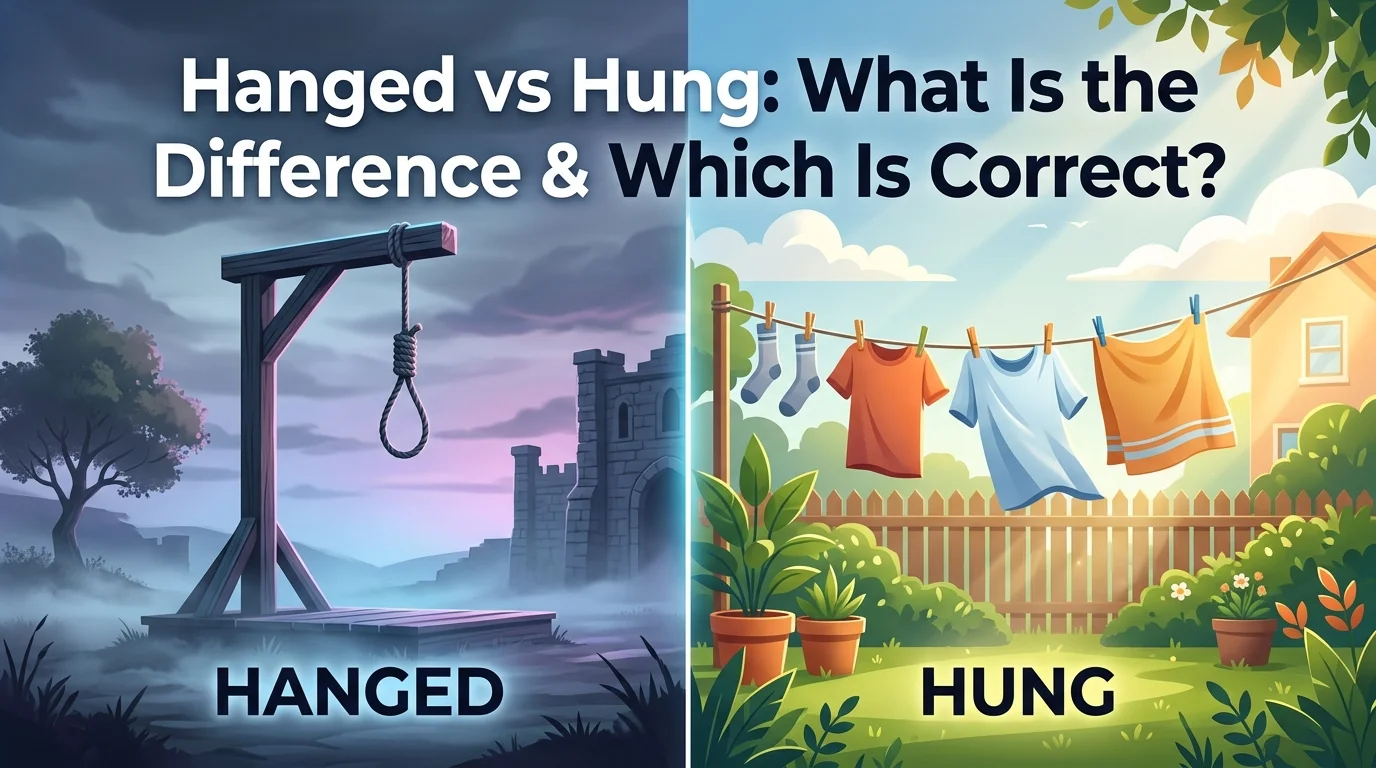

Understanding the difference between hanged and hung is important because both words come from the same verb, hang, but they are used in different situations. Many English learners and even native speakers confuse them. Knowing when to use hanged and when to use hung can improve your grammar, writing, and everyday communication.
Comparison Overview
Both hanged and hung are past tense and past participle forms of the verb hang. However, they are not interchangeable in every context.
- Hanged is used when referring to execution by hanging.
- Hung is used for everything else, such as placing objects on walls, suspending items, or attaching something above the ground.
The distinction is based on meaning and context rather than grammatical tense.
Definition of Hanged
Hanged is the past tense and past participle form of hang when referring to a person being executed by suspension from the neck.
It is a specialized grammatical form reserved for legal, historical, and criminal justice contexts.
Examples:
- The prisoner was hanged for treason.
- The criminal was hanged in the town square.
- The king ordered that the rebel be hanged.
Definition of Hung
Hung is the standard past tense and past participle form of hang in nearly all situations unrelated to execution.
It refers to placing, suspending, or attaching something above the ground or another surface.
Examples:
- She hung the picture on the wall.
- The coat was hung in the closet.
- Colorful lights were hung across the room.
Main Differences Between Hanged and Hung
| Feature | Hanged | Hung |
| Meaning | Executed by hanging | Suspended, attached, or placed above |
| Usage | Legal and historical contexts | Everyday contexts |
| Refers to people? | Yes, when executed | Usually not in execution contexts |
| Commonness | Rare and specialized | Very common |
| Example | The prisoner was hanged. | The painting was hung. |
Historical and Language Background
The verb hang originally had multiple past forms in English. Over time, usage became standardized.
Today:
- Hung became the normal past tense for ordinary situations.
- Hanged survived only in the context of execution.
This distinction is recognized by major grammar guides, dictionaries, and style manuals.
Why People Confuse Hanged and Hung
The confusion occurs because both words originate from the same verb.
For example:
- He hung the decorations.
- The criminal was hanged.
Since most verbs have only one past tense form, learners often assume one form should work everywhere. However, hang is an exception.
Grammar Guide
How Each Term Is Used in Sentences
Hanged
Pattern:
- Subject + was/were + hanged
Examples:
- The prisoner was hanged.
- The traitor was hanged for his crimes.
- Several criminals were hanged.
Hung
Pattern:
- Subject + hung + object
- Object + was/were hung
Examples:
- She hung the artwork.
- The jacket was hung on a hook.
- They hung banners around the stadium.
Common Mistakes Learners Make
Mistake 1:
- ❌ The prisoner was hung.
- ✅ The prisoner was hanged.
Mistake 2:
- ❌ She hanged the picture.
- ✅ She hung the picture.
Mistake 3:
- ❌ The decorations were hanged on the wall.
- ✅ The decorations were hung on the wall.
Mistake 4:
- ❌ The criminal was hung last year.
- ✅ The criminal was hanged last year.
Simple Rules to Remember
- If execution is involved, use hanged.
- For objects and everyday situations, use hung.
- Pictures are hung.
- Clothes are hung.
- Decorations are hung.
- Executed people are hanged.
Quick Tips for Writing and Speaking
- Think of hanged as a legal term.
- Use hung for nearly everything else.
- If you are unsure, ask whether execution is being discussed.
- In business, education, and daily communication, hung is almost always correct.
When to Use Each One
Use Hanged When
- Discussing executions.
- Referring to historical punishments.
- Writing about legal or criminal justice matters.
- Describing death by judicial hanging.
Examples:
- The outlaw was hanged.
- The sentence required that he be hanged.
- The convicted murderer was hanged.
Use Hung When
- Talking about decorations.
- Referring to clothing.
- Discussing artwork.
- Describing suspended objects.
- Writing about everyday activities.
Examples:
- She hung the curtains.
- They hung lights outside.
- The picture was hung above the fireplace.
When NOT to Use Each One
Do Not Use Hanged
Incorrect:
- The photo was hanged on the wall.
- She hanged her coat in the closet.
- We hanged decorations at the party.
Correct:
- The photo was hung on the wall.
- She hung her coat in the closet.
- We hung decorations at the party.
Do Not Use Hung
Incorrect:
- The criminal was hung after conviction.
- The prisoner was hung by the state.
Correct:
- The criminal was hanged after conviction.
- The prisoner was hanged by the state.
Which One to Use (Decision Guide)
Ask yourself one question:
Is the sentence about execution by hanging?
- Yes → Use hanged.
- No → Use hung.
Quick Decision Chart:
| Situation | Correct Word |
| Executed criminal | Hanged |
| Picture on wall | Hung |
| Coat in closet | Hung |
| Historical execution | Hanged |
| Decorations | Hung |
| Artwork display | Hung |
| Judicial punishment | Hanged |
Real-World Practical Examples
Hanged Examples
- The convicted criminal was hanged according to the law.
- The rebel leader was hanged after the trial.
- Historical records show that pirates were often hanged.
- The prisoner was hanged in the nineteenth century.
- The court ordered that the offender be hanged.
Hung Examples
- The teacher hung maps around the classroom.
- She hung family photos in the hallway.
- The company hung banners during the event.
- The engineer hung cables from the ceiling.
- Holiday lights were hung across the street.
Self-Assessment (Fill in the Blanks)
- I will use ______ when referring to a legal execution. The correct word is ______ because it describes judicial hanging.
- I will use ______ when talking about a picture on a wall. The correct word is ______ because no execution is involved.
- I will use ______ when discussing a convicted criminal’s execution. The correct word is ______ because execution requires a special form.
- I will use ______ when describing a coat in a closet. The correct word is ______ because it refers to suspension.
- I will use ______ when discussing historical executions. The correct word is ______ because it involves capital punishment.
- I will use ______ when talking about decorations at a party. The correct word is ______ because decorations are suspended objects.
- I will use ______ when referring to a person executed by the state. The correct word is ______ because execution is involved.
- I will use ______ when describing artwork above a fireplace. The correct word is ______ because it refers to placement.
- I will use ______ when discussing a legal death sentence. The correct word is ______ because the context is execution.
- I will use ______ when talking about curtains in a room. The correct word is ______ because curtains are attached or suspended.
- I will use ______ when describing a pirate’s execution. The correct word is ______ because the person was executed.
- I will use ______ when referring to classroom posters. The correct word is ______ because posters are displayed.
- I will use ______ when discussing an outlaw executed centuries ago. The correct word is ______ because execution occurred.
- I will use ______ when describing lights across a street. The correct word is ______ because they are suspended.
- I will use ______ when discussing judicial punishment by hanging. The correct word is ______ because execution is the meaning.
- I will use ______ when talking about a painting in a museum. The correct word is ______ because the object is displayed.
- I will use ______ when referring to a prisoner put to death by hanging. The correct word is ______ because it is an execution.
- I will use ______ when describing a sign attached to a wall. The correct word is ______ because it refers to placement.
- I will use ______ when discussing historical capital punishment. The correct word is ______ because the context is execution.
- I will use ______ when talking about clothes on hooks. The correct word is ______ because clothes are suspended.
Answers
- Hanged
- Hung
- Hanged
- Hung
- Hanged
- Hung
- Hanged
- Hung
- Hanged
- Hung
- Hanged
- Hung
- Hanged
- Hung
- Hanged
- Hung
- Hanged
- Hung
- Hanged
- Hung
Final Verdict
The difference between hanged and hung is straightforward once you understand the context. Hanged is reserved exclusively for execution by hanging and is commonly used in legal, historical, and criminal justice discussions. Hung, on the other hand, is the standard past tense and past participle form used for nearly every other meaning of hang, including pictures, decorations, clothing, signs, lights, and artwork. If the sentence involves a person being executed, choose hanged. For all ordinary situations involving objects that are attached, suspended, or displayed, choose hung. Remembering this simple distinction will help you write and speak more accurately and confidently in both formal and everyday English.
Conclusion About Hanged vs Hung
Understanding the difference between hanged vs hung becomes much easier once you know the specific context in which each word is used. Although both forms come from the verb hang, they serve different purposes in modern English. Hanged is reserved for situations involving execution by hanging, while hung is the correct choice for almost every other meaning, including pictures, clothes, decorations, signs, and other suspended objects. This distinction is important in both formal and everyday communication because using the wrong form can change the meaning of a sentence or make your writing appear less accurate. Whether you are a student, writer, teacher, or English learner, remembering this simple rule will help you avoid common mistakes. When in doubt, ask yourself if the sentence involves an execution. If it does, use hanged. If it does not, hung is almost certainly the correct choice.
FAQs
What is the difference between hanged and hung?
The main difference is that hanged is used when referring to a person executed by hanging, while hung is used for all other meanings of the verb hang. For example, a picture is hung on a wall, but a criminal was hanged.
Is hanged grammatically correct?
Yes, hanged is grammatically correct when discussing execution by hanging. It is a special past tense and past participle form that remains standard in legal, historical, and formal writing related to capital punishment.
Can I say a picture was hanged on the wall?
No, that would be incorrect. When talking about pictures, artwork, decorations, or other objects, the correct word is hung. The word hanged should only be used when referring to execution by hanging.
Why does English have both hanged and hung?
English preserves both forms because they developed from the same verb over time. While hung became the standard form for everyday use, hanged remained in use specifically for legal and historical references to execution.
Is hung ever used for people?
Yes, hung can describe people in non-execution contexts, though it is uncommon. However, when the meaning involves execution by hanging, hanged is always the correct and accepted form.
Which word should students use in essays?
Students should use hung for ordinary situations involving objects and hanged only when discussing executions, historical punishments, or legal matters. Choosing the correct form helps improve grammatical accuracy and clarity.
Are hanged and hung both past participles?
Yes, both are past participles of the verb hang. The difference lies in their usage. Hung is used in general contexts, while hanged is restricted to the specific context of execution.
Do dictionaries recognize both hanged and hung?
Yes, major dictionaries recognize both forms. They clearly explain that hung is the standard past tense and past participle for most uses, while hanged is reserved for execution-related meanings.
What is the easiest way to remember hanged vs hung?
A simple rule is to think about execution. If someone was executed by hanging, use hanged. For pictures, clothes, signs, decorations, lights, or anything else suspended, use hung.
Is hanged vs hung a common grammar mistake?
Yes, it is a very common grammar mistake among English learners and native speakers alike. Because both words come from the same verb, many people mistakenly use them interchangeably even though their meanings are different.
