
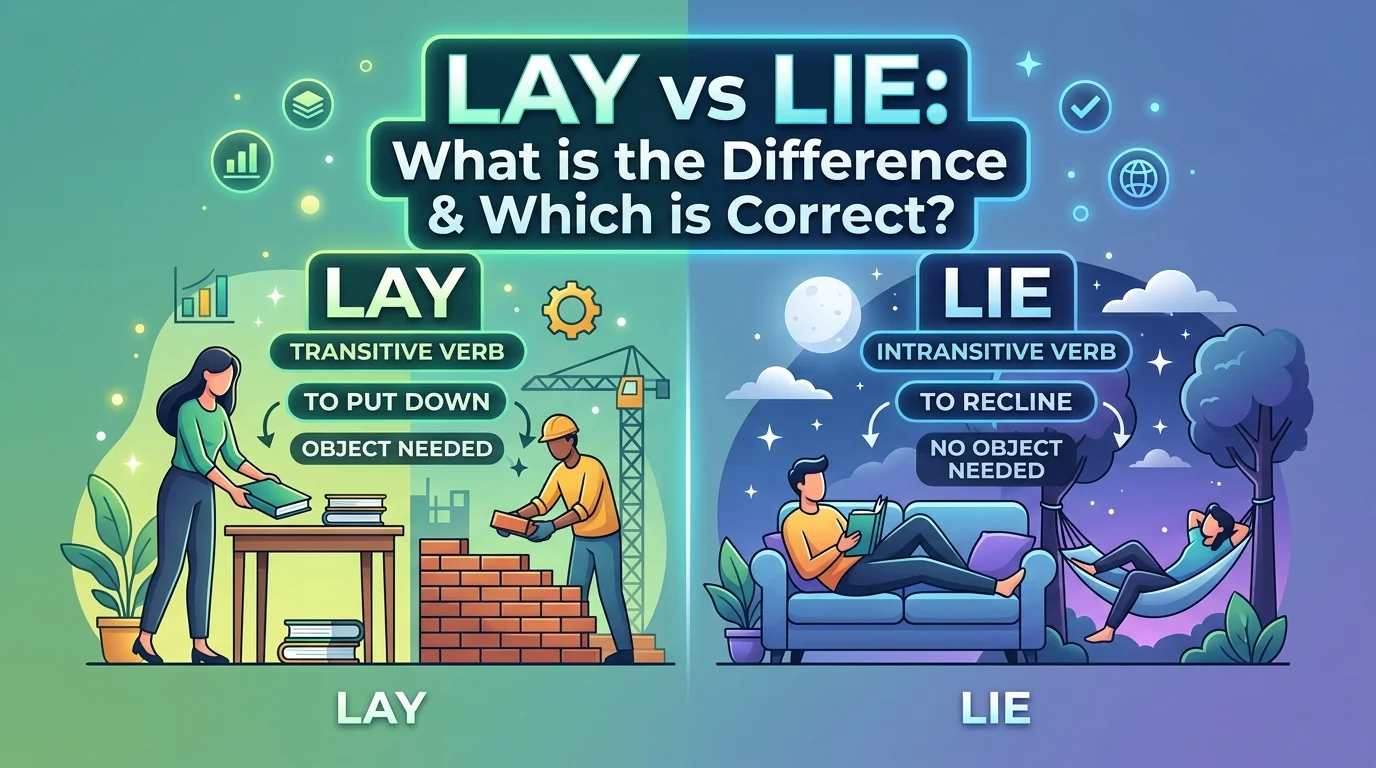

Understanding the difference between lay and lie is one of the most common grammar challenges in English. These two verbs are often confused because they relate to position and movement, and some of their past tense forms look similar. Learning when to use lay and lie correctly can improve both your writing and speaking skills.
Comparison Overview
Lay and lie are both verbs, but they have different meanings and grammatical structures.
- Lay means to put or place something down.
- Lie means to recline, rest, or be in a flat position.
The key difference is that lay usually requires an object, while lie does not.
| Feature | Lay | Lie |
| Meaning | To place something down | To recline or rest |
| Needs an object? | Yes | No |
| Example | Lay the book on the table. | Lie on the bed. |
| Action type | Done to something | Done by the subject |
Definition of Lay
Lay means to put, place, or set something somewhere. It is a transitive verb, meaning it requires a direct object.
Examples:
- Please lay the keys on the counter.
- She laid the blanket on the grass.
- The worker will lay the bricks carefully.
In every example, something is being placed somewhere.
Definition of Lie
Lie means to rest, recline, or remain in a horizontal position. It is an intransitive verb, meaning it does not take a direct object.
Examples:
- I need to lie down for a few minutes.
- The cat lies on the sofa every afternoon.
- The books lie untouched on the shelf.
In these examples, the subject itself is resting or remaining somewhere.
Main Differences Between Lay and Lie
The distinction between these verbs becomes easier when you focus on what the action affects.
| Aspect | Lay | Lie |
| Basic Meaning | Put something down | Rest or recline |
| Verb Type | Transitive | Intransitive |
| Requires Object | Yes | No |
| Present Tense | Lay | Lie |
| Past Tense | Laid | Lay |
| Past Participle | Laid | Lain |
Examples:
- Lay the phone on the desk. ✔
- Lie on the couch. ✔
- Lie the phone on the desk. ✘
- Lay on the couch. ✘
Understanding Their Verb Forms
Because these verbs have unusual tense changes, many learners become confused.
| Tense | Lay | Lie |
| Present | Lay | Lie |
| Past | Laid | Lay |
| Past Participle | Laid | Lain |
| Present Participle | Laying | Lying |
Examples:
- Today I lay the papers on the table.
- Yesterday I laid the papers on the table.
- The papers have been laid on the table.
Examples with lie:
- Today I lie on the couch.
- Yesterday I lay on the couch.
- I have lain on this couch all afternoon.
Common Situations Where Confusion Happens
Many people mistakenly use lay when they mean lie because the past tense of lie is lay.
Correct:
- Yesterday I lay on the beach.
Incorrect:
- Yesterday I laid on the beach.
The second sentence is wrong unless an object is being placed somewhere.
Grammar Guide
How Each Term Is Used in Sentences
Lay Pattern
Subject + Lay + Object
Examples:
- Lay the towel on the chair.
- Lay the report on my desk.
- Lay the cards face down.
Lie Pattern
Subject + Lie
Examples:
- Lie on the bed.
- The dog lies under the table.
- They lie quietly in the sun.
Common Mistakes Learners Make
- Using lay instead of lie.
- Forgetting that lay requires an object.
- Confusing the past tense forms.
- Using laid when no object exists.
- Mixing up lain and laid.
Incorrect:
- I laid down for a nap.
Correct:
- I lay down for a nap.
Simple Rules to Remember
- If you can place something, use lay.
- If someone is resting, use lie.
- Ask yourself: “What is being placed?”
- If there is no object, use lie.
Memory trick:
Lay = Place
Both words involve acting on something.
Quick Tips for Writing and Speaking
- Look for an object after the verb.
- If there is an object, choose lay.
- If the subject is simply resting, choose lie.
- Double-check past tense forms.
- Practice with everyday examples.
When to Use Each One
Use lay when:
- Placing an item somewhere.
- Setting objects down.
- Arranging materials.
- Positioning equipment.
- Putting something in a specific location.
Use lie when:
- Resting.
- Reclining.
- Sleeping.
- Remaining in a position.
- Describing location without moving an object.
When NOT to Use Each One
Do not use lay when:
- Nobody is placing an object.
- The subject is simply resting.
- There is no direct object.
Do not use lie when:
- Something is being placed.
- An object follows the verb.
- You are describing an action performed on another thing.
Incorrect:
- Lie the notebook on the desk.
Correct:
- Lay the notebook on the desk.
Which One to Use (Decision Guide)
Ask these questions:
Are you placing something?
If yes, use lay.
Example:
- Lay the laptop on the table.
Is someone resting or reclining?
If yes, use lie.
Example:
- Lie on the sofa.
Is there a direct object?
If yes, use lay.
Example:
- Lay the papers here.
No direct object?
Use lie.
Example:
- The papers lie untouched.
Real-World Practical Examples
Lay Examples
- The teacher laid the worksheets on every desk.
- Please lay the groceries on the kitchen counter.
- Engineers lay cables underground.
- The gardener laid fresh soil around the plants.
- The designer laid the documents beside the computer.
Lie Examples
- Students often lie on the grass during breaks.
- The smartphone lies next to the keyboard.
- Scientists observed that the fossils lie beneath several rock layers.
- The contract lies in the office archive.
- After work, I like to lie on the couch and read.
Self-Assessment (Fill in the Blanks)
- I will use ______ when placing a book on a shelf.
- The correct word is ______ because the person is resting on a bed.
- Please ______ the papers on my desk.
- The dog likes to ______ in the sun.
- Workers will ______ new pipes underground.
- I need to ______ down for a while.
- The keys ______ on the kitchen counter.
- Please ______ the blanket over the chair.
- The cat will ______ beside the fireplace.
- They carefully ______ the foundation stones.
- I will ______ the phone on the table.
- The hikers ______ on the grass after lunch.
- Please ______ your backpack near the door.
- The documents ______ untouched in storage.
- Farmers ______ seeds in neat rows.
- Children like to ______ on the floor while reading.
- The manager ______ the report on the conference table.
- The book will ______ open on the desk.
- Builders ______ bricks every day.
- I want to ______ down and relax.
Answers
- Lay
- Lie
- Lay
- Lie
- Lay
- Lie
- Lie
- Lay
- Lie
- Lay
- Lay
- Lie
- Lay
- Lie
- Lay
- Lie
- Laid
- Lie
- Lay
- Lie
Final Verdict
The difference between lay and lie comes down to one simple idea: lay means to place something, while lie means to rest or recline. If an action affects an object, use lay. If the subject is simply resting or remaining somewhere, use lie. Although their past tense forms can be confusing, remembering that lay requires an object and lie does not will help you make the right choice in most situations. With regular practice and attention to sentence structure, you can confidently use both words correctly in writing, speaking, education, business communication, and everyday conversations.
Conclusion About Lay vs Lie
Understanding the difference between lay vs lie can seem challenging at first, but it becomes much easier once you remember their basic functions. Lay means to place or put something somewhere, while lie means to rest, recline, or be positioned in a certain place. The biggest clue is whether the verb acts on an object. If something is being placed, use lay. If the subject is simply resting or remaining somewhere, use lie. Many English learners struggle because the past tense forms overlap, but regular practice with real examples can help eliminate confusion. Whether you are writing academic papers, business emails, creative content, or everyday messages, mastering lay and lie will make your communication clearer and more professional. By focusing on context, sentence structure, and the presence or absence of an object, you can confidently choose the correct word every time.
FAQs
What is the main difference between lay and lie?
The main difference is that lay means to place something down and requires a direct object, while lie means to rest or recline and does not require an object. Understanding this distinction helps prevent many common grammar mistakes.
Is lay transitive and lie intransitive?
Yes. Lay is a transitive verb because it acts on an object, such as a book or a blanket. Lie is an intransitive verb because the subject performs the action without affecting another object.
Why do people confuse lay and lie?
People often confuse these words because their meanings are related and their verb forms overlap. The past tense of lie is lay, which creates confusion even among native English speakers.
Can I say “lay down” instead of “lie down”?
Not usually. If you are talking about yourself resting, lie down is grammatically correct. Lay down is correct only when you are placing something down, such as laying a bag on a chair.
What is the past tense of lay?
The past tense of lay is laid. For example, “She laid the documents on the desk yesterday.” The action involves placing an object somewhere.
What is the past tense of lie?
The past tense of lie is lay. For example, “He lay on the beach all afternoon.” This form is one reason many learners mix up the two verbs.
How can I quickly remember when to use lay?
A simple trick is to remember that lay means “place.” If you can identify something being placed somewhere, lay is usually the correct choice.
How can I quickly remember when to use lie?
Use lie when a person, animal, or thing is resting or remaining in a position. If there is no direct object receiving the action, lie is often the correct verb.
Are lay and lie important in formal writing?
Yes. Correctly using lay and lie improves clarity and professionalism. Proper grammar is especially important in academic writing, business communication, journalism, and professional correspondence.
Can objects also lie somewhere?
Yes. The verb lie is not limited to people. Objects can also lie somewhere when they remain in a position. For example, “The papers lie on the desk awaiting review.”
