
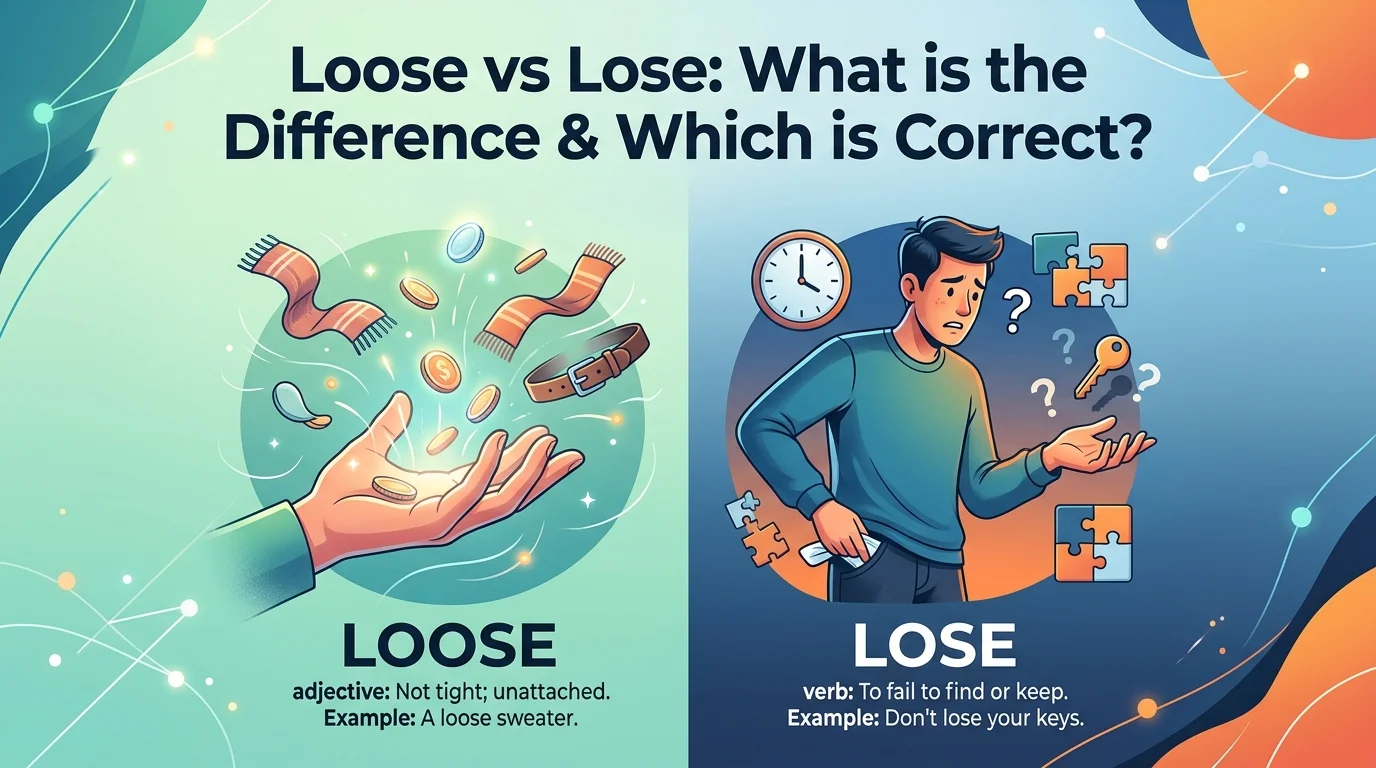

Many English learners confuse loose and lose because they look and sound similar. However, they have completely different meanings and grammatical functions. Understanding the difference between these two words is important for writing and speaking correctly. This guide explains their definitions, usage, grammar rules, examples, and common mistakes in a simple and beginner-friendly way.
Comparison Overview
Loose and lose are commonly confused words in English. While they differ by only one letter, they serve different purposes.
| Feature | Loose | Lose |
| Part of Speech | Adjective (mainly) | Verb |
| Meaning | Not tight, free, not firmly attached | To misplace, fail to keep, or no longer have |
| Pronunciation | Loos | Looz |
| Usage | Describes a condition | Describes an action |
| Example | My shirt is loose. | I don’t want to lose my keys. |
Definition of Loose
Loose is an adjective that describes something that is not tight, secure, or firmly attached. It can refer to clothing, objects, or even ideas that lack strict control.
Core Meaning
Something is loose when it has extra space, movement, or freedom.
Examples
- These shoes are too loose.
- The screw is loose.
- Her hair was loose.
- The dog got loose from the yard.
- The rules are quite loose.
Definition of Lose
Lose is a verb that means to no longer have something, fail to keep something, or be defeated.
Core Meaning
You lose something when it is gone, misplaced, or taken away from you.
Examples
- I don’t want to lose my wallet.
- Our team might lose the game.
- She lost her phone yesterday.
- You can lose weight through exercise.
- They could lose customers if prices rise.
Main Differences Between Loose and Lose
The primary difference is that loose describes a state or condition, while lose describes an action.
| Aspect | Loose | Lose |
| Function | Describes something | Shows an action |
| Part of Speech | Adjective | Verb |
| Meaning | Not tight | Misplace, fail to keep |
| Example | The rope is loose. | Don’t lose the rope. |
| Question Answered | What is it like? | What happened? |
Key Distinction
- Loose = not tight
- Lose = no longer have
Example:
- The belt is loose.
- I might lose my belt.
Pronunciation Differences
Many mistakes occur because people pronounce these words incorrectly.
| Word | Pronunciation |
| Loose | /luːs/ |
| Lose | /luːz/ |
Notice that loose ends with an s sound, while lose ends with a z sound.
Common Situations Where They Are Confused
People often write:
❌ I don’t want to loose my phone.
Correct:
✅ I don’t want to lose my phone.
People often write:
❌ My shirt will lose after washing.
Correct:
✅ My shirt will become loose after washing.
Grammar Guide
How each term is used in sentences
Loose
Usually functions as an adjective.
Pattern:
Subject + be verb + loose
Examples:
- The knot is loose.
- My jacket feels loose.
- The wheel became loose.
Lose
Functions as a verb.
Pattern:
Subject + lose + object
Examples:
- I lose my keys often.
- They may lose the match.
- We cannot lose this opportunity.
Common mistakes learners make
Mistake 1
❌ I will loose my bag.
✅ I will lose my bag.
Mistake 2
❌ These pants lose around the waist.
✅ These pants are loose around the waist.
Mistake 3
❌ Don’t loose focus.
✅ Don’t lose focus.
Simple rules to remember
- Loose has two O’s because it has extra room.
- Lose means something disappears.
- Loose is usually an adjective.
- Lose is always a verb.
- If you can replace it with “not tight,” use loose.
Quick tips for writing and speaking
- Check whether the word describes something or shows an action.
- If it’s an action, use lose.
- If it’s a condition, use loose.
- Remember: “I can lose something because it is loose.”
When to Use Each One
Use Loose When
- Talking about clothing that is not tight.
- Describing objects that are not firmly attached.
- Discussing relaxed rules.
- Referring to animals that are not confined.
- Describing freedom of movement.
Examples:
- The button is loose.
- His shirt is loose.
- The horse is loose.
- The regulations are loose.
- The wire became loose.
Use Lose When
- Talking about misplacing items.
- Discussing competition or defeat.
- Referring to weight reduction.
- Talking about missed opportunities.
- Describing loss of possession.
Examples:
- Don’t lose your passport.
- We might lose the game.
- She wants to lose weight.
- They could lose money.
- I don’t want to lose contact.
When NOT to Use Each One
Do Not Use Loose
❌ I don’t want to loose my wallet.
Correct:
✅ I don’t want to lose my wallet.
❌ We may loose the match.
Correct:
✅ We may lose the match.
Do Not Use Lose
❌ My shoes are lose.
Correct:
✅ My shoes are loose.
❌ The screw feels lose.
Correct:
✅ The screw feels loose.
Which One to Use (Decision Guide)
Ask yourself these questions:
Are you describing something that is not tight?
Use Loose.
Examples:
- Loose clothing
- Loose screw
- Loose knot
Are you talking about losing, misplacing, failing, or being defeated?
Use Lose.
Examples:
- Lose a game
- Lose money
- Lose keys
Quick Decision Chart
| If You Mean… | Use |
| Not tight | Loose |
| Missing something | Lose |
| Free or unattached | Loose |
| Defeat in a competition | Lose |
| Relaxed or unrestricted | Loose |
| No longer possess something | Lose |
Real-World Practical Examples
Loose Examples
- The student’s backpack straps were loose.
- The scientist noticed a loose connection in the equipment.
- My shirt feels loose after losing weight.
- The mechanic tightened a loose bolt.
- The dog’s collar was too loose.
Lose Examples
- Students may lose marks for late submissions.
- Businesses can lose customers due to poor service.
- You could lose important files without backups.
- Athletes hate to lose important competitions.
- Drivers can lose concentration during long trips.
Self-Assessment (Fill in the Blanks)
- I will use ______ when referring to clothing that is not tight.
- The correct word is ______ because it means to misplace something.
- I will use ______ when talking about a relaxed fit.
- The correct word is ______ because it means being defeated in a game.
- I will use ______ when describing a screw that is not secure.
- The correct word is ______ because it refers to misplacing keys.
- I will use ______ when describing extra room in a jacket.
- The correct word is ______ because it means no longer having money.
- I will use ______ when talking about an unattached wire.
- The correct word is ______ because it refers to failing to win.
- I will use ______ when describing a free-moving rope.
- The correct word is ______ because it means no longer possessing an item.
- I will use ______ when discussing clothing fit.
- The correct word is ______ because it means being defeated.
- I will use ______ when describing a knot that is not tight.
- The correct word is ______ because it means misplacing a document.
- I will use ______ when referring to a bolt needing tightening.
- The correct word is ______ because it means no longer keeping something.
- I will use ______ when describing something not firmly attached.
- The correct word is ______ because it refers to being unable to retain possession.
Answers
- Loose
- Lose
- Loose
- Lose
- Loose
- Lose
- Loose
- Lose
- Loose
- Lose
- Loose
- Lose
- Loose
- Lose
- Loose
- Lose
- Loose
- Lose
- Loose
- Lose
Final Verdict
The difference between loose and lose is straightforward once you understand their roles in English grammar. Loose is primarily an adjective that describes something that is not tight, secure, or firmly attached. Lose, on the other hand, is a verb that means to misplace something, fail to keep it, or experience defeat. Because the two words look similar, writers often accidentally substitute one for the other, but remembering that loose describes and lose acts can help prevent mistakes. Whenever you are talking about clothing, objects, or anything that lacks tightness, choose loose. Whenever you mean misplace, fail to keep, or be defeated, choose lose. By applying these simple rules and practicing with real-world examples, you can confidently use the correct word in both writing and conversation.
Conclusion About Loose vs Lose
Understanding the difference between loose vs lose is essential for clear and accurate communication. Although these two words look very similar, they have completely different meanings and grammatical roles. Loose is typically used to describe something that is not tight, secure, or firmly attached, while lose refers to the action of misplacing something, failing to keep it, or being defeated. Because they differ by only one letter, they are among the most commonly confused words in English.
The good news is that once you remember the basic distinction, choosing the correct word becomes much easier. Whenever you are describing a condition or fit, use loose. Whenever you are talking about losing possession, opportunities, money, games, or focus, use lose. By practicing the examples and rules covered in this guide, you can avoid common mistakes and use both words confidently in everyday writing, conversations, academic work, and professional communication.
FAQs
What is the main difference between loose and lose?
The main difference is that loose usually functions as an adjective meaning not tight or not firmly attached, while lose is a verb that means to misplace something, fail to keep it, or experience defeat. One describes a condition, and the other describes an action.
Is loose a verb or an adjective?
Loose is most commonly used as an adjective. It describes the state of something that is not tight, secure, or fixed properly. For example, a loose shirt, loose screw, or loose knot all refer to something that has extra movement or space.
Is lose always a verb?
Yes, lose is used as a verb. It expresses an action such as misplacing an item, being defeated in a competition, or no longer possessing something. Examples include losing keys, losing money, or losing a game.
Why do people confuse loose and lose?
People often confuse them because the words look very similar in spelling and have related pronunciations. The extra letter “o” in loose causes many writers to accidentally use it when they actually mean lose, especially in informal writing.
How do you remember the difference between loose and lose?
A simple memory trick is that loose has an extra “o,” which can remind you of extra room or space. Lose has one fewer “o” and refers to losing or no longer having something. This trick helps many learners avoid mistakes.
Which word should I use for clothing that is not tight?
You should use loose when describing clothing that does not fit tightly. Examples include a loose shirt, loose pants, or a loose jacket. In these situations, the word describes the condition or fit of the clothing.
Which word should I use when talking about misplacing something?
Use lose when referring to misplacing or no longer having something. For example, you can lose your wallet, lose your phone, or lose an important document. Since it involves an action, lose is the correct choice.
Can loose and lose be used interchangeably?
No, they cannot be used interchangeably. Although they look similar, they have different meanings and grammatical functions. Using the wrong one can make a sentence grammatically incorrect or change its intended meaning.
What are common examples of lose?
Common examples include losing a game, losing money, losing weight, losing focus, and losing personal belongings. In every case, the word describes an action where something is no longer kept, retained, or won.
What are common examples of loose?
Common examples include loose shoelaces, loose clothing, a loose screw, a loose connection, and a loose knot. In each example, the word describes something that is not tight, secure, or firmly attached.
