
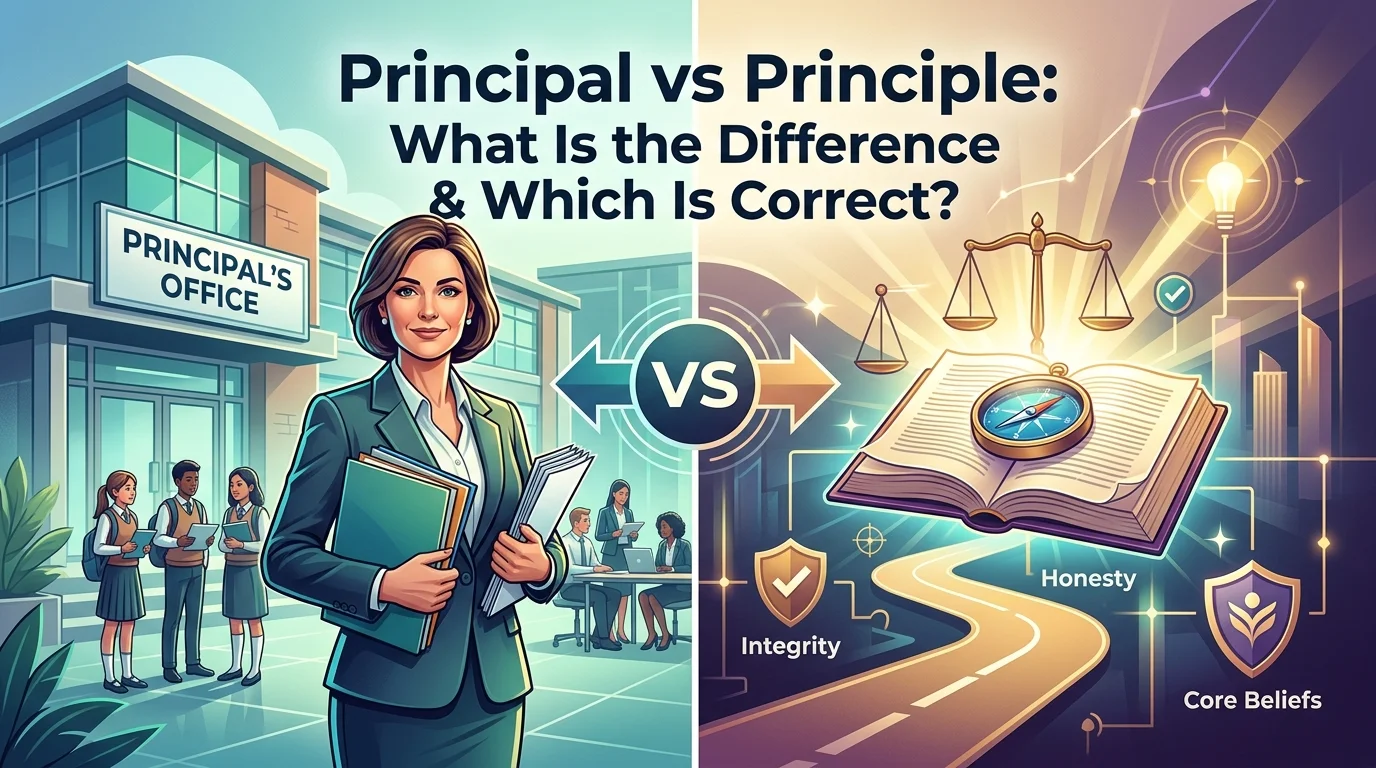

Many English learners struggle with principal vs principle because the two words sound exactly alike but have very different meanings. Choosing the wrong one can change the meaning of a sentence and make your writing look incorrect. Understanding when to use principal and when to use principle will help you write and speak English more accurately and confidently.
Comparison Overview
Principal and principle are commonly confused homophones. They share the same pronunciation but serve different grammatical functions and meanings.
- Principal is usually a noun or adjective referring to a person in charge or something that is most important.
- Principle is a noun that refers to a rule, belief, law, or fundamental truth.
Although they sound identical, they are never interchangeable when used correctly.
| Feature | Principal | Principle |
| Part of Speech | Noun, Adjective | Noun |
| Main Meaning | Leader or most important | Rule, belief, or truth |
| Refers to People? | Yes | No |
| Refers to Ideas? | Sometimes | Yes |
| Common Contexts | Schools, business, finance | Ethics, science, philosophy |
Definition of Principal
Principal generally means the person who is in charge of a school or organization. It can also mean the most important, chief, or primary thing.
As a noun:
- The principal manages a school.
As an adjective:
- The principal reason for the delay was bad weather.
Core meanings:
- Leader or head person
- Most important
- Primary or chief
- Original amount of money in finance
Definition of Principle
Principle refers to a fundamental truth, rule, belief, law, or standard that guides behavior or explains how something works.
Examples:
- Honesty is an important principle.
- The machine operates on a simple principle.
Core meanings:
- Rule of conduct
- Moral value
- Scientific law
- Fundamental truth
Main Differences Between Principal and Principle
The biggest difference is that principal often refers to a person or something of primary importance, while principle refers to an idea, belief, or rule.
| Aspect | Principal | Principle |
| Meaning | Leader or most important thing | Rule or belief |
| Grammar | Noun or adjective | Noun only |
| School Context | Head of a school | Educational philosophy or rule |
| Finance Context | Original loan amount | Financial guideline |
| Moral Context | Rarely used | Frequently used |
Key Distinctions
- A principal can be a person.
- A principle is always an idea or concept.
- Principal can describe something important.
- Principle explains standards, beliefs, or laws.
Why These Words Are Commonly Confused
The confusion occurs because:
- They sound exactly the same.
- They differ by only one letter.
- Both are frequently used in formal writing.
- Many learners focus on pronunciation instead of meaning.
Remembering their specific functions can eliminate most mistakes.
Principal vs Principle in Education
In educational settings, these words often appear together but mean different things.
Example:
- The principal announced a new policy.
- The policy was based on the principle of fairness.
Here, the principal is the person, while the principle is the guiding idea.
Principal vs Principle in Business and Finance
In business:
- Principal may refer to the primary person involved in a transaction.
- Principal may also mean the original amount of money invested or borrowed.
Example:
- She paid off the principal on her loan.
Principle in business refers to ethical standards or company values.
Example:
- The company operates on the principle of transparency.
Grammar Guide
How Each Term Is Used in Sentences
Principal
Pattern:
- Principal + noun
- The principal + verb
Examples:
- The principal welcomed the students.
- Safety is our principal concern.
- The principal approved the budget.
Principle
Pattern:
- Principle of + noun
- A principle that + clause
Examples:
- The principle of equality is important.
- She follows the principle of honesty.
- This scientific principle explains gravity.
Common Mistakes Learners Make
Mistake:
- The school principle greeted us.
Correct:
- The school principal greeted us.
Mistake:
- Honesty is an important principal.
Correct:
- Honesty is an important principle.
Mistake:
- The principal of fairness guides us.
Correct:
- The principle of fairness guides us.
Simple Rules to Remember
- The principal is your “pal” at school.
- A principle is a rule or belief.
- If referring to a leader, use principal.
- If referring to an idea or value, use principle.
- Principle is always a noun.
Quick Tips for Writing and Speaking
- Think “principal = person or primary.”
- Think “principle = belief or rule.”
- Check whether you are discussing a person or an idea.
- In school contexts, principal usually refers to the administrator.
- In ethical discussions, principle is almost always correct.
When to Use Each One
Use Principal When:
- Referring to a school leader
- Referring to a chief or primary item
- Describing something most important
- Discussing the original amount of a loan
- Identifying a main participant in business
Examples:
- The principal addressed the assembly.
- Our principal objective is growth.
- The loan principal was repaid.
Use Principle When:
- Discussing moral values
- Explaining scientific laws
- Referring to beliefs or standards
- Talking about guiding rules
- Describing fundamental truths
Examples:
- She lives by strong principles.
- This principle explains energy conservation.
- Fairness is a basic principle.
When NOT to Use Each One
Do Not Use Principal When:
- Referring to morals or ethics
- Discussing beliefs or values
- Explaining scientific laws
Incorrect:
- Kindness is an important principal.
Correct:
- Kindness is an important principle.
Do Not Use Principle When:
- Referring to a school administrator
- Describing the chief person
- Talking about loan amounts
Incorrect:
- The school principle spoke to parents.
Correct:
- The school principal spoke to parents.
Which One to Use (Decision Guide)
Ask yourself these questions:
- Am I talking about a person in charge?
- Use principal.
- Am I talking about something primary or most important?
- Use principal.
- Am I talking about a belief, value, or rule?
- Use principle.
- Am I explaining a scientific law?
- Use principle.
- Am I referring to the original amount of money borrowed?
- Use principal.
If it’s a person or something primary, choose principal. If it’s an idea or rule, choose principle.
Real-World Practical Examples
Principal Examples
- The principal welcomed new students on the first day of school.
- Customer satisfaction is our principal goal.
- The principal approved the annual budget.
- Investors recovered the principal amount of their investment.
- The principal architect designed the building.
Principle Examples
- Honesty is a principle that guides her decisions.
- The principle of gravity affects every object on Earth.
- The company follows the principle of fairness.
- Teachers encourage students to respect democratic principles.
- The machine works on a simple mechanical principle.
Self-Assessment (Fill in the Blanks)
- I will use ______ when referring to the head of a school.
- The correct word is ______ because it refers to a moral value.
- I will use ______ when discussing honesty and ethics.
- The correct word is ______ because it means the most important.
- I will use ______ when referring to a school administrator.
- The correct word is ______ because it describes a fundamental rule.
- I will use ______ when discussing the original amount of a loan.
- The correct word is ______ because it refers to a scientific law.
- I will use ______ when talking about a chief objective.
- The correct word is ______ because it means a guiding belief.
- I will use ______ when referring to a school leader.
- The correct word is ______ because it explains a natural phenomenon.
- I will use ______ when describing the primary cause.
- The correct word is ______ because it represents an ethical standard.
- I will use ______ when discussing the main reason for success.
- The correct word is ______ because it refers to a rule of conduct.
- I will use ______ when talking about loan repayment.
- The correct word is ______ because it describes a fundamental truth.
- I will use ______ when referring to the chief person in charge.
- The correct word is ______ because it represents a core belief.
Answers
- Principal
- Principle
- Principle
- Principal
- Principal
- Principle
- Principal
- Principle
- Principal
- Principle
- Principal
- Principle
- Principal
- Principle
- Principal
- Principle
- Principal
- Principle
- Principal
- Principle
Final Verdict
Understanding principal vs principle becomes much easier once you focus on their meanings rather than their pronunciation. Principal refers to a person in charge, something primary, or the original amount of money in finance. Principle refers to a rule, belief, value, or fundamental truth. A simple memory trick is that the school principal is your “pal,” while a principle is a guiding rule or idea. Whenever you are unsure, ask whether you are talking about a person or an idea. If it is a person or something most important, choose principal. If it is a belief, rule, ethical value, or scientific law, choose principle. Mastering this distinction will make your writing clearer, more professional, and grammatically correct.
Conclusion About Principal vs Principle
Understanding the difference between principal vs principle is one of the most important grammar distinctions in English because these two words sound exactly alike but carry completely different meanings. While principal usually refers to a person in charge, something primary, or the original amount of money in finance, principle refers to a rule, belief, value, or fundamental truth. Learning to recognize this distinction can improve your writing, speaking, and overall communication skills. A simple way to remember the difference is that a school principal can be your “pal,” while a principle is a guiding idea or standard. Whether you are writing an academic paper, sending a business email, or having a casual conversation, choosing the correct word helps you communicate clearly and professionally. With regular practice and attention to context, you’ll quickly become confident in using both terms correctly and avoiding one of the most common English word confusions.
FAQs
What is the difference between principal and principle?
Principal usually refers to a person in charge, something primary, or the original amount of money in a loan. Principle refers to a rule, belief, value, or fundamental truth. Although they sound the same, their meanings and uses are completely different.
Is principal a noun or an adjective?
Principal can function as both a noun and an adjective. As a noun, it often means the head of a school. As an adjective, it means most important, chief, or primary in a particular situation.
Is principle always a noun?
Yes, principle is always a noun. It refers to a belief, rule, doctrine, law, or fundamental concept. Unlike principal, it is never used as an adjective and does not refer to a person.
How can I remember principal vs principle easily?
A popular memory trick is that the school principal is your “pal.” If you are referring to a person or something primary, use principal. If you are referring to a rule, belief, or value, use principle.
Which word is used for a school leader?
The correct word is principal. A principal is the person responsible for managing and leading a school. Principle would be incorrect because it refers to an idea, belief, or rule rather than a person.
What does principal mean in finance?
In finance, principal refers to the original amount of money borrowed, invested, or deposited. It does not include interest or earnings. For example, paying off the principal reduces the actual debt amount.
Can principle refer to scientific concepts?
Yes, principle is commonly used in science. It can describe a fundamental law, theory, or concept that explains how something works. Examples include physical principles, engineering principles, and scientific principles.
Can principal mean most important?
Yes, when used as an adjective, principal means chief, leading, or most important. For example, someone might refer to the principal reason for a decision or the principal objective of a project.
Why do people confuse principal and principle?
People often confuse these words because they are homophones, meaning they sound exactly the same. Their spellings are also very similar, making it easy to choose the wrong word when writing quickly.
Are principal and principle interchangeable?
No, principal and principle are not interchangeable. Principal refers to a person in charge, something primary, or financial capital, while principle refers to a rule, belief, or fundamental truth. Using one in place of the other creates a grammatical error.
