
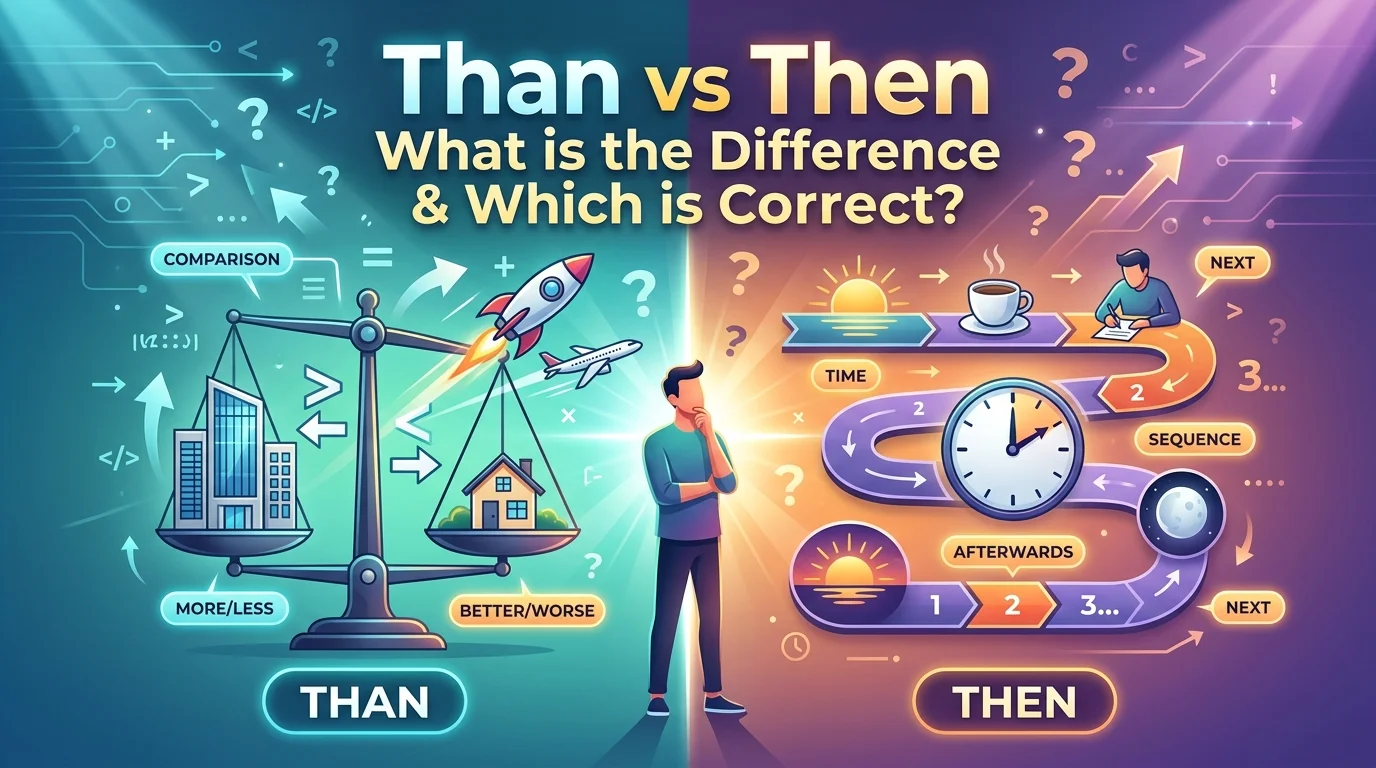

Many English learners confuse than and then because the words look and sound similar. However, they serve completely different purposes in grammar. Understanding the difference between than vs then helps improve writing, speaking, and reading comprehension. Once you learn their meanings and usage patterns, choosing the correct word becomes much easier.
Comparison Overview
Than and then are commonly confused words in English, but they belong to different parts of speech and have different meanings.
| Feature | Than | Then |
| Primary Function | Comparison | Time, sequence, or result |
| Part of Speech | Conjunction, Preposition | Adverb, Adjective, Noun |
| Used For | Comparing things | Showing what happens next |
| Example | She is taller than me. | We ate dinner, then watched a movie. |
| Question It Answers | Compared to what? | When or what happened next? |
Definition of Than
Than is a word used to make comparisons between people, things, ideas, quantities, or actions.
It helps show differences in size, quality, amount, speed, importance, or other characteristics.
Examples:
- My car is faster than yours.
- She studies more than her brother.
- This book is better than the previous one.
- I would rather stay home than go out.
In simple terms, whenever you are comparing two things, than is usually the correct choice.
Definition of Then
Then is a word that refers to time, sequence, consequence, or the next step in a process.
It tells readers or listeners what happens next or what happened at a particular moment.
Examples:
- Finish your homework, then play games.
- I was younger then.
- If it rains, then we will stay indoors.
- First mix the ingredients, then bake the cake.
In simple terms, then is usually connected to time or order.
Main Differences Between Than and Then
The biggest difference is that than is used for comparisons, while then is used for time, sequence, or results.
| Aspect | Than | Then |
| Purpose | Compare things | Show sequence or time |
| Usage | Better than, taller than | First this, then that |
| Meaning | Difference between items | Next action or moment |
| Grammar Role | Comparison connector | Time-related modifier |
| Example | He is older than me. | He finished work, then left. |
Key Difference
- Use than when comparing.
- Use then when referring to time or sequence.
Example:
- She is smarter than her classmates.
- She finished her assignment and then submitted it.
Why People Confuse Than and Then
Several factors contribute to confusion:
- The words differ by only one letter.
- Their pronunciation is similar.
- Both are common in everyday English.
- Typing errors often replace one with the other.
- Autocorrect may not always catch mistakes because both are valid words.
Comparison Table
| Situation | Correct Word |
| Comparing two items | Than |
| Showing the next step | Then |
| Discussing differences | Than |
| Talking about time | Then |
| Expressing preference | Than |
| Giving instructions in order | Then |
| Describing a past time | Then |
| Comparing quantities | Than |
Grammar Guide
How each term is used in sentences
Than Usage Pattern
Comparison + than + object
Examples:
- This laptop is cheaper than that one.
- He runs faster than I do.
- The test was harder than expected.
Then Usage Pattern
Action/Event + then + next action
Examples:
- Eat your lunch, then return to work.
- We arrived, then checked into the hotel.
- She graduated and then started her career.
Common mistakes learners make
Mistake 1
❌ She is taller then her sister.
✅ She is taller than her sister.
Mistake 2
❌ Finish your work than go home.
✅ Finish your work then go home.
Mistake 3
❌ I’d rather read then watch TV.
✅ I’d rather read than watch TV.
Mistake 4
❌ First wash the vegetables, than chop them.
✅ First wash the vegetables, then chop them.
Simple rules to remember
- Than = Comparison
- Then = Time
- If you can replace the word with “compared with,” use than.
- If you can replace the word with “next” or “afterward,” use then.
- Comparison equals than, sequence equals then.
Quick tips for writing and speaking
- Look for comparison words like better, worse, more, less, faster, and slower. They usually require than.
- Look for time indicators like first, next, afterward, and later. They usually require then.
- Proofread carefully because spellcheck may not catch the error.
- Practice by creating comparison and sequence sentences.
When to Use Each One
Use Than When
- Comparing people
- Comparing objects
- Comparing numbers
- Expressing preferences
- Showing differences
Examples:
- This route is shorter than the other one.
- She earns more than her colleague.
- I would rather walk than drive.
Use Then When
- Giving instructions
- Describing events in order
- Talking about a past moment
- Explaining consequences
- Showing progression
Examples:
- First log in, then open the dashboard.
- We had lunch, then attended the meeting.
- Back then, smartphones were rare.
When NOT to Use Each One
Do Not Use Than
- For time references
- For sequences of events
- For step-by-step instructions
Incorrect:
- First wash the dishes, than dry them.
Correct:
- First wash the dishes, then dry them.
Do Not Use Then
- For comparisons
- For expressing preferences
- For comparing quantities
Incorrect:
- He is taller then his brother.
Correct:
- He is taller than his brother.
Which One to Use (Decision Guide)
Ask yourself one simple question:
Are you comparing something?
If yes, use than.
Examples:
- More than
- Better than
- Faster than
Are you talking about time, order, or what happens next?
If yes, use then.
Examples:
- Then we left.
- First this, then that.
- Back then.
Quick decision chart:
| Question | Use |
| Am I comparing? | Than |
| Am I describing a sequence? | Then |
| Am I showing preference? | Than |
| Am I talking about time? | Then |
| Am I showing what happens next? | Then |
Real-World Practical Examples
Than Examples
- Education: Mathematics is harder than history for some students.
- Daily Life: My apartment is larger than my previous one.
- Science: Iron is denser than aluminum.
- Business: This quarter’s revenue is higher than last quarter’s.
- Technology: Fiber internet is faster than standard broadband.
Then Examples
- Education: Read the chapter, then answer the questions.
- Daily Life: We finished dinner and then went for a walk.
- Science: Heat the solution, then record the temperature.
- Business: Submit the proposal, then wait for approval.
- Technology: Install the software, then restart the computer.
Self-Assessment (Fill in the Blanks)
- I will use ______ when comparing two products.
- The correct word is ______ because it shows what happened next.
- I am taller ______ my cousin.
- First save the file, ______ close the application.
- She works harder ______ most employees.
- We ate breakfast and ______ left for school.
- This phone is better ______ the old model.
- Back ______, online classes were uncommon.
- He would rather travel ______ stay home.
- Complete the form and ______ submit it.
- Water is heavier ______ oil.
- First register, ______ verify your account.
- The movie was longer ______ expected.
- We arrived early and ______ found our seats.
- My grades improved more ______ last year.
- Read the instructions, ______ begin the test.
- The blue shirt costs less ______ the black one.
- Things were different ______.
- She is more experienced ______ her teammate.
- Finish your report, ______ send it to management.
Answers
- Than
- Then
- Than
- Then
- Than
- Then
- Than
- Then
- Than
- Then
- Than
- Then
- Than
- Then
- Than
- Then
- Than
- Then
- Than
- Then
Final Verdict
Understanding than vs then becomes simple once you remember their primary functions. Than is the word used for comparisons, helping you show differences between people, objects, ideas, or amounts. Then relates to time, sequence, order, or consequences, showing what happens next or referring to a specific moment. Whenever you are comparing, choose than. Whenever you are discussing time, steps, or progression, choose then. By applying this straightforward rule and practicing with real examples, you can avoid one of the most common English grammar mistakes and use both words correctly and confidently in everyday communication.
Conclusion About Than vs Then
Understanding the difference between than vs then is essential for clear and accurate communication. Although these two words look similar, they serve completely different purposes in English grammar. Than is used when making comparisons, while then refers to time, sequence, or what happens next. Mixing them up is a common mistake, but it can easily be avoided by remembering their core functions.
Whether you are writing an academic paper, sending a business email, creating online content, or simply having a conversation, using the correct word helps your message sound more professional and polished. A simple way to remember the distinction is that than compares, while then connects events in time. With regular practice and exposure to real-world examples, choosing between these two commonly confused words becomes second nature. Mastering than and then will strengthen your grammar skills and improve your confidence in both writing and speaking.
FAQs
What is the main difference between than and then?
The main difference is that than is used for comparisons, while then is used to indicate time, sequence, or the next step in a process. If you are comparing two things, use than. If you are talking about what happens next, use then.
Is than a conjunction or a preposition?
Than can function as both a conjunction and a preposition depending on the sentence structure. It is most commonly used to introduce the second part of a comparison, such as in the phrase “faster than expected” or “taller than her brother.”
Is then always related to time?
Most of the time, yes. Then commonly refers to a point in time, a sequence of events, or a consequence. It helps show what happened next, what will happen afterward, or what occurred during a specific period.
Can than and then ever be interchangeable?
No, than and then are not interchangeable because they have different meanings and grammatical functions. Using one in place of the other creates a grammatical error and can confuse readers or listeners.
Why do people confuse than and then?
People often confuse them because they are spelled similarly and have comparable pronunciations. Since only one letter differs between the words, typing mistakes and misunderstandings are common, especially among English learners.
How can I remember the difference between than and then?
A useful memory trick is to associate than with comparisons and then with time. If you are comparing two things, use than. If you can replace the word with “next” or “afterward,” use then.
Is it correct to say better then?
No, the correct phrase is better than because it involves a comparison. Words such as better, worse, more, less, higher, and lower are typically followed by than when comparing two things.
Can then be used at the beginning of a sentence?
Yes, then can appear at the beginning of a sentence when introducing the next event, a conclusion, or a consequence. For example: “Then we decided to continue the project despite the challenges.”
What are common phrases that use than?
Common phrases include “more than,” “less than,” “rather than,” “other than,” “better than,” and “different than.” In each case, than is used because a comparison or contrast is being made.
What are common phrases that use then?
Common phrases include “back then,” “every now and then,” “then again,” “and then,” and “if…then.” These expressions relate to time, sequence, frequency, or logical consequences.
