
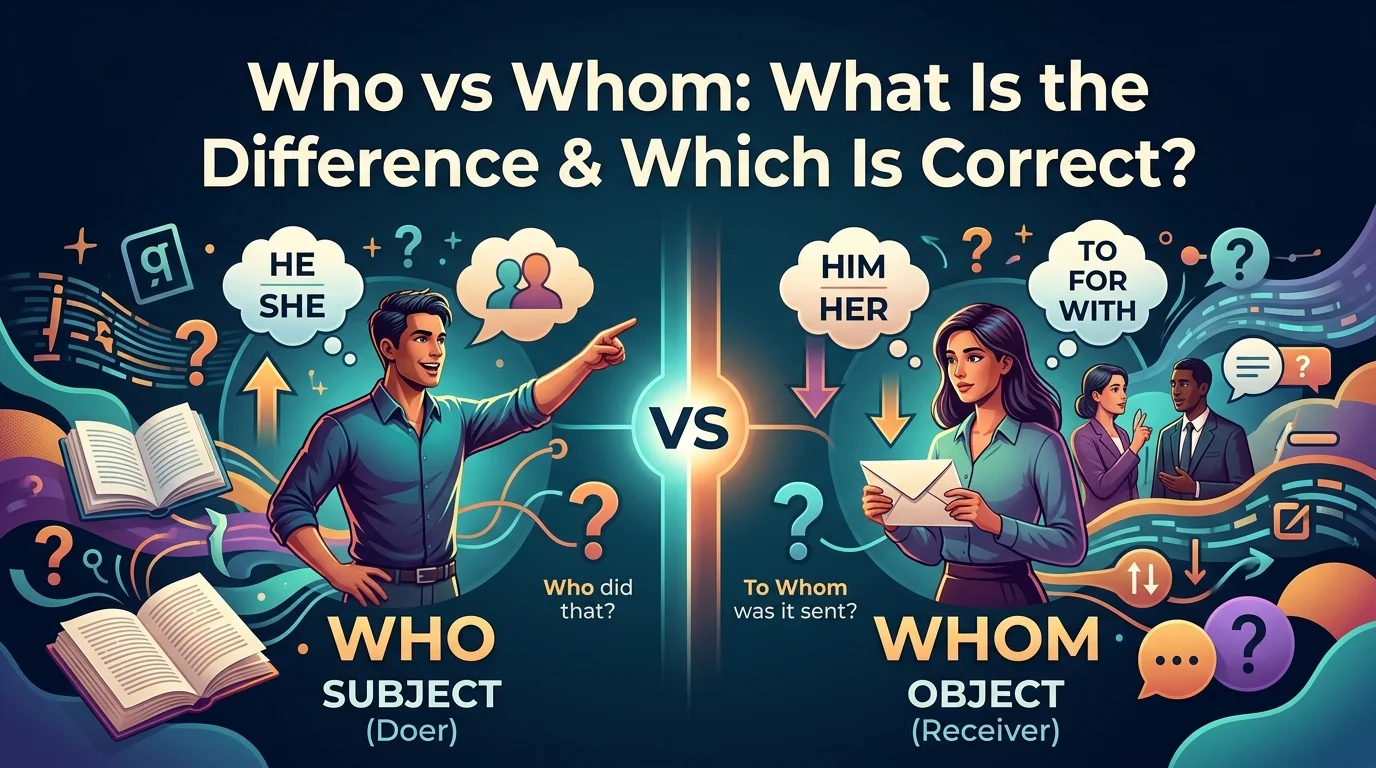

Many English learners struggle with who and whom because both words refer to people, yet they serve different grammatical roles. Understanding the difference can improve your writing, speaking, and overall grammar accuracy. This guide explains what each word means, how to use them correctly, and how to avoid common mistakes.
Comparison Overview
Who and whom are pronouns used when referring to people. The main difference lies in their grammatical function within a sentence.
| Feature | Who | Whom |
| Function | Subject pronoun | Object pronoun |
| Similar To | He, she, they | Him, her, them |
| Usage | Performs the action | Receives the action |
| Common In | Everyday speech and writing | Formal writing and grammar |
| Example | Who called you? | Whom did you call? |
Although whom is grammatically correct in certain situations, modern English often uses who in casual conversation.
Definition of Who
Who is a subject pronoun used to refer to the person performing an action in a sentence.
It works similarly to words like he, she, or they.
Examples
- Who is coming to the meeting?
- Who wrote this report?
- Who wants pizza?
- Who solved the problem?
- Who called last night?
In each sentence, the person referred to by who is performing the action.
Definition of Whom
Whom is an object pronoun used to refer to the person receiving an action.
It functions similarly to him, her, or them.
Examples
- Whom did you invite?
- To whom should I send the email?
- Whom are they discussing?
- Whom did the teacher praise?
- With whom did you travel?
In these examples, the person referred to by whom receives the action.
Main Differences Between Who and Whom
The distinction between who and whom depends on whether the person is acting as the subject or object.
| Aspect | Who | Whom |
| Grammatical Role | Subject | Object |
| Replaces | He, she, they | Him, her, them |
| Action | Performs action | Receives action |
| Informal Usage | Very common | Less common |
| Formal Usage | Common | Preferred when object is required |
Simple Test
Replace the word with he/she or him/her.
- If he/she works, use who.
- If him/her works, use whom.
Example:
- ___ called you?
- He called you.
- Correct answer: Who called you?
Example:
- You called ___?
- You called him.
- Correct answer: Whom did you call?
Subject vs Object: The Key Difference
Understanding subjects and objects makes choosing between who and whom much easier.
Subject
The subject performs the action.
- Who opened the door?
- Who completed the project?
Object
The object receives the action.
- Whom did you meet?
- Whom did they choose?
Formal vs Informal Usage
Modern English speakers frequently use who even when whom would be technically correct.
Informal
- Who did you invite?
- Who are you talking to?
Formal
- Whom did you invite?
- To whom are you speaking?
Both forms are often understood, but formal writing typically prefers whom when acting as an object.
Grammar Guide
How Each Term Is Used in Sentences
Using Who
Pattern:
Who + verb + rest of sentence
Examples:
- Who knows the answer?
- Who wants to join?
- Who called this morning?
Using Whom
Pattern:
Whom + subject + verb
Examples:
- Whom did you call?
- Whom should we hire?
- Whom are they interviewing?
Common Mistakes Learners Make
Using Who Instead of Whom
Incorrect:
- Whom is coming to dinner?
Correct:
- Who is coming to dinner?
Using Whom as a Subject
Incorrect:
- Whom wrote the article?
Correct:
- Who wrote the article?
Ignoring Objects of Prepositions
Incorrect:
- To who did you send the package?
Correct:
- To whom did you send the package?
Simple Rules to Remember
- Use who for subjects.
- Use whom for objects.
- Replace with he/she to test for who.
- Replace with him/her to test for whom.
- After prepositions, whom is usually correct.
Quick Tips for Writing and Speaking
- In casual conversation, who is widely accepted.
- In formal writing, use whom when it functions as an object.
- Use the he/him test whenever unsure.
- Check whether the person is doing or receiving the action.
- Practice identifying subjects and objects.
When to Use Each One
Use Who When
- Asking who performed an action.
- Referring to a subject.
- Writing naturally in conversation.
- Introducing a person doing something.
- Asking for identification of a person.
Examples:
- Who answered the phone?
- Who discovered the solution?
Use Whom When
- Referring to an object.
- Following a preposition.
- Writing formal documents.
- Referring to someone receiving an action.
- Using traditional grammar rules.
Examples:
- Whom did you choose?
- To whom should I address the letter?
When NOT to Use Each One
Do Not Use Who
- When the word receives the action.
- After formal prepositions when object form is required.
Incorrect:
- To who did you speak?
Correct:
- To whom did you speak?
Do Not Use Whom
- When the word performs the action.
- As the subject of a sentence.
Incorrect:
- Whom called the office?
Correct:
- Who called the office?
Which One to Use (Decision Guide)
Use this simple process:
- Is the person performing the action?
- Yes → Use who.
- No → Continue.
- Is the person receiving the action?
- Yes → Use whom.
- Replace with he/she or him/her.
- He/she fits → Who
- Him/her fits → Whom
Quick examples:
| Sentence | Correct Choice |
| ___ finished the project? | Who |
| You hired ___? | Whom |
| ___ is speaking? | Who |
| To ___ was the message sent? | Whom |
| ___ wants coffee? | Who |
Real-World Practical Examples
Who Examples
Education
- Who submitted the assignment first?
Daily Life
- Who left the lights on?
Business
- Who approved the budget?
Technology
- Who created this software?
Conversation
- Who told you that story?
Whom Examples
Education
- Whom did the professor recommend?
Daily Life
- Whom did you invite to dinner?
Business
- Whom should we contact about the contract?
Technology
- Whom did the company hire for cybersecurity?
Writing
- To whom it may concern.
Self-Assessment (Fill in the Blanks)
- I will use ______ when referring to the person who completed the task.
- The correct word is ______ because it acts as the object of the verb “call.”
- I will use ______ when asking which person is arriving.
- The correct word is ______ because it receives the action.
- I will use ______ when referring to the subject of a sentence.
- The correct word is ______ because the person was selected by the committee.
- I will use ______ when asking who performed the experiment.
- The correct word is ______ because it follows the preposition “to.”
- I will use ______ when referring to the person leading the meeting.
- The correct word is ______ because it is the object of “invite.”
- I will use ______ when asking which person discovered the solution.
- The correct word is ______ because the manager interviewed that person.
- I will use ______ when referring to someone performing an action.
- The correct word is ______ because the action is directed toward that person.
- I will use ______ when asking who made the decision.
- The correct word is ______ because it follows the preposition “with.”
- I will use ______ when identifying the person responsible.
- The correct word is ______ because the employee was promoted by the company.
- I will use ______ when referring to the sentence subject.
- The correct word is ______ because it functions as an object.
Answers
- Who
- Whom
- Who
- Whom
- Who
- Whom
- Who
- Whom
- Who
- Whom
- Who
- Whom
- Who
- Whom
- Who
- Whom
- Who
- Whom
- Who
- Whom
Final Verdict
The difference between who and whom comes down to one important grammar rule: who is used as a subject, while whom is used as an object. If the person is performing the action, choose who. If the person is receiving the action, choose whom. A helpful trick is to replace the word with he/she or him/her. If he or she sounds correct, use who. If him or her fits better, use whom. While modern spoken English often favors who in nearly all situations, using whom correctly can make your formal writing more precise and grammatically accurate. By understanding subjects, objects, and the simple substitution test, you can confidently decide which word is correct in any sentence.
Conclusion About Who vs Whom
Understanding the difference between who and whom can make your English clearer, more professional, and grammatically accurate. While both words refer to people, they serve different purposes in a sentence. Who acts as the subject and performs the action, whereas whom functions as the object and receives the action. Although modern conversational English often favors who, knowing when to use whom is still valuable, especially in formal writing, academic work, business communication, and professional correspondence.
A simple way to remember the distinction is to use the he/she and him/her test. If he or she fits, use who. If him or her fits, use whom. With regular practice, identifying the correct choice becomes much easier. Whether you are writing an email, preparing a report, or improving your grammar skills, mastering who vs whom will help you communicate with greater confidence and precision.
FAQs
What is the difference between who and whom?
The main difference is grammatical function. Who is used as the subject of a sentence and performs the action, while whom is used as the object and receives the action. Understanding whether the person is doing or receiving the action helps you choose the correct word.
Is whom still used in modern English?
Yes, whom is still used, especially in formal writing, professional communication, and academic contexts. However, many native speakers use who in everyday conversation, even when traditional grammar rules would suggest using whom.
How can I quickly decide whether to use who or whom?
Use the he/him test. Replace the word with he or him. If he sounds correct, use who. If him sounds correct, use whom. This simple trick works in most situations and helps avoid confusion.
Is it wrong to use who instead of whom?
In casual speech, using who instead of whom is generally accepted and understood. However, in formal writing or professional documents, using whom correctly can make your writing appear more polished and grammatically accurate.
Why is whom considered difficult?
Many people find whom difficult because it depends on sentence structure rather than meaning alone. You must identify whether the word functions as a subject or object, which can be challenging without understanding basic grammar concepts.
Should I always use whom after a preposition?
In traditional grammar, yes. When a pronoun follows a preposition such as to, for, with, or about, whom is usually the correct choice. Examples include “to whom” and “with whom.”
Can who be used in formal writing?
Absolutely. Who is correct whenever it functions as the subject of a sentence. Formal writing still uses who regularly. The key is understanding the grammatical role rather than assuming one word is always more formal than the other.
What are common mistakes with who and whom?
A common mistake is using whom as the subject of a sentence, such as “Whom is calling?” Another frequent error is using who when it functions as an object, especially after prepositions in formal writing.
Do native English speakers always use whom correctly?
Not always. Many native speakers prefer who in everyday conversations and may not consistently follow traditional grammar rules. However, professional writers, editors, and formal publications often use whom according to standard grammar conventions.
Is learning who vs whom important for grammar?
Yes, learning the difference improves writing accuracy and helps you understand sentence structure better. It is particularly useful for academic writing, business communication, formal correspondence, and situations where precise grammar is important.
