

Understanding the difference between adapt and adopt is important because these two words look and sound similar but have very different meanings. Many English learners confuse them in writing and speaking. Knowing when to use each word correctly can improve your grammar, communication skills, and overall confidence in English.
Comparison Overview
Both adapt and adopt are verbs, but they describe different actions.
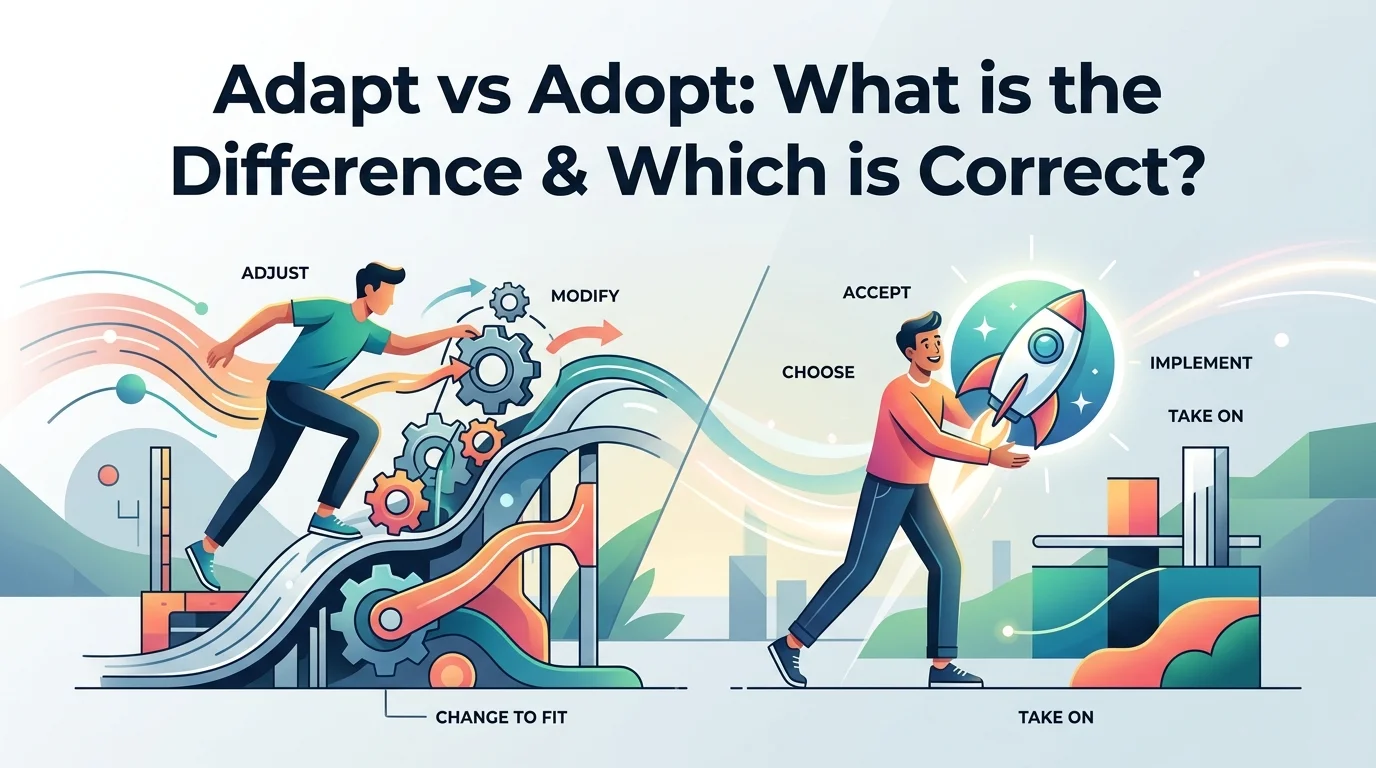
Adapt means to change, adjust, or modify something so it fits a new situation or environment.
Adopt means to take something and make it your own, accept it, or begin using it.
Although both words involve change, the key difference is that adapt focuses on modifying, while adopt focuses on accepting or choosing.
| Feature | Adapt | Adopt |
| Main Meaning | Change or adjust | Accept or take up |
| Part of Speech | Verb | Verb |
| Focus | Modification | Acceptance |
| Common Contexts | Environment, technology, education | Policies, ideas, children, habits |
| Example | Adapt a book into a movie | Adopt a new policy |
Definition of Adapt
Adapt means to alter, adjust, or modify something so it works better in a new situation.
The word is commonly used when discussing change, flexibility, and adjustment. People, organizations, technologies, and even animals can adapt to new conditions.
Examples
- Students must adapt to online learning.
- Plants adapt to different climates.
- The company adapted its strategy.
- The novel was adapted into a movie.
- Travelers often adapt to local customs.
Definition of Adopt
Adopt means to accept, choose, take on, or officially begin using something.
The word is frequently used for ideas, policies, methods, technologies, and legal adoption of children.
Examples
- The school adopted a new curriculum.
- The company adopted modern software.
- They adopted a child.
- Many countries adopted new regulations.
- She adopted a healthier lifestyle.
Main Differences Between Adapt and Adopt
The difference becomes clearer when you focus on the action involved.
| Aspect | Adapt | Adopt |
| Action | Change something | Accept something |
| Purpose | Make it suitable | Make it your own |
| Focus | Adjustment | Selection |
| Common Objects | Plans, books, behaviors, systems | Ideas, policies, children, methods |
| Example | Adapt your schedule | Adopt a schedule |
Key Difference
- If something is being modified, use adapt.
- If something is being accepted or chosen, use adopt.
For example:
- We adapted the software for mobile devices. ✓
- We adopted the software for our business. ✓
In the first sentence, the software was changed.
In the second sentence, the software was chosen for use.
Common Contexts Where Adapt and Adopt Are Used
Adapt in Everyday Situations
- Adjusting to a new school
- Modifying a business strategy
- Changing to a new climate
- Converting books into films
- Updating technology for new needs
Adopt in Everyday Situations
- Choosing a new method
- Accepting an idea
- Implementing company policies
- Taking care of a child legally
- Starting a new habit
Comparison Table: Adapt vs Adopt
| Category | Adapt | Adopt |
| Meaning | Adjust or modify | Accept or take |
| Requires Change? | Yes | Not necessarily |
| Implies Ownership? | No | Often yes |
| Used for Ideas? | Sometimes | Very often |
| Used for Children? | No | Yes |
| Used for Policies? | Rarely | Frequently |
| Used for Books and Movies? | Yes | No |
| Used for Habits? | Sometimes | Frequently |
Grammar Guide
How Each Term Is Used in Sentences
Adapt Sentence Patterns
- Adapt to + situation
- Adapt something for + purpose
- Adapt something into + another form
Examples:
- She adapted to college life.
- Engineers adapted the design for safety.
- The novel was adapted into a film.
Adopt Sentence Patterns
- Adopt + idea
- Adopt + policy
- Adopt + child
- Adopt + method
Examples:
- The company adopted a new policy.
- They adopted a child.
- Researchers adopted a different approach.
Common Mistakes Learners Make
Mistake 1
❌ The company adapted a new policy.
✅ The company adopted a new policy.
Reason: Policies are accepted, not modified.
Mistake 2
❌ Students adopted to online learning.
✅ Students adapted to online learning.
Reason: People adapt to situations.
Mistake 3
❌ The movie adopted the novel.
✅ The movie adapted the novel.
Reason: Stories are adapted into films.
Mistake 4
❌ She adapted a child.
✅ She adopted a child.
Reason: Legal acceptance requires adopt.
Simple Rules to Remember
- Adapt = Adjust
- Adopt = Accept
- Adapt often involves changing something.
- Adopt often involves choosing something.
- Movies adapt books.
- Families adopt children.
Quick Tips for Writing and Speaking
- Think of adapt as “make suitable.”
- Think of adopt as “take and use.”
- Use adapt to when discussing adjustment.
- Use adopt when discussing acceptance.
- If ownership or official acceptance is involved, choose adopt.
When to Use Each One
Use Adapt When
- Adjusting to change
- Modifying plans
- Altering designs
- Converting content
- Responding to new conditions
Examples:
- Adapt to a new culture.
- Adapt a lesson plan.
- Adapt a business strategy.
Use Adopt When
- Choosing an idea
- Accepting a policy
- Beginning a new habit
- Taking legal responsibility for a child
- Implementing a method
Examples:
- Adopt a policy.
- Adopt a child.
- Adopt a new technology.
When NOT to Use Each One
Do Not Use Adapt When
- Referring to legal adoption
- Accepting ideas or policies without modification
- Choosing a new habit
Incorrect:
- Adapt a child.
- Adapt a policy.
Do Not Use Adopt When
- Talking about adjustment to conditions
- Modifying products
- Converting books into films
Incorrect:
- Adopt to a new climate.
- Adopt a novel into a movie.
Which One to Use (Decision Guide)
Ask yourself the following question:
Are you changing or adjusting something?
Use Adapt.
Examples:
- Adapt to new circumstances.
- Adapt a design.
- Adapt a textbook.
Are you accepting, choosing, or taking something?
Use Adopt.
Examples:
- Adopt a policy.
- Adopt a child.
- Adopt a strategy.
Quick Decision Chart
| Question | Correct Word |
| Am I adjusting something? | Adapt |
| Am I changing to fit conditions? | Adapt |
| Am I accepting something? | Adopt |
| Am I choosing a method or idea? | Adopt |
| Am I legally taking responsibility for a child? | Adopt |
Real-World Practical Examples
Adapt Examples
- Students adapted to virtual classrooms during the pandemic.
- Scientists adapt research methods when new evidence appears.
- The company adapted its marketing strategy for younger customers.
- The software was adapted for mobile devices.
- The novel was adapted into a television series.
Adopt Examples
- The university adopted a new grading policy.
- The family decided to adopt a child.
- The company adopted cloud computing technology.
- Many people adopt healthier eating habits.
- Researchers adopted a new analytical method.
Self-Assessment (Fill in the Blanks)
- I will use ______ when referring to adjusting to a new environment. The correct word is ______ because adjustment is required.
- I will use ______ when referring to legally taking care of a child. The correct word is ______ because legal acceptance is involved.
- I will use ______ when referring to changing a business strategy. The correct word is ______ because modification is required.
- I will use ______ when referring to accepting a company policy. The correct word is ______ because acceptance is involved.
- I will use ______ when referring to converting a novel into a film. The correct word is ______ because transformation is involved.
- I will use ______ when referring to choosing a new teaching method. The correct word is ______ because a method is accepted.
- I will use ______ when referring to adjusting to climate change. The correct word is ______ because adaptation is needed.
- I will use ______ when referring to implementing new regulations. The correct word is ______ because regulations are accepted.
- I will use ______ when referring to modifying software. The correct word is ______ because changes are made.
- I will use ______ when referring to taking up a new habit. The correct word is ______ because the habit is accepted.
- I will use ______ when referring to adjusting work schedules. The correct word is ______ because changes are necessary.
- I will use ______ when referring to accepting an innovative idea. The correct word is ______ because the idea is chosen.
- I will use ______ when referring to changing educational materials. The correct word is ______ because modification occurs.
- I will use ______ when referring to introducing a new company procedure. The correct word is ______ because the procedure is accepted.
- I will use ______ when referring to adjusting to cultural differences. The correct word is ______ because adjustment is required.
- I will use ______ when referring to accepting a new technology. The correct word is ______ because the technology is chosen.
- I will use ______ when referring to revising a design for better performance. The correct word is ______ because modification occurs.
- I will use ______ when referring to beginning a new lifestyle. The correct word is ______ because the lifestyle is accepted.
- I will use ______ when referring to changing a training program. The correct word is ______ because adjustments are made.
- I will use ______ when referring to officially approving a policy. The correct word is ______ because official acceptance is involved.
Answers
- Adapt, Adapt
- Adopt, Adopt
- Adapt, Adapt
- Adopt, Adopt
- Adapt, Adapt
- Adopt, Adopt
- Adapt, Adapt
- Adopt, Adopt
- Adapt, Adapt
- Adopt, Adopt
- Adapt, Adapt
- Adopt, Adopt
- Adapt, Adapt
- Adopt, Adopt
- Adapt, Adapt
- Adopt, Adopt
- Adapt, Adapt
- Adopt, Adopt
- Adapt, Adapt
- Adopt, Adopt
Final Verdict
The comparison between adapt vs adopt comes down to one simple idea: adapt means to change or adjust, while adopt means to accept or take something as your own. When discussing modification, adjustment, flexibility, or transformation, use adapt. When discussing acceptance, implementation, ownership, policies, ideas, habits, or children, use adopt. Remember the simple formula: Adapt = Adjust, Adopt = Accept. Keeping this distinction in mind will help you avoid common mistakes and communicate more accurately in both writing and everyday conversation.
Conclusion About Adapt vs Adopt
Understanding the difference between adapt vs adopt helps you use English more accurately in both writing and speaking. While both words relate to change, they are not interchangeable. Adapt is used when something is adjusted or modified to fit new conditions, such as environments, systems, or plans. Adopt is used when something is accepted, chosen, or officially taken on, such as ideas, policies, habits, or legal responsibilities. Keeping this distinction in mind improves clarity and prevents common grammar mistakes. With regular exposure and real-world practice, using these two words correctly becomes natural. Whether you are learning English for academics, work, or daily communication, mastering adapt and adopt strengthens your vocabulary, boosts confidence, and helps you express ideas more precisely in every situation.
FAQs
What is the difference between adapt and adopt?
Adapt vs adopt differ in meaning and usage. Adapt means to adjust or modify something to fit a new situation or condition. Adopt means to accept or take something as your own. Adapt focuses on change and flexibility, while adopt focuses on acceptance and decision-making. They are not interchangeable in correct English usage.
When should I use adapt?
Use adapt when something is being changed or adjusted to fit new conditions. It is commonly used for environments, systems, behaviors, or plans. For example, people adapt to new workplaces or climates. It always involves modification rather than acceptance, making it useful when describing flexibility and adjustment in real-world situations.
When should I use adopt?
Use adopt when something is accepted, chosen, or officially taken on. It applies to ideas, policies, habits, technologies, or legal situations like adopting a child. It shows a decision or approval rather than a change. Adopt means making something part of your system, lifestyle, or organization without modifying it.
Can adapt and adopt be used interchangeably?
No, adapt and adopt cannot be used interchangeably. Adapt refers to adjusting or changing something to fit a situation, while adopt refers to accepting or choosing something. Using them incorrectly can change the meaning of a sentence completely. Understanding their distinct roles helps improve clarity and prevents grammar mistakes in communication.
Is adapt used for people or things?
Adapt can be used for both people and things. People adapt when they adjust to new environments or situations, such as a new job or culture. Things can also be adapted, such as books, software, or systems being modified for different purposes. It always involves some form of change or adjustment.
What are examples of adopt in daily life?
Adopt is used in daily life when someone chooses or accepts something new. For example, people adopt new habits like exercising, companies adopt new technologies, and governments adopt new policies. It can also refer to adopting a child. In all cases, it involves acceptance or decision rather than modification.
Why do people confuse adapt and adopt?
People confuse adapt and adopt because the words look and sound similar. However, their meanings are very different. Adapt relates to adjustment and change, while adopt relates to acceptance and choice. This similarity in spelling and pronunciation often leads to mistakes, especially among English learners or in fast writing situations.
Can a movie adapt a book?
Yes, a movie can adapt a book. In this case, adapt means to convert or modify the original written story into a film format. The storyline is adjusted to suit visual storytelling. This is a common usage in entertainment, where books are transformed into movies or television series through adaptation.
Is adopt only used for children?
No, adopt is not only used for children. While legal adoption refers to children, the word is also widely used for ideas, habits, policies, and technologies. For example, companies adopt new systems, people adopt healthier lifestyles, and organizations adopt strategies. It mainly means accepting or taking something as your own.
How can I remember adapt vs adopt easily?
A simple way to remember adapt vs adopt is: adapt means adjust, and adopt means accept. If something changes, use adapt. If something is chosen or taken on, use adopt. Linking adapt with adjustment and adopt with acceptance makes it easier to recall the correct usage in everyday communication.
