
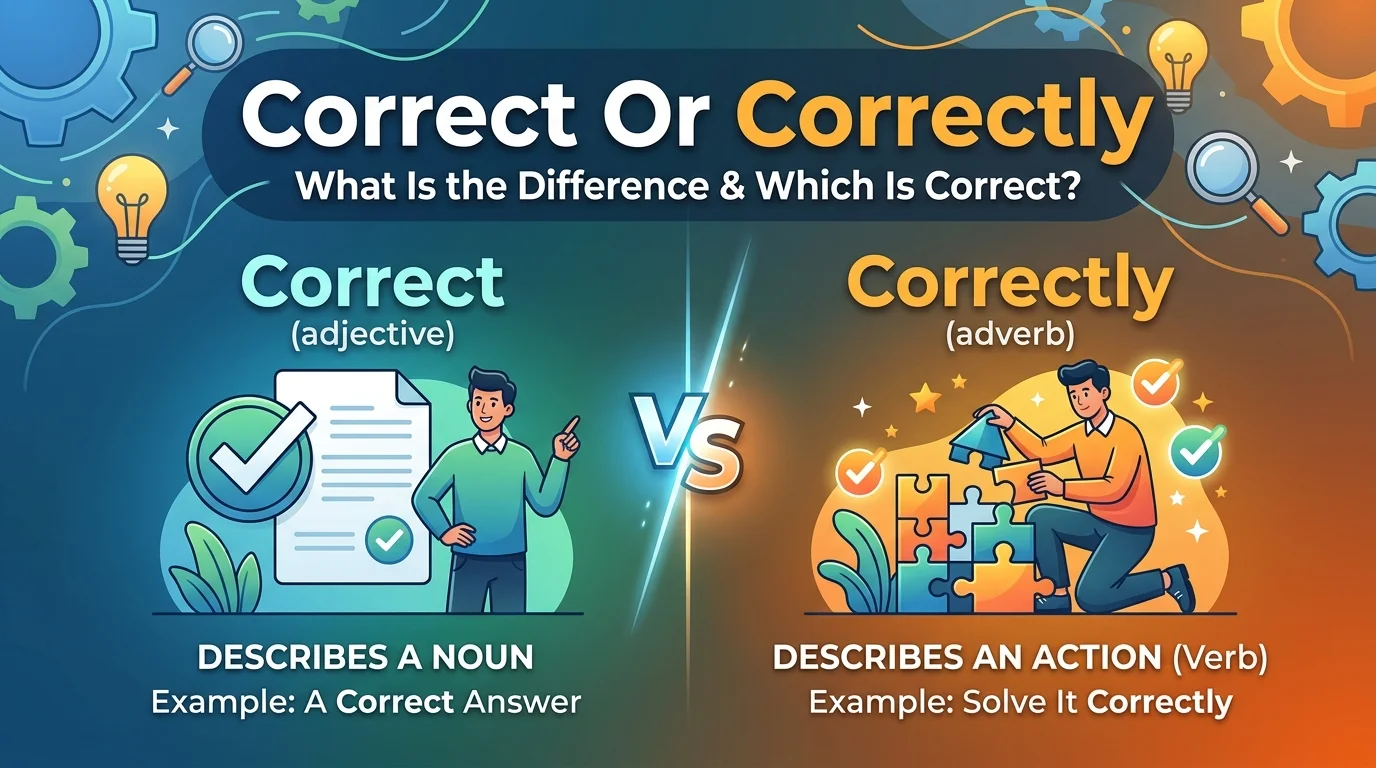

Many English learners get confused by correct and correctly because both relate to accuracy and doing things the right way. However, they serve different grammatical functions. Understanding when to use correct and when to use correctly can significantly improve your writing, speaking, and overall grammar skills.
Comparison Overview
Both correct and correctly come from the same root word and are associated with accuracy, truth, or proper performance. The main difference is that correct is usually an adjective, while correctly is an adverb.
| Term | Part of Speech | Main Function | Example |
| Correct | Adjective | Describes a noun or pronoun | The answer is correct. |
| Correctly | Adverb | Describes a verb, adjective, or adverb | She answered correctly. |
Understanding this distinction helps you choose the right word depending on what you are describing.
Definition of Correct
Correct is an adjective that means accurate, right, free from mistakes, or in accordance with facts or rules.
It is used to describe a person, thing, answer, statement, method, or idea.
Examples:
- The correct answer is B.
- Your calculation is correct.
- He gave the correct address.
- This is the correct procedure.
- The information appears correct.
Definition of Correctly
Correctly is an adverb that means in a correct manner or in the right way.
It is used to describe how an action is performed.
Examples:
- She answered the question correctly.
- The machine is working correctly.
- Please pronounce the word correctly.
- The software was installed correctly.
- They followed the instructions correctly.
Main Differences Between Correct and Correctly
The distinction between these words is primarily grammatical.
| Feature | Correct | Correctly |
| Part of Speech | Adjective | Adverb |
| Describes | Nouns and pronouns | Verbs and actions |
| Answers Question | What is it like? | How was it done? |
| Example | The answer is correct. | He answered correctly. |
| Function | State or quality | Manner of action |
Consider these examples:
- The answer is correct. ✔
- The answer is correctly. ✘
Here, we need an adjective because it describes “answer.”
Another example:
- She completed the task correctly. ✔
- She completed the task correct. ✘
Here, we need an adverb because it describes the verb “completed.”
Why Learners Confuse Correct and Correctly
Many learners assume that both words can be used interchangeably because they have similar meanings.
For example:
- Incorrect: She speaks English correct.
- Correct: She speaks English correctly.
The confusion usually occurs because some languages do not clearly distinguish between adjectives and adverbs.
Grammar Guide
How Each Term Is Used in Sentences
Correct Pattern
- Noun + be verb + correct
- The answer is correct.
- Your assumption was correct.
Correctly Pattern
- Verb + correctly
- Write correctly.
- Calculate correctly.
- Speak correctly.
Examples:
- The result is correct.
- The student answered correctly.
- The grammar rule is correct.
- The experiment was conducted correctly.
Common Mistakes Learners Make
Mistake 1
- She did it correct. ✘
- She did it correctly. ✔
Mistake 2
- The answer is correctly. ✘
- The answer is correct. ✔
Mistake 3
- He pronounced the word correct. ✘
- He pronounced the word correctly. ✔
Mistake 4
- Your solution correctly. ✘
- Your solution is correct. ✔
Simple Rules to Remember
- Use correct after a linking verb such as is, are, was, or were.
- Use correctly when describing an action.
- If you can replace the word with “accurate,” use correct.
- If you can replace the word with “properly,” use correctly.
- Adjectives describe things; adverbs describe actions.
Quick Tips for Writing and Speaking
- Ask whether you are describing a thing or an action.
- If it describes a noun, choose correct.
- If it describes a verb, choose correctly.
- Check whether the sentence contains a linking verb.
- Replace the word mentally with “accurate” or “properly” to test your choice.
When to Use Each One
Use Correct When:
- Describing an answer.
- Describing information.
- Describing a method.
- Describing a statement.
- Describing a decision.
Examples:
- That answer is correct.
- The data is correct.
- Your reasoning is correct.
Use Correctly When:
- Describing how something is done.
- Describing actions.
- Describing procedures.
- Describing performance.
- Describing execution.
Examples:
- She completed the assignment correctly.
- The technician installed the device correctly.
- He followed the instructions correctly.
When NOT to Use Each One
Do Not Use Correct When:
You are describing an action.
Incorrect:
- He solved the problem correct.
Correct:
- He solved the problem correctly.
Do Not Use Correctly When:
You are describing a noun or state.
Incorrect:
- The answer is correctly.
Correct:
- The answer is correct.
Which One to Use (Decision Guide)
Use this simple decision guide:
- Are you describing a noun, answer, idea, statement, or thing?
- Use correct.
- Are you describing how an action happens?
- Use correctly.
- Is the word following is, are, was, or were?
- Usually use correct.
- Is the word modifying a verb?
- Use correctly.
Quick test:
- The report is ____.
- Correct ✔
- She prepared the report ____.
- Correctly ✔
Real-World Practical Examples
Correct Examples
- The teacher confirmed that my answer was correct.
- The address on the package is correct.
- The scientific conclusion is correct based on the evidence.
- Your business strategy appears correct.
- The technical specification is correct according to the manual.
Correctly Examples
- The student answered the exam question correctly.
- I entered the password correctly.
- The scientist recorded the data correctly.
- The software was configured correctly.
- She used the grammar rule correctly during the conversation.
Comparison in Common Sentences
| Situation | Correct Usage |
| Describing an answer | The answer is correct. |
| Describing performance | He answered correctly. |
| Describing information | The information is correct. |
| Describing pronunciation | She pronounced it correctly. |
| Describing a process | The procedure is correct. |
| Describing execution | The procedure was followed correctly. |
Self-Assessment (Fill in the Blanks)
- The answer is ______.
- She solved the equation ______.
- The information you provided is ______.
- He followed the directions ______.
- The spelling is ______.
- The student completed the assignment ______.
- My calculation is ______.
- The software was installed ______.
- The statement is ______.
- They interpreted the results ______.
- The teacher said my response was ______.
- She pronounced the word ______.
- The method is ______.
- The machine is functioning ______.
- His explanation was ______.
- The experiment was conducted ______.
- The report is ______.
- They applied the formula ______.
- The final answer was ______.
- The instructions were followed ______.
Answers
- Correct
- Correctly
- Correct
- Correctly
- Correct
- Correctly
- Correct
- Correctly
- Correct
- Correctly
- Correct
- Correctly
- Correct
- Correctly
- Correct
- Correctly
- Correct
- Correctly
- Correct
- Correctly
Final Verdict
The difference between correct and correctly is straightforward once you understand their grammatical roles. Correct is an adjective that describes a noun, pronoun, answer, idea, or statement. Correctly is an adverb that describes how an action is performed. If you are talking about a thing being right, use correct. If you are talking about doing something in the right way, use correctly. Remembering this simple distinction will help you avoid common grammar mistakes and communicate more accurately in both writing and speech.
Conclusion About Correct Or Correctly
Understanding the difference between correct and correctly makes English clearer and more confident to use. Correct is used when something is accurate, while correctly describes how an action is done. This simple distinction helps avoid common grammar mistakes in writing and speaking. Whether you are writing emails, preparing academic work, or speaking in daily conversations, choosing the right form improves clarity and professionalism. By remembering that correct describes things and correctly describes actions, learners can quickly decide which word fits. With practice, this rule becomes natural and helps you communicate more effectively in any situation. Mastering this difference also strengthens your understanding of adjectives and adverbs, which are essential parts of English grammar. It reduces hesitation while speaking and improves writing accuracy. Keep practicing with real examples and you will soon use both words without hesitation in everyday communication.
FAQs
When should I use correct in a sentence?
You should use correct when you are describing a noun, idea, answer, or statement. It shows that something is accurate or free from mistakes. It usually follows linking verbs like is, are, was, or were. For example, “The answer is correct” shows that the answer itself is right or accurate in meaning.
When is correctly the right choice?
Correctly is used when you are describing how an action is performed. It modifies verbs and explains manner. For example, “She completed the task correctly” means the action was done in the right way. It focuses on performance rather than describing a thing or object.
Can correct and correctly be used interchangeably?
No, they cannot be used interchangeably because they serve different grammatical roles. Correct describes nouns, while correctly describes verbs. Using them incorrectly can make sentences grammatically wrong and unclear. Always check whether you are describing a thing or an action before choosing the word.
Why do learners confuse correct and correctly?
Learners often confuse these words because both relate to accuracy and share the same root. In some languages, adjectives and adverbs are not clearly different. This leads to mistakes when switching between describing things and actions in English sentences.
Is correctly always used with verbs?
Yes, correctly is mainly used with verbs because it is an adverb. It explains how an action is done. For example, “He pronounced the word correctly” shows the manner of action. It does not describe nouns or objects directly.
Can correct describe actions?
No, correct cannot describe actions because it is an adjective. It is used for nouns or subjects, not verbs. For actions, you should use correctly instead. For example, “She answered correctly” is right, not “She answered correct.”
What is the easiest way to remember the difference?
A simple way to remember is that correct describes things, while correctly describes actions. Another tip is to think of correctly ending in ly, which usually signals an adverb. This helps you quickly decide the right form in sentences.
Does correct always come after is or was?
Most of the time, yes. Correct often follows linking verbs like is, was, are, and were. It describes the subject. For example, “The report is correct” shows that the report itself is accurate or free from errors.
Can correctly be used in formal writing?
Yes, correctly is commonly used in formal writing because it clearly describes actions. It is suitable for academic, business, and technical contexts. For example, “The experiment was conducted correctly” is appropriate in scientific or professional writing.
What happens if I use the wrong form?
Using the wrong form can make your sentence grammatically incorrect and confusing. It may change the meaning or make the sentence sound unnatural. For example, “She did it correct” is wrong, while “She did it correctly” is clear and accurate.
