
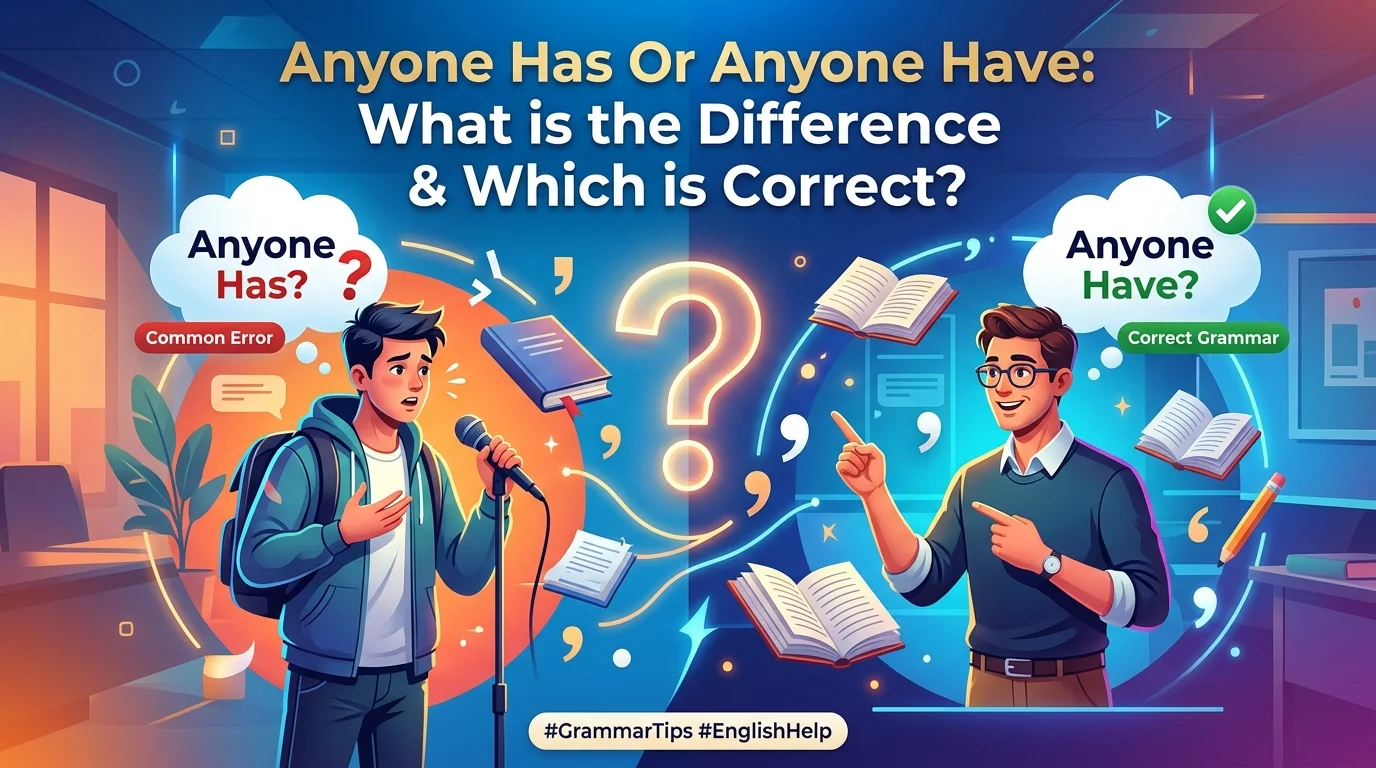

Understanding the difference between “anyone has” and “anyone have” is important for speaking and writing correct English. Many learners get confused because both sound similar, but only one is grammatically correct in most contexts. This guide explains their meanings, usage rules, and clear differences so you can confidently choose the right form every time.
Comparison Overview
“Anyone has” and “anyone have” are often confused because they involve the same subject, “anyone,” but they follow different grammatical rules. In standard English, only one structure is usually correct depending on sentence type. Both relate to possession or action, but their correctness depends on subject-verb agreement and sentence construction.
Definition of Anyone Has
“Anyone has” is a grammatically correct structure used when “anyone” is treated as a singular subject. Since “anyone” refers to a single, unspecified person, it pairs with singular verbs like “has” in affirmative statements or certain indirect speech contexts.
Definition of Anyone Have
“Anyone have” is commonly used in questions or informal speech, but it is not always grammatically correct on its own. It usually appears in interrogative structures like “Does anyone have…,” where “have” is the base form used with auxiliary verbs such as “does” or “do.”
Main Differences Between Anyone Has and Anyone Have
The key difference lies in grammar structure and sentence type. “Anyone has” is used in statements and indirect speech, while “anyone have” typically appears in questions but requires an auxiliary verb to be correct. The confusion arises because “anyone” is singular, but questions use base verbs after auxiliaries.
| Feature | Anyone Has | Anyone Have |
| Grammar role | Singular verb agreement | Base verb form in questions |
| Sentence type | Statements, indirect speech | Questions with “do/does” |
| Correct structure | Anyone has a book | Does anyone have a book |
| Formality | More formal | Informal or incomplete alone |
Grammar Guide
How each term is used in sentences
“Anyone has” is used when “anyone” is the subject in a statement. Example: “Anyone has the right to speak in the meeting.”
“Anyone have” appears only in questions with auxiliaries. Example: “Does anyone have a pen?”
Common mistakes learners make
A frequent mistake is using “anyone have” without an auxiliary verb, such as “Anyone have a pen?” in formal writing. Another error is overusing “anyone has” in questions instead of the correct “does anyone have.”
Simple rules to remember
Remember that “anyone” is singular, so it takes “has” in statements. In questions, always use “does” or “do” followed by “have.”
Quick tips for writing and speaking
Use “has” when making statements or indirect questions. Use “does anyone have” when asking direct questions. Avoid mixing structures in formal writing.
When to Use Each One
Use “anyone has” in formal statements, explanations, or indirect speech. Use “does anyone have” when asking questions in conversations, interviews, or surveys. This ensures clarity and grammatical accuracy in both written and spoken English.
When NOT to Use Each One
Avoid using “anyone have” alone in formal writing because it is incomplete. Also avoid using “anyone has” in direct questions like “Anyone has a pen?” Instead, always structure it properly with auxiliaries.
Which One to Use (Decision Guide)
If you are making a statement, use “anyone has.” If you are asking a question, use “does anyone have.” Always check whether your sentence needs an auxiliary verb. This simple check will help you avoid most grammar mistakes.
Real-World Practical Examples
Anyone Has Examples
- Anyone has the right to express their opinion in a democracy.
- I believe anyone has the ability to learn a new language.
- Anyone has access to the shared folder in the office.
- Anyone has the chance to win this competition.
- Anyone has the option to leave early today.
Anyone Have Examples
- Does anyone have a charger I can borrow?
- Does anyone have experience with this software?
- Does anyone have questions about the lesson?
- Does anyone have a spare pen?
- Does anyone have information about the meeting time?
Self-Assessment (Fill in the Blanks)
- ______ anyone have a spare key for the room?
- Anyone ______ the right to stay silent.
- Does anyone ______ a calculator?
- I think anyone ______ the ability to improve with practice.
- ______ anyone have seen my notebook?
- Anyone ______ access to this document.
- Does anyone ______ experience in coding?
- I believe anyone ______ the chance to succeed.
- ______ anyone have a question for the teacher?
- Anyone ______ the option to participate.
- Does anyone ______ a mobile charger?
- Anyone ______ the right to vote.
- ______ anyone have information about the event?
- I think anyone ______ potential in this field.
- Does anyone ______ a suggestion for improvement?
- Anyone ______ permission to enter the lab.
- ______ anyone have seen this movie before?
- Anyone ______ the ability to solve this problem.
- Does anyone ______ a pen I can use?
- Anyone ______ access to the system.
Answers
- Does
- has
- have
- has
- Has
- has
- have
- has
- Does
- has
- have
- has
- Has
- has
- have
- has
- Has
- has
- have
- has
Final Verdict
“Anyone has” is correct in statements because “anyone” is singular and requires a singular verb. “Anyone have” is not correct on its own but becomes correct in questions when paired with “does,” forming “does anyone have.” Understanding this difference helps you use English more accurately in both speaking and writing.
Conclusion About Anyone Has Or Anyone Have
In conclusion, the difference between “anyone has” and “anyone have” mainly comes down to grammar rules and sentence structure rather than meaning. Both forms relate to the same idea of referring to any person, but their correctness depends on whether you are making a statement or asking a question. “Anyone has” fits naturally in statements, while “does anyone have” is the correct form for questions. Once you understand this simple pattern, using these expressions becomes much easier in everyday writing and conversation. With regular practice, you can avoid common mistakes and speak more confidently and accurately in English.
FAQs
Is “anyone has” grammatically correct?
Yes, “anyone has” is grammatically correct when used in statements or indirect speech. Since “anyone” is singular, it pairs with “has.” For example, “Anyone has the right to express their opinion” is correct in formal or written contexts.
Can I say “anyone have” in English?
“Anyone have” is not correct on its own in standard grammar. It is only used in questions with an auxiliary verb, such as “Does anyone have a pen?” Without “does” or “do,” it is incomplete.
Why do people say “anyone have”?
People often say “anyone have” in casual spoken English because it sounds natural in fast speech. However, in proper grammar, it requires an auxiliary verb like “does” to be correct in questions.
What is the correct question form?
The correct question form is “Does anyone have…?” This structure follows subject-verb agreement rules and is used in both formal and informal English for asking questions.
Is “anyone has” formal or informal?
“Anyone has” is generally used in more formal writing or indirect statements. It is not commonly used in direct questions, where auxiliary verb structures are preferred.
Can “anyone have” ever be correct?
Yes, but only in questions with an auxiliary verb. For example, “Does anyone have time?” is correct, while “Anyone have time?” is not standard grammar.
What verb follows “anyone”?
“Anyone” is treated as singular, so it usually takes singular verbs like “has” in statements. In questions, the base form of the verb is used after auxiliaries like “does.”
Is it correct to say “has anyone have”?
No, “has anyone have” is incorrect. The proper form is “has anyone had” for past tense questions or “does anyone have” for present tense.
Why is “does anyone have” correct?
“Does anyone have” is correct because the auxiliary verb “does” handles the tense, allowing the main verb “have” to stay in its base form, which follows standard English grammar rules.
What is the easiest way to remember the difference?
Remember that “anyone” is singular, so it takes “has” in statements. In questions, always use “does anyone have.” This simple rule helps avoid most common mistakes.
