
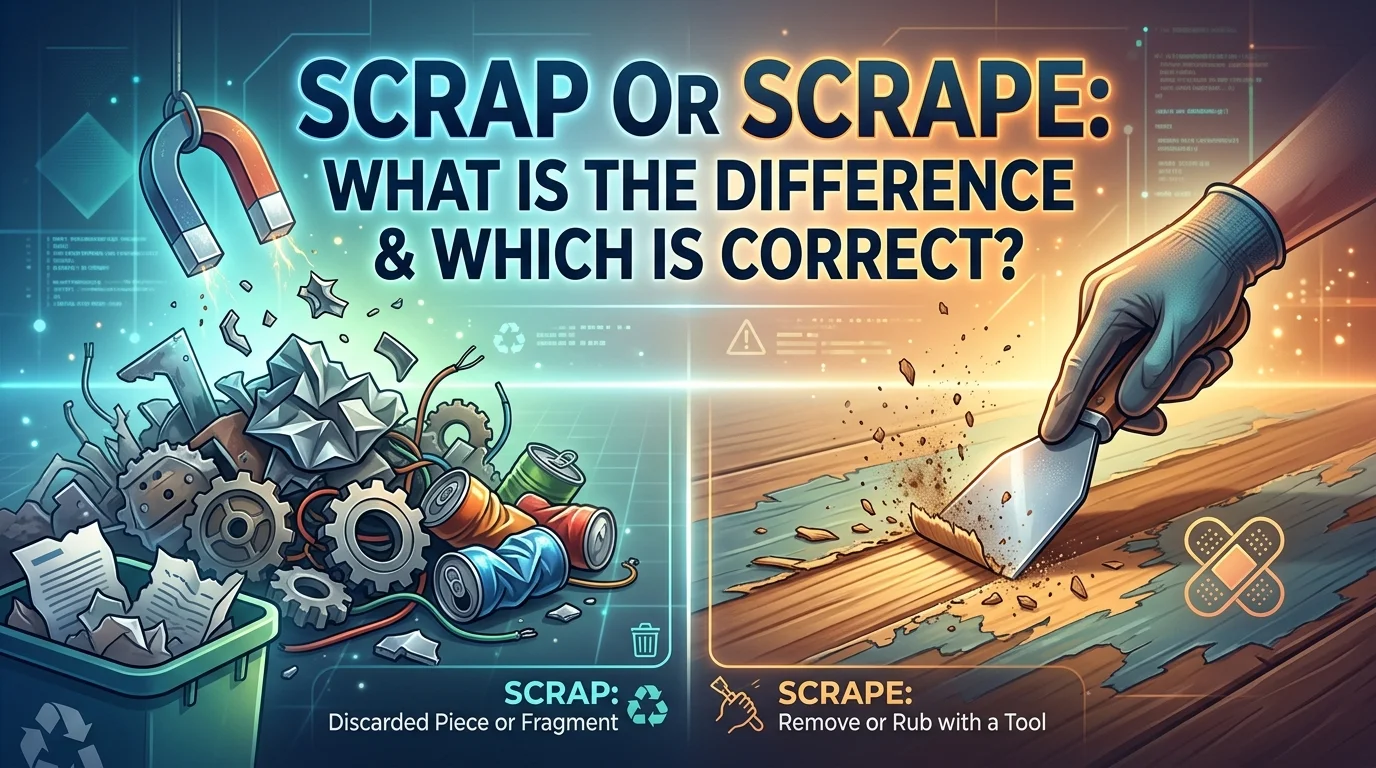

Many English learners and writers confuse scrap and scrape because the words look and sound similar. However, they have different meanings and uses. Understanding the difference helps you communicate more accurately in writing and conversation. This guide explains both terms in simple language, highlights their differences, and shows when each word should and should not be used.
Comparison Overview
Although scrap and scrape share similar spelling, they serve different purposes in English.
| Term | Part of Speech | Main Meaning | Common Contexts |
| Scrap | Noun, Verb | A small leftover piece or to discard something | Recycling, manufacturing, writing |
| Scrape | Verb, Noun | To rub or remove material from a surface | Cleaning, injuries, technology |
The confusion often arises because both words can involve removing or getting rid of something, but they are used in different situations.
Definition of Scrap
Scrap generally refers to a small leftover piece of material or something that is no longer needed. As a verb, it means to throw away, cancel, or discard something.
Examples:
- Metal scraps were collected for recycling.
- The company decided to scrap the old project.
- She saved every scrap of paper.
The word often relates to waste materials, leftovers, or abandoned plans.
Definition of Scrape
Scrape means to rub against a surface, often removing material or causing slight damage. It can also refer to the mark or injury created by such rubbing.
Examples:
- He scraped the paint from the wall.
- The child scraped her knee while running.
- Please scrape the ice off the windshield.
The word is commonly used when discussing cleaning, friction, or minor injuries.
Main Differences Between Scrap and Scrape
| Feature | Scrap | Scrape |
| Primary Meaning | Leftover material or discard something | Rub or remove material from a surface |
| Part of Speech | Noun and verb | Noun and verb |
| Focus | Disposal or leftovers | Friction or removal |
| Common Industries | Recycling, manufacturing, business | Cleaning, maintenance, healthcare |
| Example | Scrap the plan | Scrape the paint |
Key differences include:
- Scrap focuses on abandoning, discarding, or leftover material.
- Scrape focuses on rubbing, scratching, or removing material.
- A company may scrap a project.
- A worker may scrape rust from metal.
- A scrap is often a thing.
- A scrape is often an action.
Scrap vs Scrape in Everyday Language
People often encounter both words in daily life.
Examples of scrap:
- Scrap paper
- Scrap metal
- Scrap materials
- Scrap a proposal
Examples of scrape:
- Scrape food from a plate
- Scrape ice off a car
- Scrape a knee
- Scrape mud from shoes
Remember that one usually refers to leftovers or discarding, while the other refers to rubbing or removing.
Scrap vs Scrape in Technology
Technology uses both terms differently.
Scrap in Technology
- Scrapping outdated hardware
- Scrapping obsolete software projects
- Scrapping development plans
Scrape in Technology
- Web scraping data from websites
- Scraping information from databases
- Scraping content for analysis
In technology, scrape is particularly common because it describes extracting data from online sources.
Grammar Guide
How Each Term Is Used in Sentences
Scrap
As a noun:
- Every scrap of evidence was important.
- The factory sold its scrap metal.
As a verb:
- They decided to scrap the proposal.
- We should scrap the outdated process.
Scrape
As a verb:
- Scrape the mud off your shoes.
- She scraped the sticker from the glass.
As a noun:
- He suffered a scrape on his arm.
- The bicycle left a scrape on the wall.
Common Mistakes Learners Make
- Using scrape when meaning discard.
- Incorrect: We scraped the project.
- Correct: We scrapped the project.
- Using scrap when meaning rub off.
- Incorrect: Scrap the paint from the door.
- Correct: Scrape the paint from the door.
- Confusing web scraping with scrap materials.
- Web scraping always uses scrape.
- Mixing up noun and verb forms.
- Assuming the words are interchangeable.
Simple Rules to Remember
- If you mean throw away, use scrap.
- If you mean rub off, use scrape.
- If discussing leftovers, use scrap.
- If discussing scratches or friction, use scrape.
- Data extraction online uses scrape.
Quick Tips for Writing and Speaking
- Think of scrap metal when remembering scrap.
- Think of scraping paint when remembering scrape.
- Check whether the context involves disposal or friction.
- Read the sentence aloud for clarity.
- Practice using both words in separate contexts.
When to Use Each One
Use Scrap When
- Referring to leftover material.
- Talking about waste products.
- Canceling projects.
- Discarding equipment.
- Describing small pieces of something.
Examples:
- Scrap paper
- Scrap metal
- Scrap wood
- Scrap the plan
- Scrap the machine
Use Scrape When
- Removing material from a surface.
- Describing minor injuries.
- Cleaning objects.
- Discussing friction.
- Referring to web data extraction.
Examples:
- Scrape the floor.
- Scrape off paint.
- Scrape a knee.
- Scrape ice away.
- Scrape website data.
When NOT to Use Each One
Do Not Use Scrap When
- Talking about rubbing surfaces.
- Referring to scratches.
- Describing cleaning actions.
- Discussing web data extraction.
- Removing paint or dirt.
Do Not Use Scrape When
- Talking about leftovers.
- Referring to discarded materials.
- Canceling projects.
- Discussing waste metal.
- Describing small remaining pieces.
Which One to Use (Decision Guide)
Ask yourself these questions:
- Are you talking about leftovers or waste material?
- Use scrap.
- Are you talking about canceling something?
- Use scrap.
- Are you removing material from a surface?
- Use scrape.
- Are you discussing scratches or minor injuries?
- Use scrape.
- Are you extracting website data?
- Use scrape.
Quick decision chart:
| Situation | Correct Word |
| Leftover material | Scrap |
| Cancel a project | Scrap |
| Remove paint | Scrape |
| Scratch a surface | Scrape |
| Web data extraction | Scrape |
| Recycling metal | Scrap |
Real-World Practical Examples
Scrap Examples
- The factory sold scrap metal to a recycling company.
- The manager decided to scrap the marketing campaign.
- Students used scrap paper for practice exercises.
- Engineers scrapped the faulty design.
- Artists created decorations from scrap wood.
Scrape Examples
- The chef scraped burnt food from the pan.
- She scraped her knee while riding a bicycle.
- Workers scraped old paint from the building.
- The developer scraped public data from websites.
- He scraped mud from his boots before entering.
Self-Assessment (Fill in the Blanks)
- I will use ______ when referring to leftover metal. The correct word is ______ because it describes waste material.
- I will use ______ when removing paint from a wall. The correct word is ______ because it involves rubbing a surface.
- I will use ______ when canceling a project. The correct word is ______ because it means discard.
- I will use ______ when cleaning ice from a windshield. The correct word is ______ because it means remove by rubbing.
- I will use ______ when discussing recycling materials. The correct word is ______ because it refers to leftovers.
- I will use ______ when talking about a scratched knee. The correct word is ______ because it relates to friction.
- I will use ______ when abandoning an outdated plan. The correct word is ______ because it means cancel.
- I will use ______ when removing stickers from glass. The correct word is ______ because it involves rubbing.
- I will use ______ when discussing leftover fabric pieces. The correct word is ______ because it refers to remnants.
- I will use ______ when extracting data from websites. The correct word is ______ because it means collect by automated removal.
- I will use ______ when describing waste paper. The correct word is ______ because it means leftover material.
- I will use ______ when cleaning dirt from shoes. The correct word is ______ because it involves removing material.
- I will use ______ when discarding a machine. The correct word is ______ because it means get rid of.
- I will use ______ when removing rust from metal. The correct word is ______ because it requires rubbing.
- I will use ______ when discussing recycling industries. The correct word is ______ because it refers to reusable leftovers.
- I will use ______ when describing a minor skin injury. The correct word is ______ because it means a small abrasion.
- I will use ______ when ending a failed business idea. The correct word is ______ because it means abandon.
- I will use ______ when cleaning a cooking pan. The correct word is ______ because it involves removing residue.
- I will use ______ when referring to leftover wood pieces. The correct word is ______ because it describes remnants.
- I will use ______ when removing mud from a bicycle tire. The correct word is ______ because it means rub off material.
Answers
- Scrap
- Scrape
- Scrap
- Scrape
- Scrap
- Scrape
- Scrap
- Scrape
- Scrap
- Scrape
- Scrap
- Scrape
- Scrap
- Scrape
- Scrap
- Scrape
- Scrap
- Scrape
- Scrap
- Scrape
Final Verdict
Scrap and scrape are not interchangeable. Scrap refers to leftover materials, waste, or the act of discarding something. Scrape refers to rubbing, scratching, or removing material from a surface. If you are talking about recycling, leftovers, or canceling plans, choose scrap. If you are talking about cleaning, scratches, injuries, or data extraction, choose scrape. Understanding this distinction will help you use both words confidently and correctly in everyday communication.
Conclusion About Scrap Or Scrape
Understanding the difference between scrap and scrape can make your writing and speaking much clearer. While these words look similar, they serve very different purposes in English. Scrap usually refers to leftover materials, waste items, or the act of discarding something that is no longer useful. Scrape, on the other hand, relates to rubbing, scratching, or removing material from a surface. The distinction becomes especially important in professional writing, everyday communication, technology, and education.
A simple way to remember the difference is to think of scrap as something that is thrown away or left over, while scrape is an action that removes something through friction or contact. By focusing on the context of your sentence, you can easily choose the correct word. With regular practice, using scrap and scrape correctly will become natural and help you communicate with greater confidence and accuracy.
FAQs
What is the main difference between scrap and scrape?
The main difference is that scrap refers to leftover materials or the act of discarding something, while scrape means to rub against a surface to remove material or cause a slight scratch. They have different meanings and are not interchangeable.
Is scrap a noun or a verb?
Scrap can be both a noun and a verb. As a noun, it means a small leftover piece of material. As a verb, it means to discard, cancel, or get rid of something that is no longer useful.
Is scrape a noun or a verb?
Yes, scrape can function as both a noun and a verb. As a verb, it means to remove material by rubbing. As a noun, it can refer to a scratch, abrasion, or minor injury caused by friction.
Do scrap and scrape have the same pronunciation?
No, they are pronounced differently. Although the words look similar, scrap ends with a short “ap” sound, while scrape ends with a long “ape” sound. This difference helps distinguish them in speech.
What does scrap metal mean?
Scrap metal refers to leftover, discarded, or recyclable metal materials that can be reused in manufacturing. It is a common term in recycling industries and construction projects where unused metal pieces are collected for processing.
What does scrape mean in web scraping?
In technology, scrape means automatically collecting or extracting information from websites or online sources. Web scraping tools gather data for research, analysis, business intelligence, and other legitimate digital purposes.
Can I say scrap the paint from the wall?
No, that would be incorrect. When removing paint from a wall, the correct word is scrape because the action involves rubbing or stripping material from a surface rather than discarding something.
When should I use scrap as a verb?
Use scrap as a verb when talking about canceling plans, abandoning projects, discarding equipment, or getting rid of something that is no longer needed. It commonly appears in business, engineering, and manufacturing contexts.
What is a scrape injury?
A scrape injury is a minor wound caused when skin rubs against a rough surface. It usually removes a small layer of skin and is often called an abrasion. Such injuries are common during sports and outdoor activities.
How can I easily remember the difference between scrap and scrape?
A helpful memory trick is to associate scrap with leftovers and disposal, while scrape relates to scratching or removing something from a surface. If friction is involved, use scrape. If waste or discarding is involved, use scrap.
