
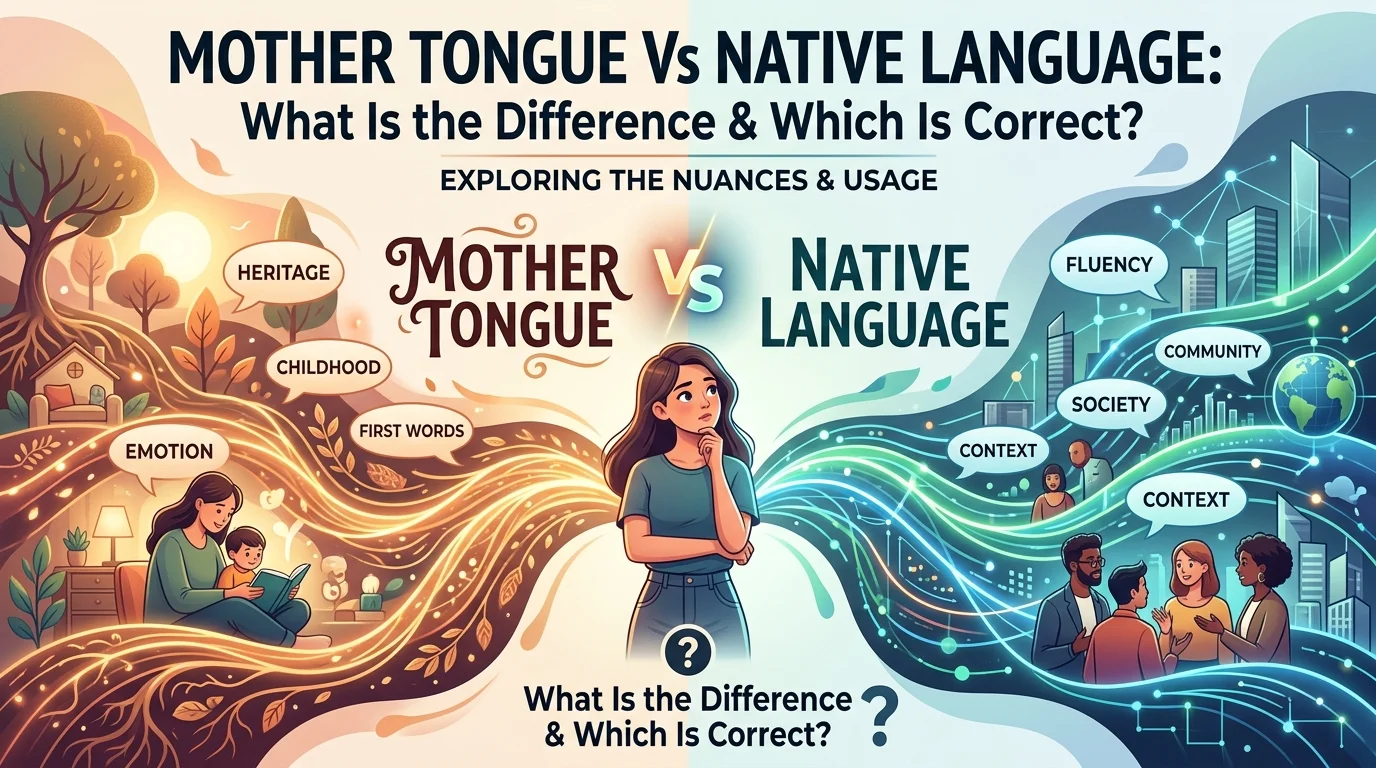

Many people use “mother tongue” and “native language” as if they mean exactly the same thing. While they are closely related, there are small differences in meaning, tone, and usage. Understanding these differences helps learners, writers, teachers, and professionals choose the correct term in speaking and writing.
Comparison Overview
“Mother tongue” and “native language” both describe the first language a person learns during childhood. These terms are commonly used in education, linguistics, communication, and cultural discussions. However, one term is often more emotional and cultural, while the other sounds more formal and academic.
| Feature | Mother Tongue | Native Language |
| Main Meaning | First language learned from parents or family | First language naturally learned in childhood |
| Tone | Emotional and cultural | Formal and academic |
| Common Usage | Daily conversation, culture, identity | Education, research, linguistics |
| Focus | Family and heritage | Fluency and natural acquisition |
| Common In | Personal discussions | Professional and educational contexts |
Definition of Mother Tongue
A mother tongue is the first language a child learns at home, usually from parents or family members. It is strongly connected to culture, identity, traditions, and emotions.
The term often emphasizes a personal and cultural relationship with a language. People may feel emotionally attached to their mother tongue because it connects them to their roots and community.
Examples:
- Punjabi is her mother tongue.
- Children should learn in their mother tongue during early education.
- He speaks his mother tongue with pride.
Definition of Native Language
A native language is the language a person learns naturally from early childhood and speaks fluently without formal study. The term focuses more on language ability and natural acquisition.
It is commonly used in linguistics, education, job applications, and language proficiency discussions.
Examples:
- English is her native language.
- Native language speakers understand idioms naturally.
- The survey asked participants to list their native language.
Main Differences Between Mother Tongue and Native Language
Although both terms describe a first language, they are not always identical in meaning or usage.
| Aspect | Mother Tongue | Native Language |
| Emotional Connection | Strong | Usually weaker |
| Cultural Identity | Important | Less emphasized |
| Academic Use | Less common | Very common |
| Formal Tone | Moderate | Highly formal |
| Family Influence | Central idea | Not always mentioned |
| Language Skill Focus | Less important | More important |
A person’s mother tongue may represent their family heritage even if they are not fully fluent in it. In contrast, a native language usually refers to the language someone speaks naturally and fluently.
For example:
- A child born in Canada to Punjabi-speaking parents may consider Punjabi their mother tongue.
- However, English may become their native language if it is the language they speak most fluently from childhood.
Historical and Cultural Importance
Mother Tongue and Cultural Identity
The phrase “mother tongue” has deep cultural importance. It reflects traditions, family history, and emotional belonging. Many communities encourage preserving the mother tongue to protect cultural heritage.
Native Language in Modern Communication
“Native language” is widely used in schools, research papers, international communication, and language testing. It sounds more neutral and professional.
Educational Usage
Schools and universities often use both terms differently.
| Context | Preferred Term |
| Language research | Native language |
| Cultural discussions | Mother tongue |
| Government forms | Native language |
| Heritage programs | Mother tongue |
| Linguistics studies | Native language |
Grammar Guide
How Each Term Is Used in Sentences
Both expressions are noun phrases.
Sentence patterns:
- Subject + is + mother tongue/native language
- My mother tongue is Urdu.
- Her native language is Spanish.
Examples:
- Bengali is his mother tongue.
- Arabic is their native language.
- She teaches students in their mother tongue.
- The app supports multiple native languages.
Common Mistakes Learners Make
Using Both Terms as Completely Different Concepts
Many learners think the terms have totally separate meanings. In reality, they overlap heavily.
Incorrect:
- Your mother tongue and native language can never be the same.
Correct:
- In many cases, they are the same language.
Confusing Native Language With National Language
A native language belongs to an individual, while a national language belongs to a country.
Incorrect:
- English is the native language of Pakistan.
Correct:
- Urdu is the national language of Pakistan.
Assuming Mother Tongue Must Be Spoken Perfectly
Some people understand their mother tongue but cannot speak it fluently.
Simple Rules to Remember
- Use “mother tongue” when discussing culture, family, or heritage.
- Use “native language” in formal, academic, or professional contexts.
- Both often describe the first language learned in childhood.
- “Native language” sounds more neutral and technical.
Quick Tips for Writing and Speaking
- In essays and research papers, prefer “native language.”
- In cultural conversations, “mother tongue” sounds warmer and more personal.
- Avoid mixing “native language” with “official language.”
- Use the term consistently throughout your writing.
When to Use Each One
Use “Mother Tongue” When:
- Talking about family heritage
- Discussing cultural identity
- Referring to emotional language connection
- Explaining traditional upbringing
- Writing about local culture or customs
Examples:
- Children should preserve their mother tongue.
- Folk songs are best understood in the mother tongue.
Use “Native Language” When:
- Filling out forms
- Writing academic papers
- Discussing fluency
- Explaining language learning
- Talking about linguistics or communication studies
Examples:
- Please state your native language.
- Native language interference affects pronunciation.
When NOT to Use Each One
Avoid “Mother Tongue” When:
- Writing highly technical research papers
- Discussing formal language proficiency tests
- Referring to official government languages
Avoid “Native Language” When:
- Discussing emotional cultural identity
- Talking about heritage preservation in a personal way
- Describing traditional family communication
Which One to Use (Decision Guide)
Use this quick guide to choose correctly:
| Situation | Best Choice |
| Cultural discussion | Mother tongue |
| Academic writing | Native language |
| Job application | Native language |
| Heritage conversation | Mother tongue |
| Linguistics research | Native language |
| Family identity | Mother tongue |
If you are unsure, “native language” is usually safer in professional writing, while “mother tongue” feels more personal and cultural.
Real-World Practical Examples
Mother Tongue Examples
- The teacher explained the lesson in the students’ mother tongue.
- Many families teach children their mother tongue at home.
- She writes poetry in her mother tongue.
- Cultural festivals often celebrate the local mother tongue.
- The child learned his mother tongue before starting school.
Native Language Examples
- English is his native language.
- The company prefers applicants with German as a native language.
- Native language influence can affect pronunciation.
- The software supports translation from your native language.
- Researchers studied how children develop their native language skills.
Self-Assessment (Fill in the Blanks)
- Punjabi is my ______ because I learned it from my family.
- The application form asked for my ______.
- Children often feel emotionally connected to their ______.
- Linguists usually use the term ______ in research papers.
- Her ______ is Spanish because she learned it naturally in childhood.
- Many schools encourage students to preserve their ______.
- In professional settings, ______ sounds more formal.
- My grandmother only speaks her ______.
- The scientist studied second-language learning after the ______ was acquired.
- Folk traditions are often passed through the ______.
- The employee listed French as her ______.
- A person may understand their ______ but not speak it fluently.
- Academic articles often prefer the phrase ______.
- The child spoke his ______ at home and English at school.
- The survey requested information about each participant’s ______.
- Cultural identity is strongly connected to the ______.
- A ______ speaker usually understands natural expressions easily.
- Teachers sometimes use the student’s ______ for better understanding.
- The phrase ______ is more emotional and cultural.
- The term ______ is common in linguistics and education.
Answers
- mother tongue
- native language
- mother tongue
- native language
- native language
- mother tongue
- native language
- mother tongue
- native language
- mother tongue
- native language
- mother tongue
- native language
- mother tongue
- native language
- mother tongue
- native language
- mother tongue
- mother tongue
- native language
Final Verdict
“Mother tongue” and “native language” are very similar terms, but they are used in slightly different ways. “Mother tongue” highlights culture, heritage, and emotional connection, while “native language” focuses on natural fluency and formal language identification. In everyday conversation, both may refer to the same language, but choosing the right one depends on context, tone, and purpose.
Conclusion About Mother Tongue Vs Native Language
Understanding the difference between “mother tongue” and “native language” can make communication clearer and more accurate. Although both terms often describe the first language a person learns, they carry slightly different meanings and emotional tones. “Mother tongue” usually reflects cultural roots, family identity, and personal connection, while “native language” is more formal and focuses on natural language ability and fluency. Knowing when to use each expression helps students, writers, teachers, and professionals avoid confusion in both speaking and writing. In everyday conversations, the two terms are frequently interchangeable, but context still matters. Whether you are discussing language learning, cultural heritage, education, or communication skills, choosing the correct term improves clarity and understanding. By remembering the simple differences between these expressions, you can confidently use both in real life, academic settings, and professional communication.
FAQs
Is mother tongue the same as native language?
Mother tongue and native language are very similar terms because both usually refer to the first language learned in childhood. However, mother tongue often highlights emotional and cultural identity, while native language focuses more on natural fluency and language ability in formal or academic contexts.
Which term is more formal, mother tongue or native language?
Native language is generally considered more formal and professional. It is commonly used in research papers, job applications, educational forms, and linguistics. Mother tongue sounds more personal and cultural, so it is often used in conversations about family heritage and traditions.
Can someone have more than one native language?
Yes, a person can have more than one native language if they grow up learning multiple languages naturally from early childhood. This is common in bilingual or multilingual families where children regularly speak different languages at home and in their community.
Is mother tongue connected to culture?
Yes, mother tongue is strongly connected to culture, traditions, family history, and identity. People often associate their mother tongue with emotional memories, cultural values, and communication within their family or local community.
What is the difference between native language and official language?
A native language belongs to an individual and is the language learned naturally in childhood. An official language is the language recognized by a government for legal, educational, or administrative purposes within a country.
Can your mother tongue change over time?
A mother tongue usually remains connected to a person’s early upbringing and cultural roots. However, language dominance can change over time if someone uses another language more frequently in daily life, education, or work.
Which term should I use in academic writing?
In academic and professional writing, native language is usually the better choice because it sounds more formal and precise. Researchers and educators commonly use this term in studies related to language learning and communication.
Why do schools encourage mother tongue education?
Schools encourage mother tongue education because children often learn concepts more easily in the language they first understand. It can improve comprehension, confidence, communication skills, and cultural awareness during early education.
Can a person forget their mother tongue?
Yes, some people partially forget their mother tongue if they stop using it regularly for many years. This can happen after moving to another country or primarily speaking a different language in everyday life.
Is native language important in communication skills?
Yes, a native language plays an important role in communication because it shapes pronunciation, vocabulary, grammar habits, and natural speaking ability. Strong native language skills can also support learning additional languages more effectively.
