
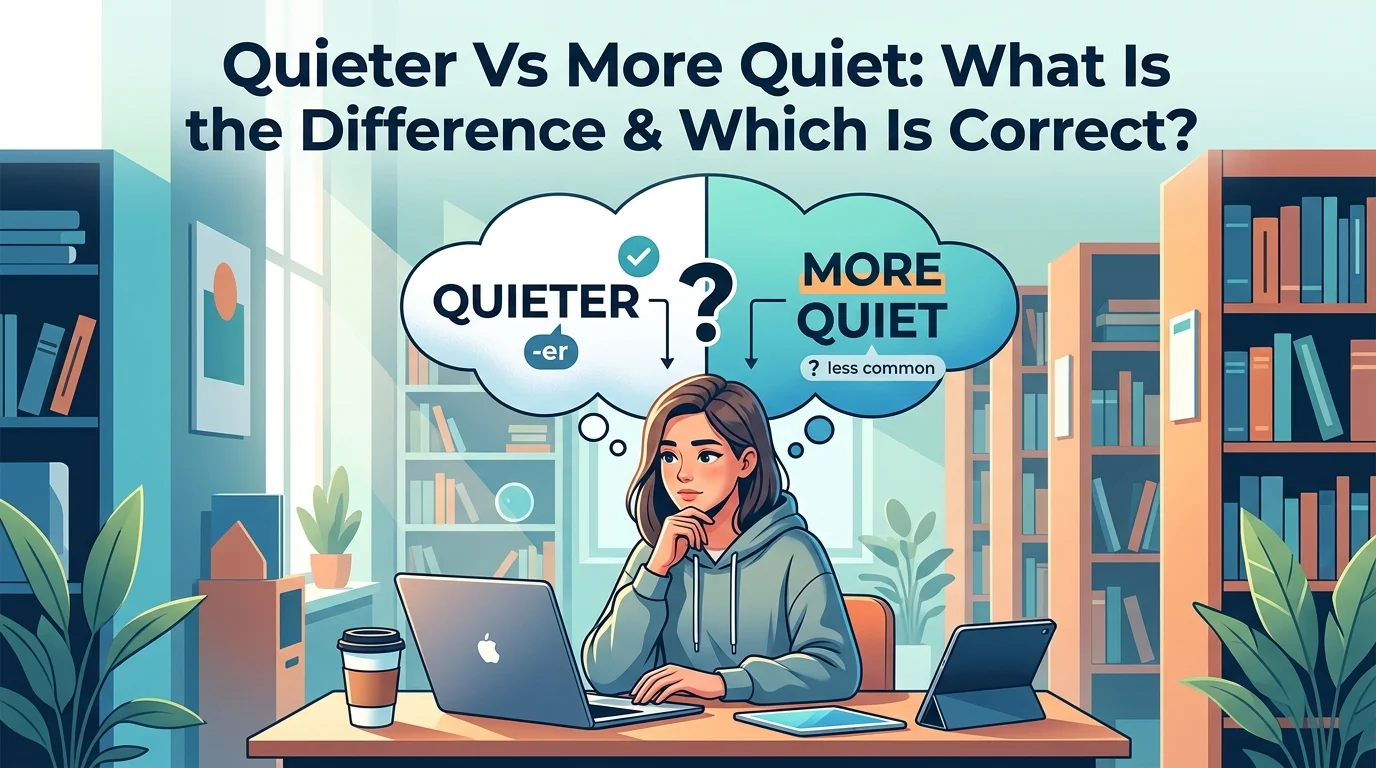

Choosing between quieter and more quiet can be confusing because both forms are used to compare levels of noise. While they often express the same idea, one form is generally preferred in modern English. Understanding the difference helps improve grammar, writing clarity, and natural communication. This guide explains when to use each expression, how they differ, and which option is usually considered correct.
Comparison Overview
Both quieter and more quiet are comparative forms of the adjective quiet. They are used when comparing two people, places, situations, or things based on how little noise they make.
While both forms are grammatically possible, quieter is the standard and more common comparative form in modern English. More quiet is less common but may sometimes be used for emphasis or stylistic reasons.
| Feature | Quieter | More Quiet |
| Part of Speech | Comparative adjective | Comparative adjective |
| Commonness | Very common | Less common |
| Preferred in modern English | Yes | Usually no |
| Meaning | Less noisy | Less noisy |
| Natural in conversation | Yes | Sometimes |
Definition of Quieter
Quieter is the standard comparative form of the adjective quiet. It is used when comparing two things and showing that one has less noise than the other.
Examples:
- This room is quieter than the hallway.
- The countryside is quieter than the city.
- The library became quieter after lunch.
The word follows the common English rule of adding -er to many short adjectives to create a comparison.
Definition of More Quiet
More quiet is an alternative comparative form of quiet. It carries the same meaning as quieter, indicating a lower level of noise when compared to something else.
Examples:
- The office became more quiet after everyone left.
- The neighborhood seemed more quiet at night.
Although grammatically acceptable, native speakers usually prefer quieter because it sounds more natural and concise.
Main Differences Between Quieter and More Quiet
The primary difference is not meaning but usage and style.
| Aspect | Quieter | More Quiet |
| Meaning | Less noisy | Less noisy |
| Grammar Preference | Standard comparative | Alternative comparative |
| Frequency | Very frequent | Less frequent |
| Natural Sound | More natural | Slightly less natural |
| Academic Writing | Preferred | Rarely preferred |
Key differences include:
- Quieter is the standard comparative form taught in grammar.
- More quiet is grammatically possible but less common.
- Most native speakers naturally choose quieter.
- Formal and informal writing generally favor quieter.
- The meaning remains essentially identical.
Comparative Forms of Quiet
English allows some adjectives to have both an -er form and a more form. The adjective quiet belongs to this category.
Examples:
- The room is quieter today.
- The room is more quiet today.
Both are understandable, but the first sentence sounds more natural to most English speakers.
Why Quieter Is Usually Preferred
The adjective quiet has two syllables. Many two-syllable adjectives can take -er for comparison.
Examples:
- quiet → quieter
- narrow → narrower
- simple → simpler
Because of this pattern, quieter has become the standard comparative form in everyday English.
Grammar Guide
How Each Term Is Used in Sentences
Quieter Pattern
- Subject + be + quieter + than + comparison
Examples:
- This classroom is quieter than that one.
- My new computer is quieter than my old one.
More Quiet Pattern
- Subject + be + more quiet + than + comparison
Examples:
- The street is more quiet than before.
- The area became more quiet after midnight.
Common Mistakes Learners Make
- Using both comparative markers together.
- Incorrect: More quieter
- Correct: Quieter
- Assuming more quiet is always wrong.
- It is less common, but not always incorrect.
- Avoiding quieter unnecessarily.
- Quieter is usually the best choice.
- Mixing comparative structures.
- Incorrect: Quieter than before than yesterday.
Simple Rules to Remember
- Use quieter in most situations.
- Do not say more quieter.
- Both forms mean the same thing.
- Choose quieter for natural English.
- Use more quiet only when a specific style or emphasis is desired.
Quick Tips for Writing and Speaking
- In conversations, use quieter.
- In essays, use quieter unless there is a stylistic reason not to.
- If unsure, choose quieter.
- Avoid double comparatives.
- Read your sentence aloud to check which sounds more natural.
When to Use Each One
Use Quieter When:
- Comparing noise levels.
- Writing formal documents.
- Speaking naturally.
- Writing academic content.
- Describing places, people, or situations.
Examples:
- This fan is quieter than the old one.
- The town is quieter during winter.
Use More Quiet When:
- Seeking a particular writing style.
- Emphasizing the adjective itself.
- Following a deliberate literary tone.
Examples:
- The valley became more quiet as evening approached.
- The atmosphere felt more quiet than expected.
When NOT to Use Each One
Do Not Use Quieter
- When creating a double comparative.
- Incorrect: More quieter
Do Not Use More Quiet
- When trying to sound natural in everyday speech.
- When concise wording is preferred.
- When standard grammar conventions are expected.
Which One to Use (Decision Guide)
Ask yourself these questions:
- Are you comparing two things?
- Yes → Continue.
- Do you want standard, natural English?
- Yes → Use quieter.
- Are you writing in a literary or stylistic way?
- Yes → More quiet may work.
- Are you unsure?
- Choose quieter.
Decision Summary:
| Situation | Best Choice |
| Everyday conversation | Quieter |
| Academic writing | Quieter |
| Business writing | Quieter |
| Informal communication | Quieter |
| Literary style | More Quiet (sometimes) |
Real-World Practical Examples
Quieter Examples
- The classroom became quieter after the exam started.
- This electric car is quieter than older vehicles.
- The library is quieter in the morning.
- Our new printer is much quieter than the previous model.
- The discussion became quieter when the speaker entered.
More Quiet Examples
- The neighborhood felt more quiet after the festival ended.
- The forest seemed more quiet at sunrise.
- The office became more quiet during the holiday season.
- The atmosphere was more quiet than I expected.
- The research facility appeared more quiet at night.
Self-Assessment (Fill in the Blanks)
- This room is ______ than the cafeteria.
- The correct word is ______ because standard English prefers the comparative ending.
- Our new machine is ______ than the previous model.
- The correct word is ______ because it sounds more natural in conversation.
- The library became ______ after students left.
- The correct word is ______ because it is the usual comparative form of quiet.
- The countryside is ______ than downtown.
- The correct word is ______ because everyday English favors it.
- This fan is ______ than the old one.
- The correct word is ______ because double comparatives are incorrect.
- The atmosphere felt ______ after sunset.
- The correct word is ______ because it follows common grammar rules.
- The office became ______ during the weekend.
- The correct word is ______ because it is preferred in professional writing.
- The classroom grew ______ as the lesson continued.
- The correct word is ______ because it is shorter and more common.
- The town is ______ than the capital city.
- The correct word is ______ because it is the standard comparative adjective.
- The laboratory was ______ after the experiment ended.
- The correct word is ______ because most native speakers choose it.
Answers
- quieter
- quieter
- quieter
- quieter
- quieter
- quieter
- quieter
- quieter
- quieter
- quieter
- quieter
- quieter
- quieter
- quieter
- quieter
- quieter
- quieter
- quieter
- quieter
- quieter
Final Verdict
Both quieter and more quiet can be used to compare levels of noise, and both communicate essentially the same meaning. However, quieter is the standard comparative form and is overwhelmingly preferred in modern English. It sounds more natural, follows common grammar patterns, and is appropriate in everyday conversation, academic writing, business communication, and professional contexts. More quiet is not necessarily wrong, but it is less common and usually appears only for stylistic or literary effect. If your goal is clear, correct, and natural English, quieter should almost always be your first choice. By remembering that quiet →quieter follows the normal comparative pattern, you can confidently select the right form in nearly every situation.
Conclusion About Quieter Vs More Quiet
Understanding the difference between quieter and more quiet can help you write and speak English with greater confidence. Although both expressions communicate the idea of being less noisy, quieter is the form most native speakers use in everyday conversations, professional writing, academic work, and formal communication. It follows the standard comparative pattern for the adjective quiet and sounds more natural in most situations.
On the other hand, more quiet is not necessarily incorrect. It occasionally appears in literature, creative writing, or contexts where a writer wants a specific style or emphasis. However, it is far less common than quieter.
If you ever find yourself choosing between the two, the safest and most widely accepted option is quieter. By remembering this simple rule, you can avoid common grammar mistakes and communicate more clearly in both writing and speech.
FAQs
Is quieter grammatically correct?
Yes, quieter is grammatically correct and is the standard comparative form of the adjective quiet. It is commonly used when comparing two people, places, or things to show that one produces less noise than the other.
Is more quiet wrong?
No, more quiet is not wrong. It is grammatically acceptable in English. However, it is less common than quieter and may sound less natural in everyday speech and writing.
Which is more common: quieter or more quiet?
Quieter is much more common in modern English. Native speakers typically prefer it because it is shorter, smoother, and follows the standard comparative pattern used with many adjectives.
Can I use quieter in formal writing?
Yes, quieter is appropriate in formal, academic, and professional writing. It is generally the preferred choice when comparing levels of noise or describing something as less noisy.
Why do some writers use more quiet?
Some writers use more quiet for stylistic reasons, emphasis, or rhythm within a sentence. While less common, it can occasionally fit certain literary or creative contexts.
What is the comparative form of quiet?
The standard comparative form of quiet is quieter. It is used when comparing two things and indicating that one is less noisy than the other.
Is more quieter correct?
No, more quieter is incorrect because it creates a double comparative. You should use either quieter or more quiet, but never both together.
Are quieter and more quiet different in meaning?
Not significantly. Both expressions generally mean the same thing: having less noise compared to something else. The main difference lies in preference, style, and frequency of use.
How can I remember which form to use?
A simple rule is to remember that quiet usually becomes quieter, just as simple becomes simpler. In most situations, choosing quieter will sound natural and correct.
Which form should English learners use?
English learners should primarily use quieter because it is the standard form taught in grammar lessons and is widely accepted in both spoken and written English.
