
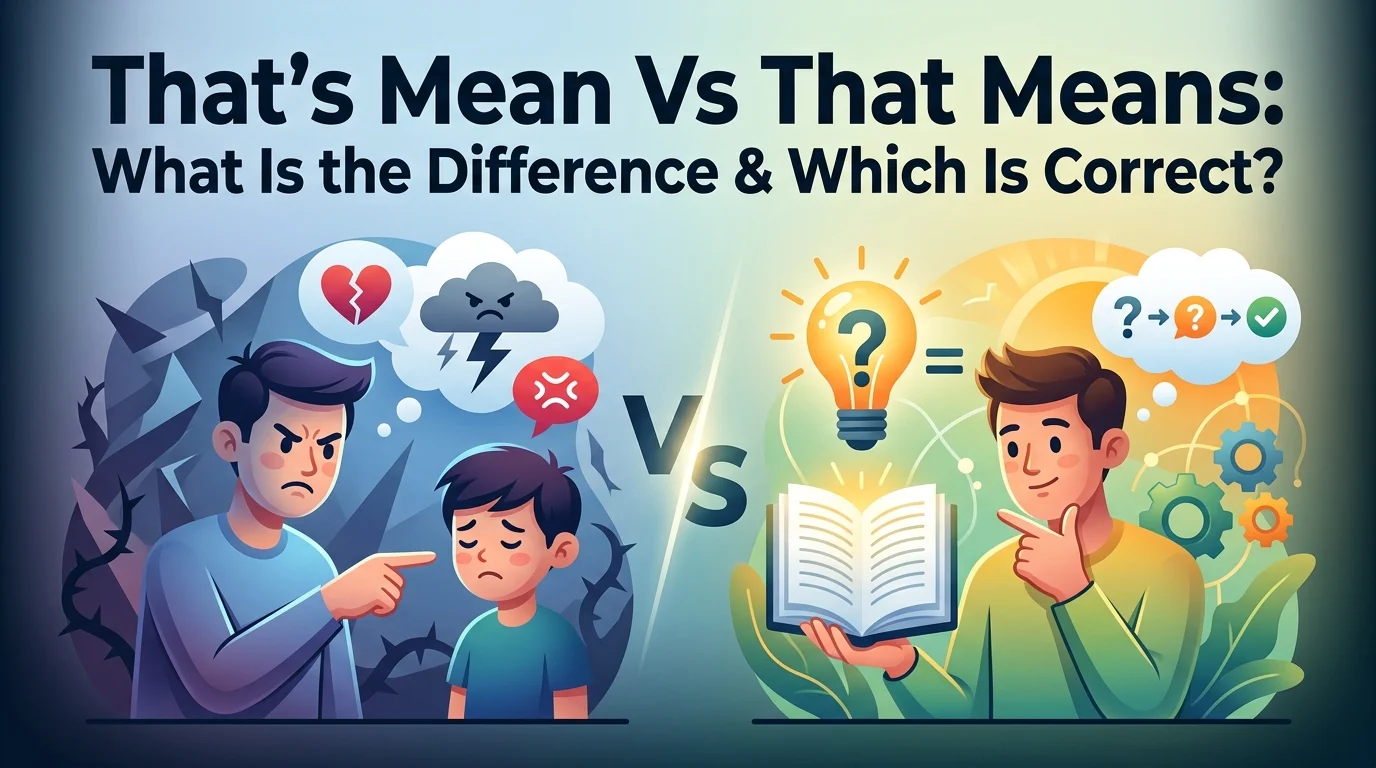

Many English learners get confused between “that’s mean” and “that means” because the phrases look and sound somewhat similar. However, they have completely different meanings and grammatical functions. Understanding the difference is important for speaking and writing accurately. This guide explains both expressions in simple terms, highlights their differences, and shows exactly when to use each one.
Comparison Overview
Although “that’s mean” and “that means” may appear similar, they serve different purposes in English.
- That’s mean is used to describe something as unkind, rude, or cruel.
- That means is used to explain the meaning, result, or implication of something.
Because one phrase describes behavior while the other explains information, they cannot usually be used interchangeably.
| Phrase | Meaning | Function | Example |
| That’s mean | That is unkind or cruel | Description | That’s mean to say. |
| That means | That indicates or signifies | Explanation | That means we are late. |
Definition of That’s Mean
That’s mean is a contraction of “that is mean.”
The word mean is an adjective in this phrase. It describes someone’s behavior, words, or actions as rude, unkind, hurtful, or cruel.
Purpose of “That’s Mean”
The phrase is commonly used to express disapproval of someone’s actions or comments.
Examples:
- That’s mean to laugh at someone.
- That’s mean and unnecessary.
- That’s mean behavior.
- That’s mean to your friend.
- That’s mean of him to say.
Definition of That Means
That means uses the verb means, which comes from the verb mean.
In this expression, means indicates a definition, explanation, consequence, or conclusion.
Purpose of “That Means”
The phrase helps explain what something signifies or what result follows from a situation.
Examples:
- That means the meeting is canceled.
- That means we need more time.
- That means the answer is correct.
- That means you’re eligible.
- That means the project can begin.
Main Differences Between That’s Mean and That Means
The primary difference lies in grammar and meaning.
| Feature | That’s Mean | That Means |
| Part of Speech | Adjective phrase | Verb phrase |
| Meaning | Unkind or rude | Indicates or signifies |
| Function | Describes behavior | Explains information |
| Common Context | Emotions and actions | Definitions and conclusions |
| Example | That’s mean. | That means you’re right. |
Meaning Difference
- That’s mean = That is cruel or unkind.
- That means = That indicates something.
Function Difference
- That’s mean describes.
- That means explains.
Context Difference
- Use that’s mean when judging behavior.
- Use that means when interpreting information.
Why People Confuse These Phrases
Several factors contribute to confusion:
- Similar pronunciation.
- Same root word (mean).
- Nearly identical spelling.
- Fast spoken English can make them sound alike.
Despite these similarities, the phrases perform completely different grammatical jobs.
Grammar Guide
How Each Term Is Used in Sentences
That’s Mean
Pattern:
That’s mean + description
Examples:
- That’s mean to everyone.
- That’s mean of her.
- That’s mean and unfair.
That Means
Pattern:
That means + explanation/result
Examples:
- That means we succeeded.
- That means the store is closed.
- That means your application was accepted.
Common Mistakes Learners Make
Mistake 1
❌ That’s mean we are late.
✅ That means we are late.
Mistake 2
❌ That means of you.
✅ That’s mean of you.
Mistake 3
❌ That means behavior.
✅ That’s mean behavior.
Mistake 4
❌ That’s mean the lesson is finished.
✅ That means the lesson is finished.
Simple Rules to Remember
- If you are describing someone’s behavior, use that’s mean.
- If you are explaining a result or meaning, use that means.
- Mean as an adjective describes people or actions.
- Means as a verb explains information.
Quick Tips for Writing and Speaking
- Think of means = explains.
- Think of mean = unkind.
- If you can replace it with “that is rude,” use that’s mean.
- If you can replace it with “that indicates,” use that means.
When to Use Each One
Use That’s Mean When:
- Talking about rude behavior.
- Criticizing unfair actions.
- Describing hurtful comments.
- Expressing disapproval.
- Discussing kindness or cruelty.
Examples:
- That’s mean to exclude her.
- That’s mean and disrespectful.
- That’s mean to make fun of someone.
Use That Means When:
- Explaining information.
- Interpreting results.
- Giving definitions.
- Drawing conclusions.
- Clarifying consequences.
Examples:
- That means the experiment worked.
- That means we can continue.
- That means the ticket is valid.
When NOT to Use Each One
Do Not Use That’s Mean
Avoid using it when explaining a result.
❌ That’s mean we won the game.
✅ That means we won the game.
❌ That’s mean the train is arriving.
✅ That means the train is arriving.
Do Not Use That Means
Avoid using it when describing rude behavior.
❌ That means of him.
✅ That’s mean of him.
❌ That means and hurtful.
✅ That’s mean and hurtful.
Which One to Use (Decision Guide)
Ask yourself one simple question:
Are you describing behavior or explaining information?
If describing behavior:
➡ Use That’s Mean
Example:
- That’s mean to insult others.
If explaining information:
➡ Use That Means
Example:
- That means the test is over.
Quick Decision Chart
| Situation | Correct Choice |
| Someone was rude | That’s Mean |
| Explaining a result | That Means |
| Describing cruelty | That’s Mean |
| Giving a definition | That Means |
| Explaining consequences | That Means |
| Criticizing behavior | That’s Mean |
Real-World Practical Examples
That’s Mean Examples
- Education: That’s mean to make fun of a classmate’s answer.
- Daily Life: That’s mean to ignore your friend.
- Business: That’s mean to blame employees publicly.
- Technology: That’s mean to post hurtful comments online.
- Conversation: That’s mean to laugh at someone’s mistake.
That Means Examples
- Education: That means your homework was completed correctly.
- Science: The color change occurred. That means the reaction worked.
- Business: Sales increased. That means profits may rise.
- Technology: The green light is on. That means the device is connected.
- Daily Life: The bus left already. That means we’ll need another ride.
Self-Assessment (Fill in the Blanks)
- That’s ______ to tease younger children.
- The store is closed. That ______ we must come back tomorrow.
- That’s ______ and unfair.
- The signal disappeared. That ______ there is no connection.
- That’s ______ of him to say.
- The teacher approved the project. That ______ we can continue.
- That’s ______ behavior.
- The payment was successful. That ______ your order is confirmed.
- That’s ______ to laugh at mistakes.
- The road is blocked. That ______ we need another route.
- That’s ______ and disrespectful.
- The battery is full. That ______ the device is ready.
- That’s ______ to exclude someone from the group.
- The document was signed. That ______ the agreement is official.
- That’s ______ and hurtful.
- The software updated correctly. That ______ the issue is fixed.
- That’s ______ to spread rumors.
- The application was accepted. That ______ you got the position.
- That’s ______ to insult others.
- The class ended early. That ______ students can leave.
Answers
- mean
- means
- mean
- means
- mean
- means
- mean
- means
- mean
- means
- mean
- means
- mean
- means
- mean
- means
- mean
- means
- mean
- means
Final Verdict
The difference between “that’s mean” and “that means” is straightforward once you understand their roles. That’s mean is used to describe behavior that is unkind, rude, or hurtful. That means is used to explain the meaning, result, or implication of something. While they share the same root word, they belong to different parts of speech and cannot normally replace each other. If you’re talking about someone’s actions, choose that’s mean. If you’re explaining information, drawing a conclusion, or defining something, choose that means. Remembering this simple distinction will help you communicate more clearly and avoid one of the most common grammar mistakes English learners make.
Conclusion About Thats Mean Vs That Means
Understanding the difference between that’s mean and that means can make your English clearer and more natural. Although these phrases look very similar, they serve completely different purposes in communication. That’s mean is used when describing behavior that is rude, unkind, or hurtful, while that means is used to explain a meaning, result, definition, or conclusion. Confusing the two can change the entire message of a sentence and lead to misunderstandings.
A simple way to remember the distinction is to focus on what you want to express. If you are judging someone’s actions, choose that’s mean. If you are explaining what something indicates or signifies, choose that means. With regular practice and exposure to real-world examples, using the correct phrase becomes much easier. Mastering this small grammar difference will help you write more accurately, speak more confidently, and communicate your ideas effectively in both casual and professional situations.
FAQs
Is that’s mean grammatically correct?
Yes, that’s mean is grammatically correct. It is a contraction of that is mean and is used to describe behavior, actions, or words that are rude, unkind, unfair, or hurtful. It commonly appears in everyday conversations when expressing disapproval of someone’s actions.
Is that means grammatically correct?
Yes, that means is grammatically correct when used to explain a meaning, result, implication, or conclusion. The word means acts as a verb in the sentence. It is frequently used when interpreting information or clarifying what something indicates.
What is the main difference between that’s mean and that means?
The main difference is their function. That’s mean describes someone’s behavior as unkind or rude, while that means explains what something signifies or what conclusion can be drawn. One is descriptive, and the other is explanatory.
Why do people confuse that’s mean and that means?
People often confuse these phrases because they sound similar when spoken quickly and share the word mean. However, their grammar and meanings are different. Understanding whether you are describing behavior or explaining information helps prevent confusion.
Can that’s mean and that means be used interchangeably?
No, they cannot usually be used interchangeably. That’s mean refers to unkind behavior, whereas that means explains a definition, result, or implication. Replacing one with the other will often create a grammatically incorrect or confusing sentence.
When should I use that’s mean?
Use that’s mean when talking about actions, comments, or behavior that seem cruel, rude, unfair, or hurtful. It is commonly used in conversations when reacting to something that negatively affects another person.
When should I use that means?
Use that means when explaining what information, evidence, or a situation indicates. It helps connect facts to conclusions and is commonly used in education, business, science, writing, and everyday communication.
Is mean an adjective in that’s mean?
Yes, in that’s mean, the word mean functions as an adjective. It describes a person’s behavior or actions. The phrase is equivalent to saying that is unkind, that is rude, or that is cruel.
Is means a verb in that means?
Yes, in that means, the word means is a verb. It comes from the verb mean, which can signify, indicate, represent, or explain something. The phrase introduces a conclusion or interpretation.
How can I easily remember the difference?
A useful memory trick is that means equals explains. If you are explaining a result or meaning, use that means. If you are describing rude or hurtful behavior, use that’s mean. This simple rule works in most situations.
