
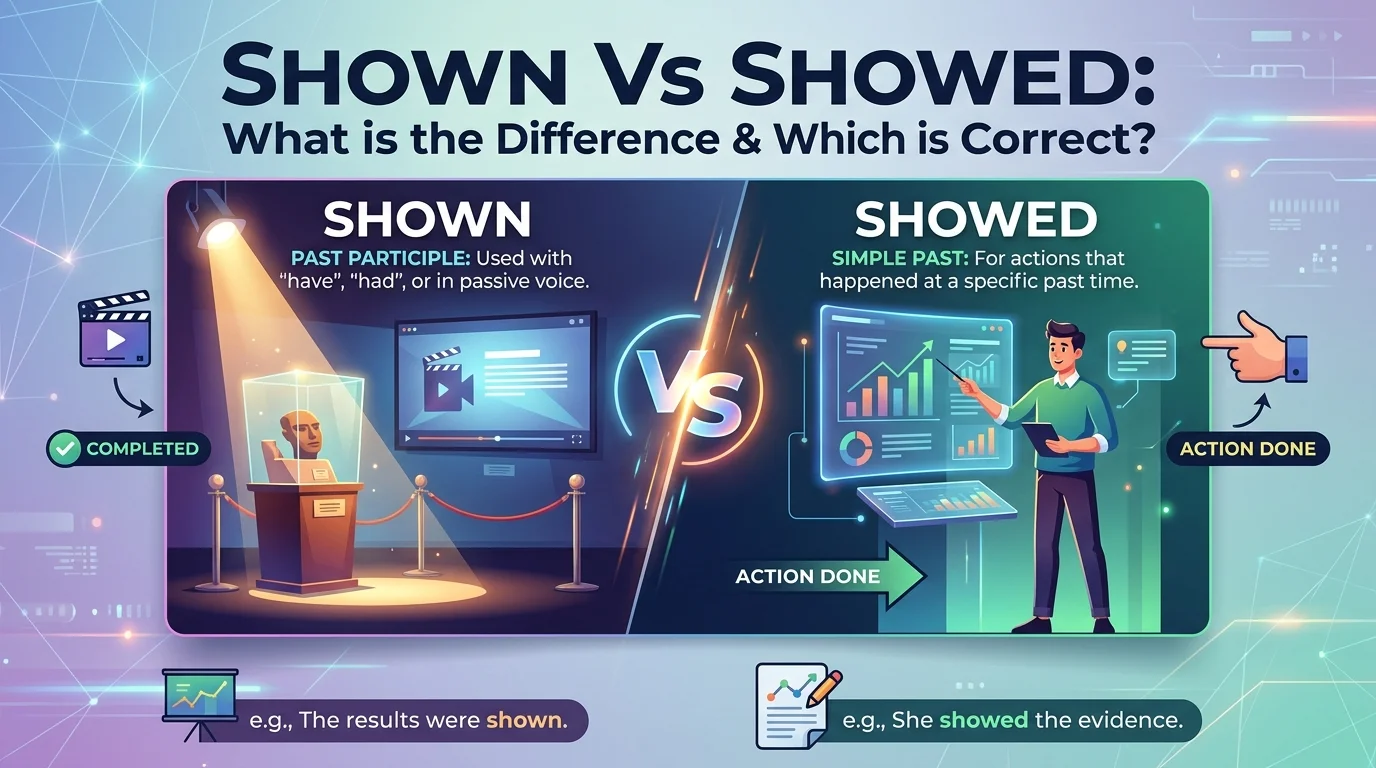

Many English learners get confused between “shown” and “showed” because both come from the verb “show.” While they are related, they are not always used in the same way. Understanding the difference between these two forms can help you write and speak more naturally and correctly in both formal and casual English.
Comparison Overview
“Shown” and “showed” are both forms of the verb “show,” which means to display, present, explain, or make something visible. The confusion happens because English verbs often change forms depending on tense and grammar structure.
“Showed” is the simple past tense form of “show,” while “shown” is the past participle form. Each one has a different grammatical role and is used in different sentence patterns.
| Word | Verb Form | Usage |
| Show | Base Form | Present tense |
| Showed | Simple Past | Describes completed past actions |
| Shown | Past Participle | Used with helping verbs |
Definition of Shown
“Shown” is the past participle form of the verb “show.” It is mainly used with helping verbs such as “has,” “have,” “had,” “was,” “were,” and “been.”
It describes something that has already been displayed, presented, or revealed.
Examples:
- She has shown great improvement.
- The results were shown on the screen.
- He had shown the teacher his homework.
“Shown” cannot usually stand alone as the main verb without a helping verb.
Definition of Showed
“Showed” is the simple past tense form of the verb “show.” It describes an action that happened and finished in the past.
Examples:
- She showed me her new phone.
- They showed the movie yesterday.
- He showed kindness to everyone.
“Showed” works independently as the main verb in a sentence.
Main Differences Between Shown and Showed
The main difference between “shown” and “showed” is their grammatical function.
| Feature | Shown | Showed |
| Verb Type | Past participle | Simple past tense |
| Needs Helping Verb? | Yes, usually | No |
| Used Alone? | Rarely | Yes |
| Example | She has shown courage. | She showed courage. |
| Grammar Role | Perfect/passive structures | Completed past actions |
Another important difference is sentence structure.
Correct:
- I have shown my ID.
- She showed her ID yesterday.
Incorrect:
- I shown my ID.
- She has showed her ID.
Why People Confuse Shown and Showed
English irregular verbs often create confusion because they change forms differently from regular verbs.
For example:
| Base Verb | Past Tense | Past Participle |
| Show | Showed | Shown |
| Write | Wrote | Written |
| Break | Broke | Broken |
Since “showed” already sounds like a past form, learners sometimes incorrectly use it as a past participle.
Grammar Guide
How each term is used in sentences
“Showed” is used for completed actions in the past.
Pattern:
Subject + showed + object
Examples:
- The manager showed us the office.
- My friend showed me a funny video.
“Shown” is used with helping verbs.
Pattern:
Subject + helping verb + shown + object
Examples:
- The teacher has shown us the answer.
- The evidence was shown in court.
Common mistakes learners make
Many learners mix up simple past tense and past participle forms.
Incorrect:
- He has showed me the report.
- They were showed the picture.
Correct:
- He has shown me the report.
- They were shown the picture.
Another common mistake is using “shown” without a helper verb.
Incorrect:
- She shown me her bag.
Correct:
- She showed me her bag.
- She has shown me her bag.
Simple rules to remember
- Use “showed” for simple past actions.
- Use “shown” after helping verbs.
- If you see “has,” “have,” “had,” “was,” or “were,” “shown” is usually correct.
Easy memory trick:
“Shown” likes company because it usually needs a helper verb.
Quick tips for writing and speaking
- In formal writing, double-check perfect tense structures.
- Listen for helping verbs before choosing “shown.”
- Use “showed” when talking about a finished event in the past.
- Read sentences aloud to hear what sounds natural.
- Practice with common sentence patterns daily.
When to Use Each One
Use “showed” when:
- Talking about a completed past action
- Describing something that happened yesterday, last week, or earlier
- Writing simple past tense sentences
Examples:
- He showed me the directions.
- The guide showed tourists the museum.
Use “shown” when:
- Using present perfect tense
- Using past perfect tense
- Using passive voice
- Combining with helping verbs
Examples:
- She has shown patience.
- The chart was shown during the meeting.
When NOT to Use Each One
Do not use “showed”:
- After “has,” “have,” or “had”
- In passive voice structures
Incorrect:
- They have showed the results.
- The image was showed yesterday.
Do not use “shown”:
- Alone as the main past tense verb
- In simple past tense sentences without helpers
Incorrect:
- He shown me the photo yesterday.
- We shown our tickets at the gate.
Which One to Use (Decision Guide)
Use this quick guide to choose correctly:
| Situation | Correct Word |
| Simple past action | Showed |
| After has/have/had | Shown |
| Passive voice | Shown |
| Finished action yesterday | Showed |
| Present perfect tense | Shown |
Quick decision examples:
- “I ___ him the file yesterday.” → showed
- “I have ___ him the file already.” → shown
Real-World Practical Examples
Shown Examples
- The teacher has shown students how to solve the equation.
- The results were shown during the science presentation.
- The company has shown strong growth this year.
- Her artwork was shown at a local gallery.
- The app has shown significant improvement after the update.
Showed Examples
- My brother showed me how to ride a bicycle.
- The professor showed the class an interesting experiment.
- She showed kindness to the new employee.
- The salesperson showed us different laptop models.
- He showed his passport at the airport.
Sentence Structure Comparison
| Sentence Type | Correct Form |
| Simple Past | She showed the picture. |
| Present Perfect | She has shown the picture. |
| Past Perfect | She had shown the picture. |
| Passive Voice | The picture was shown. |
Tips for Mastering Irregular Verbs
Learning irregular verbs becomes easier with repetition and practice.
Helpful strategies:
- Memorize verb form groups.
- Read English articles daily.
- Practice writing sentences using all verb forms.
- Create flashcards with base, past, and participle forms.
- Listen to native English conversations.
Example practice:
- Show → Showed → Shown
- Speak → Spoke → Spoken
- Drive → Drove → Driven
Grammar Patterns With Shown
“Shown” commonly appears in these grammar structures:
| Grammar Structure | Example |
| Present Perfect | He has shown improvement. |
| Past Perfect | She had shown interest earlier. |
| Passive Voice | The report was shown publicly. |
| Future Perfect | They will have shown the results. |
Self-Assessment (Fill in the Blanks)
- She has ______ her talent in many competitions.
- He ______ me the way to the station yesterday.
- The chart was ______ during the meeting.
- They ______ us their vacation photos last night.
- I have never ______ this document before.
- The teacher ______ the students a new method yesterday.
- The evidence has been ______ to the jury.
- My friend ______ me a useful app last week.
- The product was ______ on television.
- She had ______ great patience before the problem started.
- He ______ everyone his new car.
- The instructions were clearly ______ in the video.
- We have ______ strong teamwork this month.
- The coach ______ the players a new strategy.
- The results have already been ______ online.
- She ______ me her art project yesterday.
- The mistake was ______ in the final report.
- They had ______ interest in the proposal earlier.
- My uncle ______ me old family photos.
- The solution was ______ to the audience carefully.
Answers
- shown
- showed
- shown
- showed
- shown
- showed
- shown
- showed
- shown
- shown
- showed
- shown
- shown
- showed
- shown
- showed
- shown
- shown
- showed
- shown
Final Verdict
“Showed” and “shown” are both correct, but they are used differently in English grammar. “Showed” is the simple past tense and works independently to describe completed actions in the past. “Shown” is the past participle and usually appears with helping verbs such as “has,” “have,” “had,” “was,” or “were.”
If you are talking about something that happened in the past by itself, use “showed.” If your sentence includes a helping verb or passive structure, use “shown.” Once you understand this difference, choosing the correct form becomes much easier in everyday speaking and writing.
Conclusion About Shown Vs Showed
Understanding the difference between “shown” and “showed” can greatly improve your grammar, writing clarity, and confidence in English communication. Although both words come from the verb “show,” they serve different grammatical purposes. “Showed” is used for simple past actions, while “shown” works as a past participle with helping verbs and passive structures. Many learners confuse these forms because they sound similar, but once you recognize the sentence pattern, choosing the correct word becomes much easier. Whether you are writing emails, speaking in conversations, preparing academic work, or improving professional communication, using these verb forms correctly helps your English sound more natural and polished. Regular practice with examples, grammar rules, and sentence patterns will help you master both words quickly. By understanding when to use “shown” and “showed,” you can avoid common mistakes and communicate more effectively in everyday English.
FAQs
Is “shown” grammatically correct?
Yes, “shown” is grammatically correct when used as the past participle form of “show.” It is commonly used with helping verbs such as “has,” “have,” “had,” “was,” and “were.” For example, “She has shown improvement” is a correct sentence because “shown” follows the helping verb “has.”
Is “showed” a real English word?
Yes, “showed” is a correct English word and the simple past tense of “show.” It is used to describe an action completed in the past. For example, “He showed me his project yesterday” is correct because it refers to a finished past action.
What is the main difference between shown and showed?
The main difference is grammatical usage. “Showed” is the simple past tense, while “shown” is the past participle. “Showed” can stand alone in a sentence, but “shown” usually requires a helping verb like “has” or “was.”
Can I say “has showed”?
No, “has showed” is considered incorrect in standard English grammar. After helping verbs like “has,” “have,” or “had,” you should use the past participle “shown.” The correct sentence is “She has shown great progress.”
Why do people confuse shown and showed?
People confuse these words because both come from the same verb and refer to past actions. English irregular verbs often have different past tense and past participle forms, which can make learning grammar more difficult for beginners and non-native speakers.
Is “was shown” correct?
Yes, “was shown” is correct because it uses passive voice. In passive constructions, the past participle form “shown” is required. For example, “The presentation was shown on the screen” follows correct grammar rules.
Can “shown” be used without a helping verb?
Usually, no. “Shown” normally appears with helping verbs like “has,” “have,” “had,” “was,” or “were.” Using “shown” alone as the main verb often creates an incorrect sentence structure in standard English grammar.
Which form is more common in daily conversation?
Both forms are common, but they appear in different contexts. “Showed” is frequent in casual conversations about past events, while “shown” is common in formal writing, professional communication, and perfect tense structures.
How can I easily remember when to use shown?
A simple trick is to check for helping verbs. If the sentence includes words like “has,” “have,” “had,” “was,” or “were,” use “shown.” If the sentence talks about a finished action in the past without helpers, use “showed.”
Are shown and showed interchangeable?
No, they are not interchangeable in most situations. Each word has a specific grammatical role. Replacing one with the other can create incorrect grammar and awkward sentence structure, especially in formal or academic writing.
