
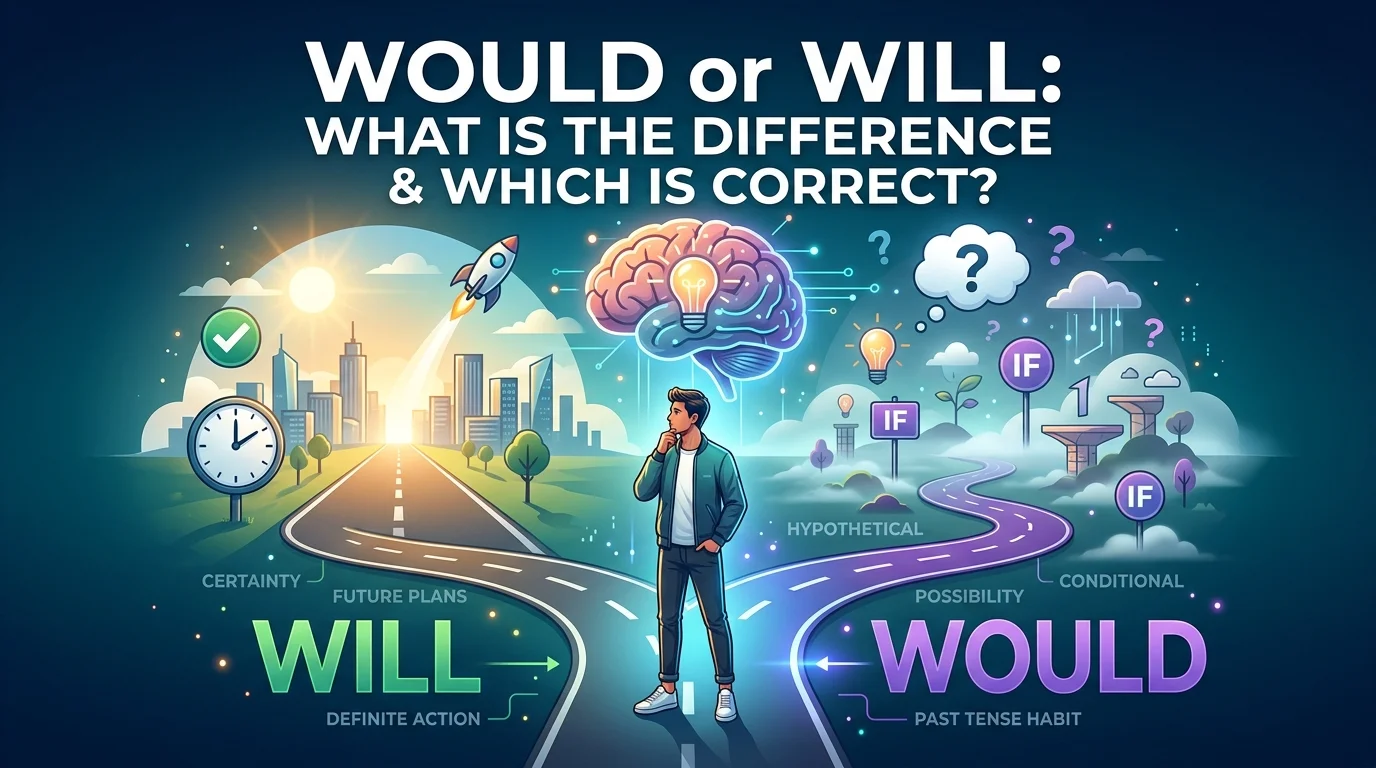

Many English learners struggle with would and will because both words relate to actions, events, and possibilities. While they may seem similar, they serve different grammatical purposes and are used in different situations. Understanding the difference between would and will helps you communicate more clearly, write accurately, and avoid common grammar mistakes.
Comparison Overview
Would and will are modal verbs used to talk about actions, intentions, possibilities, requests, and future events. Although they are closely related, they are not interchangeable in every situation.
| Feature | Would | Will |
| Main Purpose | Hypothetical, conditional, polite situations | Future actions and decisions |
| Time Reference | Often conditional or imagined situations | Usually future events |
| Politeness | More polite and formal | More direct |
| Certainty | Less certain | More certain |
| Common Use | Conditional sentences, requests | Predictions, promises, decisions |
Definition of Would
Would is a modal verb used to describe hypothetical situations, polite requests, preferences, imagined outcomes, or future actions viewed from a past perspective.
It often shows something that may happen under certain conditions rather than something that is definitely going to happen.
Examples:
- I would travel more if I had extra money.
- Would you help me with this project?
- She said she would arrive at noon.
Definition of Will
Will is a modal verb used to express future actions, promises, predictions, decisions, and intentions.
It usually indicates that the speaker believes something is likely or certain to happen in the future.
Examples:
- I will call you tomorrow.
- It will rain tonight.
- We will complete the project next week.
Main Differences Between Would and Will
The primary difference lies in certainty and context.
| Aspect | Would | Will |
| Certainty | Conditional or hypothetical | Definite or expected |
| Future Meaning | Future from a past viewpoint or imagined future | Direct future |
| Requests | More polite | More direct |
| Preferences | Frequently used | Rarely used |
| Conditional Sentences | Common | Less common |
Examples:
- I will buy the car. (Definite intention)
- I would buy the car if I had enough money. (Conditional)
Another example:
- Will you open the window? (Direct request)
- Would you open the window? (Polite request)
Future Meaning: How They Express Time Differently
Although both can refer to future actions, they do so differently.
Will for Direct Future Events
Use will when discussing something expected to happen.
Examples:
- The meeting will start at 10 a.m.
- They will launch the product next month.
- I will finish the report tonight.
Would for Imagined or Conditional Futures
Use would when discussing future events that depend on a condition.
Examples:
- I would move abroad if I got the opportunity.
- She would attend if she were invited.
- They would invest more if profits increased.
Politeness and Formal Communication
One of the biggest differences appears in requests.
Using Will
- Will you send the file?
- Will you join us?
Using Would
- Would you send the file?
- Would you join us?
Both are correct, but would sounds more polite and professional.
Grammar Guide
How Each Term Is Used in Sentences
Using Would
Common patterns:
- Would + base verb
- Would + rather
- Would + have + past participle
Examples:
- I would visit Paris.
- She would rather stay home.
- They would have won if they had practiced.
Using Will
Common patterns:
- Will + base verb
- Will be + verb-ing
- Will have + past participle
Examples:
- I will visit Paris.
- She will be working tomorrow.
- They will have completed the task by Friday.
Common Mistakes Learners Make
Mistake 1
Incorrect:
- I would go tomorrow.
Correct:
- I will go tomorrow.
Reason: A definite future plan requires will.
Mistake 2
Incorrect:
- If I get rich, I will buy a yacht.
This is correct.
Incorrect:
- If I got rich, I will buy a yacht.
Correct:
- If I got rich, I would buy a yacht.
Reason: Conditional sentences require matching structures.
Mistake 3
Incorrect:
- Would you tell me the time tomorrow?
Correct:
- Will you tell me the time tomorrow?
Reason: Future requests often use will unless emphasizing politeness.
Simple Rules to Remember
- Use will for definite future events.
- Use would for hypothetical situations.
- Use would for polite requests.
- Use will for promises and decisions.
- Use would in many conditional sentences.
Quick Tips for Writing and Speaking
- Choose will when certainty is high.
- Choose would when imagining possibilities.
- Use would in professional emails for greater politeness.
- Use will for commitments and promises.
- Check whether a condition exists before choosing would.
When to Use Each One
Use Would When
- Making polite requests
- Discussing hypothetical situations
- Expressing preferences
- Reporting future events from the past
- Creating conditional statements
Examples:
- Would you help me?
- I would choose the blue one.
- He said he would return.
Use Will When
- Making promises
- Predicting future events
- Offering assistance
- Announcing decisions
- Describing expected outcomes
Examples:
- I will help you.
- It will snow tomorrow.
- We will start immediately.
When NOT to Use Each One
Do Not Use Would
- For definite future plans without conditions
- For firm promises
- For scheduled future events
Incorrect:
- I would meet you at 5 p.m.
Correct:
- I will meet you at 5 p.m.
Do Not Use Will
- In hypothetical conditional results
- In polite preference expressions
- In many unreal situations
Incorrect:
- If I won the lottery, I will buy a mansion.
Correct:
- If I won the lottery, I would buy a mansion.
Which One to Use (Decision Guide)
Ask yourself these questions:
- Is the event definitely expected to happen?
- Use will.
- Is the event dependent on a condition?
- Use would.
- Are you making a promise?
- Use will.
- Are you making a polite request?
- Use would.
- Are you imagining a situation?
- Use would.
- Are you discussing a straightforward future action?
- Use will.
Real-World Practical Examples
Would Examples
- Education: I would study abroad if I received a scholarship.
- Daily Life: I would cook dinner if I got home earlier.
- Business: We would expand if demand increased.
- Technology: Users would benefit from faster software.
- Science: The experiment would succeed under ideal conditions.
Will Examples
- Education: I will submit my assignment tomorrow.
- Daily Life: We will visit our grandparents this weekend.
- Business: The company will release a new product.
- Technology: The update will improve performance.
- Science: Researchers will publish the findings next month.
Self-Assessment (Fill in the Blanks)
- I ______ call you tomorrow because I promised.
- I ______ travel more if I had additional vacation days.
- ______ you help me carry these boxes?
- She said she ______ arrive later.
- The train ______ leave at 8 p.m.
- If I had a million dollars, I ______ buy a house.
- We ______ finish the project next week.
- ______ you mind opening the door?
- They ______ visit us during the holidays.
- He ______ accept the offer if the salary were higher.
- I ______ always support my team.
- If it snowed tomorrow, schools ______ close.
- She ______ rather stay home tonight.
- The software ______ launch next month.
- We ______ attend if we received invitations.
- The correct word is ______ because the sentence describes a definite future action.
- The correct word is ______ because the action depends on a condition.
- The correct word is ______ because the speaker is making a promise.
- The correct word is ______ because the request is polite.
- The correct word is ______ because the situation is hypothetical.
Answers
- will
- would
- Will
- would
- will
- would
- will
- Would
- will
- would
- will
- would
- would
- will
- would
- will
- would
- will
- would
- would
Final Verdict
Both would and will are essential English modal verbs, but they serve different purposes. Will is the correct choice when talking about definite future actions, promises, decisions, and predictions. Would is used for hypothetical situations, conditional statements, polite requests, preferences, and future events viewed from a past perspective. If you are describing something that is expected or certain, choose will. If you are imagining a possibility, expressing a condition, or speaking politely, choose would. By focusing on certainty, conditions, and context, you can confidently decide which word fits your sentence and communicate more naturally in both writing and conversation.
Conclusion About Would or Will
Understanding the difference between would and will is an important step toward mastering English grammar. While both modal verbs can refer to future actions, they serve different purposes and create different meanings. Will is generally used for future plans, promises, decisions, and predictions that are expected to happen. Would, on the other hand, is commonly used for hypothetical situations, polite requests, preferences, and conditional statements.
The key to choosing the correct word is understanding the context. If you are talking about something definite or likely in the future, will is usually the right choice. If you are imagining a possibility, expressing a condition, or making a polite request, would is often more appropriate. By practicing these differences in everyday conversations and writing, you can use both words naturally and confidently, making your communication clearer, more accurate, and more professional.
FAQs
What is the main difference between would and will?
The main difference is that will expresses a definite future action or intention, while would often expresses a hypothetical situation, a polite request, or a conditional outcome. Will usually shows greater certainty, whereas would suggests possibility or dependence on a condition.
Is would the past tense of will?
Yes, would is traditionally considered the past form of will in reported speech. For example, “She said she will come” becomes “She said she would come.” However, would also has several other uses beyond being a past form.
When should I use will in a sentence?
Use will when making predictions, promises, offers, decisions, or talking about future events that you expect to happen. It is commonly used when there is confidence or certainty about a future action or outcome.
When should I use would in a sentence?
Use would for hypothetical situations, polite requests, preferences, and conditional statements. It is especially useful when discussing actions that depend on certain circumstances or when speaking more politely.
Can would and will be used interchangeably?
No, they cannot always be used interchangeably. Replacing one with the other can change the meaning of a sentence. Will often indicates certainty, while would usually suggests a condition, possibility, or a more polite tone.
Which is more polite, would or will?
Would is generally considered more polite than will. For example, “Would you help me?” sounds softer and more courteous than “Will you help me?” making it common in professional and formal communication.
Is would used in conditional sentences?
Yes, would is frequently used in conditional sentences. It often appears in the result clause of hypothetical situations, such as “If I had more time, I would learn another language.”
Can will be used for promises?
Yes, will is commonly used to make promises and commitments. Sentences such as “I will help you tomorrow” clearly communicate a future intention or assurance from the speaker.
Why do English learners confuse would and will?
Many learners confuse them because both can refer to future situations. The confusion often comes from not recognizing whether the situation is certain, hypothetical, conditional, or simply a future event.
How can I remember the difference between would and will?
A simple rule is to think of will as expressing certainty and would as expressing possibility or conditions. If the action is expected to happen, use will. If it depends on something else or is imagined, use would.
