
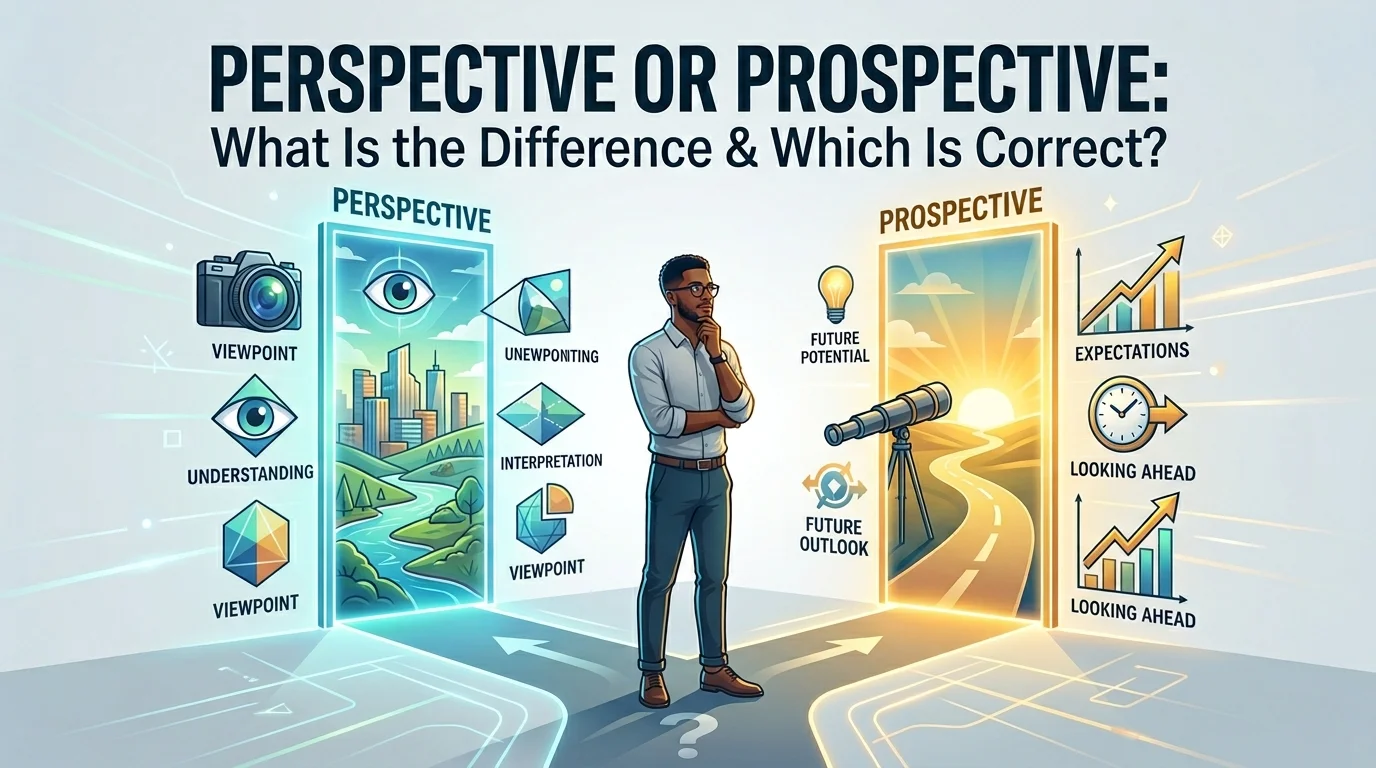

Many English learners confuse perspective and prospective because they look and sound similar. However, they have very different meanings and are used in different situations. Understanding the distinction can improve your writing, speaking, and grammar accuracy. This guide explains each term clearly and shows exactly when and how to use them correctly.
Comparison Overview
Perspective and prospective belong to different parts of speech and express different ideas.
| Term | Part of Speech | Meaning | Common Use |
| Perspective | Noun | A point of view, outlook, or way of seeing something | Opinions, viewpoints, visual art |
| Prospective | Adjective | Likely or expected in the future | Future plans, potential people or opportunities |
Although both words relate to thinking and understanding, perspective focuses on how something is viewed, while prospective focuses on future possibilities.
Definition of Perspective
Perspective is a noun that refers to a person’s viewpoint, attitude, or way of understanding a situation.
It can also refer to a technique in art that creates the illusion of depth and distance.
Core Meaning
A particular way of looking at or thinking about something.
Examples
- From my perspective, the project was successful.
- The teacher offered a different perspective on the issue.
- Travel gives people a broader perspective on life.
- The article presents multiple perspectives.
- Artists use perspective to create realistic drawings.
Definition of Prospective
Prospective is an adjective that describes something expected or likely to happen in the future.
It is commonly used to refer to potential people, opportunities, customers, students, employees, or future events.
Core Meaning
Expected, potential, or likely to become something in the future.
Examples
- The university welcomed prospective students.
- The company interviewed prospective employees.
- She met with a prospective client.
- Investors reviewed prospective opportunities.
- The prospective buyer made an offer.
Main Differences Between Perspective and Prospective
| Feature | Perspective | Prospective |
| Part of Speech | Noun | Adjective |
| Main Idea | Viewpoint or outlook | Future possibility |
| Time Focus | Present or past understanding | Future expectation |
| Common Contexts | Opinions, analysis, art | Business, education, careers |
| Example | “My perspective changed.” | “A prospective customer called.” |
Key Difference
Use perspective when discussing a way of seeing or understanding something.
Use prospective when discussing a person, event, or opportunity that may exist or occur in the future.
Why These Words Are Commonly Confused
The confusion happens because:
- Both words start with “perspect-“.
- They have similar spelling.
- They are often encountered in professional and academic writing.
- Many learners mistakenly assume they are interchangeable.
However, replacing one with the other often creates grammatical and meaning errors.
Incorrect
- From my prospective, the decision was correct.
Correct
- From my perspective, the decision was correct.
Incorrect
- The company contacted several perspective employees.
Correct
- The company contacted several prospective employees.
Comparison Table
| Situation | Correct Word |
| Giving an opinion | Perspective |
| Discussing a viewpoint | Perspective |
| Talking about future customers | Prospective |
| Referring to future students | Prospective |
| Describing a potential employee | Prospective |
| Discussing how someone sees a problem | Perspective |
Grammar Guide
How Each Term Is Used in Sentences
Perspective
Usually functions as a noun.
Patterns:
- from a perspective
- my perspective
- different perspectives
- gain perspective
Examples:
- My perspective changed after reading the report.
- We should consider another perspective.
- The experience gave me perspective.
Prospective
Usually functions as an adjective before a noun.
Patterns:
- prospective student
- prospective employee
- prospective customer
- prospective buyer
Examples:
- The university invited prospective students.
- We met several prospective clients.
- A prospective tenant visited the apartment.
Common Mistakes Learners Make
Mistake 1: Using Prospective Instead of Perspective
Incorrect:
- From my prospective, this plan will work.
Correct:
- From my perspective, this plan will work.
Mistake 2: Using Perspective Before a Noun
Incorrect:
- Perspective customers attended the event.
Correct:
- Prospective customers attended the event.
Mistake 3: Confusing Viewpoints with Future Possibilities
Incorrect:
- The article offers several prospective on climate change.
Correct:
- The article offers several perspectives on climate change.
Simple Rules to Remember
- Perspective = Point of View
- Prospective = Potential Future
- If you can replace it with “viewpoint,” use perspective.
- If you can replace it with “potential” or “future,” use prospective.
- Perspective is usually a noun, while prospective is usually an adjective.
Quick Tips for Writing and Speaking
- Think of perspective as “how you see.”
- Think of prospective as “what may come.”
- Check whether you need a noun or an adjective.
- Use perspective when discussing opinions.
- Use prospective when discussing future possibilities.
When to Use Each One
Use Perspective When
- Sharing opinions
- Discussing viewpoints
- Analyzing situations
- Talking about understanding
- Referring to artistic techniques
Examples:
- My perspective differs from yours.
- The book offers a unique perspective.
- The artist mastered perspective.
Use Prospective When
- Referring to future customers
- Discussing possible employees
- Talking about future students
- Mentioning potential buyers
- Describing expected opportunities
Examples:
- The school hosted prospective students.
- The company contacted prospective clients.
- The house attracted prospective buyers.
When NOT to Use Each One
Do Not Use Perspective When
- Talking about potential future people
- Describing expected opportunities
- Referring to future events
Incorrect:
- Perspective employees attended the meeting.
Correct:
- Prospective employees attended the meeting.
Do Not Use Prospective When
- Expressing opinions
- Discussing viewpoints
- Referring to personal outlooks
Incorrect:
- From my prospective, the plan is effective.
Correct:
- From my perspective, the plan is effective.
Which One to Use (Decision Guide)
Ask yourself the following question:
Are you talking about a viewpoint or opinion?
Use Perspective.
Example:
- Her perspective helped solve the problem.
Are you talking about someone or something that may exist in the future?
Use Prospective.
Example:
- The company met prospective investors.
Quick Decision Chart
| Question | Word |
| Is it a viewpoint? | Perspective |
| Is it an opinion? | Perspective |
| Is it a way of understanding? | Perspective |
| Is it a future possibility? | Prospective |
| Is it a potential person or opportunity? | Prospective |
Real-World Practical Examples
Perspective Examples
- Education: The teacher shared a new perspective on history.
- Daily Life: My perspective changed after moving abroad.
- Business: Management considered the employee’s perspective.
- Technology: Users offered a different perspective on the software.
- Writing: The novel is told from the child’s perspective.
Prospective Examples
- Education: The college welcomed prospective students.
- Business: The company contacted prospective clients.
- Real Estate: Several prospective buyers toured the house.
- Employment: Human resources interviewed prospective employees.
- Technology: Investors evaluated prospective technology projects.
Self-Assessment (Fill in the Blanks)
- I will use ______ when referring to a personal viewpoint.
- The correct word is ______ because it describes a future employee.
- I will use ______ when discussing how someone sees a situation.
- The correct word is ______ because it refers to a potential customer.
- I will use ______ when talking about an opinion.
- The correct word is ______ because it describes someone who may enroll next year.
- I will use ______ when referring to a way of understanding a problem.
- The correct word is ______ because it refers to a possible buyer.
- I will use ______ when discussing outlooks and attitudes.
- The correct word is ______ because it describes a future opportunity.
- I will use ______ when analyzing different viewpoints.
- The correct word is ______ because it refers to a potential investor.
- I will use ______ when discussing artistic depth in drawing.
- The correct word is ______ because it refers to someone likely to become a customer.
- I will use ______ when talking about a person’s interpretation.
- The correct word is ______ because it describes a likely future student.
- I will use ______ when comparing opinions.
- The correct word is ______ because it refers to a future tenant.
- I will use ______ when discussing a way of seeing events.
- The correct word is ______ because it describes a potential employee.
Answers
- Perspective
- Prospective
- Perspective
- Prospective
- Perspective
- Prospective
- Perspective
- Prospective
- Perspective
- Prospective
- Perspective
- Prospective
- Perspective
- Prospective
- Perspective
- Prospective
- Perspective
- Prospective
- Perspective
- Prospective
Final Verdict
Perspective and prospective may look similar, but they serve completely different purposes in English. Perspective is a noun that refers to a viewpoint, outlook, or way of understanding something. Prospective is an adjective that refers to someone or something expected, potential, or likely in the future. If you’re expressing an opinion or point of view, choose perspective. If you’re describing a future possibility, customer, student, buyer, or employee, choose prospective. Remembering “perspective = viewpoint” and “prospective = potential future” will help you use both words confidently and correctly.
Conclusion About Perspective or Prospective
Understanding the difference between perspective and prospective can make your writing and communication much clearer. While these two words look similar, they serve very different purposes in English. Perspective refers to a viewpoint, outlook, or way of understanding a situation, whereas prospective describes someone or something that is expected, potential, or likely in the future. Knowing this distinction helps you avoid common grammar mistakes and choose the right word with confidence.
Whether you are writing an academic paper, sending a business email, preparing professional documents, or simply improving your everyday English, using these terms correctly adds accuracy and professionalism to your communication. A simple way to remember them is that perspective relates to how you see something, while prospective relates to what may happen next. Once you understand this core difference, selecting the correct word becomes much easier in both speaking and writing.
FAQs
What does perspective mean?
Perspective is a noun that refers to a person’s point of view, opinion, attitude, or way of understanding a situation. It can also describe a technique in art that creates the appearance of depth and distance. The word is commonly used when discussing ideas, experiences, and viewpoints.
What does prospective mean?
Prospective is an adjective that describes something expected or likely to happen in the future. It is often used for potential students, customers, employees, buyers, or opportunities. The word focuses on future possibilities rather than current opinions or viewpoints.
Is perspective a noun or an adjective?
Perspective is primarily a noun. It represents a viewpoint, outlook, or interpretation of a situation. In most sentences, it functions as a thing or concept rather than a describing word, making it different from prospective.
Is prospective a noun or an adjective?
Prospective is an adjective. It is used to describe a person, event, or opportunity that may exist or occur in the future. It usually appears before a noun, such as prospective student, prospective client, or prospective employee.
Can perspective and prospective be used interchangeably?
No, perspective and prospective cannot be used interchangeably. Perspective refers to a viewpoint or understanding, while prospective refers to a future possibility. Replacing one with the other changes the meaning of a sentence and often creates grammatical errors.
How can I remember the difference between perspective and prospective?
A useful memory trick is to connect perspective with “point of view” and prospective with “potential future.” If you are discussing opinions or outlooks, use perspective. If you are discussing someone or something that may happen later, use prospective.
What is an example of perspective in a sentence?
An example is: “From my perspective, the new policy will improve productivity.” In this sentence, perspective refers to a personal viewpoint or opinion about a particular situation.
What is an example of prospective in a sentence?
An example is: “The university invited prospective students to attend the open house.” Here, prospective describes students who may enroll in the future but are not yet officially enrolled.
Why do English learners confuse these words?
English learners often confuse these words because they have similar spelling and pronunciation. Both begin with the same letters and appear in formal writing. However, their meanings and grammatical functions are completely different.
Which word is more common in business writing?
Both words are common in business writing but in different contexts. Perspective is often used when discussing opinions, strategies, or viewpoints. Prospective is frequently used when referring to future clients, customers, employees, investors, or business opportunities.
