
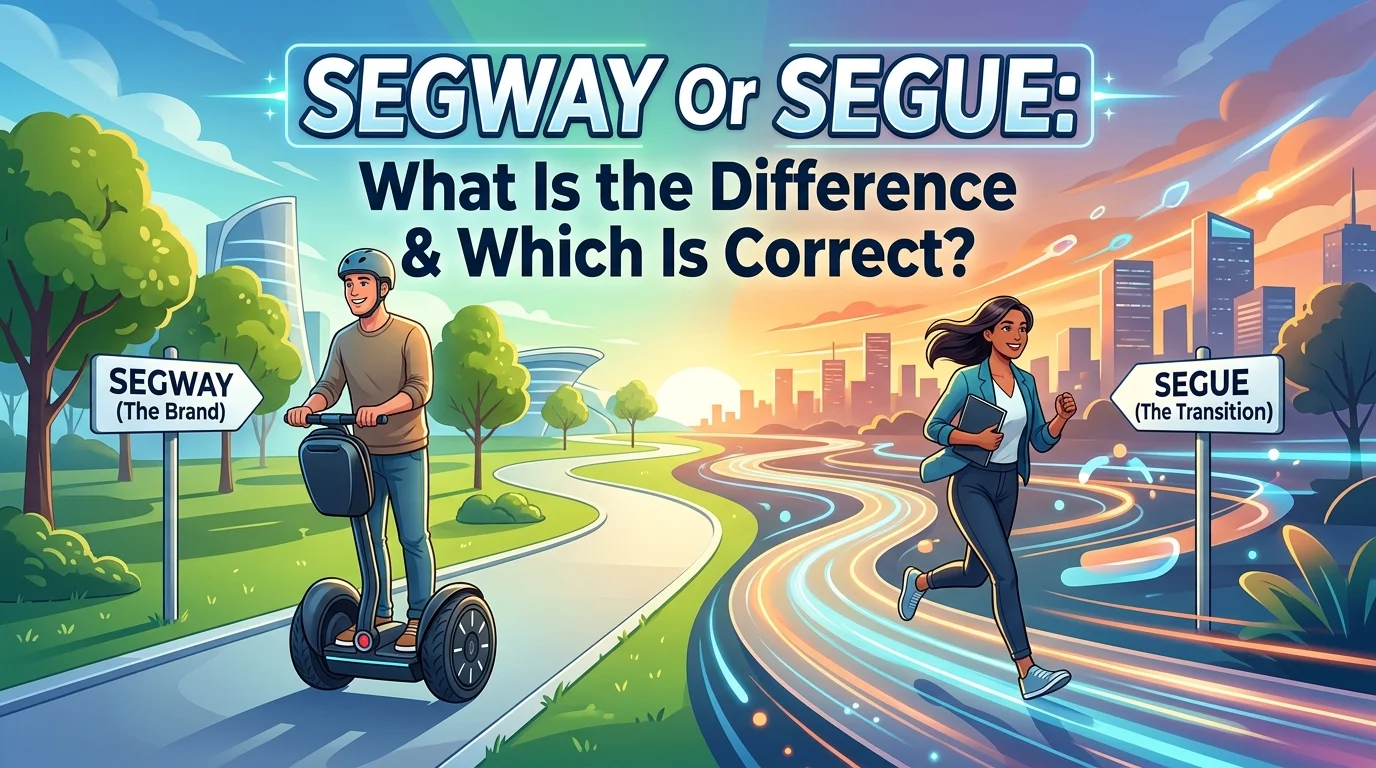

Many English learners and native speakers confuse “Segway” and “segue” because they sound almost identical. However, these two words have very different meanings and uses. One is a famous transportation brand, while the other is a grammar and communication term. Understanding the difference between Segway and segue helps improve both writing accuracy and everyday communication.
Comparison Overview
“Segway” and “segue” are homophones, meaning they are pronounced similarly but have different meanings, spellings, and functions.
“Segway” is primarily known as a brand name for a two wheeled personal transportation device. “Segue,” on the other hand, is a word used in writing, speaking, music, and conversation to describe a smooth transition from one topic or section to another.
Because they sound alike, people often mistakenly write “segway” when they actually mean “segue,” especially in casual online writing.
| Term | Type | Meaning | Common Usage |
| Segway | Noun/Brand Name | A self balancing personal transporter | Transportation, technology |
| Segue | Verb/Noun | A smooth transition from one thing to another | Writing, speech, music |
Definition of Segway
“Segway” refers to a self balancing electric transportation device invented for personal mobility. It is also the official brand name of the product developed by the company Segway Inc..
A Segway typically has:
- Two wheels
- A standing platform
- Handle controls
- Electric balancing technology
People commonly use Segways for:
- Tourism
- Security patrols
- Short distance travel
- Recreational riding
Example:
- The tour guide showed us the city on a Segway.
Definition of Segue
“Segue” is a word used to describe a smooth transition from one topic, activity, idea, or musical section to another without interruption.
It can function as:
- A verb
- A noun
As a verb:
- The speaker segued into a new topic.
As a noun:
- The transition was a perfect segue between scenes.
“Segue” is widely used in:
- Writing
- Public speaking
- Music
- Presentations
- Broadcasting
- Conversations
Main Differences Between Segway and Segue
Although “Segway” and “segue” sound similar, they are completely different words with unrelated meanings.
| Feature | Segway | Segue |
| Meaning | Personal transportation device | Smooth transition |
| Word Type | Proper noun/brand | Verb or noun |
| Context | Travel, technology | Writing, speech, music |
| Pronunciation | Similar to “segue” | Similar to “Segway” |
| Capitalization | Usually capitalized | Usually lowercase |
| Grammar Role | Object/device | Action or transition |
The biggest confusion occurs because many people type “segway” when discussing transitions in writing or speech. Grammatically, this is incorrect.
Correct:
- Let me segue into the next point.
Incorrect:
- Let me segway into the next point.
Why People Confuse Segway and Segue
The confusion mainly comes from pronunciation. Both words are pronounced almost the same way:
- Segway → “SEG-way”
- Segue → “SEG-way”
Another reason is that “Segway” looks more phonetic and easier to spell, so many writers accidentally use it instead of “segue.”
Autocorrect systems and informal internet writing have also contributed to the mistake becoming common online.
Comparison Table
| Aspect | Segway | Segue |
| Origin | Brand name | Italian musical term |
| Main Purpose | Transportation | Transition |
| Used in Grammar? | No | Yes |
| Used in Technology? | Yes | Sometimes |
| Used in Public Speaking? | No | Yes |
| Common Error | Used instead of “segue” | Misspelled as “segway” |
Grammar Guide
How Each Term Is Used in Sentences
Segway Sentence Usage
“Segway” is used as a noun.
Pattern:
- Subject + verb + Segway
Examples:
- She rode a Segway around the park.
- The officer arrived on a Segway.
Segue Sentence Usage
“Segue” can be used as both a noun and a verb.
As a verb:
- Subject + segue + into + topic
Examples:
- The teacher segued into the next chapter.
- He smoothly segued into politics.
As a noun:
- This scene is a segue to the ending.
Common Mistakes Learners Make
Many learners incorrectly replace “segue” with “segway.”
Incorrect:
- Let me segway into another idea.
Correct:
- Let me segue into another idea.
Another mistake is capitalizing “segue” unnecessarily.
Incorrect:
- The speaker made a great Segue.
Correct:
- The speaker made a great segue.
Simple Rules to Remember
- Use “Segway” for the transportation device.
- Use “segue” for transitions or topic changes.
- If you can ride it, it is a Segway.
- If it connects ideas smoothly, it is a segue.
Quick Tips for Writing and Speaking
- In essays and presentations, always use “segue” for transitions.
- Capitalize “Segway” because it is a brand name.
- Double check spellings in professional writing.
- Remember that “segue into” is a common phrase.
When to Use Each One
Use “Segway” when discussing:
- Transportation devices
- Technology
- Tourism vehicles
- Electric mobility
Examples:
- We rented Segways during vacation.
- The mall security team uses Segways.
Use “segue” when discussing:
- Topic transitions
- Writing flow
- Public speaking
- Music transitions
Examples:
- The article segues into a new argument.
- The host used humor as a segue.
When NOT to Use Each One
Do not use “Segway” when referring to:
- Writing transitions
- Speech flow
- Conversation changes
Incorrect:
- The paragraph segways nicely.
Correct:
- The paragraph segues nicely.
Do not use “segue” when referring to:
- Electric scooters
- Transportation devices
- Rideable technology
Incorrect:
- I bought a new segue yesterday.
Correct:
- I bought a new Segway yesterday.
Which One to Use (Decision Guide)
Use this quick guide to choose the correct word:
| Situation | Correct Word |
| Talking about a rideable device | Segway |
| Transitioning to another topic | Segue |
| Discussing grammar or writing | Segue |
| Referring to electric transport | Segway |
| Describing smooth movement between ideas | Segue |
A simple memory trick:
- “Segue” connects ideas.
- “Segway” carries people.
Real World Practical Examples
Segway Examples
- The tourists explored the city using Segways.
- Airport staff sometimes travel on Segways.
- He learned how to balance on a Segway quickly.
- The company introduced new Segway technology.
- Police officers patrolled the event on Segways.
Segue Examples
- The professor segued from history into politics.
- The movie used music as a segue between scenes.
- Her speech segued naturally into the final argument.
- The writer included a clever segue between chapters.
- The podcast host smoothly segued into the interview.
Self Assessment (Fill in the Blanks)
- I will use ______ when referring to a personal transportation device.
- The correct word is ______ because it describes a smooth transition.
- We toured the museum on a ______.
- The speaker used a smooth ______ into the next topic.
- She accidentally wrote “segway” instead of ______.
- The officer rode a ______ during the parade.
- The article will ______ into another subject.
- A ______ helps connect ideas smoothly.
- My friend bought a new ______ last week.
- The musician used a perfect ______ between songs.
- The teacher smoothly ______ into science class discussion.
- Tourists often rent a ______ in busy cities.
- The podcast included a natural ______ to advertising.
- You should not use “______” when discussing grammar transitions.
- The brand name ______ is capitalized.
- The conversation suddenly ______ into sports news.
- A smooth ______ improves essay flow.
- The mall security guard used a ______ for transportation.
- “Segue” is commonly used in ______ and public speaking.
- “Segway” is related to ______ technology.
Answers
- Segway
- segue
- Segway
- segue
- segue
- Segway
- segue
- segue
- Segway
- segue
- segued
- Segway
- segue
- Segway
- Segway
- segued
- segue
- Segway
- writing
- transportation
Final Verdict
“Segway” and “segue” may sound alike, but they have completely different meanings and uses. “Segway” refers to the well known personal transportation device, while “segue” describes a smooth transition between ideas, topics, or sections.
If you are talking about grammar, writing, speeches, music, or conversations, “segue” is the correct word. If you are discussing electric mobility devices or transportation technology, “Segway” is correct. Understanding this distinction helps you avoid a very common English mistake and improves both professional and casual communication.
Conclusion About Segway Or Segue
Understanding the difference between “Segway” and “segue” can instantly improve your writing, speaking, and overall communication skills. Although these words sound almost identical, they belong to completely different contexts. “Segway” refers to the well known personal transportation device, while “segue” describes a smooth transition between ideas, topics, or sections in conversation, writing, music, and presentations.
Many people accidentally confuse the two because of their pronunciation, but remembering their meanings makes choosing the correct word much easier. If you are talking about movement between thoughts or topics, “segue” is the correct option. If you are discussing technology or transportation, “Segway” is the right choice. By mastering this small but important distinction, you can avoid common grammar mistakes and communicate with greater confidence in both professional and everyday situations.
FAQs
Is Segway and segue the same thing?
No, “Segway” and “segue” are completely different words. “Segway” is a transportation device brand, while “segue” means a smooth transition between topics, ideas, or sections in speech, writing, or music.
Why do people confuse Segway and segue?
People confuse them because they are pronounced almost the same way. Since “Segway” looks more phonetic, many writers mistakenly use it instead of “segue” when discussing transitions or topic changes.
Is segue a verb or a noun?
“Segue” can be both a verb and a noun. As a verb, it means to transition smoothly into another topic. As a noun, it refers to the transition itself between sections, ideas, or musical parts.
Should Segway always be capitalized?
Yes, “Segway” is usually capitalized because it is a brand name. Proper nouns and brand names in English normally begin with capital letters in both formal and informal writing.
How do you use segue in a sentence?
You can use “segue” to describe a smooth transition. For example: “The speaker smoothly segued into the next discussion topic.” It is commonly used in presentations, writing, broadcasting, and everyday conversation.
Can segue be used in formal writing?
Yes, “segue” is very common in formal writing and professional speaking. Writers, teachers, journalists, and presenters often use it when discussing transitions between ideas or sections.
What is a Segway used for?
A Segway is used for personal transportation. People often ride Segways for tourism, security patrols, short distance travel, and recreational activities in cities, parks, and large public areas.
Is using “segway” instead of “segue” grammatically incorrect?
Yes, using “segway” when you mean a transition is grammatically incorrect. The correct word for transitions in writing or speaking is always “segue.”
Does segue come from another language?
Yes, “segue” comes from Italian. It originally appeared in music terminology and later became widely used in English to describe smooth transitions between topics or sections.
Which word should I use in presentations?
In presentations, you should use “segue” when moving from one point to another. Example: “Let me segue into the next topic.” Use “Segway” only when discussing the transportation device.
