
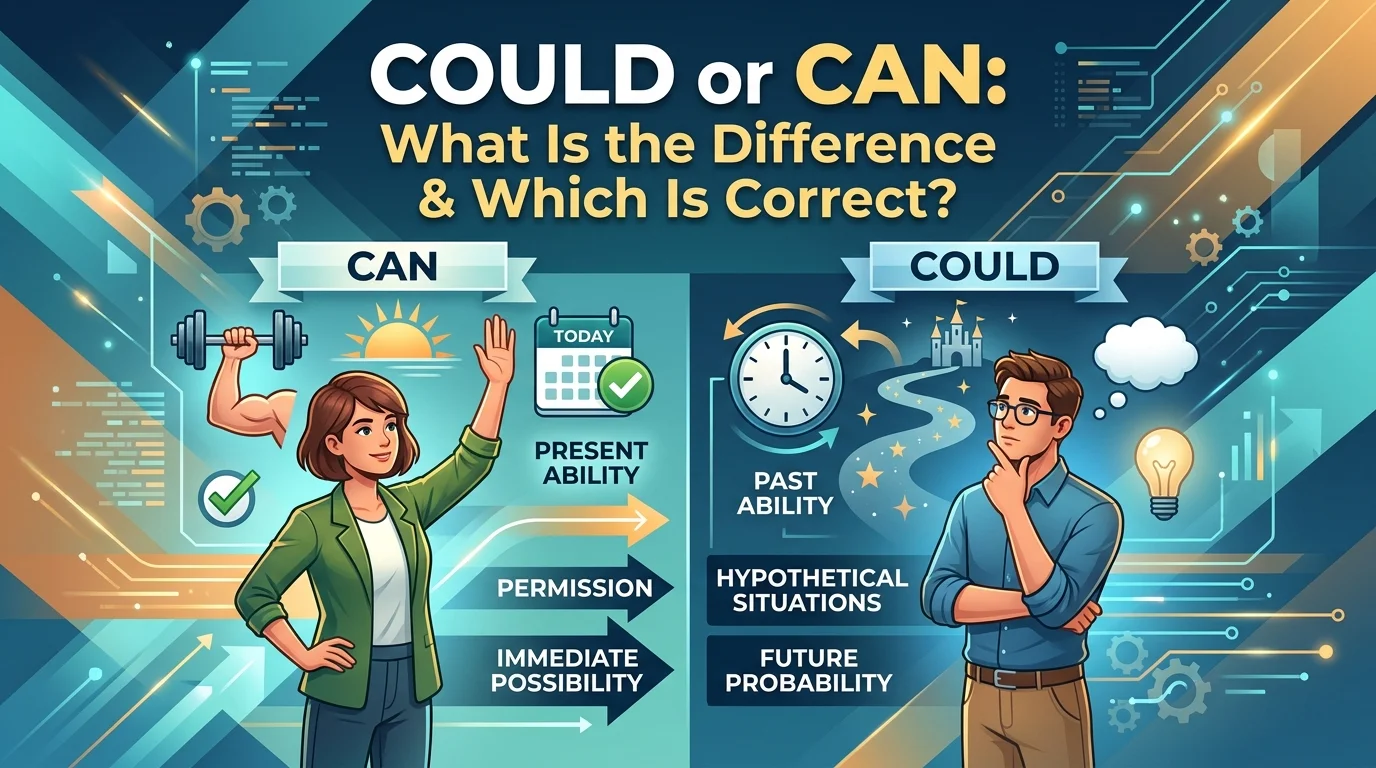

Understanding the difference between could and can is important because both words express ability, possibility, permission, and requests. Although they are closely related, they are not always interchangeable. Knowing when to use each one helps you communicate more clearly and sound more natural in both writing and speaking.
Comparison Overview
Can and could are modal verbs in English grammar. They are used to talk about ability, permission, possibility, and requests. Generally, can refers to present or future situations, while could often refers to past ability, polite requests, or hypothetical situations. Choosing the correct word depends on the context and meaning you want to express.
| Feature | Can | Could |
| Present Ability | Yes | Rarely |
| Past Ability | No | Yes |
| Permission | Yes | Yes (more polite) |
| Requests | Yes | Yes (more polite) |
| Possibility | Yes | Yes |
| Hypothetical Situations | Rarely | Yes |
| Formality | Less formal | More polite/formal |
Definition of Can
Can is a modal verb used to express present ability, permission, possibility, or capability.
It often describes what someone is able to do right now or what is generally possible.
Examples:
- I can swim.
- She can solve difficult problems.
- You can leave now.
- We can finish the project today.
Definition of Could
Could is the past form of can, but it also has additional uses. It expresses past ability, polite requests, possibility, and hypothetical situations.
Examples:
- I could swim when I was five.
- Could you help me?
- It could rain tomorrow.
- We could travel if we had more money.
Main Differences Between Could and Can
Time Reference
Can usually refers to present or future ability.
Example:
- I can drive.
Could often refers to past ability.
Example:
- I could drive when I was sixteen.
Politeness
Could sounds more polite than can when making requests.
Example:
- Can you open the window?
- Could you open the window?
Possibility
Both can express possibility, but could often suggests a less certain possibility.
Example:
- This can happen during winter.
- This could happen during winter.
Hypothetical Situations
Could is commonly used for imagined or conditional situations.
Example:
- I could buy a new car if I saved enough money.
Quick Comparison
| Usage | Can | Could |
| Ability Now | ✓ | ✗ |
| Ability in the Past | ✗ | ✓ |
| Polite Request | ✓ | ✓✓ |
| Hypothetical Situation | ✗ | ✓ |
| Possibility | ✓ | ✓ |
Can and Could in Everyday Communication
Using Can for Immediate Ability
Use can when discussing something that is possible or achievable right now.
Examples:
- I can hear music.
- She can type quickly.
Using Could for Polite Communication
Use could when you want to sound respectful or formal.
Examples:
- Could you explain this again?
- Could I ask a question?
Using Could for Imagined Outcomes
Examples:
- We could start a business together.
- This solution could improve performance.
Grammar Guide
How Each Term Is Used in Sentences
Can
Pattern:
Subject + can + base verb
Examples:
- I can speak French.
- They can play football.
- She can understand the lesson.
Could
Pattern:
Subject + could + base verb
Examples:
- I could run faster when I was younger.
- Could you help me?
- They could succeed with better planning.
Common Mistakes Learners Make
Using Could for Current Ability
Incorrect:
- I could speak English. (when discussing current ability)
Correct:
- I can speak English.
Using Can for Past Ability
Incorrect:
- I can swim when I was young.
Correct:
- I could swim when I was young.
Using Can Instead of Could in Formal Requests
Less Polite:
- Can you send the report?
More Polite:
- Could you send the report?
Simple Rules to Remember
- Use can for present ability.
- Use could for past ability.
- Use could for polite requests.
- Use could for hypothetical situations.
- Use can for immediate capability.
Quick Tips for Writing and Speaking
- Choose could when speaking formally.
- Choose can when discussing current facts.
- Use could to soften requests.
- Use can when certainty is stronger.
- Use could when discussing possibilities or imagined outcomes.
When to Use Each One
Use Can When
- Talking about present abilities.
- Giving permission.
- Discussing current possibilities.
- Stating facts and capabilities.
- Making informal requests.
Examples:
- I can cook dinner.
- You can enter the room.
- We can solve this issue.
Use Could When
- Talking about past abilities.
- Making polite requests.
- Describing possibilities.
- Discussing hypothetical situations.
- Offering suggestions.
Examples:
- I could read before starting school.
- Could you help me?
- We could try another approach.
When NOT to Use Each One
Avoid Can When
- Referring to past ability.
- Creating formal requests.
- Discussing hypothetical situations.
Incorrect:
- I can ride a bike when I was six.
Correct:
- I could ride a bike when I was six.
Avoid Could When
- Describing a clear present ability.
- Expressing definite capability right now.
Incorrect:
- I could speak English. (if you mean now)
Correct:
- I can speak English.
Which One to Use (Decision Guide)
Ask yourself these questions:
Are You Talking About Present Ability?
Use can.
Example:
- I can solve the problem.
Are You Talking About Past Ability?
Use could.
Example:
- I could solve difficult puzzles as a child.
Are You Making a Polite Request?
Use could.
Example:
- Could you pass the salt?
Are You Describing a Hypothetical Situation?
Use could.
Example:
- We could move abroad someday.
Are You Giving Permission?
Usually use can.
Example:
- You can leave early.
Real-World Practical Examples
Can Examples
- Education: I can understand the lesson clearly.
- Daily Life: I can cook dinner tonight.
- Technology: This computer can process large files.
- Business: We can meet tomorrow morning.
- Science: Water can exist in three states.
Could Examples
- Education: I could memorize poems easily in school.
- Daily Life: Could you help me carry these bags?
- Technology: This update could improve performance.
- Business: We could increase sales with better marketing.
- Science: The discovery could change future research.
Self-Assessment (Fill in the Blanks)
- I will use ______ when talking about a skill I have today. The correct word is ______ because it shows present ability.
- I will use ______ when describing a skill I had as a child. The correct word is ______ because it shows past ability.
- ______ you help me with this assignment? The correct word is ______ because the request is polite.
- I ______ speak three languages. The correct word is ______ because the ability exists now.
- When I was young, I ______ run very fast. The correct word is ______ because the ability existed in the past.
- We ______ finish the work today. The correct word is ______ because it refers to present capability.
- We ______ travel more if we had extra money. The correct word is ______ because the situation is hypothetical.
- ______ I borrow your pen? The correct word is ______ because it is a polite request.
- This software ______ solve the problem. The correct word is ______ because it describes current capability.
- This idea ______ improve productivity. The correct word is ______ because it expresses possibility.
- I ______ swim across the lake now. The correct word is ______ because it refers to present ability.
- My grandfather ______ lift heavy objects when he was younger. The correct word is ______ because it refers to past ability.
- You ______ enter the building now. The correct word is ______ because it gives permission.
- We ______ develop a better solution in the future. The correct word is ______ because it expresses possibility.
- ______ you please explain this topic? The correct word is ______ because the request is polite.
- She ______ play the piano beautifully today. The correct word is ______ because it refers to present skill.
- She ______ play the piano well when she was ten. The correct word is ______ because it refers to past ability.
- The experiment ______ produce interesting results. The correct word is ______ because it expresses possibility.
- I ______ help you right now. The correct word is ______ because it describes present ability.
- They ______ succeed if they worked harder. The correct word is ______ because the situation is hypothetical.
Answers
- Can, can
- Could, could
- Could, could
- Can, can
- Could, could
- Can, can
- Could, could
- Could, could
- Can, can
- Could, could
- Can, can
- Could, could
- Can, can
- Could, could
- Could, could
- Can, can
- Could, could
- Could, could
- Can, can
- Could, could
Final Verdict
Both can and could are essential modal verbs, but they serve different purposes. Use can when discussing present ability, permission, or current possibilities. Use could when referring to past ability, making polite requests, expressing uncertainty, or describing hypothetical situations. While the two words are related, they are not always interchangeable. Understanding the difference helps you write accurately, speak naturally, and avoid common grammar mistakes. If you are talking about what is possible now, choose can. If you are talking about the past, politeness, or imagined situations, choose could.
Conclusion About Could or Can
Understanding the difference between could and can is an important step toward mastering English grammar. While both modal verbs are used to express ability, possibility, permission, and requests, their meanings and contexts are not always the same. Can is generally used for present abilities and direct situations, whereas could is often used for past abilities, polite requests, and hypothetical possibilities.
Learning when to use each word correctly can make your communication clearer, more natural, and more professional. Whether you are writing an email, having a conversation, studying English, or creating business content, choosing the right modal verb helps you express your ideas accurately. The key is to focus on the context. If you are talking about something that is possible or true right now, can is usually the correct choice. If you are discussing the past, being polite, or imagining a situation, could is often the better option. With regular practice, distinguishing between these two words becomes simple and automatic.
FAQs
What is the main difference between could and can?
The main difference is that can usually refers to present ability, permission, or possibility, while could often refers to past ability, polite requests, or hypothetical situations. Although they are related modal verbs, their usage depends on the context and the meaning you want to express.
Is could the past tense of can?
Yes, could is traditionally considered the past form of can when talking about ability. For example, “I can swim” refers to present ability, while “I could swim when I was six” refers to an ability someone had in the past.
Can and could be used interchangeably?
Sometimes they can, especially when discussing possibility or making requests. However, they are not always interchangeable because could often sounds more polite and may indicate less certainty than can. Choosing the correct one depends on the intended meaning.
Which is more polite, can or could?
Could is generally considered more polite and formal than can. For example, “Could you help me?” sounds softer and more respectful than “Can you help me?” This is why many speakers prefer could in professional or formal situations.
When should I use can for permission?
Use can when giving or asking for permission in everyday situations. For example, “You can leave now” grants permission. In informal conversations, can is very common and widely accepted for permission-related statements and questions.
When should I use could for requests?
Use could when making polite requests or asking someone for assistance. For example, “Could you send me the report?” sounds courteous and professional. It is especially useful in workplace communication, customer service, and formal conversations.
Can could be used to express possibility?
Yes, could is often used to express possibility. For example, “It could rain later” suggests that something is possible but not certain. Compared with can, could usually implies a lower level of certainty about the outcome.
Why do English learners confuse can and could?
Many learners confuse them because both words share similar meanings related to ability and possibility. However, differences in time reference, politeness, and certainty create confusion. Understanding their specific functions and practicing with examples helps reduce mistakes.
Is it correct to say could you help me?
Yes, “Could you help me?” is completely correct and very common in English. It is a polite way to ask for assistance and is frequently used in both personal and professional communication. Many native speakers prefer it over more direct alternatives.
How can I remember the difference between could and can?
A simple way to remember is that can usually refers to present ability or permission, while could often relates to past ability, politeness, or imagined situations. Think of could as the softer and more flexible version of can that works in a wider range of contexts.
