
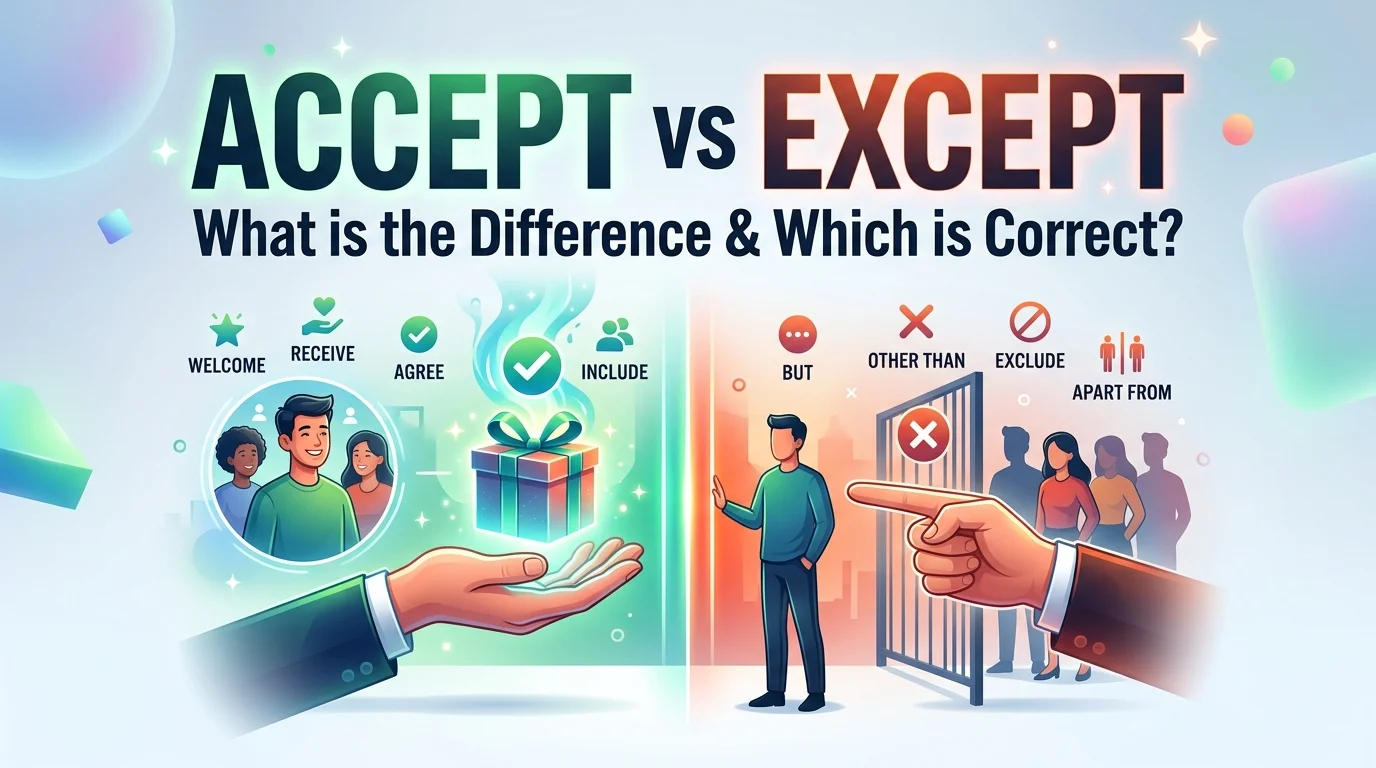

Accept and except are two commonly confused English words because they sound similar, but their meanings are completely different. Understanding the difference between accept and except is important for clear communication, accurate writing, and proper grammar. This guide explains their meanings, uses, grammar rules, examples, and practical tips to help you use each word confidently.
Comparison Overview
The words “accept” and “except” are often mistaken for one another due to their similar pronunciation. However, they serve different purposes in English grammar.
| Word | Part of Speech | Main Meaning | Example |
| Accept | Verb | To receive, agree to, or approve something | I accept your invitation. |
| Except | Preposition/Conjunction | Excluding something or someone | Everyone came except John. |
While accept involves receiving or agreeing, except refers to excluding or leaving something out.
Definition of Accept
Accept is a verb that means to receive, approve, agree to, or take something that is offered.
People use accept when they willingly receive gifts, invitations, responsibilities, proposals, or facts.
Core Meaning of Accept
The primary purpose of accept is to show agreement, approval, or willingness to receive something.
Examples
- I accept your apology.
- She accepted the job offer.
- We accept credit card payments.
- The committee accepted the proposal.
- He accepted responsibility for the mistake.
Definition of Except
Except is usually a preposition or conjunction that means excluding, other than, or leaving out.
It identifies something that does not belong to a group or situation.
Core Meaning of Except
The purpose of except is to show exclusion.
Examples
- Everyone attended except Sarah.
- I like all fruits except bananas.
- The store opens every day except Sunday.
- Nobody knew the answer except the teacher.
- Everything was completed except the final report.
Main Differences Between Accept and Except
Although the words sound similar, their functions and meanings differ significantly.
| Feature | Accept | Except |
| Part of Speech | Verb | Preposition/Conjunction |
| Meaning | Receive, agree, approve | Exclude, leave out |
| Action Involved | Yes | No |
| Usage | Accepting something | Excluding something |
| Example | I accept the invitation. | Everyone came except Tom. |
Key Difference
Accept means “to receive.”
Except means “to leave out.”
For example:
- I accept your gift. ✔
- I except your gift. ✘
- Everyone came except Tom. ✔
- Everyone came accept Tom. ✘
Why People Confuse Accept and Except
Several factors contribute to confusion between these words.
Similar Pronunciation
The words sound very similar when spoken quickly.
Similar Spelling
Only one letter differs between them.
Frequent Usage
Both words commonly appear in everyday communication.
Grammar Confusion
Learners may not recognize that accept is a verb while except usually functions as a preposition or conjunction.
Comparison Table
| Aspect | Accept | Except |
| Meaning | Receive or agree | Exclude or leave out |
| Function | Action word | Exclusion word |
| Grammar Category | Verb | Preposition/Conjunction |
| Indicates | Approval or reception | Exception |
| Common Contexts | Invitations, offers, gifts | Lists, groups, exclusions |
Grammar Guide
Understanding the grammar behind these words makes correct usage much easier.
How each term is used in sentences
Accept
Pattern:
Subject + Accept + Object
Examples:
- I accept your offer.
- They accepted the decision.
- She accepts criticism positively.
Except
Pattern:
Main Statement + Except + Exception
Examples:
- Everyone passed except Mark.
- All stores were open except one.
- Nobody left except the manager.
Common mistakes learners make
Mistake 1
Using accept when exclusion is intended.
Incorrect:
- Everyone accept Tom.
Correct:
- Everyone except Tom.
Mistake 2
Using except when receiving is intended.
Incorrect:
- I except your invitation.
Correct:
- I accept your invitation.
Mistake 3
Ignoring the part of speech.
Remember:
- Accept = Verb
- Except = Preposition/Conjunction
Simple rules to remember
- Accept contains “A” for Agree.
- Accept means to receive.
- Except contains “EX” for Exclude.
- Except means to leave out.
- If an action is happening, use accept.
- If something is excluded, use except.
Quick tips for writing and speaking
- Ask whether something is being received or excluded.
- Use accept for offers, gifts, invitations, and responsibilities.
- Use except when identifying exceptions.
- Proofread carefully because spellcheck may not catch contextual errors.
- Remember: Accept = Agree, Except = Exclude.
When to Use Each One
Use Accept When
- Receiving a gift
- Agreeing to an offer
- Approving a proposal
- Taking responsibility
- Acknowledging facts
Examples:
- I accept the scholarship.
- She accepted the invitation.
- We accept your terms.
- They accepted the recommendation.
- He accepted the challenge.
Use Except When
- Identifying an exclusion
- Mentioning exceptions
- Removing an item from a group
- Describing something left out
- Comparing complete and incomplete groups
Examples:
- Everyone attended except Ali.
- All files were saved except one.
- The office is open daily except holidays.
- Nothing changed except the schedule.
- Every student passed except two.
When NOT to Use Each One
Do Not Use Accept When
- Referring to exclusions
- Listing exceptions
- Leaving something out
Incorrect:
- Everyone accept Tom.
Correct:
- Everyone except Tom.
Do Not Use Except When
- Receiving offers
- Approving decisions
- Agreeing to requests
Incorrect:
- I except your proposal.
Correct:
- I accept your proposal.
Which One to Use (Decision Guide)
Use this simple guide whenever you are unsure.
Ask yourself:
Are you receiving, agreeing, approving, or taking something?
Use Accept
Examples:
- Accept a gift
- Accept a job
- Accept an apology
- Accept a proposal
Are you excluding or leaving something out?
Use Except
Examples:
- Everyone except me
- All days except Sunday
- Every student except one
- Everything except the final chapter
Real-World Practical Examples
Accept Examples
Education
- The university accepted her application.
Daily Life
- I accepted the dinner invitation.
Business
- The company accepted the contract.
Technology
- The website accepts online payments.
Conversation
- He accepted my apology immediately.
Except Examples
Education
- Every student passed except one.
Daily Life
- I eat all vegetables except cabbage.
Business
- All departments approved the plan except finance.
Technology
- Every feature works except the search tool.
Conversation
- Everyone agreed except Michael.
Self-Assessment (Fill in the Blanks)
- I will use ______ when agreeing to a job offer.
- The correct word is ______ because it means excluding one person from the group.
- I will use ______ when receiving a gift.
- The correct word is ______ because it means leaving something out.
- I will use ______ when approving a proposal.
- The correct word is ______ because one student is excluded.
- I will use ______ when agreeing to an invitation.
- The correct word is ______ because it identifies an exception.
- I will use ______ when receiving an award.
- The correct word is ______ because it excludes one item from a list.
- I will use ______ when taking responsibility.
- The correct word is ______ because it means “other than.”
- I will use ______ when agreeing with terms and conditions.
- The correct word is ______ because everyone is included except one member.
- I will use ______ when receiving an apology.
- The correct word is ______ because a holiday is excluded from the schedule.
- I will use ______ when approving an application.
- The correct word is ______ because something is left out.
- I will use ______ when agreeing to participate.
- The correct word is ______ because it introduces an exclusion.
Answers
- Accept
- Except
- Accept
- Except
- Accept
- Except
- Accept
- Except
- Accept
- Except
- Accept
- Except
- Accept
- Except
- Accept
- Except
- Accept
- Except
- Accept
- Except
Final Verdict
Accept and except may sound alike, but they have very different meanings and functions. Accept is a verb that means to receive, approve, agree to, or take something willingly. Except is a preposition or conjunction that means excluding, leaving out, or other than. Whenever you are deciding between the two, ask yourself whether you are accepting something or identifying an exception. If you are receiving, approving, or agreeing, choose accept. If you are excluding someone or something from a group, choose except. Remember the simple memory trick: Accept equals Agree, while Except equals Exclude. By understanding these differences and practicing with real-world examples, you can avoid common mistakes and use both words correctly in speaking and writing with confidence.
Conclusion About Accept vs Except
Understanding the difference between accept vs except is essential for clear and accurate communication. Although these two words sound similar, they serve completely different purposes in English grammar. Accept means to receive, approve, agree to, or take something willingly, while except means to exclude or leave something out. Confusing them can change the meaning of an entire sentence and create misunderstandings in both writing and conversation.
A simple way to remember the difference is that accept is associated with agreement or receiving something, whereas except is connected to exclusion. Whether you are writing an email, completing school assignments, preparing business documents, or having everyday conversations, using the correct word helps make your message more professional and precise. By learning their meanings, grammar rules, and common usage patterns, you can confidently choose the right word every time and avoid one of the most common English language mistakes.
FAQs
What is the difference between accept and except?
Accept means to receive, agree to, or approve something. Except means to exclude or leave something out. The key difference is that accept involves receiving or agreeing, while except refers to an exception within a group or situation.
Is accept a verb or a preposition?
Accept is a verb. It describes an action such as receiving an offer, agreeing to a proposal, or approving a decision. It is never used as a preposition in standard English grammar.
Is except a verb?
Except is most commonly used as a preposition or conjunction to indicate exclusion. Although it can occasionally function as a verb in formal contexts, most everyday usage involves meaning “excluding” or “other than.”
How can I remember the difference between accept and except?
A helpful memory trick is that accept starts with “A” for agree, while except starts with “EX” for exclude. If something is being received, use accept. If something is being left out, use except.
Can accept and except be used interchangeably?
No, they cannot be used interchangeably. They have different meanings and grammatical functions. Using one in place of the other often creates a grammatical error or completely changes the meaning of a sentence.
Why do people confuse accept and except?
People often confuse them because they sound very similar when spoken. Their spellings are also nearly identical, differing by only one letter, which can make them easy to mix up while writing.
What is an example sentence using accept?
A simple example is: “I accept your invitation to the conference.” In this sentence, accept means to agree to or receive an invitation that has been offered.
What is an example sentence using except?
A simple example is: “Everyone attended the meeting except James.” Here, except shows that James is the one person excluded from the group being discussed.
Which word should I use when excluding someone from a group?
You should use except. Whenever you want to show that someone or something is not included in a group, list, or situation, except is the correct word choice.
Are accept and except commonly tested in English exams?
Yes, accept and except are frequently included in grammar tests, language proficiency exams, and school assessments because they are commonly confused words that test vocabulary and usage knowledge.
