
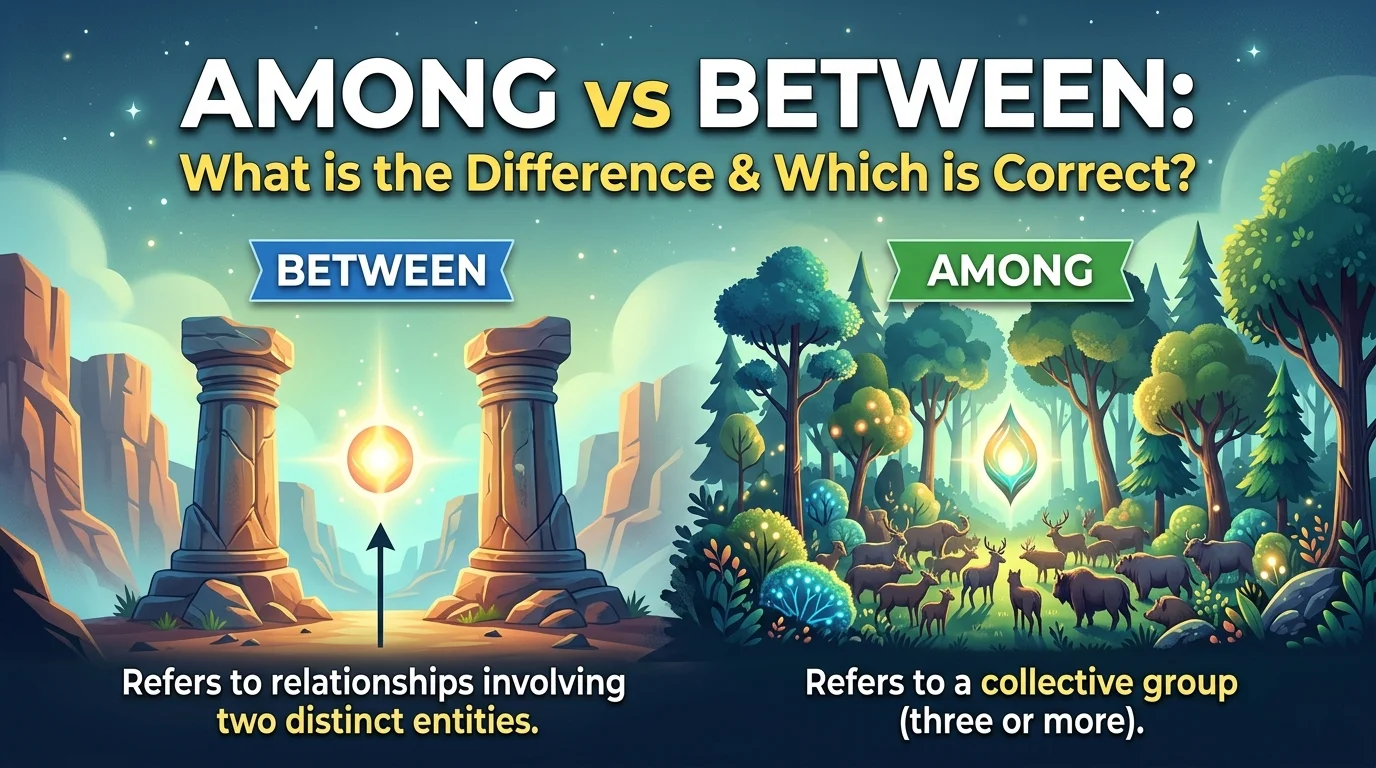

Understanding the difference between “among” and “between” is essential for clear and correct English usage. Many learners confuse these two prepositions because both relate to relationships or connections. However, they are used in different contexts depending on whether we are talking about two or more items, groups, or relationships. This guide makes the distinction simple, practical, and easy to remember.
Comparison Overview
“Among” and “between” are prepositions used to describe relationships involving people, places, or things. While they may seem similar, they are not interchangeable in most cases. “Between” is typically used when referring to two distinct items or clear relationships, while “among” is used when referring to more than two items or when something is part of a group. Understanding this difference helps improve clarity in both writing and speaking.
Definition of Among
“Among” is a preposition used when referring to things that are part of a group, mass, or collective. It shows a relationship that exists within a group rather than between clearly separated individuals. It is commonly used when the elements are not treated as separate units.
In simple terms, “among” means being surrounded by or included in a group of three or more people or things.
Definition of Between
“Between” is a preposition used when referring to two distinct people, things, or clearly defined relationships. It highlights separation, comparison, or direct connection between specific elements. It can also be used with more than two items when each relationship is considered individually.
In simple terms, “between” means a direct relationship linking one thing to another.
Main Differences Between Among and Between
The key difference lies in how relationships are viewed. “Among” is used for collective or group situations, while “between” is used for individual and distinct relationships.
“Among” focuses on inclusion within a group, where elements are not separated clearly. “Between” focuses on direct connections or comparisons between specific items.
“Between” is more precise and specific, while “among” is more general and collective.
| Aspect | Among | Between |
| Number of items | Three or more in a group | Two or more distinct items |
| Focus | Collective relationship | Individual relationship |
| Usage style | General inclusion or distribution | Direct comparison or connection |
| Clarity | Less specific | More specific |
Grammar Guide
How each term is used in sentences
“Among” is used when something is part of a group. Common patterns include:
- among + plural noun
- among + collective group
“Between” is used when showing a relationship between distinct items. Common patterns include:
- between + two nouns
- between + specific choices or options
Common mistakes learners make
A common mistake is using “between” for group situations where “among” is needed. Another mistake is using “among” when only two items are involved. These errors can make sentences sound unnatural or incorrect.
Simple rules to remember
Use “among” for groups and collective situations. Use “between” for clear, separate, and distinct items or comparisons.
Quick tips for writing and speaking
Think of “among” as being inside a crowd. Think of “between” as standing in the middle of two clear points or choices.
When to Use Each One
Use “among” when referring to something shared within a group. Use “between” when referring to comparisons, choices, or clear relationships between separate items.
When NOT to Use Each One
Do not use “among” when referring to only two items. Do not use “between” when referring to a broad group where individual items are not separated. Incorrect usage can reduce clarity in communication.
Which One to Use (Decision Guide)
If you are talking about two clearly separate items, use “between.” If you are talking about a group of three or more items without separating them individually, use “among.” If the relationship is direct and specific, choose “between.” If it is collective and general, choose “among.”
Real-World Practical Examples
Among Examples
- The teacher distributed sweets among the students.
- There is strong unity among the team members.
- He got lost among the crowd at the event.
- The message spread among the villagers quickly.
- There is trust among close friends.
Between Examples
- She had to choose between two universities.
- The contract between the companies was signed yesterday.
- The debate between the leaders was intense.
- He divided his time between study and work.
- The difference between success and failure is consistency.
Self-Assessment (Fill in the Blanks)
- The gift was shared ______ all the children.
- Choose ______ coffee and tea.
- There is friendship ______ the group.
- The argument ______ the two men lasted long.
- He walked ______ the trees in the forest.
- The deal was made ______ the companies.
- The secret spread ______ friends.
- She had to decide ______ two dresses.
- There is competition ______ students.
- The rumor spread ______ villagers.
- The meeting is scheduled ______ Monday and Tuesday.
- There is peace ______ the community.
- The conflict ______ the nations continues.
- He stood ______ the crowd.
- The decision ______ the options was difficult.
- Cooperation exists ______ departments.
- The difference ______ truth and lies is clear.
- The news spread ______ people quickly.
- The agreement ______ buyer and seller was signed.
- Respect exists ______ teammates.
Answers
- among
- between
- among
- between
- among
- between
- among
- between
- among
- among
- between
- among
- between
- among
- between
- among
- between
- among
- between
- among
Final Verdict
The difference between “among” and “between” depends on whether you are talking about a group or distinct items. Use “among” for collective situations involving multiple elements, and use “between” for clear, specific relationships. Once this rule is understood, choosing the correct word becomes simple and natural in everyday writing and speech.
Conclusion About Among vs Between
Understanding the difference between among and between makes English clearer, more accurate, and more natural in everyday communication. While both words describe relationships, their usage depends on context. “Among” is best used when referring to something within a group or collective setting, where individual elements are not separated. On the other hand, “between” is used when dealing with clear, distinct items or direct comparisons. Once you learn this simple distinction, you can avoid common grammar mistakes and express your thoughts more confidently. Whether you are writing essays, speaking in daily conversations, or preparing for exams, mastering these two words will significantly improve your clarity and fluency in English.
FAQs
When should I use among instead of between?
“Among” should be used when referring to a group of three or more people or things where the items are not seen as separate. It describes something shared or existing within a collective environment. For example, trust among friends or distribution among students. It emphasizes inclusion rather than separation.
Can between be used for more than two things?
Yes, “between” can be used for more than two things when each item is considered individually. For example, negotiations between countries or differences between options. It focuses on distinct relationships rather than group inclusion, even if multiple elements are involved.
What is the main difference between among and between?
The main difference is that “among” refers to a collective group, while “between” refers to distinct and separate items. “Among” is general and inclusive, whereas “between” is specific and comparative. This distinction helps maintain clarity in writing and communication.
Is it wrong to use between for groups?
It is not always wrong, but it can be incorrect if used for general group inclusion. “Between” should only be used when clear individual relationships or comparisons exist. For general group situations, “among” is usually more appropriate and natural in English.
Why do people confuse among and between?
People often confuse these words because both describe relationships and connections. Additionally, in casual speech, the difference is not always emphasized. However, in formal writing, correct usage is important for clarity and grammatical accuracy.
Can among be used for two people?
No, “among” is generally not used for only two people or things. It is intended for groups of three or more. For two items, “between” is always the correct and standard choice in English grammar.
What are common mistakes with among and between?
Common mistakes include using “between” for large groups or using “among” for two items. Another error is using them interchangeably without considering context. These mistakes can make sentences unclear or grammatically incorrect.
How can I easily remember the difference?
A simple way to remember is: “among” feels like being inside a crowd, while “between” feels like being in the middle of two clear points. This mental image helps quickly choose the correct word in writing or speech.
Is among more formal than between?
Neither word is more formal than the other. Both are equally acceptable in formal and informal English. The difference lies in usage, not in formality. Choosing the correct one depends on context rather than tone.
Do among and between change meaning in modern English?
No, their core meanings remain the same in modern English. “Among” still refers to group inclusion, and “between” still refers to distinct relationships. Their usage rules have stayed consistent in both spoken and written communication.
