
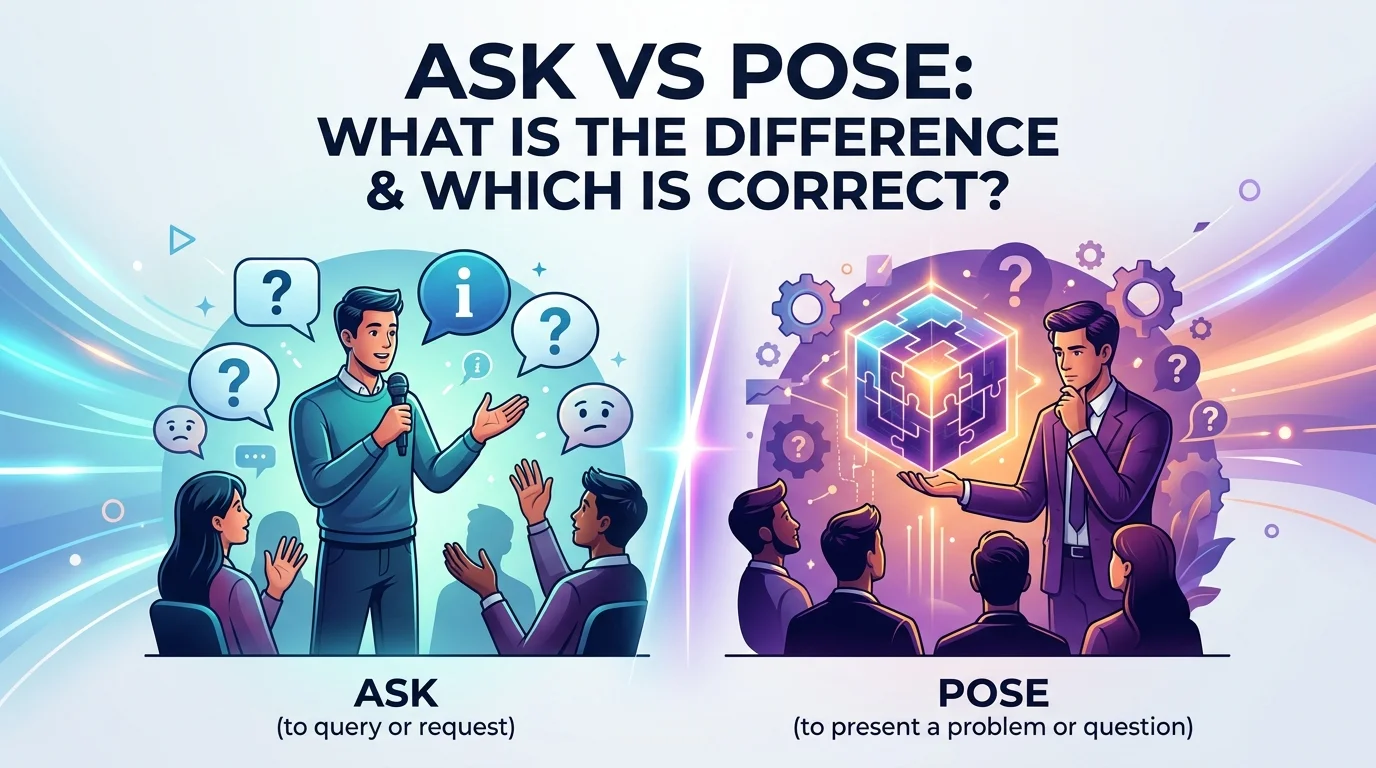

Many English learners encounter confusion when choosing between ask and pose because both can involve presenting a question or request. However, these words are not always interchangeable. Understanding their meanings, grammar, and proper usage helps you communicate more accurately in speaking and writing. This guide explains the differences, correct usage, and practical examples of both terms.
Comparison Overview
Both ask and pose relate to presenting questions, requests, or issues. However, they serve different purposes and are used in different contexts.
Ask is a common everyday verb used when requesting information, help, permission, or action.
Pose is a more formal verb often used when presenting a question, challenge, problem, or threat for consideration.
Although both can involve questions, their tone, purpose, and grammatical patterns differ significantly.
| Feature | Ask | Pose |
| Primary Meaning | Request information or action | Present a question, issue, or challenge |
| Formality | Common and everyday | More formal |
| Typical Context | Conversations, requests, inquiries | Academic, professional, analytical discussions |
| Direct Interaction | Usually involves a person | Often involves a question or problem |
| Common Object | Person or question | Question, problem, challenge |
Definition of Ask
Ask means to request information, assistance, permission, advice, or action from someone.
It is one of the most common verbs in English and is used in everyday conversations, professional settings, education, and writing.
Examples:
- I asked my teacher for help.
- She asked a question.
- They asked for directions.
- Can I ask you something?
The focus of ask is making a request or seeking information.
Definition of Pose
Pose means to present or put forward a question, problem, challenge, threat, or issue for consideration.
It is generally more formal than ask and is often found in academic, scientific, legal, and professional writing.
Examples:
- The professor posed an interesting question.
- Climate change poses serious risks.
- The study poses new challenges.
- The interviewer posed several difficult questions.
The focus of pose is presenting something for thought, analysis, or consideration.
Main Differences Between Ask and Pose
Purpose
Ask is used to request something.
Pose is used to present something.
Examples:
- She asked for advice.
- She posed a question.
Formality
Ask works in both formal and informal situations.
Pose is generally more formal.
Examples:
- Ask your manager for clarification.
- The report poses important concerns.
Typical Objects
Ask often takes people, questions, favors, or requests as objects.
Pose usually takes questions, challenges, risks, threats, or problems as objects.
Communication Style
Ask involves direct interaction between people.
Pose focuses on introducing an idea, issue, or inquiry.
Ask vs Pose Comparison Table
| Situation | Correct Word |
| Requesting help | Ask |
| Seeking information | Ask |
| Presenting a difficult question | Pose |
| Introducing a challenge | Pose |
| Asking permission | Ask |
| Presenting a problem for discussion | Pose |
| Everyday conversation | Ask |
| Academic writing | Often Pose |
Common Contexts Where They Appear
Everyday Communication
In daily speech, ask is overwhelmingly more common.
Example:
- Ask your friend about the meeting.
Academic Writing
Researchers often pose questions or hypotheses.
Example:
- The article poses an important research question.
Business Communication
Both words may appear depending on context.
Examples:
- Ask the client for feedback.
- The proposal poses financial risks.
Scientific Discussions
Scientists frequently use pose when discussing challenges or research questions.
Example:
- The findings pose new questions for future studies.
Grammar Guide
How Each Term Is Used in Sentences
Ask Patterns
- Ask + person + question
- Ask + for + noun
- Ask + to + verb
Examples:
- I asked him a question.
- She asked for assistance.
- They asked me to wait.
Pose Patterns
- Pose + question
- Pose + challenge
- Pose + risk
- Pose + threat
Examples:
- The journalist posed a question.
- The situation poses a challenge.
- Pollution poses health risks.
Common Mistakes Learners Make
Using Pose for Everyday Requests
Incorrect:
- Pose your teacher for help.
Correct:
- Ask your teacher for help.
Using Ask with Abstract Challenges
Less natural:
- The situation asks a challenge.
Correct:
- The situation poses a challenge.
Confusing Formal and Informal Contexts
Using pose in casual conversation can sound unnatural.
Example:
- I posed my friend a question. (Possible but uncommon)
- I asked my friend a question. (Natural)
Simple Rules to Remember
- If you want information, use ask.
- If you are presenting a problem or issue, use pose.
- Everyday conversations usually use ask.
- Formal discussions often use pose.
- You ask people, but you pose questions or challenges.
Quick Tips for Writing and Speaking
- Use ask for requests.
- Use ask when talking to someone directly.
- Use pose for formal reports and discussions.
- Use pose for challenges, risks, and problems.
- Check whether you’re requesting or presenting something.
When to Use Each One
Use Ask When
- Requesting information
- Seeking help
- Asking permission
- Making inquiries
- Speaking casually
Examples:
- Ask for directions.
- Ask your boss for approval.
- Ask a question.
Use Pose When
- Presenting a question
- Introducing a challenge
- Discussing risks
- Writing formally
- Analyzing issues
Examples:
- Pose a question.
- Pose a challenge.
- Pose a threat.
When NOT to Use Each One
Do Not Use Ask When
- Referring to risks or threats
- Presenting analytical challenges
Incorrect:
- The virus asks a threat.
Correct:
- The virus poses a threat.
Do Not Use Pose When
- Requesting help
- Seeking permission
- Asking favors
Incorrect:
- I posed my teacher for help.
Correct:
- I asked my teacher for help.
Which One to Use (Decision Guide)
Use ask if:
- You need information.
- You want help.
- You are making a request.
- You are speaking informally.
Use pose if:
- You are presenting a question.
- You are discussing a challenge.
- You are introducing a risk.
- You are writing formally.
Quick decision:
- Requesting = Ask
- Presenting = Pose
Real-World Practical Examples
Ask Examples
- The student asked the teacher for extra guidance.
- I asked my neighbor about the local event.
- The customer asked for a refund.
- The manager asked employees to arrive early.
- The programmer asked a question during the technology conference.
Pose Examples
- The scientist posed a new research question.
- Artificial intelligence poses ethical concerns.
- The lawyer posed several questions to the witness.
- Economic instability poses challenges for businesses.
- The professor posed a complex problem for students to solve.
Self-Assessment (Fill in the Blanks)
- I will use ______ when requesting information from a friend.
- The correct word is ______ because a challenge is being presented.
- I will use ______ when seeking permission.
- The correct word is ______ because a research question is being introduced.
- I will use ______ when requesting assistance.
- The correct word is ______ because a threat is being discussed.
- I will use ______ when talking to my teacher.
- The correct word is ______ because a formal issue is being presented.
- I will use ______ when requesting directions.
- The correct word is ______ because a problem is being introduced.
- I will use ______ when making an inquiry.
- The correct word is ______ because a risk is being discussed.
- I will use ______ when requesting advice.
- The correct word is ______ because an analytical question is being presented.
- I will use ______ when asking someone for help.
- The correct word is ______ because a challenge requires consideration.
- I will use ______ during everyday conversations.
- The correct word is ______ because a scientific issue is being introduced.
- I will use ______ when requesting clarification.
- The correct word is ______ because a formal question is being presented.
Answers
- Ask
- Pose
- Ask
- Pose
- Ask
- Pose
- Ask
- Pose
- Ask
- Pose
- Ask
- Pose
- Ask
- Pose
- Ask
- Pose
- Ask
- Pose
- Ask
- Pose
Final Verdict
The difference between ask and pose comes down to purpose and context. Ask is the everyday verb used when requesting information, help, permission, or action from someone. It is common in conversations, emails, classrooms, and workplaces. Pose, on the other hand, is a more formal verb used when presenting questions, challenges, risks, threats, or problems for consideration. While both can relate to questions, ask focuses on seeking an answer, whereas pose focuses on introducing something that requires thought or analysis. If you are communicating with people directly, ask is usually the correct choice. If you are discussing ideas, challenges, or formal issues, pose is often the better option. Understanding this distinction will help you write and speak English with greater confidence and accuracy.
Conclusion About Ask Vs Pose
Understanding the difference between ask and pose can make your English more precise and natural. While both words may relate to questions, they serve different purposes and appear in different contexts. Ask is the everyday choice when you want information, help, permission, or action from someone. It is direct, simple, and commonly used in conversations, emails, and daily communication. Pose, on the other hand, is often used in formal, academic, professional, or analytical settings when presenting a question, challenge, risk, or issue for consideration.
Choosing the correct word depends on what you are trying to communicate. If you are requesting something from a person, use ask. If you are introducing an idea, problem, or question for discussion, use pose. By remembering this simple distinction, you can improve both your writing and speaking skills and avoid one of the most common vocabulary confusions in English.
FAQs
What is the main difference between ask and pose?
The main difference is that ask means to request information, help, or action, while pose means to present a question, challenge, problem, or issue for consideration. Ask is common in everyday communication, whereas pose is often used in more formal contexts.
Can ask and pose be used interchangeably?
Sometimes they can be used when referring to questions, but not always. For example, both “ask a question” and “pose a question” are correct. However, you cannot usually replace ask with pose when requesting help, permission, or information from someone.
Is pose more formal than ask?
Yes, pose is generally considered more formal. It frequently appears in academic papers, research discussions, professional reports, and analytical writing. Ask is suitable for both formal and informal communication but is much more common in everyday speech.
When should I use ask?
Use ask when you want information, assistance, clarification, permission, advice, or action from another person. It is the standard verb for making requests and inquiries in both spoken and written English.
When should I use pose?
Use pose when presenting a question, challenge, risk, threat, or problem for discussion or consideration. It is especially useful in formal writing, education, science, business, and professional communication.
Can I say pose a question?
Yes, “pose a question” is a correct and widely used expression. It means to present a question for others to think about or answer. This phrase is common in academic, professional, and formal discussions.
Why is ask more common in conversation?
Ask is more common because everyday conversations often involve requesting information, help, or opinions from others. Since these situations occur frequently, ask naturally becomes one of the most commonly used verbs in English.
What are common mistakes with ask and pose?
A common mistake is using pose when requesting something from a person. For example, “pose your teacher for help” is incorrect. Another mistake is using ask when referring to challenges or risks, where pose is usually the better choice.
Can pose be used with problems and risks?
Yes. Pose is commonly used with words such as problem, challenge, risk, danger, and threat. For example, “The new policy poses several challenges” and “The storm poses a serious risk to the community” are both correct.
How can I remember the difference easily?
A simple rule is to remember that ask is for requesting and pose is for presenting. If you need something from someone, use ask. If you are introducing a question, issue, or challenge for discussion, use pose.
