
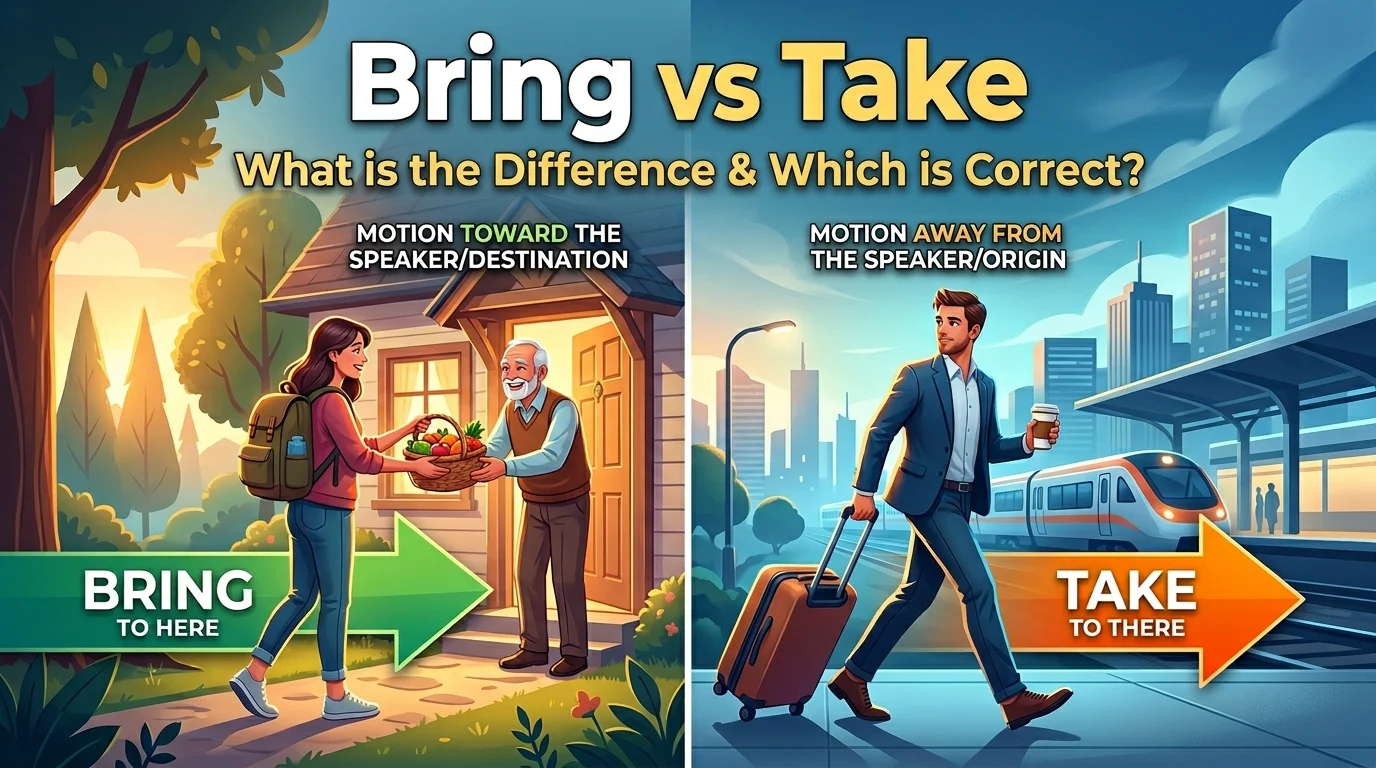

Understanding the difference between “bring” and “take” is important for clear and natural English communication. These two verbs often confuse learners because both involve movement, but they are used from different points of view. This guide explains their meanings, differences, and correct usage in a simple way.
Comparison Overview
“Bring” and “take” are both verbs that describe movement of people or objects. The key difference is direction. “Bring” is used when something moves toward the speaker or a specific location. “Take” is used when something moves away from the speaker or current place. This small difference completely changes the meaning of a sentence.
Definition of Bring
“Bring” means to carry or move something toward the speaker or toward a specific destination where the speaker or listener is located.
It focuses on movement coming closer or arriving at a place.
Core meaning of Bring
To carry something toward here or toward the listener’s location.
Simple idea
Use “bring” when something is coming to you or to the place you are referring to.
Definition of Take
“Take” means to carry or move something away from the speaker or from the current location to another place.
It focuses on movement going away from here.
Core meaning of Take
To carry something from here to another place.
Simple idea
Use “take” when something is leaving with someone or moving somewhere else.
Main Differences Between Bring and Take
The main difference between “bring” and “take” is direction based on the speaker’s location.
“Bring” shows movement toward a place, while “take” shows movement away from a place. This difference depends on perspective, not the object itself.
Key comparison points
Meaning: Bring means toward, Take means away
Direction: Bring comes closer, Take goes farther
Focus: Bring is arrival, Take is departure
Perspective: Bring is from listener’s side, Take is from leaving side
Comparison Table
| Feature | Bring | Take |
| Direction | Toward speaker | Away from speaker |
| Focus | Arrival | Departure |
| Context | Coming here | Going there |
| Example | Bring me water | Take this book to school |
Grammar Guide
Both “bring” and “take” are regular verbs and follow standard English grammar rules. They can be used in present, past, and future forms.
How each term is used in sentences
Bring structure: Subject + bring + object + to + place
Example: She brings lunch to the office.
Take structure: Subject + take + object + to + place
Example: He takes his laptop to school.
Common mistakes learners make
Many learners confuse direction and use the wrong verb. For example, using “bring” when the object is actually moving away from the speaker.
Another mistake is not considering where the speaker is located in the situation.
Simple rules to remember
Use “bring” when coming toward here.
Use “take” when going away from here.
Think: come equals bring, go equals take.
Quick tips for writing and speaking
First identify where the speaker is.
Then check whether the object is coming or going.
Match the verb to direction, not just the object.
When to Use Each One
Use “bring” when someone is carrying something toward you or toward a shared place. It is common in requests, invitations, and meetings.
Use “take” when someone is carrying something away from you or leaving a place. It is common in travel, errands, and deliveries.
When NOT to Use Each One
Do not use “bring” for movement away from the speaker because it creates confusion in direction.
Do not use “take” for movement toward the speaker because it misrepresents arrival.
Avoid switching them without checking location and direction first.
Which One to Use (Decision Guide)
If something is coming toward your location, use “bring.”
If something is going away from your location, use “take.”
A simple memory trick is:
Come here means bring.
Go there means take.
Real-World Practical Examples
Bring Examples
- Please bring your notebook to class tomorrow.
- Can you bring some tea to the meeting room?
- She will bring her friend to the event.
- Bring your documents when you visit the office.
- He brought food for everyone at the party.
Take Examples
- Please take this form to the reception.
- I will take my bag to school today.
- She takes her lunch to work every day.
- He took the parcel to the courier office.
- Take your keys with you when you leave.
Self-Assessment (Fill in the Blanks)
I will use ______ when something moves toward me.
The correct word is ______ when something moves away from here.
If an object comes to my place, I use ______.
If an object leaves with someone, I use ______.
I should choose ______ when I am receiving something.
I should choose ______ when I am sending something away.
The verb ______ is used for arrival situations.
The verb ______ is used for departure situations.
If someone comes to me with something, I say ______.
If I send something with someone, I say ______.
Movement toward here uses ______.
Movement away from here uses ______.
When something reaches me, I use ______.
When something leaves me, I use ______.
If I go somewhere with an object, I use ______.
If someone comes here with an object, I use ______.
The rule depends on ______ and direction.
“Come here” matches ______.
“Go there” matches ______.
The main factor is ______.
Answers
- bring
- take
- bring
- take
- bring
- take
- bring
- take
- bring
- take
- bring
- take
- bring
- take
- take
- bring
- context
- bring
- take
- context
Final Verdict
“Bring” and “take” are simple verbs, but they depend entirely on direction and perspective. “Bring” is used when something moves toward a place, while “take” is used when something moves away. Once you focus on whether the action is coming or going, choosing the correct word becomes easy and natural in both speaking and writing.
Conclusion About Bring vs Take
Understanding the difference between bring and take makes everyday English much clearer and more natural. Although both words describe movement, they are used based on direction and perspective. “Bring” is used when something moves toward the speaker or a specific place, while “take” is used when something moves away from the speaker to another location. Once you focus on this simple idea of coming versus going, choosing the right word becomes easy in both speaking and writing. Practicing real-life examples helps strengthen this habit over time. With consistent use, you will naturally avoid confusion and communicate more confidently in daily conversations, academic writing, and professional situations.
FAQs
What is the main difference between bring and take?
The main difference is direction. “Bring” is used when something moves toward the speaker or a specific place, while “take” is used when something moves away from the speaker. It depends on where the action is happening from the speaker’s point of view, not just the object involved.
When should I use bring in a sentence?
Use “bring” when someone is carrying something toward you or toward the place you are referring to. For example, bring your book to class means the book is coming to the class. It focuses on arrival or movement closer to the speaker or listener’s location.
When should I use take in a sentence?
Use “take” when someone is carrying something away from you or leaving a place with it. For example, take this letter to the office means it is going away from the current location. It focuses on departure or movement toward another destination.
Can bring and take be used interchangeably?
No, they cannot be used interchangeably because they depend on direction. Using the wrong word can change the meaning of a sentence. Always check whether the object is coming toward or going away from the speaker before choosing between bring and take.
Why do people confuse bring and take?
People often confuse them because both involve movement and transportation. The confusion comes from not considering the speaker’s position. Once learners understand that bring is for coming and take is for going, the difference becomes much easier to remember and apply correctly.
Is bring used for future events?
Yes, “bring” can be used for future events when something will come toward a location. For example, bring your documents tomorrow means the documents should come to the event or place in the future. It still follows the same direction rule.
Is take used for travel situations?
Yes, “take” is commonly used in travel or movement away from a place. For example, take a bus to the city means you are going from one location to another. It always emphasizes leaving the current position and moving elsewhere.
What is a simple trick to remember bring and take?
A simple trick is to remember: come equals bring, and go equals take. If something is coming toward you, use bring. If something is going away from you, use take. This mental shortcut helps avoid confusion in most situations.
Do bring and take change in past tense?
Yes, both verbs change in past tense. “Bring” becomes “brought,” and “take” becomes “took.” For example, she brought food yesterday or he took the package earlier. The meaning of direction remains the same even in past tense usage.
Can bring and take be used in business communication?
Yes, both are widely used in business communication. “Bring” is used for items or information coming to meetings, while “take” is used for documents or materials being sent to another place. Correct usage helps maintain clear and professional communication.
