
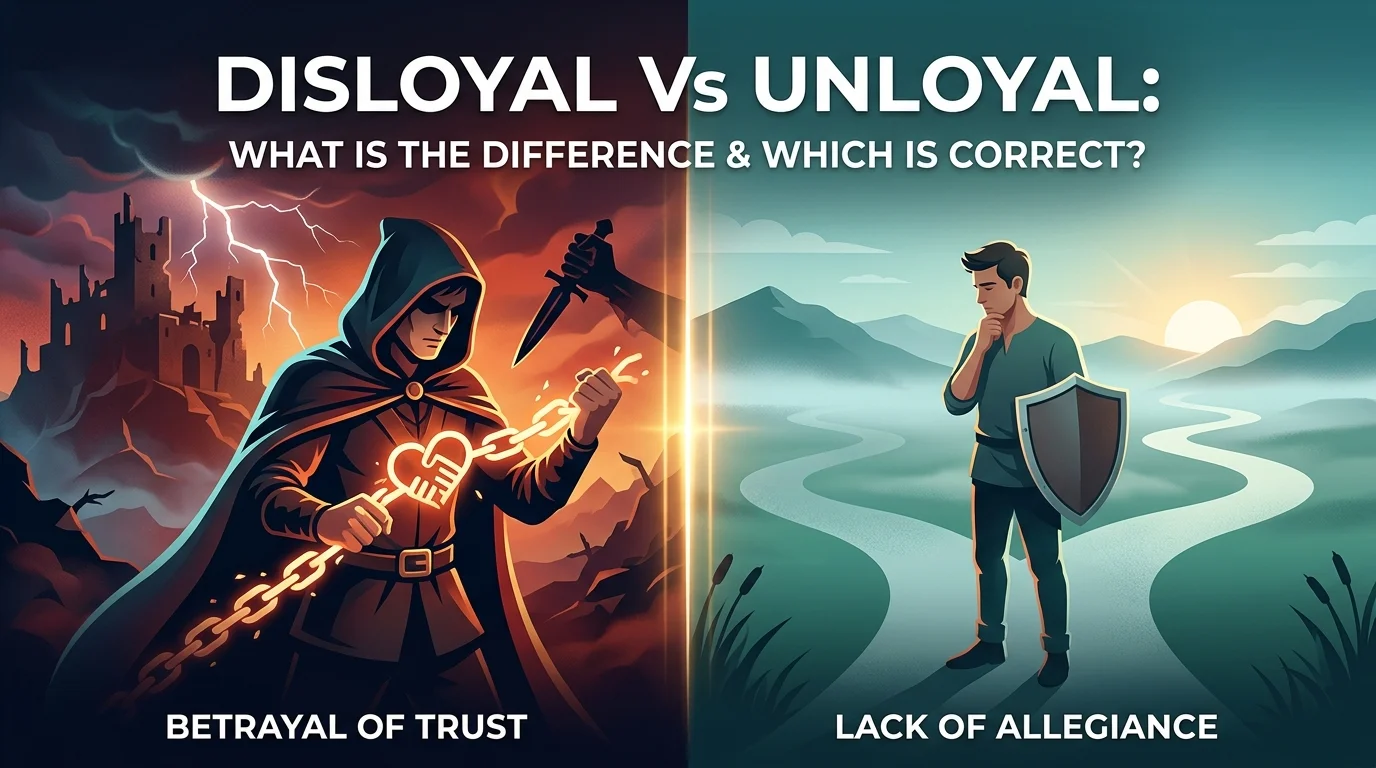

The comparison between “disloyal” and “unloyal” often confuses English learners and writers. Both words seem similar, but only one is widely accepted in standard English. Understanding their difference helps you avoid mistakes in writing and speaking while improving clarity, correctness, and overall communication in academic, professional, and everyday contexts.
Comparison Overview
“Disloyal” and “unloyal” both attempt to describe a lack of loyalty, but they are not used equally in English. “Disloyal” is the correct and standard word found in dictionaries and formal writing. “Unloyal” is rarely used and is generally considered nonstandard or incorrect in modern English usage.
Definition of Disloyal
“Disloyal” is an adjective used to describe someone who does not show loyalty, support, or faithfulness to a person, group, or cause. It is the accepted and grammatically correct form in English.
It comes from the prefix “dis-” meaning opposite or absence of, combined with “loyal,” meaning faithful and trustworthy.
Definition of Unloyal
“Unloyal” is an uncommon and nonstandard word formed by adding the prefix “un-” to “loyal.” While it may be understood in informal contexts, it is not recognized as correct in standard English grammar or formal writing.
Most dictionaries do not recommend its use, and it is generally replaced by “disloyal.”
Main Differences Between Disloyal and Unloyal
The key difference lies in correctness and usage. “Disloyal” is widely accepted in formal English, while “unloyal” is considered incorrect or outdated.
“Disloyal” is used in literature, academic writing, and professional communication. “Unloyal” may appear in casual speech or as a learner’s error.
Comparison Table
| Feature | Disloyal | Unloyal |
| Standard Usage | Yes | No |
| Dictionary Acceptance | Yes | Rare/No |
| Formal Writing | Correct | Incorrect |
| Common Usage | High | Very low |
| Recommended | Yes | No |
Grammar Guide
How each term is used in sentences
“Disloyal” is used as an adjective describing behavior or attitude.
Examples:
- He was disloyal to his team.
- The employee acted disloyal during negotiations.
“Unloyal” is rarely used in correct grammar and is usually replaced with “disloyal.”
Common mistakes learners make
Many learners assume both prefixes “dis-” and “un-” can be freely added to any adjective. This leads to incorrect usage like “unloyal,” which is not standard English.
Simple rules to remember
If you want to express the opposite of loyal, always use “disloyal,” not “unloyal.”
Quick tips for writing and speaking
In exams, essays, or professional communication, avoid “unloyal” completely and stick with “disloyal” for accuracy and credibility.
When to Use Each One
Use “disloyal” when describing betrayal, lack of faithfulness, or broken trust in any relationship, group, or organization. It fits both formal and informal contexts.
“Unloyal” should generally be avoided. Even in casual speech, it is better to correct it to “disloyal.”
When NOT to Use Each One
Do not use “unloyal” in academic writing, business communication, or exams because it is not considered standard English.
Also avoid using it when clarity and correctness are important, as it may appear as a grammatical mistake.
Which One to Use (Decision Guide)
If you are writing or speaking and need the correct opposite of “loyal,” always choose “disloyal.” It is the only widely accepted and grammatically correct option.
If you are unsure, remember this simple rule: “disloyal” is correct, “unloyal” is not recommended.
Real-World Practical Examples
Disloyal Examples
- The politician was accused of being disloyal to his party.
- She felt disloyal for leaving her team during the project.
- A disloyal employee may damage company trust.
- He was disloyal to his friends during the argument.
- The dog was surprisingly disloyal and ran away.
Unloyal Examples
- He is unloyal to his friends (incorrect usage, should be disloyal).
- She acted unloyal during the discussion (nonstandard).
- Being unloyal can harm relationships (incorrect form).
- The manager called him unloyal (should be disloyal).
- They considered him unloyal to the group (wrong usage).
Self-Assessment (Fill in the Blanks)
- The correct opposite of loyal is ______.
- He was accused of being ______ to his team.
- The word ______ is not standard English.
- A ______ person may break trust easily.
- We should avoid using ______ in formal writing.
- The employee was ______ during the meeting.
- ______ is preferred in dictionaries.
- “Unloyal” is considered ______.
- She felt ______ after leaving the group.
- ______ is correct in academic writing.
- The opposite of loyalty is ______ behavior.
- He was seen as ______ by his colleagues.
- ______ should not be used in exams.
- A ______ friend cannot be trusted.
- The correct prefix form is ______.
- Using ______ is a common learner mistake.
- He showed ______ actions during conflict.
- ______ is widely accepted in English.
- The manager called him ______ (incorrect form).
- Always prefer ______ over unloyal.
Answers
- disloyal
- disloyal
- unloyal
- disloyal
- unloyal
- disloyal
- disloyal
- incorrect
- disloyal
- disloyal
- disloyal
- disloyal
- unloyal
- disloyal
- dis-
- unloyal
- disloyal
- disloyal
- unloyal
- disloyal
Final Verdict
“Disloyal” is the correct and standard English word used to describe someone who lacks loyalty or faithfulness. “Unloyal” is not accepted in formal grammar and should be avoided in writing and speech. For clear, correct, and professional communication, always use “disloyal” as the proper choice.
Conclusion About Disloyal Vs Unloyal
In the end, the difference between “disloyal” and “unloyal” is simple but important for clear English communication. “Disloyal” is the correct, widely accepted, and professionally used term in writing, speech, and education. It properly describes a lack of loyalty in relationships, work, or personal situations. On the other hand, “unloyal” is not considered standard English and is rarely used in formal contexts. Understanding this distinction helps learners avoid common mistakes and improve their grammar accuracy. Choosing the right word not only strengthens your writing but also builds confidence in communication. Whenever you want to express the idea of broken trust or faithfulness, “disloyal” is always the safe and correct choice. Keeping this rule in mind ensures your language remains polished, natural, and easy to understand in any situation.
FAQs
Is disloyal a correct English word?
Yes, “disloyal” is a correct and standard English adjective. It is widely used in formal writing, education, and daily communication to describe someone who does not remain faithful or trustworthy in relationships, groups, or responsibilities.
Is unloyal a real English word?
“Unloyal” exists but is not considered standard English. It is rarely used and generally viewed as incorrect in formal writing. Most dictionaries and grammar guides recommend using “disloyal” instead.
Why is disloyal preferred over unloyal?
“Disloyal” is preferred because it is historically established and grammatically accepted. “Unloyal” does not follow standard usage patterns in English, making it unsuitable for academic, professional, or formal contexts.
Can I use unloyal in speaking?
Even in speaking, it is better to avoid “unloyal.” While people may understand it, using “disloyal” ensures clarity, correctness, and better communication in both casual and formal conversations.
What does disloyal mean in simple words?
“Disloyal” means not being faithful, trustworthy, or supportive. It describes someone who breaks trust or does not stay committed to a person, group, or belief.
Is disloyal a negative word?
Yes, “disloyal” is usually negative because it refers to betrayal, lack of trust, or broken loyalty. It is often used when someone behaves unfairly toward others.
Is unloyal used in modern English?
No, “unloyal” is not commonly used in modern English. It appears rarely and is generally considered incorrect compared to the standard form “disloyal.”
What is the opposite of disloyal?
The opposite of “disloyal” is “loyal.” Loyal describes someone who is faithful, supportive, and trustworthy in relationships, work, or personal commitments.
Can disloyal be used in formal writing?
Yes, “disloyal” is appropriate and correct for formal writing such as essays, reports, and professional communication. It is the recommended term in all serious contexts.
How can I remember the correct word easily?
A simple rule is to always use “disloyal” because it is accepted in dictionaries and formal English. Avoid “unloyal” since it is not standard and may be marked as incorrect.
