
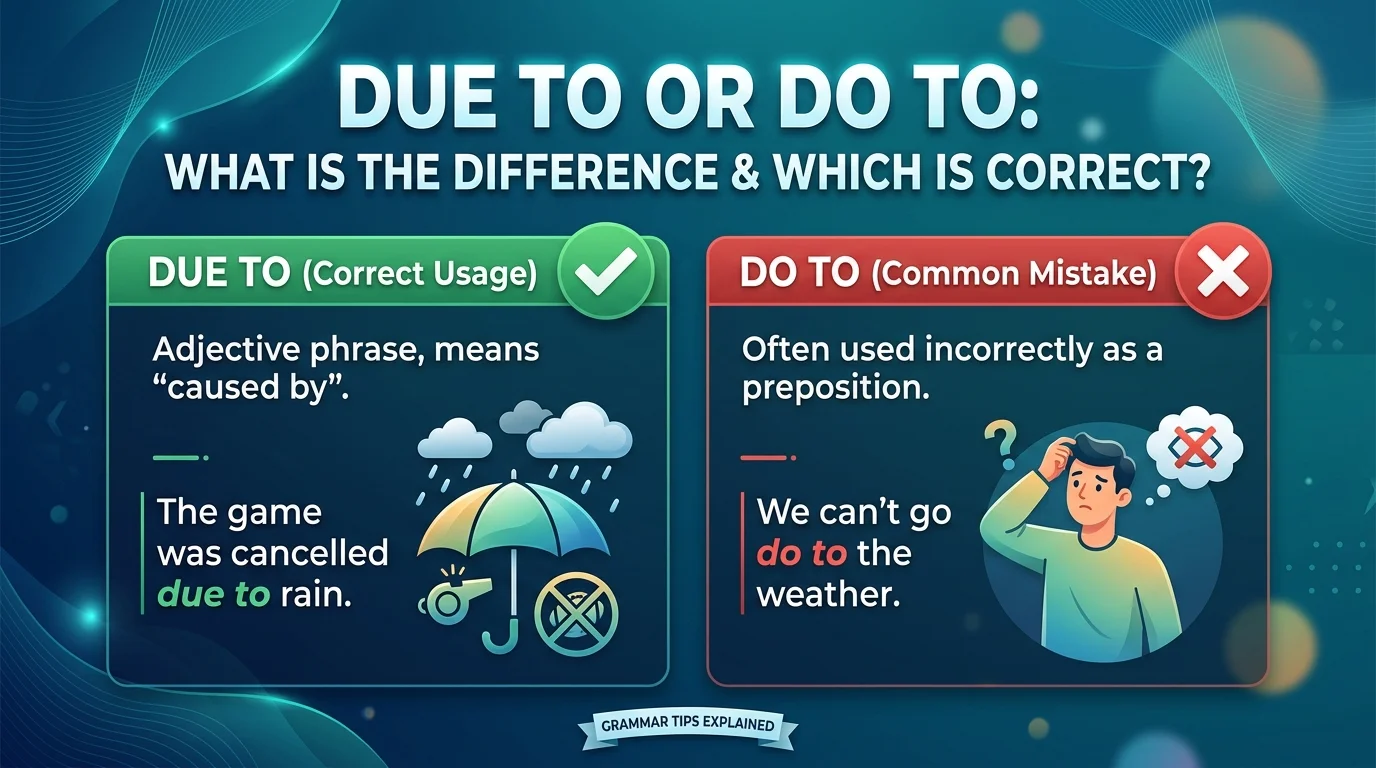

Many English learners confuse “due to” and “do to” because they sound almost identical when spoken. However, these two phrases have completely different meanings and grammatical functions. Understanding when to use each one correctly can improve your writing, speaking, and overall grammar accuracy in both formal and casual communication.
Comparison Overview
“Due to” is a common English phrase used to explain a reason or cause. It is often similar in meaning to “because of.” On the other hand, “do to” is much less common and usually appears when the verb “do” is followed by the word “to” in a sentence structure.
Although the phrases sound alike, they are not interchangeable. One is a fixed expression related to cause, while the other depends on verb usage and sentence construction.
| Phrase | Meaning | Function | Common Usage |
| Due to | Because of; caused by | Prepositional phrase | Very common |
| Do to | Perform an action toward something | Verb + preposition | Less common |
Definition of Due To
“Due to” means “because of” or “as a result of.” It is used to explain why something happened.
This phrase usually introduces the cause of a situation, condition, or event.
Examples:
- The flight was delayed due to bad weather.
- The meeting was canceled due to technical issues.
- Schools closed due to heavy rain.
In modern English, “due to” is widely accepted in both formal and informal writing.
Definition of Do To
“Do to” is not a fixed phrase like “due to.” Instead, it is formed when the verb “do” is followed by the preposition “to.”
It generally means performing an action toward someone or something.
Examples:
- What did you do to the computer?
- Please do to others as you want them to do to you.
- I would never do that to my friend.
Unlike “due to,” this structure depends on the sentence and verb meaning.
Main Differences Between Due To and Do To
The biggest difference is that “due to” explains a cause, while “do to” describes an action.
| Feature | Due To | Do To |
| Meaning | Because of | Perform an action toward |
| Grammar Type | Prepositional phrase | Verb + preposition |
| Purpose | Explains reasons | Describes actions |
| Commonness | Very common | Less common |
| Example | Due to traffic, we were late. | What did you do to my phone? |
Key differences:
- “Due to” answers the question “Why?”
- “Do to” answers the question “What action?”
- “Due to” often replaces “because of.”
- “Do to” cannot replace “because of.”
Why People Confuse These Terms
These phrases are commonly confused because:
- They sound nearly identical in spoken English.
- Fast pronunciation makes “due” and “do” difficult to distinguish.
- Spell-check tools may not always catch the error.
- Learners often write based on sound rather than grammar.
For example:
- Incorrect: The game was canceled do to rain.
- Correct: The game was canceled due to rain.
Common Situations Where These Terms Appear
“Due to” commonly appears in:
- Academic writing
- Business emails
- News reports
- Everyday conversation
- Formal announcements
“Do to” commonly appears in:
- Questions
- Instructions
- Conversations
- Action-based sentences
Examples:
- Due to maintenance, the website is unavailable.
- What did you do to the printer?
Grammar Guide
How each term is used in sentences
Due To Sentence Patterns
Common structures:
- due to + noun
- due to + noun phrase
Examples:
- The event ended early due to rain.
- Production slowed due to supply shortages.
Do To Sentence Patterns
Common structures:
- do + something + to + someone/something
- did + subject + do to + object
Examples:
- What did you do to the file?
- Please do no harm to animals.
Common mistakes learners make
Frequent mistakes include:
- Using “do to” instead of “due to”
- Thinking both phrases mean the same thing
- Writing based on pronunciation
Incorrect:
- The train stopped do to snow.
Correct:
- The train stopped due to snow.
Incorrect:
- Due to the computer?
Correct:
- What did you do to the computer?
Simple rules to remember
Easy memory tips:
- “Due to” = reason or cause
- “Do to” = action toward something
- If “because of” fits, use “due to.”
- If an action is happening, use “do to.”
Quick test:
- The picnic was canceled because of rain.
- The picnic was canceled due to rain.
The substitution works, so “due to” is correct.
Quick tips for writing and speaking
- Double-check spelling when typing quickly.
- Read the sentence aloud carefully.
- Replace “due to” with “because of” to test correctness.
- Look for an action verb before using “do to.”
When to Use Each One
Use “due to” when:
- Explaining reasons
- Describing causes
- Giving explanations
- Writing formally
- Discussing results
Examples:
- Due to traffic, we arrived late.
- Due to illness, she missed class.
Use “do to” when:
- Talking about actions
- Asking questions about actions
- Describing treatment or behavior
Examples:
- What did you do to the car?
- Never do that to your brother again.
When NOT to Use Each One
Do not use “do to” when explaining causes.
Incorrect:
- The store closed do to flooding.
Correct:
- The store closed due to flooding.
Do not use “due to” when discussing actions.
Incorrect:
- What due to the laptop?
Correct:
- What did you do to the laptop?
Which One to Use (Decision Guide)
Use this simple guide:
Ask yourself:
- Am I explaining a reason?
- Yes → Use “due to”
- Am I describing an action?
- Yes → Use “do to”
Examples:
- The match ended early due to rain.
- What did you do to your hair?
Another quick trick:
- If “because of” works, choose “due to.”
- If an action verb is involved, choose “do to.”
Real-World Practical Examples
Due To Examples
- The school closed due to severe weather.
- Sales increased due to holiday shopping.
- The experiment failed due to human error.
- The app crashed due to a software bug.
- Flights were delayed due to fog.
Do To Examples
- What did you do to my notebook?
- Please do to others with kindness.
- What did the update do to the system?
- Never do that to your pet.
- What did you do to improve performance?
Self-Assessment (Fill in the Blanks)
- The concert was canceled ______ heavy rain.
- What did you ______ the computer?
- The road was blocked ______ construction work.
- What did the storm ______ the building?
- Classes moved online ______ flooding.
- What did you ______ your phone screen?
- The delay happened ______ technical issues.
- Never ______ that to your teammates.
- The game stopped ______ poor lighting.
- What did the software update ______ the app?
- The company lost money ______ market changes.
- What did you ______ the kitchen walls?
- The event was postponed ______ security concerns.
- What did the chemicals ______ the metal?
- Production slowed ______ supply shortages.
- Please do not ______ harm to animals.
- The website crashed ______ server overload.
- What did the heat ______ the plastic?
- The train arrived late ______ snow.
- What did you ______ the document?
Answers
- due to
- do to
- due to
- do to
- due to
- do to
- due to
- do
- due to
- do to
- due to
- do to
- due to
- do to
- due to
- do
- due to
- do to
- due to
- do to
Final Verdict
“Due to” and “do to” may sound alike, but they serve very different purposes in English grammar. “Due to” explains causes and reasons, while “do to” describes actions performed toward someone or something. If you remember that “due to” works like “because of,” you can avoid one of the most common spelling and grammar mistakes in English writing.
Conclusion About Due To Or Do To
Understanding the difference between “due to” and “do to” can make your English writing much clearer and more professional. Even though these phrases sound very similar, they serve completely different purposes in grammar. “Due to” is used to explain reasons or causes, while “do to” refers to actions performed toward someone or something. Learning this distinction helps you avoid common spelling and grammar mistakes in emails, school assignments, business writing, and daily conversations. A simple way to remember the difference is that “due to” often works like “because of,” while “do to” usually follows an action verb. With regular practice and attention to sentence meaning, choosing the correct phrase becomes much easier. Once you understand how each expression works, you can communicate more confidently and naturally in both spoken and written English.
FAQs
Is “due to” grammatically correct?
Yes, “due to” is grammatically correct and widely used in both formal and informal English. It is commonly used to explain the reason or cause of something happening. Many writers use it as an alternative to “because of” in sentences related to events, situations, or outcomes.
Is “do to” ever correct?
Yes, “do to” can be correct when “do” is used as a verb followed by “to.” It usually describes an action directed toward someone or something. For example, “What did you do to the computer?” is a correct sentence because it refers to an action performed on the computer.
What is the main difference between “due to” and “do to”?
The main difference is meaning and grammar. “Due to” explains a cause or reason, while “do to” refers to an action. “Due to” acts as a phrase similar to “because of,” whereas “do to” depends on the verb “do” within a sentence structure.
Can I replace “due to” with “because of”?
In many cases, yes. “Due to” and “because of” often have similar meanings and can replace each other naturally. For example, “The match was canceled due to rain” can also be written as “The match was canceled because of rain.”
Why do people confuse “due to” and “do to”?
People confuse these phrases because they sound almost identical in spoken English. Fast pronunciation often makes “due” sound like “do.” Many learners also rely on sound instead of grammar rules when writing, which increases the chance of using the wrong phrase.
Is “do to” commonly used in English?
“Do to” is less common than “due to,” but it still appears regularly in questions and action-based sentences. It is usually used when discussing what someone did to a person, object, or situation rather than explaining a reason or cause.
Which phrase is more common in formal writing?
“Due to” is much more common in formal writing. It appears frequently in academic papers, reports, news articles, emails, and professional communication because it clearly explains causes and reasons in a concise and natural way.
How can I quickly remember the correct usage?
A simple trick is to replace “due to” with “because of.” If the sentence still makes sense, “due to” is correct. If the sentence talks about an action someone performed, then “do to” is usually the right choice instead.
Is “due to” considered professional English?
Yes, “due to” is considered professional and acceptable in formal English. It is often used in business communication, official notices, academic writing, and workplace reports to explain causes or reasons clearly and professionally.
Can spell-check tools detect this mistake?
Not always. Since both “due” and “do” are real English words, spell-check tools may fail to identify the error. That is why understanding the actual meaning and grammar of each phrase is important for accurate writing.
