
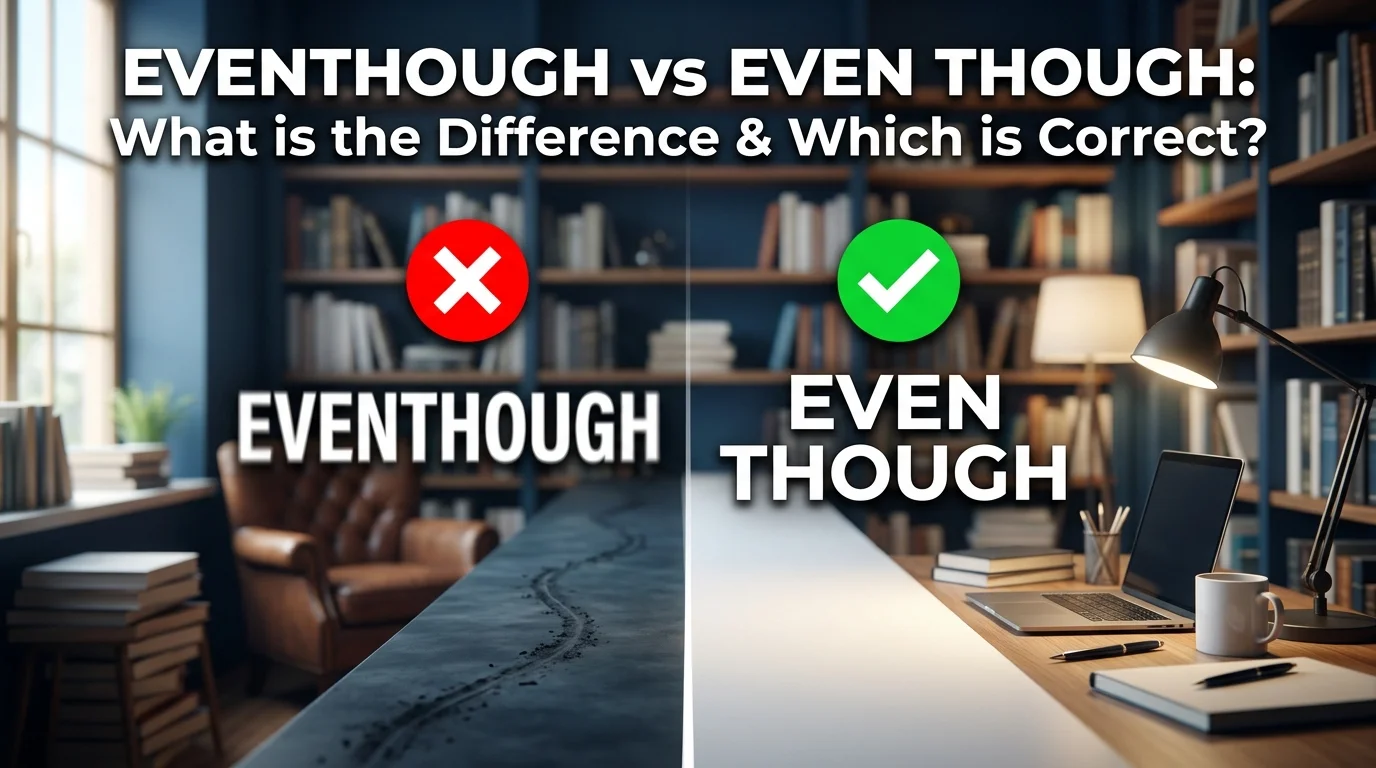

Many English learners get confused between “eventhough” and “even though” because they sound exactly the same in conversation. However, only one form is considered grammatically correct in standard English. Understanding the difference helps improve your writing, speaking, academic work, and professional communication.
Comparison Overview
“Eventhough” and “even though” are often used by people who want to express contrast or unexpected situations. The confusion happens because both forms sound identical when spoken quickly. However, there is an important grammatical distinction between them.
“Even though” is the correct and accepted English phrase. It is used as a conjunction to introduce contrast between two ideas.
“Eventhough” is generally considered a spelling mistake or a nonstandard variation. Most dictionaries, grammar guides, and professional writing standards do not accept it as a proper word.
| Feature | Eventhough | Even Though |
| Correct English Form | No | Yes |
| Accepted in Formal Writing | No | Yes |
| Part of Speech | Incorrect spelling | Conjunction |
| Common Usage | Typing mistake | Standard English |
| Used to Show Contrast | Intended but incorrect | Correctly used |
Definition of Eventhough
“Eventhough” is an incorrect spelling created when writers combine the two separate words “even” and “though” into one word.
People often type it accidentally because the phrase is commonly spoken quickly in everyday conversation. However, grammar rules require the words to remain separate.
Example of incorrect usage:
❌ Eventhough it was raining, we went outside.
Correct version:
✔ Even though it was raining, we went outside.
Definition of Even Though
“Even though” is a subordinating conjunction used to introduce a contrast, contradiction, or unexpected result between two parts of a sentence.
It means “despite the fact that” or “although.”
Examples:
✔ Even though she was tired, she finished the project.
✔ Even though the road was busy, we arrived on time.
The phrase is widely accepted in formal writing, education, business communication, and daily conversation.
Main Differences Between Eventhough and Even Though
The biggest difference is correctness.
“Even though” is the grammatically accepted phrase, while “eventhough” is considered incorrect in standard English.
Here are the main distinctions:
| Aspect | Eventhough | Even Though |
| Grammar Status | Incorrect | Correct |
| Dictionary Recognition | Not accepted | Fully accepted |
| Formal Writing | Avoided | Recommended |
| Academic Usage | Wrong | Correct |
| Professional Communication | Incorrect | Appropriate |
| Meaning | Intended meaning only | Clear grammatical meaning |
Another important difference is credibility. Using “eventhough” in professional or academic writing may make your work appear careless or unedited.
Why People Confuse Eventhough and Even Though
The confusion mainly comes from pronunciation. Native speakers often pronounce “even though” quickly, making it sound like one word.
Other English compound words also contribute to the confusion, such as:
- Although
- Therefore
- However
- Nevertheless
Learners sometimes assume “even though” should also become one word, but English grammar keeps it separated.
Is “Eventhough” Ever Correct?
In standard English grammar, “eventhough” is not correct.
Some informal online messages or social media posts may contain it, but dictionaries and grammar checkers still mark it as an error.
If you want accurate and professional English, always write:
✔ Even though
Never:
❌ Eventhough
Grammar Guide
How each term is used in sentences
Eventhough
“Eventhough” should not be used in sentences because it is considered incorrect spelling.
Incorrect examples:
❌ Eventhough he studied hard, he failed the test.
❌ Eventhough the store was closed, people waited outside.
Even Though
“Even though” connects two contrasting ideas.
Sentence pattern:
Even though + clause, main clause.
Examples:
✔ Even though it was cold, we went swimming.
✔ Even though she apologized, he remained upset.
✔ I bought the laptop even though it was expensive.
Common mistakes learners make
Many learners make these mistakes:
| Mistake | Correction |
| Writing “eventhough” as one word | Write “even though” |
| Confusing it with “although” | Both are correct but different in style |
| Forgetting contrast meaning | Use it only when ideas contrast |
| Using it without a complete clause | Include subject and verb |
Incorrect:
❌ Even though tired, he worked.
Better:
✔ Even though he was tired, he worked.
Simple rules to remember
Here are easy rules:
- “Even though” is always two words.
- Use it to show contrast.
- Replace it with “although” to test the sentence.
- If the sentence still makes sense, “even though” is probably correct.
Example:
✔ Even though she was nervous, she spoke confidently.
✔ Although she was nervous, she spoke confidently.
Quick tips for writing and speaking
- Always separate “even” and “though.”
- Use “even though” in essays, emails, and reports.
- Proofread typing mistakes carefully.
- Remember that spell checkers usually flag “eventhough.”
When to Use Each One
Use “even though” when:
- Showing contrast
- Describing unexpected results
- Writing formal English
- Speaking naturally in conversation
- Writing essays or reports
Examples:
✔ Even though the meeting was long, it was productive.
✔ Even though he disagreed, he stayed polite.
Do not use “eventhough” in any professional or academic context.
When NOT to Use Each One
Do not use “eventhough”:
- In school assignments
- In business emails
- In exams
- In published writing
- In professional communication
Avoid “even though” when there is no contrast.
Incorrect:
❌ Even though I like coffee, I drink coffee every day.
Better:
✔ I like coffee, so I drink it every day.
Which One to Use (Decision Guide)
Use this quick guide:
| Situation | Correct Choice |
| Formal writing | Even though |
| Academic essay | Even though |
| Casual texting | Even though |
| Professional email | Even though |
| Grammar test | Even though |
| Incorrect spelling | Eventhough |
If you are unsure, remember this simple rule:
✔ “Even though” = correct
❌ “Eventhough” = incorrect
Real-World Practical Examples
Eventhough Examples
These examples demonstrate incorrect usage:
❌ Eventhough the software was updated, bugs remained.
❌ Eventhough she practiced daily, she felt nervous.
❌ Eventhough the business expanded, profits dropped.
❌ Eventhough the weather improved, flights stayed delayed.
❌ Eventhough the teacher explained clearly, some students remained confused.
Even Though Examples
✔ Even though the internet was slow, the video uploaded successfully.
✔ Even though the company faced challenges, it continued growing.
✔ Even though the experiment failed, scientists learned valuable information.
✔ Even though he missed the bus, he arrived on time.
✔ Even though the instructions were simple, many users made mistakes.
✔ Even though she was busy, she helped her friend.
✔ Even though the phone was expensive, many customers bought it.
✔ Even though the class was difficult, students enjoyed it.
✔ Even though the restaurant was crowded, service remained fast.
✔ Even though the movie was long, it never became boring.
Self-Assessment (Fill in the Blanks)
- ______ it was raining, the match continued.
- The correct spelling is ______ because it follows grammar rules.
- ______ she felt sick, she attended school.
- I continued reading ______ the book was difficult.
- The incorrect form is ______.
- ______ he trained hard, he lost the competition.
- Use ______ when showing contrast between ideas.
- ______ the computer crashed, the work was saved.
- The phrase ______ is accepted in formal English.
- ______ they disagreed, they stayed respectful.
- The grammar checker marked ______ as incorrect.
- ______ the traffic was heavy, we arrived early.
- Writers should avoid ______ in essays.
- ______ she lacked experience, she performed well.
- The correct conjunction is ______.
- ______ the project was delayed, the team stayed motivated.
- Dictionaries recognize ______ as standard English.
- ______ he apologized, she remained upset.
- Never combine “even” and “though” into ______.
- ______ the lecture was long, students stayed attentive.
Answers
- Even though
- Even though
- Even though
- Even though
- Eventhough
- Even though
- Even though
- Even though
- Even though
- Even though
- Eventhough
- Even though
- Eventhough
- Even though
- Even though
- Even though
- Even though
- Even though
- Eventhough
- Even though
Final Verdict
The comparison between “eventhough” and “even though” is actually very simple once you understand the grammar rule. “Even though” is the correct and accepted English phrase used to show contrast or unexpected situations. “Eventhough,” on the other hand, is considered a spelling mistake and should be avoided in formal, academic, and professional writing.
If you want clear, polished, and grammatically accurate English, always write “even though” as two separate words. Remembering this small difference can greatly improve your writing quality and help you communicate more confidently in everyday conversations, school assignments, business communication, and online content.
Conclusion About Eventhough Vs Even Though
Understanding the difference between “even though” and “even though” can make your English writing much clearer and more professional. While both forms may sound identical in conversation, only “even though” is grammatically correct and widely accepted in formal and informal communication. “Eventhough” is simply a spelling mistake that should be avoided in essays, emails, business writing, and academic work. Learning this distinction helps improve grammar accuracy, sentence structure, and overall confidence in English usage. Whether you are writing a school paper, creating online content, or speaking in daily conversations, using “even though” correctly allows your message to sound natural and polished. By remembering that the phrase should always be written as two separate words, you can avoid a very common mistake and communicate more effectively in every situation.
FAQs
Is “eventhough” a real English word?
No, “eventhough” is not considered a correct English word in standard grammar. Most dictionaries and grammar tools identify it as a spelling mistake. The proper and accepted form is “even though,” written as two separate words.
Is “even though” grammatically correct?
Yes, “even though” is completely correct in English grammar. It is a conjunction used to show contrast between two ideas. It is commonly used in both formal and informal communication.
Why do people write “eventhough” instead of “even though”?
Many people combine the words because the phrase sounds like one word in fast speech. Typing quickly and confusion with compound words also contribute to this common spelling error.
Can I use “eventhough” in formal writing?
No, you should avoid using “eventhough” in formal writing such as essays, reports, business emails, or academic assignments. It may appear unprofessional and grammatically incorrect.
What does “even though” mean?
“Even though” means “despite the fact that” or “although.” It is used to introduce a surprising contrast between two ideas or situations in a sentence.
Is “even though” the same as “although”?
They are very similar and often interchangeable. However, “even though” usually adds stronger emphasis to the contrast, while “although” can sound slightly more neutral or formal.
Can “even though” start a sentence?
Yes, “even though” can begin a sentence when introducing a dependent clause. A comma is usually placed after the first clause before continuing the sentence.
How can I remember the correct spelling?
A simple trick is to remember that “even” and “though” are always written separately. If you see them combined into one word, it is likely incorrect.
Is “even though” used in spoken English?
Yes, native speakers use “even though” very often in everyday conversations. It is common in casual speech, storytelling, discussions, and professional communication.
Are grammar checkers able to detect “eventhough”?
Yes, most grammar and spell-checking tools identify “eventhough” as an incorrect spelling and suggest replacing it with “even though.”
