
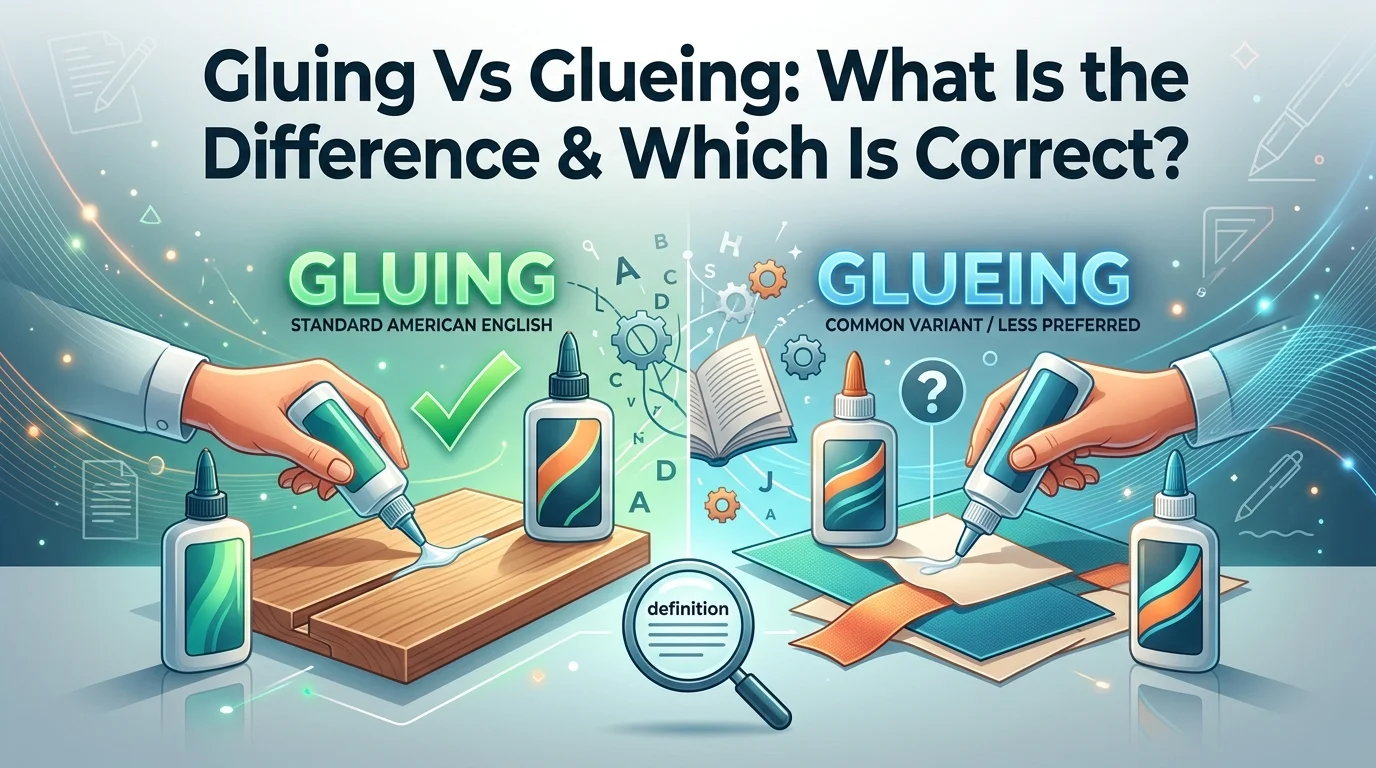

Many English learners get confused between “gluing” and “glueing” because both forms look possible. However, only one spelling is considered standard in modern English grammar. Understanding the difference matters for writing, speaking, academic work, and professional communication. This guide explains the meanings, spelling rules, grammar usage, and real-world examples in a simple and beginner-friendly way.
Comparison Overview
“Gluing” and “glueing” both relate to the verb “glue,” which means joining things together using adhesive material. The confusion happens because English sometimes keeps or removes the final “e” before adding “-ing.”
In modern standard English:
| Word | Status | Correctness | Common Usage |
| Gluing | Standard spelling | Correct | Widely accepted |
| Glueing | Alternative/rare spelling | Usually considered incorrect in modern usage | Rare |
Most dictionaries, style guides, schools, and professional writers prefer “gluing.”
Definition of Gluing
“Gluing” is the present participle and gerund form of the verb “glue.” It describes the action of attaching objects together with glue.
Examples:
- She is gluing the papers together.
- Gluing wood requires patience.
- The student spent hours gluing the project pieces.
The spelling follows the common English grammar rule of dropping the silent “e” before adding “-ing.”
Definition of Glueing
“Glueing” is a less common alternative spelling of “gluing.” It appears occasionally in older texts or in very limited regional usage, but it is not the preferred modern spelling.
Examples:
- Rare: He was glueing the model airplane parts.
- Rare: Glueing decorations onto cardboard can be messy.
Most modern grammar checkers and dictionaries recommend replacing “glueing” with “gluing.”
Main Differences Between Gluing and Glueing
| Feature | Gluing | Glueing |
| Modern acceptance | Highly accepted | Rarely accepted |
| Dictionary preference | Preferred spelling | Usually listed as variant |
| Grammar style | Standard | Nonstandard or outdated |
| Common in schools | Yes | No |
| Used in professional writing | Yes | Rarely |
| Ease of reading | Natural | Looks awkward to many readers |
The main difference is not meaning but spelling correctness and modern usage preference.
Why “Gluing” Is the Standard Spelling
English grammar usually removes a silent “e” before adding “-ing.”
Examples:
- Make → Making
- Write → Writing
- Drive → Driving
- Glue → Gluing
This is why “gluing” follows the normal spelling pattern.
“Glueing” keeps the silent “e,” which makes it look unusual in standard English writing.
Comparison Table
| Aspect | Gluing | Glueing |
| Verb base | Glue | Glue |
| Form type | Present participle/gerund | Alternative participle form |
| Recommended by dictionaries | Yes | Rarely |
| Common in academic writing | Yes | No |
| Common in business writing | Yes | No |
| Grammar-friendly | Yes | Usually no |
| Reader familiarity | High | Low |
Grammar Guide
How each term is used in sentences
Gluing
“Gluing” is used as both a verb form and a noun-like activity.
Sentence patterns:
- Subject + is/are + gluing + object
- Gluing + object + verb
Examples:
- They are gluing the posters to the wall.
- Gluing plastic pieces requires precision.
- She enjoys gluing craft items together.
Glueing
“Glueing” is used the same way grammatically, but the spelling is uncommon.
Examples:
- He was glueing the broken vase.
- Glueing papers together took time.
Most teachers and editors would change these to “gluing.”
Common mistakes learners make
Using “glueing” in formal writing
Many learners assume the final “e” should stay. This often leads to spelling corrections.
Mixing spelling styles
Some writers use “gluing” in one sentence and “glueing” in another. Consistency matters.
Forgetting the silent “e” rule
Learners may not know that silent “e” is usually removed before adding “-ing.”
Simple rules to remember
- If a verb ends with silent “e,” remove it before adding “-ing.”
- Glue → Gluing
- Write → Writing
- Bake → Baking
Remember:
“Gluing” is the standard modern spelling.
Quick tips for writing and speaking
- Use “gluing” in essays, emails, reports, and exams.
- Avoid “glueing” unless discussing historical spelling variations.
- Spell-check tools usually accept “gluing.”
- Professional editors strongly prefer “gluing.”
When to Use Each One
Use “gluing” when:
- Writing school assignments
- Sending professional emails
- Creating blog posts
- Writing books or articles
- Speaking about adhesive activities
- Describing arts and crafts
Examples:
- We are gluing the labels onto the boxes.
- The carpenter is gluing the wooden boards.
Use “glueing” when:
- Referring to rare historical spelling
- Quoting older documents exactly
- Discussing spelling variations linguistically
Examples:
- The old manual used the spelling “glueing.”
- Researchers noticed historical variations like “glueing.”
When NOT to Use Each One
Do not use “gluing” incorrectly:
- Do not use it as a noun unrelated to glue.
- Incorrect: The gluing was delicious.
- Correct: The glue was strong.
Do not use “glueing” in modern formal writing:
- Avoid it in exams.
- Avoid it in resumes.
- Avoid it in business communication.
- Avoid it in academic essays.
Which One to Use (Decision Guide)
Use this simple guide:
| Situation | Correct Choice |
| School writing | Gluing |
| Professional communication | Gluing |
| Everyday conversation | Gluing |
| Academic papers | Gluing |
| Historical spelling discussion | Glueing |
| Modern grammar usage | Gluing |
If you are unsure, always choose “gluing.”
Real-World Practical Examples
Gluing Examples
- The students were gluing pictures into their science notebooks.
- She spent the afternoon gluing decorations onto the party cards.
- The engineer was gluing small components inside the device.
- We are gluing broken ceramic pieces together carefully.
- The artist enjoys gluing recycled materials into sculptures.
Glueing Examples
- The old instruction book mentioned glueing the edges together.
- Some older texts still contain the spelling glueing.
- The archived document described glueing leather by hand.
- A few writers mistakenly keep using glueing in modern articles.
- Historical spelling records occasionally include glueing.
Self-Assessment (Fill in the Blanks)
- She is ______ the craft paper onto the board.
- The correct spelling in modern English is usually ______.
- They spent hours ______ the broken pieces together.
- Most teachers prefer ______ over glueing.
- He was ______ labels onto the packages.
- The outdated spelling is often considered ______.
- We are ______ photos into the scrapbook.
- Professional editors recommend ______.
- The children enjoyed ______ colorful shapes together.
- In academic writing, ______ is preferred.
- The carpenter is ______ wood panels carefully.
- The rare spelling variation is ______.
- She kept ______ decorations onto the wall.
- Grammar checkers usually accept ______.
- They practiced ______ model airplane parts together.
- Most dictionaries list ______ as standard.
- The artist was ______ fabric onto cardboard.
- The unusual spelling form is ______.
- The teacher corrected “glueing” to ______.
- We are ______ materials for the science project.
Answers
- gluing
- gluing
- gluing
- gluing
- gluing
- glueing
- gluing
- gluing
- gluing
- gluing
- gluing
- glueing
- gluing
- gluing
- gluing
- gluing
- gluing
- glueing
- gluing
- gluing
Final Verdict
“Gluing” is the correct and widely accepted modern spelling in English. It follows the standard grammar rule of dropping the silent “e” before adding “-ing.” While “glueing” may appear in rare or older texts, it is generally considered outdated or nonstandard today. For academic, professional, and everyday writing, “gluing” is the safest and most accurate choice.
Conclusion About Gluing Vs Glueing
Understanding the difference between “gluing” and “glueing” can make your writing clearer, more professional, and grammatically correct. While both words come from the verb “glue,” modern English strongly prefers “gluing” because it follows the standard spelling rule of dropping the silent “e” before adding “-ing.” In everyday conversation, academic writing, business communication, and creative projects, “gluing” is the form you should confidently use. Although “glueing” may still appear in older texts or rare spelling variations, it is generally considered outdated in modern grammar. By learning this simple distinction, you can avoid common spelling mistakes and improve both your written and spoken English. Whether you are writing essays, crafting instructions, or simply describing an activity, choosing the correct spelling helps your communication sound natural, polished, and easy to understand.
FAQs
Is gluing the correct spelling?
Yes, “gluing” is the correct and standard modern English spelling. It follows the common grammar rule of dropping the silent “e” before adding “-ing” to a verb. Most dictionaries, schools, and professional writers use “gluing” in formal and informal writing.
Is glueing a real word?
“Glueing” exists as a rare alternative spelling, but it is not commonly accepted in modern English. Most grammar experts and style guides recommend using “gluing” instead because it follows standard spelling conventions more naturally.
Why do people confuse gluing and glueing?
People often get confused because the base word “glue” ends with the letter “e.” Some writers think the “e” should remain when adding “-ing.” However, English grammar usually removes the silent “e” before adding “-ing.”
Which spelling should I use in school writing?
You should use “gluing” in school assignments, essays, exams, and academic projects. Teachers and grammar checkers generally consider it the correct spelling and may mark “glueing” as incorrect or outdated.
Is glueing ever acceptable?
“Glueing” may appear in older books, historical documents, or discussions about spelling variations. However, it is rarely used in modern professional or academic writing and is usually avoided in standard English communication.
Does gluing follow an English grammar rule?
Yes, “gluing” follows the rule of dropping a silent “e” before adding “-ing.” Similar examples include “making,” “writing,” and “driving.” This makes “gluing” consistent with standard English spelling patterns.
Can I use glueing in professional writing?
It is better not to use “glueing” in professional writing. Business emails, reports, articles, and official documents should use “gluing” because it is the accepted modern spelling and looks more polished to readers.
How is gluing used in a sentence?
“Gluing” is used to describe the action of joining things together with adhesive. For example: “The children are gluing pictures into their notebooks.” It can also act as a noun-like activity in sentences.
Why does gluing look more natural than glueing?
“Gluing” looks more natural because English readers are familiar with the silent “e” removal rule. “Glueing” appears visually unusual and can interrupt reading flow because it keeps an unnecessary extra vowel combination.
Are gluing and glueing pronounced differently?
No, both words are pronounced the same way. The difference is only in spelling, not pronunciation. Even though they sound identical, “gluing” is the preferred and correct written form in modern English.
