
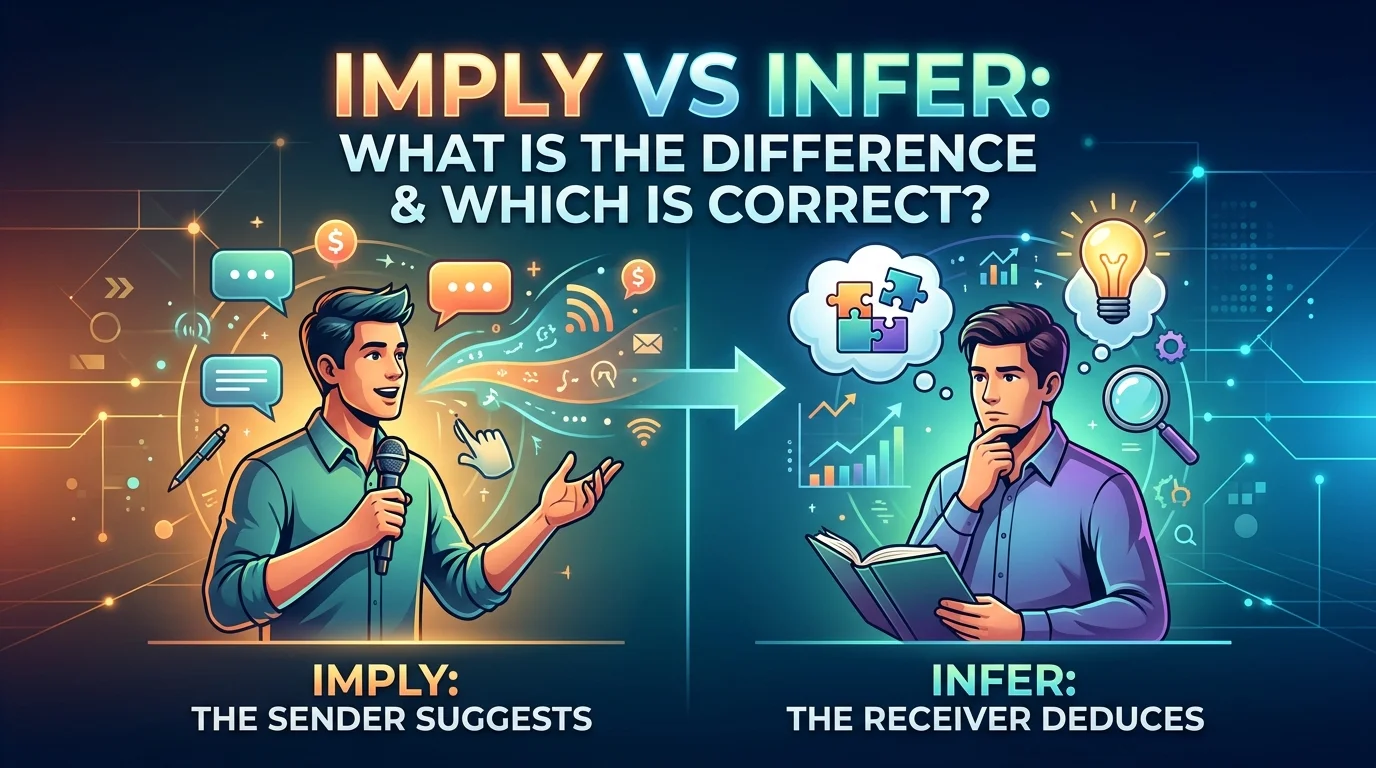

Understanding the difference between imply and infer is important because these two words are often confused in everyday communication, writing, and grammar. Although they are closely related, they describe opposite sides of communication. Knowing when to use each word correctly can make your writing clearer and help you avoid common language mistakes.
Comparison Overview
Imply and infer are connected actions in communication. A speaker or writer implies something by suggesting it indirectly, while a listener or reader infers something by drawing a conclusion from the information provided.
In simple terms:
| Term | Who Does It? | Meaning |
| Imply | Speaker/Writer | Suggest something indirectly |
| Infer | Listener/Reader | Reach a conclusion from clues |
Because both words deal with hidden meanings and indirect communication, many people accidentally use them interchangeably. However, their roles are different.
Definition of Imply
Imply means to suggest or indicate something without stating it directly.
When someone implies something, they hint at a message rather than expressing it openly. The responsibility for implying belongs to the person speaking or writing.
Examples
- The teacher implied that the test would be difficult.
- His smile implied approval.
- The report implied that changes were needed.
- She implied dissatisfaction with the service.
- The article implied that the policy might fail.
Definition of Infer
Infer means to reach a conclusion based on evidence, clues, or suggestions.
When someone infers something, they interpret information and determine what is being suggested. The responsibility for inferring belongs to the person receiving the message.
Examples
- I inferred that the test would be difficult.
- The detective inferred the suspect’s motive from the evidence.
- Readers inferred the author’s opinion from the article.
- We inferred that the meeting had been canceled.
- Scientists inferred the existence of the planet from observations.
Main Differences Between Imply and Infer
Although the two words are connected, they represent different actions.
| Feature | Imply | Infer |
| Action | Suggest | Conclude |
| Performed By | Speaker or writer | Listener or reader |
| Direction | Sending a hidden message | Receiving a hidden message |
| Purpose | Hint indirectly | Understand indirectly |
| Communication Role | Source of meaning | Receiver of meaning |
Key Difference
A speaker implies.
A listener infers.
For example:
“The manager implied that promotions were coming.”
Employees inferred that they might receive raises.
The manager provided the hint. The employees drew the conclusion.
How Imply and Infer Work Together
Communication often involves both actions.
- Someone implies a message.
- Another person receives the message.
- That person infers the intended meaning.
Example
Statement:
“We may need to reduce expenses next quarter.”
The manager implied possible budget cuts.
Employees inferred that spending restrictions were likely.
Without the implication, there would be nothing to infer.
Common Situations Where They Are Used
Imply in Communication
People imply things when they want to:
- Be polite
- Avoid direct criticism
- Suggest ideas subtly
- Leave room for interpretation
- Communicate indirectly
Infer in Understanding
People infer things when they:
- Analyze information
- Read between the lines
- Interpret clues
- Understand hidden meanings
- Draw conclusions
Grammar Guide
How Each Term Is Used in Sentences
Imply Sentence Pattern
Subject + imply + that-clause
Examples:
- The professor implied that attendance mattered.
- The report implied that costs would rise.
- Her expression implied concern.
Infer Sentence Pattern
Subject + infer + that-clause
Examples:
- Students inferred that attendance was important.
- Analysts inferred that costs would rise.
- I inferred concern from her expression.
Common Mistakes Learners Make
Mistake 1: Using Infer Instead of Imply
Incorrect:
- The speaker inferred that sales were declining.
Correct:
- The speaker implied that sales were declining.
Mistake 2: Using Imply Instead of Infer
Incorrect:
- I implied from his tone that he was upset.
Correct:
- I inferred from his tone that he was upset.
Mistake 3: Confusing Sender and Receiver
Remember:
- Sender = imply
- Receiver = infer
Simple Rules to Remember
- If you give a hint, you imply.
- If you understand a hint, you infer.
- Writers imply.
- Readers infer.
- Speakers imply.
- Listeners infer.
Quick Tips for Writing and Speaking
- Ask who is communicating the message.
- If someone is suggesting something, use imply.
- If someone is interpreting something, use infer.
- Think of imply as sending and infer as receiving.
- Check whether the person is giving clues or using clues.
When to Use Each One
Use Imply When
- Suggesting something indirectly
- Hinting at an opinion
- Communicating subtly
- Writing persuasive content
- Avoiding direct statements
Examples:
- The article implied criticism.
- The manager implied concern.
- Her comment implied disappointment.
Use Infer When
- Drawing conclusions
- Interpreting evidence
- Understanding indirect messages
- Reading hidden meanings
- Analyzing information
Examples:
- We inferred concern from the manager’s words.
- Readers inferred criticism from the article.
- Scientists inferred results from data.
When NOT to Use Each One
Do Not Use Imply When
- You are interpreting information.
- You are reaching a conclusion.
- You are analyzing clues.
Incorrect:
- I implied he was angry from his voice.
Correct:
- I inferred he was angry from his voice.
Do Not Use Infer When
- You are providing a hint.
- You are suggesting something indirectly.
- You are communicating a hidden meaning.
Incorrect:
- The article inferred that change was needed.
Correct:
- The article implied that change was needed.
Which One to Use (Decision Guide)
Ask yourself this question:
Are You Giving the Message?
Use imply.
Example:
- The coach implied that practice would be mandatory.
Are You Understanding the Message?
Use infer.
Example:
- Players inferred that attendance was required.
Quick Decision Chart
| Question | Correct Word |
| Am I hinting at something? | Imply |
| Am I suggesting indirectly? | Imply |
| Am I drawing a conclusion? | Infer |
| Am I interpreting clues? | Infer |
| Am I the sender? | Imply |
| Am I the receiver? | Infer |
Real-World Practical Examples
Imply Examples
- The teacher implied that extra study would improve grades.
- The advertisement implied that the product was superior.
- The scientist implied a connection between the results.
- The manager implied future organizational changes.
- The author implied criticism of the policy.
Infer Examples
- Students inferred that exams would be challenging.
- Customers inferred that the product offered better value.
- Researchers inferred a relationship from the data.
- Employees inferred that restructuring was coming.
- Readers inferred the author’s viewpoint from the article.
Self-Assessment (Fill in the Blanks)
- The teacher ______ that more practice would help students.
- Students ______ that they needed additional practice.
- His comment seemed to ______ dissatisfaction.
- I ______ from her tone that she was upset.
- The report ______ financial concerns.
- Investors ______ potential risks from the report.
- The article ______ criticism of the proposal.
- Readers ______ that the proposal had weaknesses.
- The manager ______ future changes.
- Employees ______ that new policies were coming.
- I will use ______ when referring to suggesting something indirectly.
- I will use ______ when referring to drawing a conclusion.
- The correct word is ______ because the speaker is giving a hint.
- The correct word is ______ because the listener is interpreting clues.
- The scientist ______ a possible connection.
- Researchers ______ the relationship from the evidence.
- Her expression ______ disappointment.
- We ______ disappointment from her expression.
- The author ______ a deeper meaning.
- Readers ______ that deeper meaning.
Answers
- implied
- inferred
- imply
- inferred
- implied
- inferred
- implied
- inferred
- implied
- inferred
- imply
- infer
- imply
- infer
- implied
- inferred
- implied
- inferred
- implied
- inferred
Final Verdict
The difference between imply and infer is straightforward once you understand their roles in communication. Imply is used by the person giving information, suggesting an idea, or hinting at a meaning without stating it directly. Infer is used by the person receiving information and drawing conclusions from the clues provided. Think of it as a communication partnership: one person implies, and another infers. Whenever you are unsure which word to choose, ask yourself whether you are sending a message or interpreting one. If you are sending the hidden meaning, use imply. If you are figuring out the hidden meaning, use infer. Following this simple rule will help you use both words accurately and confidently in speaking, writing, education, business, and everyday conversations.
Conclusion About Imply vs Infer
Understanding the difference between imply vs infer can significantly improve both your writing and communication skills. While these two words are closely connected, they perform opposite functions in a conversation. A speaker, writer, or source implies a message by suggesting it indirectly, while a listener, reader, or audience infers that message by interpreting the clues provided. This simple distinction helps eliminate one of the most common grammar mistakes in English.
Whether you are writing academic papers, business emails, professional reports, or everyday messages, using the correct term makes your meaning clearer and more precise. Remember the easiest rule: the person sending the hidden message implies, and the person understanding the hidden message infers. Once you keep this sender-versus-receiver relationship in mind, choosing between imply and infer becomes much easier. With regular practice and exposure to real-world examples, you can confidently use both words accurately in any context.
FAQs
What is the main difference between imply and infer?
The main difference is that imply means to suggest something indirectly, while infer means to draw a conclusion from available information or clues. The speaker or writer implies, and the listener or reader infers.
Is imply the opposite of infer?
They are not exact opposites, but they represent different sides of the same communication process. One person implies a message, and another person infers the meaning from that message.
Can imply and infer be used interchangeably?
No. Although they are related, they have different meanings. Using them interchangeably can create grammatical errors and confusion because they refer to different roles in communication.
Who implies and who infers?
The person giving the information, hint, or suggestion implies. The person receiving the information and drawing a conclusion infers. This is the easiest way to remember the difference.
Is infer always based on evidence?
Yes. When you infer something, you rely on clues, facts, observations, context, or information that helps you reach a logical conclusion.
Can a writer imply something without saying it directly?
Yes. Writers often imply ideas, emotions, or opinions through tone, context, and word choice rather than stating them openly. Readers then infer the intended meaning.
Why do people confuse imply and infer?
People confuse them because both words involve hidden meanings and indirect communication. However, imply refers to giving a message, while infer refers to understanding that message.
Which word is more common in academic writing?
Both words appear frequently in academic writing. Authors may imply certain conclusions, while readers, researchers, and students are often expected to infer meaning from evidence.
How can I remember imply vs infer easily?
A simple memory trick is to think of imply as sending a hint and infer as receiving and interpreting that hint. The sender implies, and the receiver infers.
Are imply and infer important for clear communication?
Yes. Using the correct word helps avoid misunderstandings and makes communication more accurate. It also demonstrates a stronger understanding of English grammar and vocabulary.
