
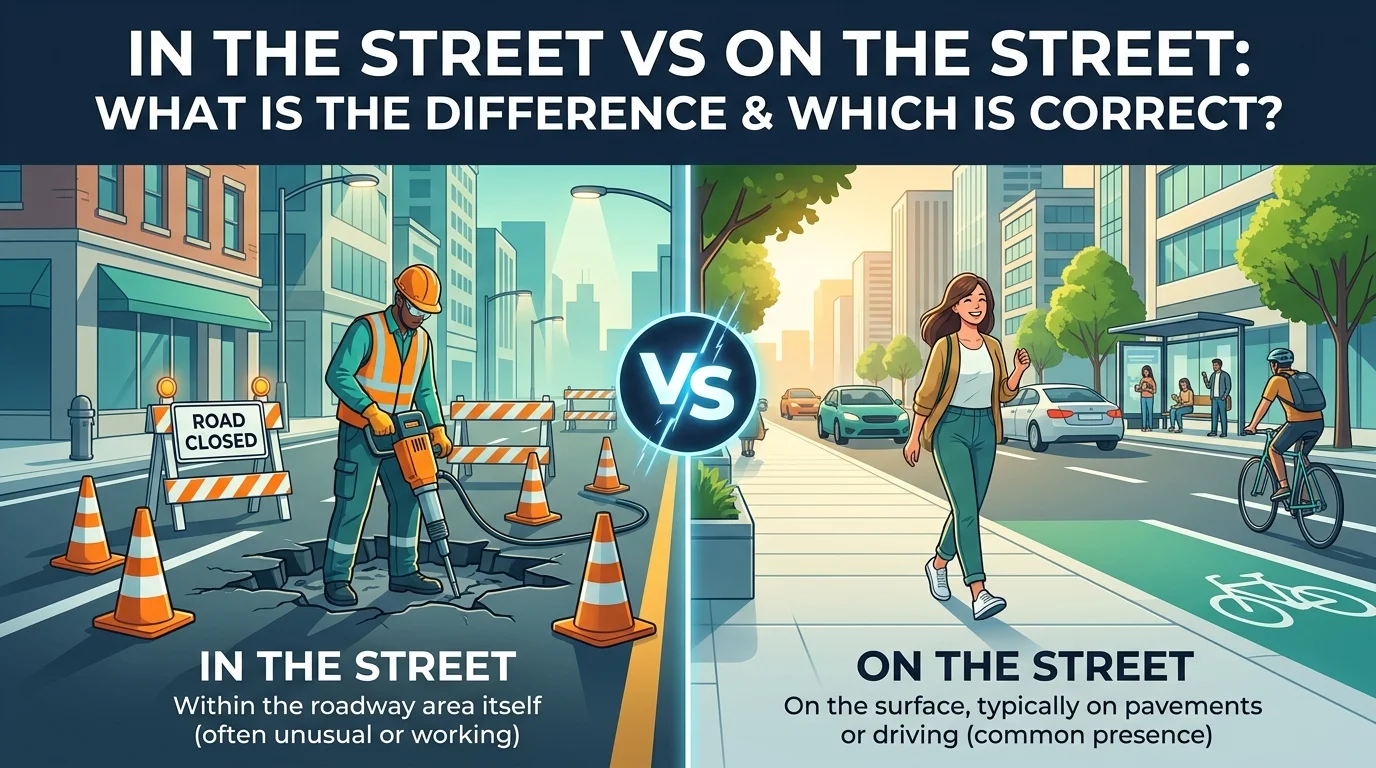

Many English learners get confused between “in the street” and “on the street” because both phrases talk about streets and locations. However, they are used differently depending on context, meaning, and regional English style. Understanding the difference helps you sound more natural, avoid grammar mistakes, and communicate clearly in writing and speaking.
Comparison Overview
“In the street” and “on the street” are both prepositional phrases used to describe location. Even though they seem similar, native speakers use them differently depending on whether they are talking about physical position, movement, British English, American English, or figurative meanings.
“In the street” usually refers to being physically inside the roadway or traffic area itself.
“On the street” commonly refers to being located along a street, living without housing, or information spreading informally.
The correct choice depends on context, meaning, and regional usage.
| Phrase | Common Meaning | Typical Usage | More Common In |
| In the street | Inside the roadway area | Physical location | British English |
| On the street | Along the street or publicly | General location or idioms | American English |
Definition of In The Street
“In the street” means physically within the street area itself, especially the roadway where cars move. It often emphasizes being directly in traffic or standing inside the road.
This phrase is more commonly used in British English.
Examples:
- The children were playing in the street.
- A bicycle was lying in the street.
- There was water everywhere in the street after the storm.
The phrase focuses on being inside the actual street space rather than beside it.
Definition of On The Street
“On the street” usually means located along a street or in a public outdoor area. It can also have figurative meanings related to homelessness or public rumors.
This phrase is more common in American English.
Examples:
- There is a coffee shop on the street.
- She met him on the street yesterday.
- Rumor on the street says the company will expand.
It often refers to a general public location rather than being physically inside the roadway.
Main Differences Between In The Street and On The Street
The biggest difference is the way each phrase describes location and context.
| Feature | In The Street | On The Street |
| Meaning | Inside the roadway | Along or around the street |
| Focus | Physical position | General public location |
| Common English Style | British English | American English |
| Literal or Figurative | Mostly literal | Literal and figurative |
| Common Tone | Specific location | Broader meaning |
“In the street” usually suggests someone or something is actually in the road.
Example:
- The dog was sitting in the street.
“On the street” may simply mean outside or somewhere nearby on a street.
Example:
- I saw him on the street near the station.
“On the street” also has idiomatic meanings.
Example:
- After losing his job, he ended up on the street.
British English vs American English Usage
Regional English differences are important here.
In British English:
- “In the street” is more natural for physical location.
- Example: Kids are playing in the street.
In American English:
- “On the street” is often preferred.
- Example: Kids are playing on the street.
Both can sometimes be understood internationally, but native preference varies.
Literal and Figurative Meanings
“In the street” is mostly literal.
Example:
- Trash was scattered in the street.
“On the street” can be literal or figurative.
Literal:
- We walked on the street for hours.
Figurative:
- There is talk on the street about new laws.
- Many people were left on the street after the disaster.
Common Expressions Using On The Street
“On the street” appears in many common English expressions.
| Expression | Meaning |
| On the street | Homeless |
| Word on the street | Public rumor or gossip |
| Man on the street | Average ordinary person |
| Life on the street | Living outdoors or publicly |
These idioms are extremely common in spoken English.
Grammar Guide
How each term is used in sentences
“In the street” sentence pattern:
- Subject + verb + in the street
Examples:
- People danced in the street.
- A car stopped in the street.
“On the street” sentence pattern:
- Subject + verb + on the street
Examples:
- I met her on the street.
- There are shops on the street.
Common mistakes learners make
Many learners use the phrases interchangeably without considering context.
Incorrect:
- The child was standing on the street.
Possible but less precise in British English.
Better:
- The child was standing in the street.
Incorrect:
- There are many stores in the street.
Better:
- There are many stores on the street.
Another common mistake is misunderstanding figurative usage.
Incorrect:
- Word in the street says the exam is canceled.
Correct:
- Word on the street says the exam is canceled.
Simple rules to remember
- Use “in the street” for physical position inside the road.
- Use “on the street” for general public location.
- Use “on the street” for idioms and figurative meanings.
- British English prefers “in the street” more often.
- American English prefers “on the street” more often.
Quick tips for writing and speaking
- Think about whether someone is physically inside the roadway.
- Use “on the street” for rumors, public life, or homelessness.
- Match your usage to British or American English style.
- Read example sentences from native speakers regularly.
When to Use Each One
Use “in the street” when:
- Someone is physically in the roadway
- Talking about traffic areas
- Using British English
- Describing objects inside the road
Examples:
- The ball rolled in the street.
- Workers were repairing pipes in the street.
Use “on the street” when:
- Talking about public outdoor locations
- Referring to businesses along roads
- Using idioms
- Speaking in American English
Examples:
- We found a restaurant on the street.
- There are musicians on the street tonight.
When NOT to Use Each One
Do not use “in the street”:
- For figurative expressions
- For homelessness
- For public rumors
Incorrect:
- He is living in the street.
Correct:
- He is living on the street.
Do not use “on the street”:
- When emphasizing someone standing directly in traffic in British English
Less natural in British English:
- The boy was on the street.
More natural:
- The boy was in the street.
Which One to Use (Decision Guide)
Use this quick guide to choose correctly.
| Situation | Correct Phrase |
| Someone physically inside the roadway | In the street |
| Shops or buildings along a road | On the street |
| Public rumors or gossip | On the street |
| Homelessness | On the street |
| British English physical location | In the street |
| American English general location | On the street |
If you are unsure:
- Choose “in the street” for exact roadway position.
- Choose “on the street” for general public location or idioms.
Real-World Practical Examples
In The Street Examples
- The children were playing football in the street after school.
- Broken glass was scattered in the street after the accident.
- Scientists measured flooding levels in the street during the storm.
- Workers repaired electrical cables in the street yesterday.
- A photographer stood in the street to capture the parade.
On The Street Examples
- I met my teacher on the street this morning.
- There are several technology stores on the street.
- Word on the street is that prices will rise soon.
- Many musicians perform on the street during festivals.
- After losing his apartment, he sadly ended up on the street.
Self-Assessment (Fill in the Blanks)
- The kids were playing ______ during the summer evening.
- I saw several food trucks ______ near the stadium.
- There was broken furniture lying ______ after the storm.
- Word ______ says the company will hire new employees.
- A dog suddenly ran ______ and stopped traffic.
- She opened a small bookstore ______ downtown.
- Many people were left ______ after the economic crisis.
- We watched dancers perform ______ during the festival.
- A bicycle was abandoned ______ all night.
- Rumors ______ suggest the school rules may change.
- The workers were digging holes ______ yesterday.
- I met an old friend ______ while shopping.
- Trash was floating ______ after heavy rain.
- The journalist interviewed people ______ for public opinions.
- Children should not play ______ when cars are moving.
- There are beautiful cafes ______ near the park.
- The actor was recognized ______ by several fans.
- A large tree branch fell ______ during the storm.
- The homeless man spent years living ______.
- The police blocked traffic because debris was ______.
Answers
- in the street
- on the street
- in the street
- on the street
- in the street
- on the street
- on the street
- on the street
- in the street
- on the street
- in the street
- on the street
- in the street
- on the street
- in the street
- on the street
- on the street
- in the street
- on the street
- in the street
Final Verdict
“In the street” and “on the street” may look similar, but they are used differently depending on location, meaning, and style of English. “In the street” usually refers to being physically inside the roadway and is especially common in British English. “On the street” is broader and more flexible, commonly used in American English for public locations, businesses, rumors, and idiomatic expressions.
If you are talking about something directly in the road, “in the street” is often the better choice. If you mean along a street, in public, or in a figurative sense, “on the street” is usually correct. Learning these small differences will make your English sound more natural, accurate, and fluent in both writing and conversation.
Conclusion About In The Street Vs On The Street
Understanding the difference between “in the street” and “on the street” can make your English sound more natural, confident, and accurate. While both phrases relate to streets and public places, their meanings change depending on context, grammar, and regional usage. “In the street” usually focuses on being physically inside the roadway, especially in British English, while “on the street” is more common for general public locations, idioms, and American English expressions. Learning when to use each phrase helps you avoid common grammar mistakes in conversations, writing, business communication, and everyday English. The more you practice these expressions in real sentences, the easier it becomes to recognize the correct choice automatically. Whether you are a student, writer, teacher, or English learner, mastering this small difference can greatly improve your fluency and communication skills in both formal and casual situations.
FAQs
Is “in the street” grammatically correct?
Yes, “in the street” is grammatically correct. It is commonly used when talking about someone or something physically located inside the roadway area. This usage is especially popular in British English and often emphasizes an exact position within the street itself rather than beside it.
Is “on the street” grammatically correct?
Yes, “on the street” is also grammatically correct. It is widely used in American English and can refer to being along a street, outside in public, or connected to figurative meanings like rumors or homelessness. The correct phrase depends on context and intended meaning.
What is the main difference between “in the street” and “on the street”?
The main difference is location and usage. “In the street” usually means physically inside the roadway, while “on the street” refers more generally to public areas, locations along a road, or idiomatic expressions. Regional English differences also affect which phrase sounds more natural.
Which phrase is more common in American English?
“On the street” is more common in American English. Americans often use it for both literal and figurative situations, such as meeting someone outside or talking about public rumors. “In the street” is still understood but is less frequently used in everyday American conversation.
Which phrase is more common in British English?
“In the street” is more common in British English when referring to physical location in the roadway. British speakers often prefer this phrasing when talking about children playing, objects lying in traffic, or activities happening directly inside the street area.
Can “on the street” mean homeless?
Yes, “on the street” can describe homelessness. In this context, it means someone is living without permanent housing. For example, “After losing his home, he ended up on the street” uses the phrase figuratively rather than as a simple location description.
Can “in the street” and “on the street” be interchangeable?
Sometimes they can be interchangeable, especially in casual conversation. However, they do not always carry the same meaning or tone. “In the street” usually sounds more specific and physical, while “on the street” sounds broader and more flexible in usage.
Why do learners confuse these phrases?
Learners often confuse these phrases because both refer to streets and public spaces. The confusion increases because British and American English use them differently. Idiomatic meanings connected to “on the street” also make the distinction harder for non native speakers.
Is “word in the street” correct?
No, the standard expression is “word on the street.” This phrase means rumors, gossip, or public opinion. “Word in the street” is not considered a natural or commonly accepted English expression in standard grammar and conversation.
How can I remember the difference easily?
A simple way to remember is this: use “in the street” for something physically inside the road and “on the street” for public places, businesses, or figurative meanings. If the phrase involves rumors, homelessness, or public activity, “on the street” is usually correct.
