
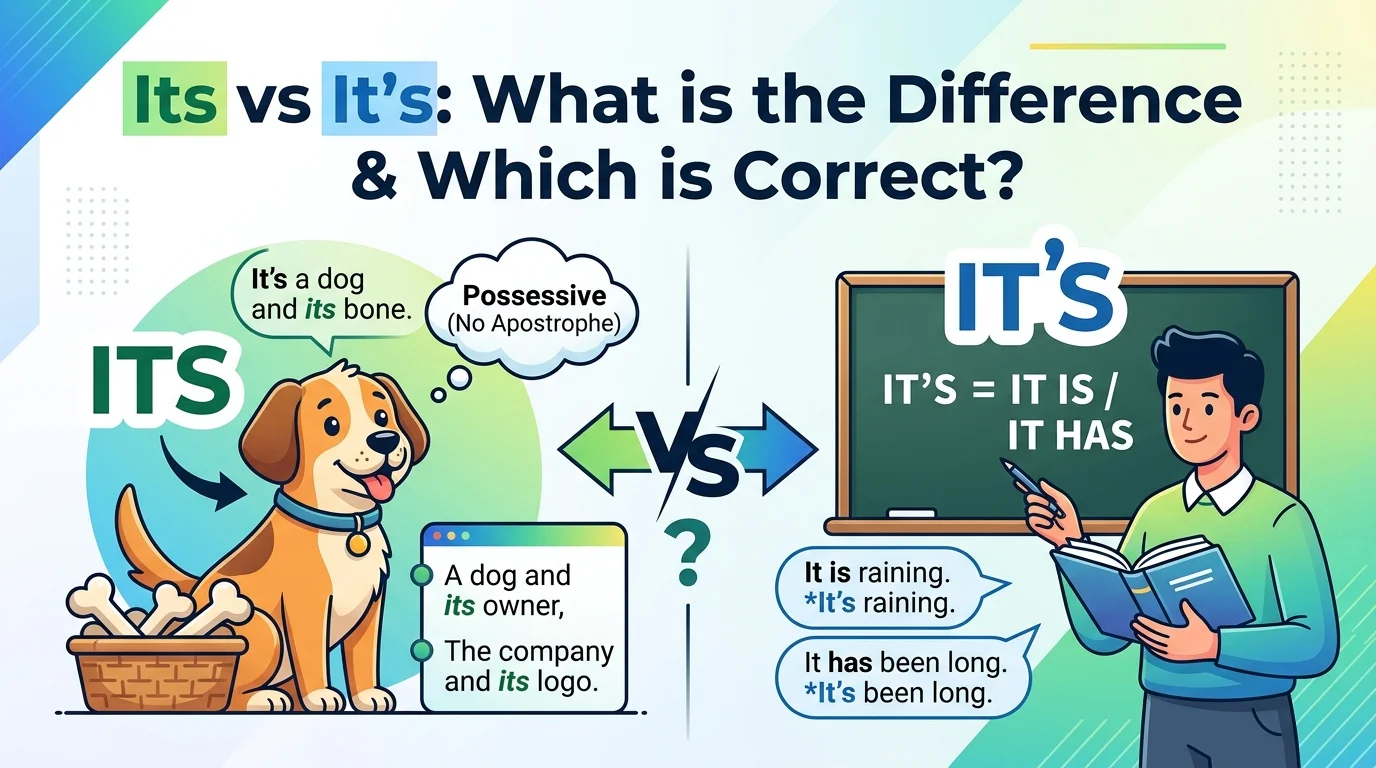

Many English learners and even native speakers often confuse its and it’s because they look almost identical. However, these two words have very different meanings and grammatical functions. Understanding the difference between its and it’s is essential for accurate writing, professional communication, and everyday English usage.
Comparison Overview
The words its and it’s are commonly mixed up because they differ by only one apostrophe. Despite their similar appearance, they serve completely different purposes in grammar.
- Its is a possessive pronoun that shows ownership.
- It’s is a contraction that means either it is or it has.
Using the correct form helps make your writing clear, professional, and grammatically correct.
| Feature | Its | It’s |
| Part of Speech | Possessive Pronoun | Contraction |
| Meaning | Belonging to it | It is / It has |
| Apostrophe | No | Yes |
| Shows Ownership | Yes | No |
| Can Be Expanded? | No | Yes |
Definition of Its
Its is a possessive pronoun used to show that something belongs to an animal, object, organization, idea, or thing.
It works similarly to possessive pronouns such as his, her, and their.
Examples:
- The dog wagged its tail.
- The company changed its policy.
- The machine stopped because its battery died.
In each sentence, its indicates ownership or possession.
Definition of It’s
It’s is a contraction formed by combining it is or it has.
The apostrophe replaces the missing letter(s).
Examples:
- It’s raining outside. (It is raining outside.)
- It’s been a long day. (It has been a long day.)
- It’s important to study grammar. (It is important to study grammar.)
Whenever you can replace the word with it is or it has, it’s is correct.
Main Differences Between Its and It’s
The main distinction is that its shows possession, while it’s is a shortened form of it is or it has.
| Aspect | Its | It’s |
| Purpose | Shows ownership | Shortens a phrase |
| Meaning | Belonging to it | It is / It has |
| Grammar Role | Possessive pronoun | Contraction |
| Example | The bird lost its feather. | It’s flying away. |
| Expansion Possible | No | Yes |
Example Comparison
- The cat licked its paw. ✔
- The cat licked it’s paw. ✘
- It’s a beautiful day. ✔
- Its a beautiful day. ✘
Why People Confuse Its and It’s
Many possessive nouns use an apostrophe.
Examples:
- John’s book
- Sarah’s car
Because of this pattern, learners often assume it’s must be the possessive form of it.
However, English is unusual here:
- his = possessive
- hers = possessive
- theirs = possessive
- its = possessive
No apostrophe is used.
Comparison Table with Examples
| Sentence | Correct Word |
| The tree lost _____ leaves. | its |
| _____ a wonderful idea. | it’s |
| The company updated _____ website. | its |
| _____ been a difficult year. | it’s |
| The robot moved _____ arm. | its |
| _____ time to leave. | it’s |
Grammar Guide
How Each Term Is Used in Sentences
Using Its
Pattern:
Subject + its + noun
Examples:
- The bird built its nest.
- The company launched its product.
- The school updated its website.
Using It’s
Pattern:
It’s + adjective/noun/verb phrase
Examples:
- It’s cold today.
- It’s an exciting event.
- It’s going to rain.
Pattern:
It’s + past participle
Examples:
- It’s been wonderful.
- It’s become popular.
Common Mistakes Learners Make
Mistake 1: Using It’s for Ownership
Incorrect:
- The dog wagged it’s tail.
Correct:
- The dog wagged its tail.
Mistake 2: Using Its Instead of It Is
Incorrect:
- Its raining outside.
Correct:
- It’s raining outside.
Mistake 3: Ignoring the Expansion Test
Incorrect:
- Its been a long day.
Correct:
- It’s been a long day.
Simple Rules to Remember
- If you mean belonging to it, use its.
- If you mean it is, use it’s.
- If you mean it has, use it’s.
- Try expanding the word.
- If expansion works, choose it’s.
Quick Tips for Writing and Speaking
- Always check whether ownership is involved.
- Replace it’s with it is to test the sentence.
- Remember that possessive pronouns usually do not use apostrophes.
- Proofread carefully in formal writing.
- Watch for autocorrect errors.
When to Use Each One
Use Its When:
- Showing possession
- Referring to ownership
- Talking about animals
- Talking about objects
- Referring to organizations or systems
Examples:
- The computer updated its software.
- The company changed its logo.
- The horse injured its leg.
Use It’s When:
- Meaning “it is”
- Meaning “it has”
- Beginning statements
- Describing conditions
- Referring to time, weather, or situations
Examples:
- It’s late.
- It’s sunny today.
- It’s been a successful year.
When NOT to Use Each One
Do Not Use Its
- When you mean “it is”
- When you mean “it has”
Incorrect:
- Its a great opportunity.
Correct:
- It’s a great opportunity.
Do Not Use It’s
- When showing ownership
- When indicating possession
Incorrect:
- The phone lost it’s signal.
Correct:
- The phone lost its signal.
Which One to Use (Decision Guide)
Ask yourself one simple question:
Can I replace the word with “it is” or “it has”?
If yes:
→ Use it’s
Example:
- It’s raining.
- It’s been exciting.
If no:
→ Use its
Example:
- The bird spread its wings.
- The company increased its profits.
Quick Decision Chart
| Question | Answer | Word |
| Means “it is”? | Yes | It’s |
| Means “it has”? | Yes | It’s |
| Shows ownership? | Yes | Its |
| Refers to possession? | Yes | Its |
Real-World Practical Examples
Its Examples
- The school updated its curriculum.
- The smartphone improved its battery life.
- The company expanded its operations overseas.
- The cat cleaned its fur after dinner.
- The planet follows its orbit around the sun.
It’s Examples
- It’s important to arrive on time.
- It’s raining heavily this morning.
- It’s been a productive meeting.
- It’s difficult to solve this problem.
- It’s becoming more common to work remotely.
Self-Assessment (Fill in the Blanks)
- The company changed ______ logo.
- ______ a beautiful afternoon.
- The bird built ______ nest in the tree.
- ______ been an amazing journey.
- The laptop needs ______ charger.
- ______ going to snow tomorrow.
- The organization updated ______ policies.
- ______ important to stay healthy.
- The dog buried ______ bone.
- ______ been a busy week.
- The university revised ______ admission rules.
- ______ difficult to learn a language overnight.
- The machine lost ______ power source.
- ______ time for lunch.
- The business increased ______ revenue.
- ______ been a successful project.
- The horse injured ______ hoof.
- ______ easier than it seems.
- The software completed ______ installation.
- ______ becoming more popular every year.
Answers
- its
- it’s
- its
- it’s
- its
- it’s
- its
- it’s
- its
- it’s
- its
- it’s
- its
- it’s
- its
- it’s
- its
- it’s
- its
- it’s
Final Verdict
The difference between its and it’s is simple once you understand their functions. Its is a possessive pronoun that shows ownership, while it’s is a contraction meaning it is or it has. The easiest way to choose correctly is to use the expansion test. If the sentence still makes sense when you replace the word with it is or it has, then it’s is the right choice. If the sentence shows possession or ownership, use its. Mastering this small but important distinction will improve your grammar, strengthen your writing, and help you communicate more confidently in academic, professional, and everyday situations.
Conclusion About Its vs It’s
Understanding the difference between its and it’s is one of the most important grammar skills for clear and accurate English writing. Although these two words look very similar, they serve completely different purposes. Its is a possessive pronoun used to show ownership, while it’s is a contraction meaning it is or it has. The confusion often comes from the apostrophe, but remembering a simple rule can make the choice much easier. If you can replace the word with it is or it has, then it’s is correct. If you are showing possession, use its. Whether you are writing emails, academic papers, business documents, or social media posts, using these terms correctly helps improve clarity and professionalism. With regular practice and careful proofreading, choosing between its and it’s will soon become second nature, making your writing stronger and more confident.
FAQs
What is the difference between its and it’s?
The word its is a possessive pronoun that shows ownership, while it’s is a contraction of it is or it has. The apostrophe in it’s indicates that letters have been omitted.
Is its a possessive word?
Yes, its is a possessive pronoun. It is used to show that something belongs to an animal, object, organization, or idea. Unlike many possessive nouns, it does not contain an apostrophe.
Why doesn’t its have an apostrophe?
Although many possessive forms use apostrophes, possessive pronouns generally do not. Words like his, hers, theirs, and its show possession without an apostrophe.
When should I use it’s?
Use it’s whenever you mean it is or it has. If you can expand the word and the sentence still makes sense, then it’s is the correct choice.
How can I quickly test whether its or it’s is correct?
Replace the word with it is or it has. If the sentence still sounds correct, use it’s. If the sentence is showing ownership, then its is the correct option.
Is “The dog wagged it’s tail” correct?
No, that sentence is incorrect. Since the sentence shows ownership of the tail, the correct form is its. The correct sentence is “The dog wagged its tail.”
Can it’s ever show possession?
No, it’s can never show possession. It is only a contraction of it is or it has. Possession is always expressed with its.
Why do writers often confuse its and it’s?
Many people assume that all possessive forms require an apostrophe. Because of this common assumption, writers sometimes mistakenly use it’s when they actually need the possessive pronoun its.
Are its and it’s important in formal writing?
Yes, using the correct form is important in academic, business, and professional writing. Mixing them up can create grammar errors and may affect the credibility of your writing.
Do native English speakers make mistakes with its and it’s?
Yes, even native speakers occasionally confuse these words. Because they sound identical when spoken, errors often occur during writing. Careful proofreading helps catch these mistakes.
