
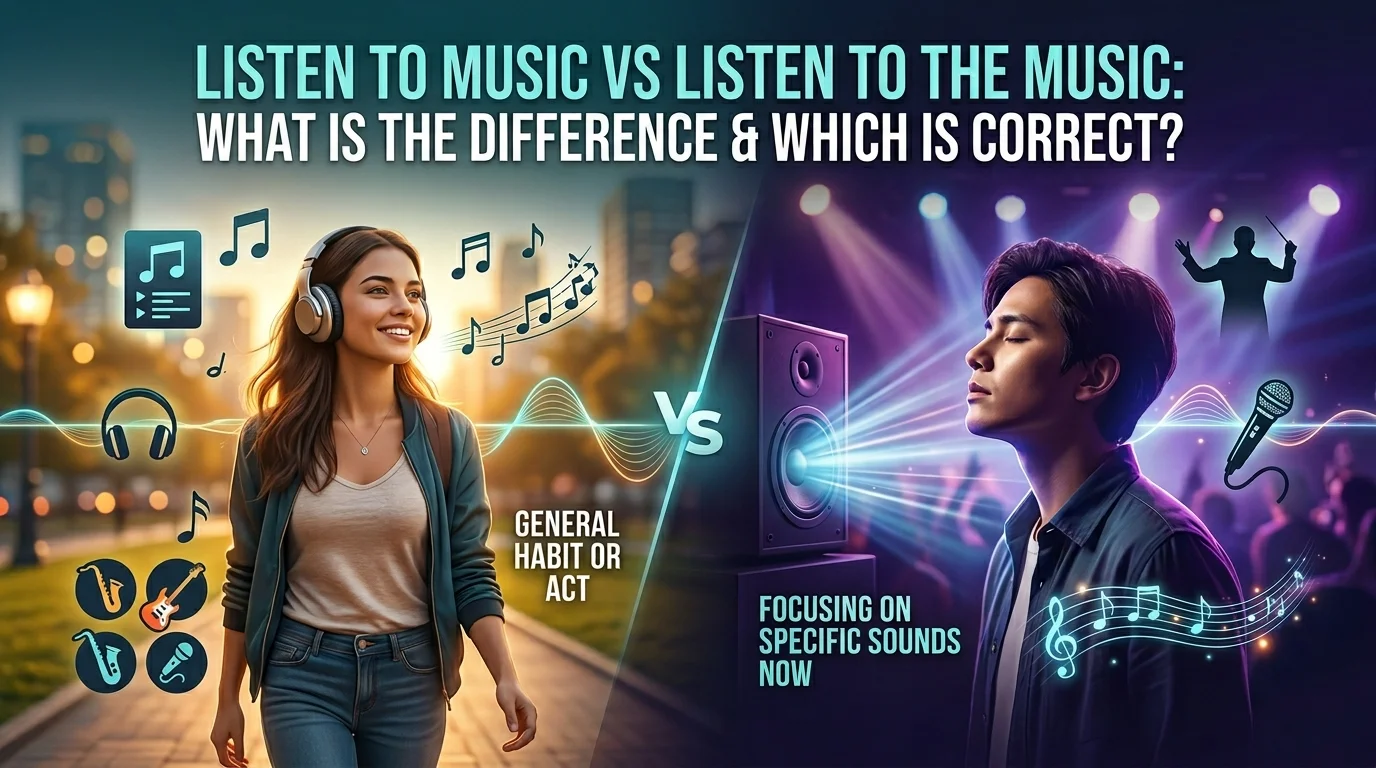

Many English learners wonder whether they should say “listen to music” or “listen to the music.” Both expressions are grammatically correct, but they are used in different situations. The difference mainly depends on whether you are talking about music in general or referring to a specific piece of music. Understanding this distinction can make your English sound more natural and accurate in both speaking and writing.
Comparison Overview
“Listen to music” and “listen to the music” both describe the act of hearing music attentively. However, they differ in specificity.
| Expression | Meaning | Usage |
| Listen to music | Listen to music in general | General activity or habit |
| Listen to the music | Listen to a specific piece, song, performance, or music being discussed | Specific context |
The key difference is the presence of the definite article “the,” which points to a particular music source.
Definition of Listen To Music
“Listen to music” refers to the activity of hearing music in a general sense. It does not identify any specific song, album, performance, or musical piece.
People commonly use this phrase when discussing hobbies, habits, entertainment, relaxation, or personal preferences.
Examples:
- I like to listen to music while studying.
- She listens to music every evening.
- Many people listen to music during workouts.
Definition of Listen To The Music
“Listen to the music” refers to a particular piece of music, song, concert, soundtrack, or music already known in the conversation.
The article “the” makes the phrase specific rather than general.
Examples:
- Listen to the music playing in the background.
- Everyone stopped talking to listen to the music.
- Listen to the music from that movie.
Main Differences Between Listen To Music and Listen To The Music
| Feature | Listen To Music | Listen To The Music |
| Specificity | General | Specific |
| Article Used | No article | Uses “the” |
| Reference | Music in general | Particular music |
| Common Context | Habits, hobbies, preferences | Specific songs, concerts, performances |
| Example | I listen to music daily. | Listen to the music coming from that room. |
The biggest distinction is whether the speaker is referring to music as a general activity or to a specific piece of music.
Understanding the Role of “The”
The word “the” is called a definite article.
When you use “the,” you point to something specific that both the speaker and listener can identify.
Compare:
- I enjoy listening to music. (music in general)
- I enjoy listening to the music from that album. (specific music)
Without “the,” the meaning remains broad. With “the,” the meaning becomes more precise.
Common Situations Where Both Appear
Sometimes both expressions can appear in similar conversations.
Example:
- I listen to music every morning.
- When my favorite song comes on, I listen to the music carefully.
The first sentence describes a habit. The second refers to a specific musical selection.
Grammar Guide
How each term is used in sentences
Listen to music
Pattern:
Subject + listen/listens + to music
Examples:
- They listen to music after work.
- We listen to music while driving.
- He listens to music before bed.
Listen to the music
Pattern:
Subject + listen/listens + to the music + specific reference
Examples:
- Listen to the music from the concert.
- She listened to the music in the theater.
- We listened to the music playing outside.
Common mistakes learners make
Mistake 1: Using “the” unnecessarily
Incorrect:
- I enjoy listening to the music every day.
Better:
- I enjoy listening to music every day.
Mistake 2: Omitting “the” when specificity is required
Incorrect:
- Listen to music coming from the next room.
Better:
- Listen to the music coming from the next room.
Mistake 3: Assuming one form is always correct
Both forms are correct depending on context.
Simple rules to remember
- Use “listen to music” for general activities.
- Use “listen to the music” for specific music.
- If you can identify the exact music, “the” is often needed.
- If no particular music is identified, omit “the.”
Quick tips for writing and speaking
- Talking about hobbies? Use “listen to music.”
- Talking about a concert, song, or soundtrack? Use “listen to the music.”
- Check whether the listener knows which music you mean.
- When in doubt, ask whether the music is general or specific.
When to Use Each One
Use “Listen To Music” When:
- Discussing habits
- Talking about hobbies
- Describing preferences
- Referring to music generally
- Mentioning everyday activities
Examples:
- I listen to music while exercising.
- Students often listen to music when studying.
Use “Listen To The Music” When:
- Referring to a specific song
- Talking about a concert
- Discussing a soundtrack
- Referring to music already mentioned
- Pointing out music currently playing
Examples:
- Listen to the music from this film.
- Listen to the music playing downstairs.
When NOT to Use Each One
Do Not Use “Listen To Music”
When referring to identifiable music.
Incorrect:
- Listen to music coming from the radio right now.
Better:
- Listen to the music coming from the radio right now.
Do Not Use “Listen To The Music”
When discussing music generally.
Incorrect:
- I love listening to the music.
Better:
- I love listening to music.
Which One to Use (Decision Guide)
Ask yourself one question:
Am I talking about music generally or specifically?
If the answer is general:
→ Use listen to music
If the answer is specific:
→ Use listen to the music
Quick decision chart:
| Situation | Correct Choice |
| Hobby | Listen to music |
| Daily routine | Listen to music |
| Specific song | Listen to the music |
| Concert performance | Listen to the music |
| Background soundtrack | Listen to the music |
| Music in general | Listen to music |
Real-World Practical Examples
Listen To Music Examples
- Students often listen to music while preparing for exams.
- I listen to music during my morning walk.
- Software developers sometimes listen to music while coding.
- Many employees listen to music to improve focus.
- Teenagers frequently listen to music on streaming platforms.
- Scientists have studied how people listen to music while working.
- Writers often listen to music for inspiration.
Listen To The Music Examples
- Listen to the music playing during the opening ceremony.
- The audience listened to the music before the speech began.
- Listen to the music from the latest movie soundtrack.
- Engineers tested the speakers by listening to the music carefully.
- Everyone paused to listen to the music coming from the stage.
- Listen to the music in this advertisement.
- The children listened to the music performed by the orchestra.
Self-Assessment (Fill in the Blanks)
- I will use ______ when talking about my daily habit of enjoying songs.
- The correct word is ______ because the music from the concert is specific.
- I usually ______ while exercising.
- Please ______ coming from that room.
- She likes to ______ before sleeping.
- We stopped to ______ during the live performance.
- They ______ every afternoon while studying.
- Everyone listened to ______ from the movie soundtrack.
- I enjoy ______ when traveling.
- Please ______ being played by the orchestra.
- Most teenagers ______ on their phones.
- The audience listened to ______ before the show started.
- I often ______ during long flights.
- Listen to ______ from the theater production.
- Employees sometimes ______ while working.
- We listened to ______ during the ceremony.
- Children often ______ at home.
- Listen to ______ playing on the radio right now.
- I like to ______ when relaxing.
- Everyone paused to listen to ______ from the stage.
Answers
- listen to music
- listen to the music
- listen to music
- listen to the music
- listen to music
- listen to the music
- listen to music
- the music
- listen to music
- the music
- listen to music
- the music
- listen to music
- the music
- listen to music
- the music
- listen to music
- the music
- listen to music
- the music
Final Verdict
Both “listen to music” and “listen to the music” are correct English expressions, but they serve different purposes. Use “listen to music” when speaking about music in a general sense, such as hobbies, routines, preferences, or everyday activities. Use “listen to the music” when referring to a particular song, soundtrack, concert, performance, or any music that is clearly identified within the context. Remember this simple rule: general music takes no article, while specific music usually requires “the.” Once you understand this distinction, choosing the correct expression becomes easy, helping you communicate more naturally and accurately in both written and spoken English.
Conclusion About Listen To Music Vs Listen To The Music
Understanding the difference between listen to music and listen to the music can greatly improve your English communication. While both phrases are grammatically correct, they are used in different contexts. Listen to music refers to enjoying music in a general sense, such as a hobby, daily activity, or personal preference. In contrast, listen to the music points to a specific piece of music, song, concert, soundtrack, or performance that the speaker and listener can identify.
The key to choosing the correct expression is determining whether the music is general or specific. Once you understand this simple distinction, your writing and speaking will sound more natural and accurate. Whether you are learning English, improving grammar skills, or refining professional communication, mastering the use of these two phrases will help you express yourself with greater confidence and clarity.
FAQs
Is “listen to music” grammatically correct?
Yes, “listen to music” is completely grammatically correct. It is used when referring to music in a general sense rather than a particular song or musical piece. This expression commonly appears when discussing hobbies, habits, entertainment, or personal preferences.
Is “listen to the music” grammatically correct?
Yes, “listen to the music” is also grammatically correct. It is used when talking about specific music that has already been mentioned or can be clearly identified within the situation. The article “the” makes the reference specific.
What is the main difference between “listen to music” and “listen to the music”?
The main difference is specificity. “Listen to music” refers to music generally, while “listen to the music” refers to a particular song, performance, soundtrack, or musical selection. The presence of “the” changes the meaning from general to specific.
When should I use “listen to music”?
Use “listen to music” when discussing general listening habits, hobbies, relaxation, studying, exercising, or entertainment. It is appropriate whenever you are not referring to any particular song, album, or musical performance.
When should I use “listen to the music”?
Use “listen to the music” when referring to identifiable music. This may include music playing in a room, a concert performance, a movie soundtrack, or a song that has already been mentioned in the conversation.
Can I use both expressions in the same conversation?
Yes, both expressions can appear naturally in the same conversation. You might talk about your habit of listening to music generally and later refer to a specific song or performance by saying “listen to the music.”
Why does adding “the” change the meaning?
The word “the” is a definite article that points to something specific. When added before “music,” it signals that the speaker has a particular piece of music in mind rather than music as a general concept.
Do native English speakers use both phrases?
Yes, native speakers regularly use both phrases. The choice depends entirely on context. They use “listen to music” for general activities and “listen to the music” when discussing specific music sources or performances.
Is “listen to the music” more formal than “listen to music”?
No, the difference is not about formality. Both phrases are common in everyday English. The distinction is based on meaning and context rather than formal or informal language usage.
How can I easily remember the difference?
A simple rule is to ask yourself whether the music is general or specific. If it is music in general, use “listen to music.” If it is a particular song, soundtrack, concert, or performance, use “listen to the music.”
