
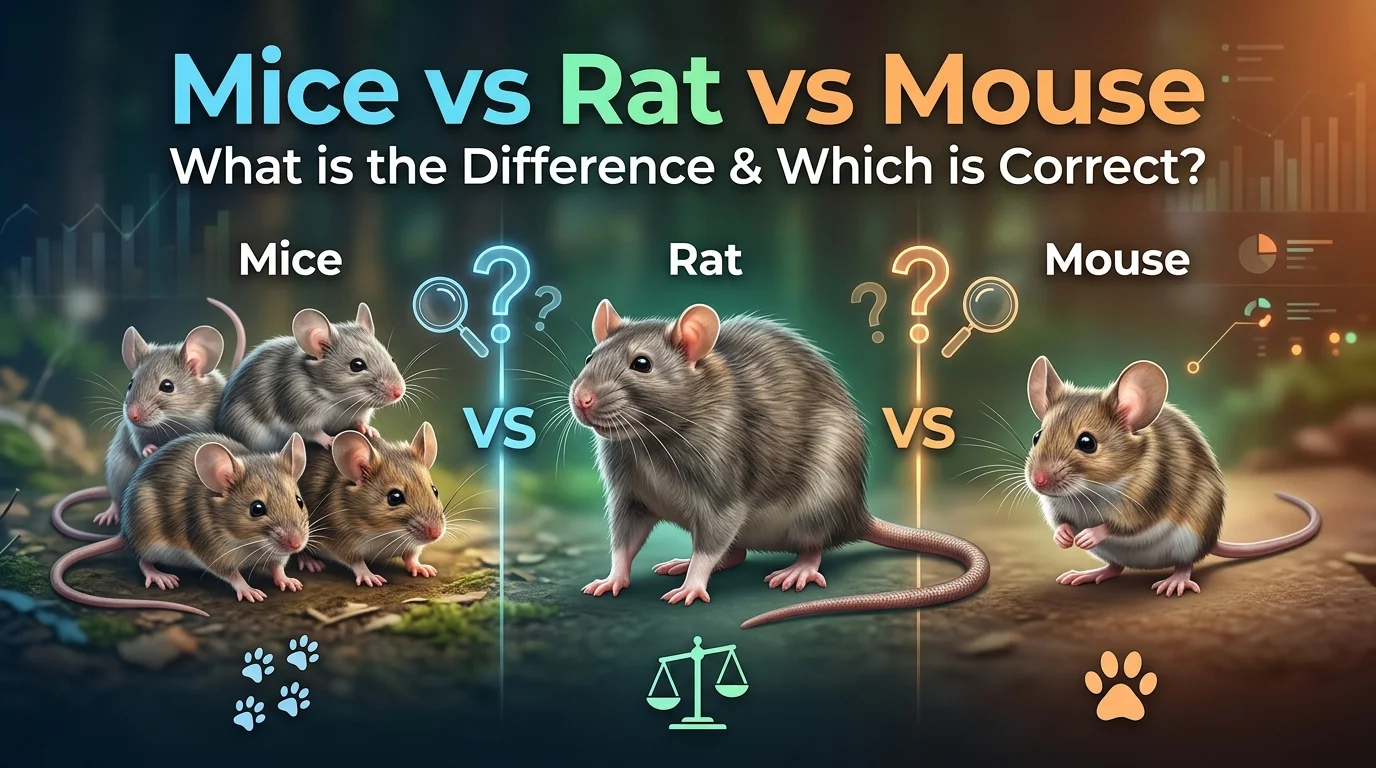

Understanding the difference between mice, rat, and mouse is important because these terms are often confused in writing, speech, and science. While they are related to similar rodents, each word has a different meaning, usage, and grammatical form. This guide explains everything in a simple way so you can use them correctly and confidently.
Comparison Overview
Mice, rat, and mouse all refer to small rodents found in homes, fields, laboratories, and urban areas. A mouse is the singular form, mice is the plural form of mouse, and rat refers to a different but closely related rodent species that is generally larger and behaviorally different. Although they look similar to beginners, they are not interchangeable in grammar or biology.
Definition of Mouse
A mouse is a small rodent with a pointed nose, small body, and long thin tail. It is commonly found in houses, farms, and laboratories. In English grammar, mouse is the singular form used when referring to one animal.
Definition of Mice
Mice is the plural form of mouse. It is used when talking about more than one mouse. The word is irregular, meaning it does not follow the simple rule of adding “s” or “es.”
Definition of Rat
A rat is a larger rodent compared to a mouse. It has a thicker body, stronger teeth, and is often considered more adaptable to harsh environments. Rats are commonly found in cities, sewers, farms, and sometimes laboratories. Unlike mouse and mice, rat is both singular and plural in its base form (rat for one, rats for more than one).
Main Differences Between Mouse, Mice, and Rat
The main differences lie in size, grammar, and usage context. A mouse is smaller and singular, mice refers to multiple small mice, while rat is a separate species that is larger and often seen as more aggressive or resilient. In writing, mouse and mice are used when discussing one or many of the same animal, while rat is used for a different classification.
| Feature | Mouse | Mice | Rat |
| Number | Singular | Plural | Singular or plural (rats) |
| Size | Small | Multiple small rodents | Larger rodent |
| Usage | One animal | More than one mouse | Different species |
| Grammar form | Regular singular | Irregular plural | Regular noun |
Grammar Guide
How each term is used in sentences
Mouse is used for one animal, mice for more than one, and rat or rats for the larger rodent type.
Examples:
A mouse is hiding under the table.
There are many mice in the field.
A rat ran across the street.
Common mistakes learners make
Many learners mistakenly use mouses instead of mice. Another common mistake is using rat when referring to a mouse or vice versa. Mixing singular and plural forms is also frequent.
Simple rules to remember
Use mouse for one small rodent.
Use mice for more than one mouse.
Use rat for the larger rodent species.
Quick tips for writing and speaking
Remember that mice is an irregular plural form. Think of it like other irregular plurals such as foot and feet. Always check whether you are describing one animal or many before choosing the correct word.
When to Use Each One
Use mouse when talking about a single small rodent or a computer mouse in technology contexts. Use mice when referring to multiple small rodents in groups or studies. Use rat when describing a larger rodent species found in urban or rural environments.
When NOT to Use Each One
Do not use mice when referring to only one animal. Do not use mouse when talking about multiple animals. Avoid using rat when you specifically mean a mouse, especially in scientific or academic writing where accuracy matters.
Which One to Use (Decision Guide)
If you are talking about one small rodent, choose mouse. If you are talking about more than one, choose mice. If the animal is larger and belongs to a different species, choose rat or rats. Always consider both number and species before deciding.
Real-World Practical Examples
Mouse Examples
A mouse is running under the sofa.
The scientist studied a mouse in the lab.
A mouse can squeeze through small holes.
I saw a mouse in the kitchen at night.
The cat caught a mouse outside.
Mice Examples
The field was full of mice during harvest season.
Scientists observed mice in the experiment.
Mice are often used in medical research.
There are many mice living in the barn.
The traps caught several mice overnight.
Rat Examples
A rat was seen near the garbage area.
Rats are common in urban environments.
The sewer system has many rats.
A rat entered the storage room.
Farmers often deal with rats in grain storage.
Self-Assessment (Fill in the Blanks)
- A ______ is a small rodent often found in houses.
- The plural form of mouse is ______.
- A ______ is generally larger than a mouse.
- There are many ______ in the field.
- I saw a ______ under the table.
- ______ are used in scientific experiments.
- A ______ ran across the road at night.
- The correct plural of mouse is ______.
- ______ are often found in sewers.
- One small rodent is called a ______.
- Many ______ were trapped in the barn.
- A ______ has a thicker body than a mouse.
- Scientists study ______ in laboratories.
- A ______ can hide in very small spaces.
- Urban areas often have many ______.
- The word mice is used when referring to ______ than one mouse.
- A ______ was seen in the kitchen.
- ______ are different from rats in size.
- Farmers sometimes see ______ in storage areas.
- A single animal is called a ______.
Answers
- Mouse
- Mice
- Rat
- Mice
- Mouse
- Mice
- Rat
- Mice
- Rats
- Mouse
- Mice
- Rat
- Mice
- Mouse
- Rats
- More
- Mouse
- Mice
- Rats
- Mouse
Final Verdict
Mouse, mice, and rat are related but not interchangeable. Mouse is used for a single small rodent, mice is the plural form, and rat refers to a different and larger rodent species. Understanding these differences helps in grammar, science, and everyday communication. Once you remember the singular, plural, and species distinction, using these terms correctly becomes simple and natural.
Conclusion About Mice vs Rat vs Mouse
Understanding the difference between mice, rat, and mouse helps avoid confusion in both writing and real life communication. Although these words are related to similar rodents, they carry distinct meanings, especially in grammar and species identification. A mouse refers to a single small rodent, while mice is simply its plural form used for groups. A rat, however, is a different and larger rodent species with its own characteristics. Knowing when to use each term improves clarity in academic writing, conversations, and even scientific discussions. With simple rules and regular practice, it becomes easy to choose the correct word without hesitation. This small but important distinction helps you communicate more accurately and confidently in everyday English.
FAQs
What is difference between mouse and mice?
Mouse is used when referring to one small rodent, while mice is the plural form used for more than one. The main difference is grammatical, not biological. Both words describe the same species, but the form changes depending on quantity. Mouse is singular, and mice is an irregular plural form in English usage.
Is rat the same as mouse?
No, rat and mouse are not the same. They are different species of rodents. Rats are generally larger, stronger, and more adaptable than mice. Mice are smaller and often found in houses or laboratories. Although they look similar, they differ in size, behavior, and habitat preferences in most environments.
Why is mice the plural of mouse?
Mice is an irregular plural form that comes from Old English language patterns. Instead of adding “s” like regular nouns, some words change their internal structure. Mouse follows this rule, changing to mice in plural form. This makes English unique and sometimes challenging for learners.
Where are rats commonly found?
Rats are commonly found in urban areas, sewers, garbage sites, farms, and storage places. They are highly adaptable and can survive in many environments where food is available. Unlike mice, rats often prefer larger spaces and can live both indoors and outdoors depending on conditions.
Can mouse and rat be used interchangeably?
No, mouse and rat cannot be used interchangeably. They refer to different species with different characteristics. Using the wrong term can cause confusion in both scientific and everyday communication. It is important to identify whether you are referring to a small mouse or a larger rat.
Are mice used in laboratories?
Yes, mice are widely used in scientific and medical research. They are preferred because they are small, easy to manage, and share many biological similarities with humans. Researchers use mice to study diseases, genetics, and treatments, making them important in advancing modern medicine and biology.
What is correct plural of mouse?
The correct plural of mouse is mice. It does not follow the regular rule of simply adding “s” or “es.” Instead, it is an irregular plural form that must be memorized. Using “mouses” is incorrect in standard English grammar and should be avoided in writing and speech.
How to remember mouse mice difference?
A simple way to remember is that mouse refers to one, while mice refers to many. Think of similar irregular pairs like foot and feet. Associating mouse with singular and mice with group helps avoid confusion. Practicing sentences regularly also strengthens memory and correct usage over time.
Are rats more dangerous than mice?
Rats are generally considered more dangerous than mice because of their larger size, stronger teeth, and ability to spread more diseases. However, both can carry health risks if they enter human spaces. The level of danger depends on environment, population, and hygiene conditions rather than the animal alone.
Why do people confuse mouse and rat?
People often confuse mouse and rat because they look similar at a glance and belong to the same rodent family. Their size difference and behavior are not always obvious to beginners. Additionally, language confusion arises when plural and singular forms are mixed in everyday speech and writing.
