
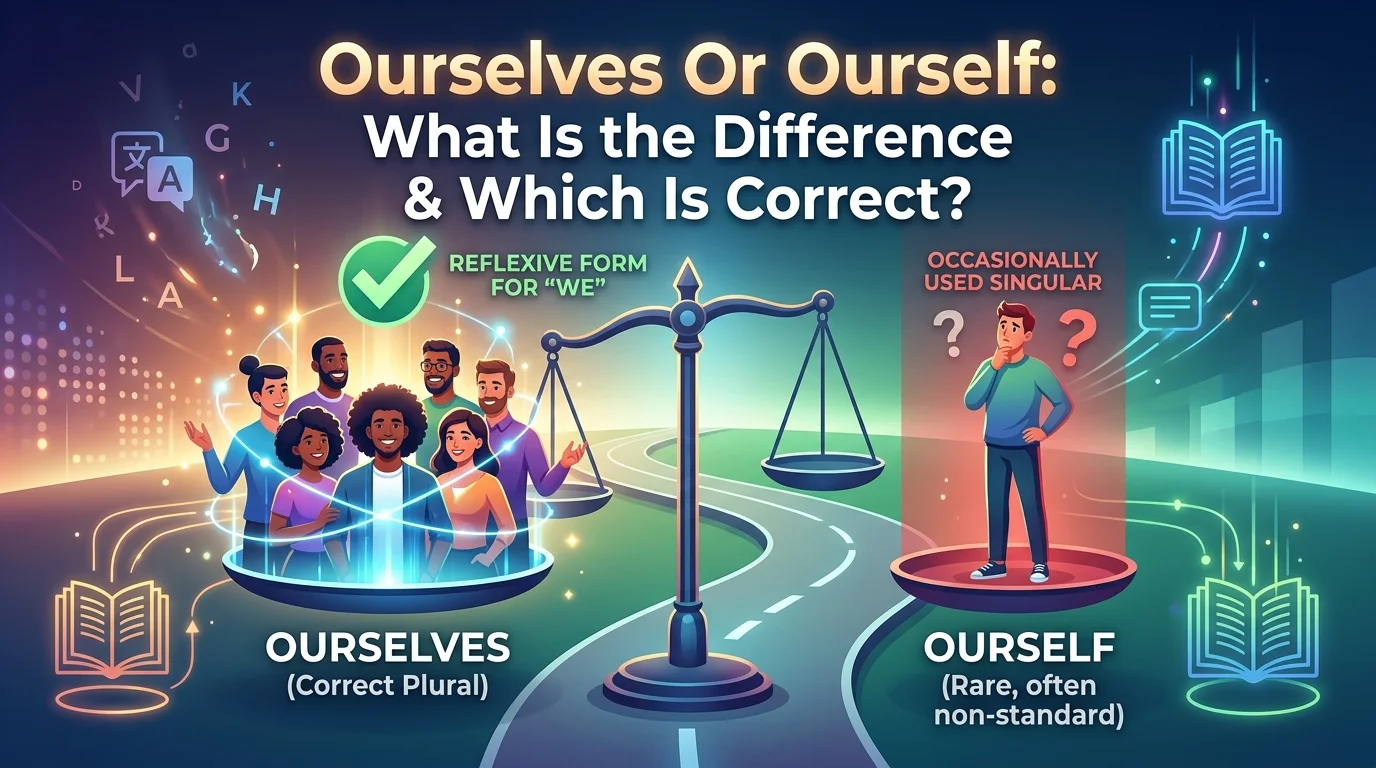

Many English learners get confused when choosing between ourselves and ourself. While both words are reflexive pronouns connected to the pronoun we, they are not used in the same way. Understanding the difference is important for writing grammatically correct sentences and communicating clearly. This guide explains the meanings, usage rules, examples, and common mistakes so you can confidently decide which form is appropriate in different situations.
Comparison Overview
Ourselves and ourself are reflexive pronouns that refer back to a subject. They both relate to the pronoun we, but they are used differently depending on whether the group is viewed as multiple individuals or as a single collective unit.
| Feature | Ourselves | Ourself |
| Number | Plural | Singular collective |
| Common Usage | Very common | Rare |
| Modern English | Standard | Limited use |
| Refers To | Multiple people | A group acting as one unit |
| Formal Acceptance | Widely accepted | Accepted in specific contexts |
Definition of Ourselves
Ourselves is the standard reflexive pronoun used with the subject we. It refers back to a group of people and emphasizes that the action affects the same people performing it.
Examples:
- We taught ourselves French.
- We prepared ourselves for the interview.
- We introduced ourselves to the guests.
The word highlights that several people are involved.
Definition of Ourself
Ourself is a much less common reflexive pronoun. It is occasionally used when a group, organization, institution, or authority speaks as a single unit rather than as individual members.
Examples:
- We consider ourself responsible for the decision.
- We present ourself as a unified organization.
In modern everyday English, this form is rare and may sound unusual.
Main Differences Between Ourselves and Ourself
The primary difference is grammatical number and perspective.
| Aspect | Ourselves | Ourself |
| Meaning | Refers to multiple people | Refers to one collective entity |
| Frequency | Extremely common | Rare |
| Everyday Speech | Yes | Usually no |
| Academic Writing | Yes | Occasionally in special contexts |
| Sounds Natural to Most Speakers | Yes | Often no |
Key differences:
- Ourselves treats members of a group individually.
- Ourself treats the group as a single unit.
- Ourselves is the standard choice for most situations.
- Ourself appears mainly in formal, institutional, or historical contexts.
Historical Development of the Terms
Historically, ourself was more common than it is today. Older forms of English often used singular collective expressions. Over time, ourselves became the preferred and standard reflexive form.
Today, dictionaries recognize ourself, but it remains uncommon in everyday communication.
Common Contexts Where They Appear
Ourselves
- Daily conversation
- Academic writing
- Business communication
- Educational materials
- Personal writing
Ourself
- Official statements
- Institutional communications
- Legal documents
- Historical texts
- Formal organizational announcements
Grammar Guide
How Each Term Is Used in Sentences
Ourselves
Pattern:
- We + verb + ourselves
Examples:
- We challenged ourselves.
- We helped ourselves.
- We introduced ourselves.
Ourself
Pattern:
- We + verb + ourself
Examples:
- We regard ourself as a single entity.
- We present ourself to the public.
Common Mistakes Learners Make
- Using ourself in normal conversation.
- Replacing ourselves with ourself without understanding collective usage.
- Assuming both forms are equally common.
- Mixing singular and plural meanings.
- Using ourself after a clearly plural reference.
Incorrect:
- We enjoyed ourself during the trip.
Correct:
- We enjoyed ourselves during the trip.
Simple Rules to Remember
- If multiple people are involved, use ourselves.
- If a group acts as one official unit, ourself may be acceptable.
- When unsure, choose ourselves.
- Modern English strongly favors ourselves.
Quick Tips for Writing and Speaking
- Use ourselves in nearly all conversations.
- Use ourself only in specialized formal contexts.
- Check whether the group is viewed individually or collectively.
- Read the sentence aloud to see which sounds natural.
When to Use Each One
Use Ourselves When
- Referring to multiple people.
- Talking about actions performed by a group.
- Writing essays and reports.
- Speaking casually.
- Communicating in business or education.
Examples:
- We taught ourselves coding.
- We reminded ourselves about the deadline.
Use Ourself When
- An organization speaks as one unit.
- A collective identity is emphasized.
- Formal institutional language is used.
Examples:
- We present ourself as a unified body.
- We dedicate ourself to public service.
When NOT to Use Each One
Do Not Use Ourselves
- When a singular collective style is intentionally required.
Do Not Use Ourself
- In most everyday conversations.
- In normal classroom writing.
- When referring to several people individually.
- When natural modern English is desired.
Incorrect:
- We bought ourself some coffee.
Correct:
- We bought ourselves some coffee.
Which One to Use (Decision Guide)
Ask yourself these questions:
- Am I referring to more than one person?
- Yes → Use ourselves.
- Is a group speaking as a single organization?
- Yes → Ourself may be appropriate.
- Is this everyday English?
- Yes → Use ourselves.
- Am I unsure?
- Choose ourselves.
For nearly all learners and writers, ourselves is the correct choice.
Real-World Practical Examples
Ourselves Examples
- We taught ourselves mathematics before the exam.
- We introduced ourselves during the conference.
- We trained ourselves for the competition.
- We protected ourselves from online scams.
- We challenged ourselves to improve our writing.
Ourself Examples
- We present ourself as a united institution.
- We dedicate ourself to community development.
- We describe ourself as one governing body.
- We hold ourself accountable for these actions.
- We represent ourself as a single organization.
Self-Assessment (Fill in the Blanks)
- We introduced ______ at the meeting.
- We prepared ______ for the exam.
- The organization describes ______ as a unified body.
- We taught ______ how to swim.
- We encouraged ______ to continue.
- We presented ______ to the audience.
- We blamed ______ for the mistake.
- The council refers to ______ as one authority.
- We challenged ______ to improve.
- We reminded ______ about the appointment.
- The institution committed ______ to reform.
- We enjoyed ______ during the holiday.
- We educated ______ on the issue.
- The board identifies ______ as a single entity.
- We congratulated ______ after the victory.
- We defended ______ against criticism.
- We motivated ______ to work harder.
- The committee presents ______ formally.
- We introduced ______ to the new manager.
- We prepared ______ for the project.
Answers
- ourselves
- ourselves
- ourself
- ourselves
- ourselves
- ourselves
- ourselves
- ourself
- ourselves
- ourselves
- ourself
- ourselves
- ourselves
- ourself
- ourselves
- ourselves
- ourselves
- ourself
- ourselves
- ourselves
Final Verdict
The difference between ourselves and ourself comes down to how a group is viewed. Ourselves is the standard plural reflexive pronoun used in everyday English, academic writing, business communication, and conversation. It is the form that most native speakers expect and use regularly.
Ourself, on the other hand, is a rare form that appears when a group or organization chooses to present itself as a single collective unit. While grammatically recognized, it is uncommon in modern speech and writing.
For most situations, the safest and most natural choice is ourselves. Unless you are writing for a formal institution or using a specific collective style, ourselves will almost always be the correct option.
Conclusion About Ourselves Or Ourself
Understanding the difference between ourselves and ourself can help you write and speak with greater confidence. While both words function as reflexive pronouns connected to we, they are not interchangeable in most situations. Ourselves is the standard and widely accepted form used when referring to multiple people acting on or referring back to themselves. In contrast, ourself is a much rarer form that appears mainly when a group or organization is treated as a single collective unit.
For everyday conversations, academic writing, professional communication, and most forms of modern English, ourselves is almost always the correct choice. Knowing when each term applies can prevent common grammar mistakes and make your writing sound more natural. If you remember that ourselves is the preferred modern form and ourself is limited to special contexts, choosing the right word becomes much easier.
FAQs
Is ourselves or ourself more common in modern English?
Ourselves is far more common in modern English. It is the standard reflexive pronoun used with we in everyday speech, writing, education, and business communication. Ourself is recognized but appears mainly in formal, institutional, or historical contexts.
Is ourself grammatically correct?
Yes, ourself is grammatically correct in certain situations. It is used when a group or organization refers to itself as a single entity. However, it is uncommon in everyday English and may sound unusual to many readers.
Why do most people use ourselves instead of ourself?
Most people use ourselves because it matches the plural pronoun we and follows standard modern English grammar. Since we usually refers to more than one person, ourselves is the natural reflexive form.
Can I use ourself in academic writing?
You can use ourself only if the context specifically treats a group as a single unit. In most academic writing, ourselves is preferred because it aligns with modern grammar conventions and is more familiar to readers.
Is ourselves a reflexive pronoun?
Yes, ourselves is a reflexive pronoun. It refers back to the subject we and shows that the action is performed by and affects the same group of people.
When should an organization use ourself?
An organization may use ourself when presenting itself as one unified body rather than emphasizing individual members. This usage is most common in formal statements, policies, or official communications.
Can ourselves and ourself have the same meaning?
They can express similar ideas, but they differ in perspective. Ourselves refers to multiple individuals within a group, while ourself emphasizes the group as a single collective entity.
Which form should English learners use?
English learners should generally use ourselves. It is the standard choice in modern English and is appropriate for nearly all speaking and writing situations. Using ourselves will help avoid confusion and grammatical errors.
Is ourself considered old-fashioned?
In many contexts, yes. Ourself is much less common today than it was in earlier forms of English. Although still correct in specific situations, it often sounds formal, specialized, or slightly old-fashioned.
How can I remember the difference between ourselves and ourself?
A simple rule is to connect we with ourselves whenever you are talking about multiple people. Think of ourself as a special form reserved for a group acting as one single unit. When in doubt, choose ourselves.
